Bent Arms vs. Straight Arms in Lateral Raises: Which Builds Bigger Shoulders?
Quick answer: Bent arms reduce joint torque and are the safer, more sustainable default; straight arms increase medial deltoid activation but demand more from the joint and more precise technique. Neither is universally “correct” — the right choice depends on your current shoulder health and specific goal.
Researched and written by the GymGoodies team, fact-checked against manufacturer specs and current fitness guidance.
We’ve covered bent-arm and straight-arm lateral raises in real depth across several articles on this site — mechanics, safety, EMG data, individual variability. This piece pulls all of that together into one condensed, scannable comparison, with links to the full deep-dives for anyone who wants the complete picture on a specific factor.
Side-by-Side Comparison
| Factor | Bent Arm | Straight Arm |
|---|---|---|
| Medial deltoid activation | Lower (shorter lever arm) | Higher (longer lever arm) |
| Joint torque/stress | Lower | Higher |
| Beginner-friendly | Yes, generally recommended default | Better introduced after establishing bent-arm control |
| Shoulder impingement risk | Lower | Higher, especially with poor technique or existing sensitivity |
| Best for | Joint longevity, beginners, rehab | Deltoid definition/isolation once foundation is solid |
| Typical weight used | Can handle relatively more load safely | Requires noticeably lighter load than bent-arm equivalent |
The Core Mechanical Difference, Briefly
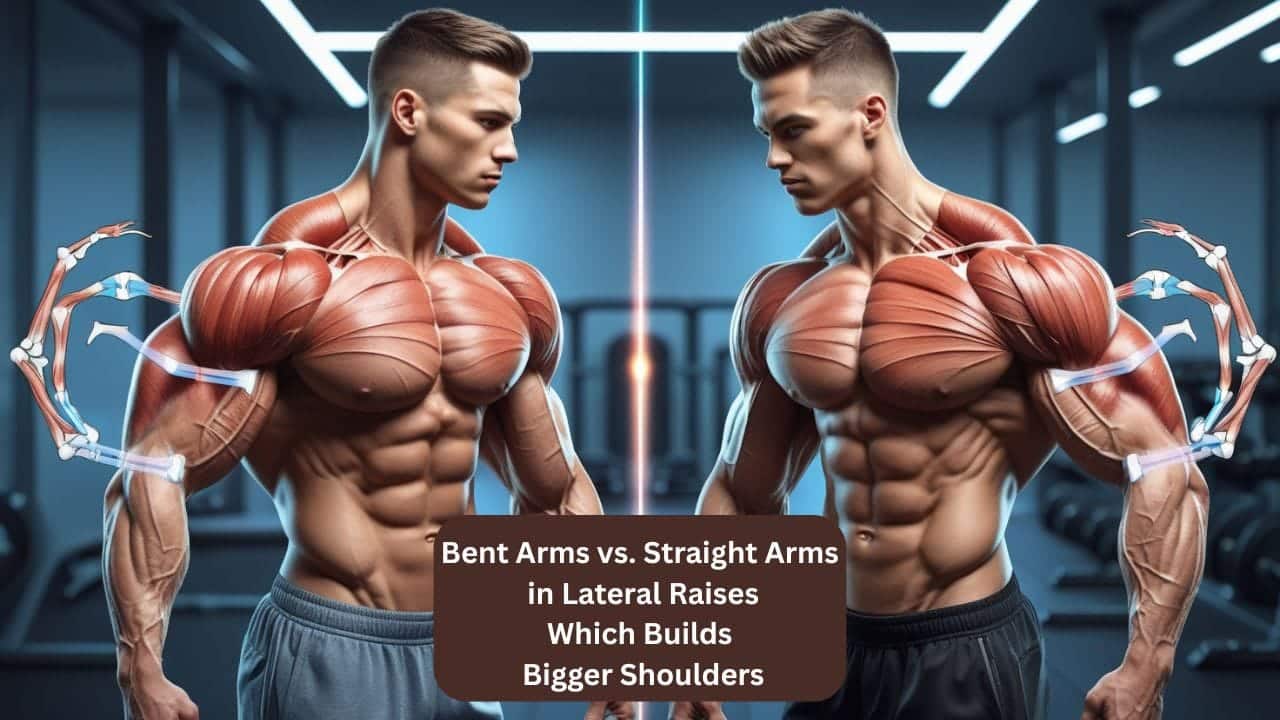
Bending your elbow shortens the distance between your shoulder joint and the weight in your hand — this “lever arm” directly determines how much torque your shoulder has to control. A peer-reviewed EMG study on lateral raise variations confirmed this trade-off directly: the flexed-elbow (bent-arm) version produced measurably lower medial deltoid activation than straighter-arm variations, consistent with the shorter lever arm reducing demand on the target muscle — and, by the same mechanism, on the joint.
Quick Decision Guide
- New to lateral raises or have any shoulder sensitivity? → Start bent-arm. Full breakdown: Bent-Arm Lateral Raises
- Healthy shoulders, chasing maximum deltoid definition? → Layer in straight-arm work. Full breakdown: Straight-Arm Lateral Raises
- Currently managing shoulder pain or a diagnosed condition? → Neither, without guidance first. Full breakdown: A Physiotherapist’s Take on Straight-Arm Raises
- Want to understand exactly how much joint stress changes with angle? → How Arm Angle Affects Joint Stress
- Wondering if “bent = safe” is a permanent rule? → It isn’t. Is a Bent Arm Safer? covers progressive loading and why avoidance forever isn’t the goal.
- Want to know if higher EMG activation actually means more muscle growth? → Worth reading before assuming straight-arm automatically “wins”: How Bent vs. Straight Arms Impact Deltoid Activation
What the Research Doesn’t Settle
It’s worth being honest about the limits of this data. The EMG research tells us which position activates the medial deltoid more during a single measured set — it doesn’t directly prove which position builds more muscle over an actual months-long training program, since that requires different, longitudinal research that hasn’t been done specifically for this comparison. It also doesn’t account for individual variability: people respond somewhat differently to the same training stimulus, meaning population averages are a reasonable starting hypothesis, not a personal guarantee.
A Practical, Non-Absolutist Approach
Rather than picking one arm position permanently, most well-designed shoulder programs use both, deliberately:
- Anchor your training with bent-arm raises for consistent, joint-friendly volume — this can be your primary or even sole variation if joint longevity is your priority.
- Layer in straight-arm work as an accessory or finisher, using a noticeably lighter weight, once your bent-arm technique and shoulder stability are consistently solid.
- Adjust the ratio based on your current shoulder status — lean more heavily on bent-arm work during any period of shoulder sensitivity, and feel free to shift more toward straight-arm work when healthy and specifically chasing definition.
For a fuller framework on matching lateral raise variations to specific goals (strength, definition, injury prevention), see our 3 Lateral Raise Modifications guide.
Common Questions People Land Here Looking For
Is one position objectively “correct”?
No — this is a genuinely goal-dependent decision, not a settled debate with one right answer for everyone.
Which builds more muscle?
Straight-arm produces higher measured activation during a set, but whether that translates to proportionally more long-term growth for you specifically isn’t settled by current research — see our deeper look at EMG’s limitations as a growth predictor for the full nuance.
Which is safer for my shoulders?
Bent-arm, generally, due to reduced joint torque — but “safer” isn’t the same as “the only acceptable option forever.” See Is a Bent Arm Safer? for how to think about progressing over time.
Do I need to pick one and stick with it?
No — combining both, weighted toward your current shoulder status and goals, is a completely reasonable and common approach.
What about equipment — does dumbbells vs. cables vs. bands change this comparison?
Yes, somewhat — see our Dumbbells vs. Cables and Resistance Bands guides for how equipment interacts with arm position specifically.
Bottom Line
Bent arms reduce joint stress and are the safer, more sustainable default, especially for beginners or anyone with shoulder sensitivity. Straight arms increase deltoid activation and offer a real definition benefit for healthy, well-trained shoulders, but demand lighter loads and more careful technique. Most well-rounded training approaches use both rather than treating this as a permanent, either-or decision — start here, then dig into whichever linked guide above matches your specific situation.
Which position makes up the bulk of your current lateral raise training? Let us know in the comments, and check out the linked deep-dives above for whichever factor matters most to you.