Straight-Arm Lateral Raises: A Forgotten Gem for Shoulder Definition?
Quick answer: Straight-arm lateral raises do increase medial deltoid activation compared to bent-arm variations, according to EMG research — the longer lever arm makes the muscle work harder for the same relative effort. This makes them a legitimate tool for shoulder definition, but they demand more from the joint and more precise technique than the bent-arm version.
Researched and written by the GymGoodies team, fact-checked against manufacturer specs and current fitness guidance.
Straight-arm lateral raises tend to get overshadowed by the more commonly recommended bent-arm version, often dismissed as riskier without much examination of what they actually offer. The research tells a more nuanced story: straight-arm raises do provide a genuine activation benefit, but that benefit comes with real tradeoffs worth understanding before adding them to your training.
What the Research Actually Shows
A peer-reviewed EMG study examining lateral raise variations in competitive bodybuilders compared several versions of the exercise, including a flexed-elbow (bent-arm) variation against straighter-arm versions with different degrees of shoulder rotation. The study, published in the International Journal of Environmental Research and Public Health, found that the flexed-elbow variation produced lower medial deltoid muscle activation than the straighter-arm versions, attributing this specifically to the shorter lever arm created by bending the elbow. In other words, the longer lever arm of a straighter arm does appear to genuinely increase the training demand on the target muscle — this isn’t just a theoretical claim, it’s been measured directly.
Why This Makes Straight-Arm Raises Worth Considering
If your specific goal is maximizing medial deltoid activation — the muscle responsible for that “capped” shoulder look — the research suggests straighter-arm variations have a real edge over bent-arm raises for this purpose. This doesn’t mean bent-arm raises are ineffective; it means straight-arm work offers a distinct activation advantage worth using deliberately rather than avoiding by default.
The Tradeoff: Increased Joint Demand
The same mechanism that increases muscle activation — the longer lever arm — also increases the torque your shoulder joint has to control. This is the direct tradeoff: more muscle activation per pound of weight, but also more joint stress per pound of weight. This is why straight-arm raises are generally recommended with lighter loads than their bent-arm counterparts, and why they’re not necessarily the right starting point for beginners or anyone with existing shoulder sensitivity. Our physiotherapist’s take on straight-arm raises covers who should be cautious with this variation in more depth.
How to Perform Straight-Arm Lateral Raises Properly
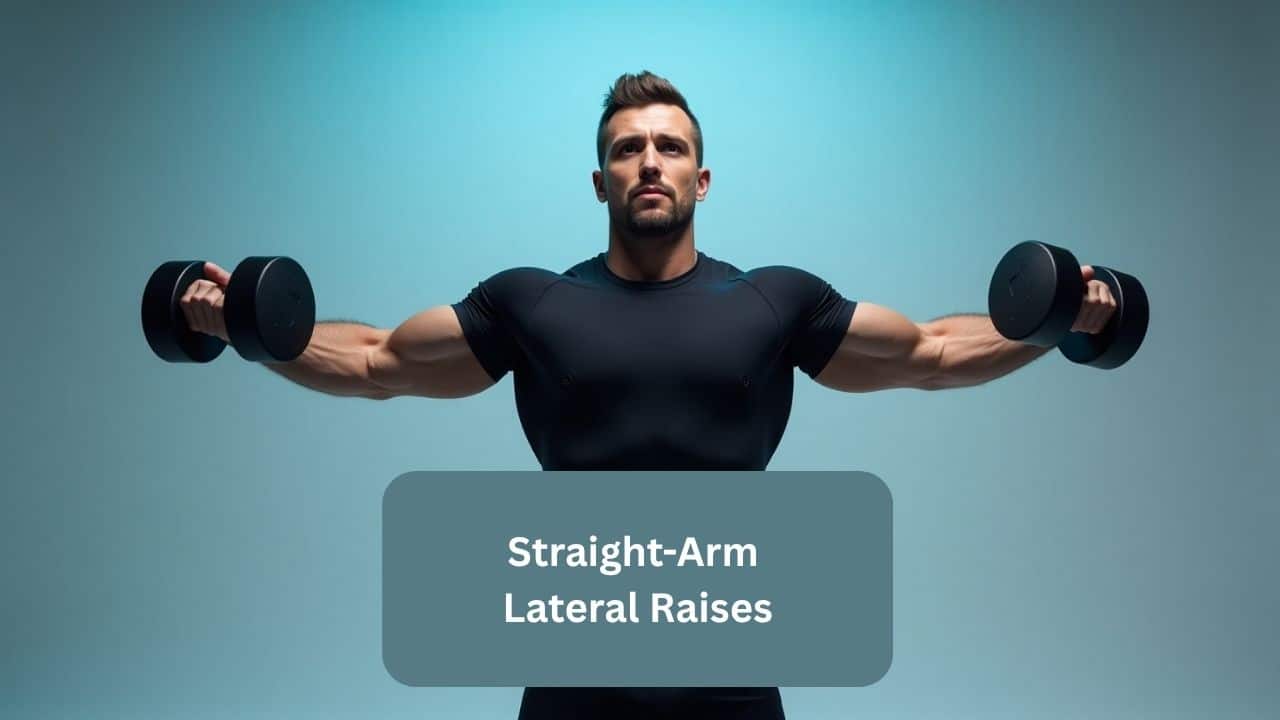
- Hold dumbbells at your sides with arms nearly straight — a very slight, soft bend in the elbow (not a hard lock) is fine and doesn’t meaningfully change the lever arm.
- Raise your arms out to the sides, angling slightly forward toward the scapular plane rather than directly lateral.
- Lift only to shoulder height — going higher tends to shift emphasis toward the trapezius rather than the deltoid.
- Use a noticeably lighter weight than you’d use for bent-arm raises — this isn’t a sign of weakness, it’s the correct adjustment for the increased lever demand.
- Keep your shoulder blades down and back throughout; if you notice shrugging, the weight is too heavy for strict straight-arm form.
Who Should Consider Adding Straight-Arm Raises
- Lifters with healthy, well-controlled shoulders who have already established solid bent-arm technique
- Anyone specifically prioritizing deltoid definition and shape over pure strength or joint longevity
- Intermediate to advanced lifters looking to add training variety once a strength base is established
Who Should Be Cautious or Avoid This Variation
- Anyone with a current or recent shoulder impingement diagnosis
- Lifters with a history of rotator cuff issues, even if currently symptom-free
- Beginners who haven’t yet established consistent scapular control during simpler variations
- Anyone experiencing pinching, catching, or pain during the movement
A Progressive Way to Introduce This Variation
Rather than switching entirely from bent-arm to straight-arm, consider layering it in gradually:
- Confirm consistent, pain-free bent-arm lateral raise technique first — see our Bent-Arm Lateral Raises guide if you need to establish this baseline.
- Introduce straight-arm raises as an accessory or finisher, using noticeably lighter weight, rather than your primary working sets.
- Monitor how your shoulder responds over several sessions before increasing the weight or volume of this variation.
- If you experience any discomfort beyond normal muscular fatigue, scale back to the bent-arm version and reassess. Our piece on whether a bent arm is actually the safer choice discusses this progression framework in more detail.
Straight-Arm Raises as Part of a Broader Program
This variation doesn’t need to replace bent-arm work — it works well as one tool among several. Our 3 Lateral Raise Modifications guide breaks down how a joint-friendly bent-arm version, a definition-focused straighter-arm version like this one, and an injury-prevention-focused version can each serve a different purpose within the same overall training approach.
Common Mistakes With Straight-Arm Lateral Raises
- Using the same weight as your bent-arm sets — this is the single most common mistake, since the increased lever arm makes an equivalent weight substantially more demanding.
- Locking the elbow completely, which can create unnecessary joint stress without any real activation benefit over a very slightly softened elbow.
- Raising too high, past shoulder height, which shifts emphasis toward the trapezius and increases impingement-related risk.
- Skipping the progressive introduction and going straight to heavy straight-arm work without an established bent-arm foundation.
Frequently Asked Questions
Do straight-arm lateral raises really build more shoulder definition than bent-arm raises?
EMG research suggests they do produce higher medial deltoid activation due to the longer lever arm, which can translate to a training advantage for definition-focused goals when programmed appropriately.
Are straight-arm lateral raises dangerous?
Not inherently, but they do increase joint torque compared to bent-arm variations, making them worth approaching cautiously if you have any shoulder sensitivity, and worth introducing gradually even for healthy lifters.
Should beginners do straight-arm lateral raises?
Generally, it’s better to establish solid bent-arm technique and shoulder stability first before adding this more demanding variation.
Bottom Line
Straight-arm lateral raises aren’t a forgotten gimmick — research supports a real activation advantage for the medial deltoid compared to bent-arm variations. But that benefit comes with a genuine increase in joint demand, which means this variation is best used deliberately, with lighter loads and a solid technical foundation, rather than as a default replacement for bent-arm training.
Have you tried straight-arm lateral raises specifically for shoulder definition? Let us know in the comments how the lighter weight adjustment felt compared to your usual bent-arm sets.