How to Build Confidence with Free Weights at Home
Quick Answer
Build confidence with free weights at home by starting with light loads and perfect technique, mastering a small number of fundamental patterns, progressing one variable at a time, filming your lifts for feedback, and treating early sessions as skill practice rather than tests of strength. Use controlled tempos, leave repetitions in reserve, and focus on consistency over intensity. Confidence grows from repeated successful experiences with good form, not from lifting heavy before the movement is owned.
Why Free Weights Feel Intimidating at First
Free weights require the lifter to control the load in three dimensions. Unlike machines that guide the path, dumbbells and kettlebells demand stability, coordination, and decision-making on every repetition. This freedom is exactly what makes them effective, but it also creates uncertainty for beginners. Common fears include dropping the weight, losing balance, looking awkward, or getting injured. These concerns are normal and solvable through a structured, low-pressure approach that prioritises competence before intensity.
Core Principles for Building Free-Weight Confidence
- Competence precedes intensity – Own the movement with light loads before adding weight.
- Small, successful exposures – Short sessions with clear wins build belief faster than long, overwhelming workouts.
- Visible progress tracking – Recording technique and performance makes improvement concrete.
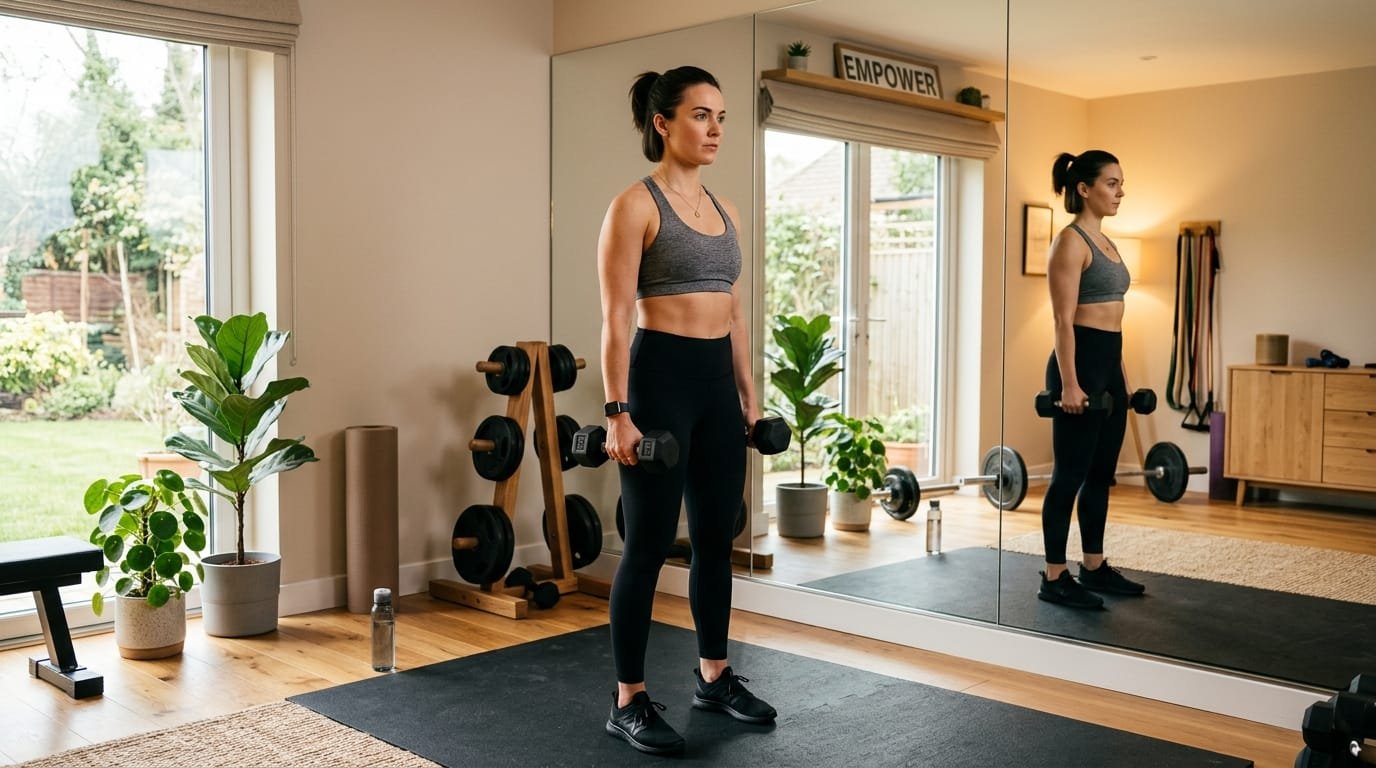
- Controlled environments – Train in a clear space with minimal distractions and easy bail-out options.
- One variable at a time – Change load, reps, or tempo separately so each success is attributable.
- Self-compassion during the learning phase – Early awkwardness is part of skill acquisition, not evidence of inability.
Fundamental Patterns to Master First
| Pattern | Why It Builds Confidence | Beginner Starting Point | Confidence Checkpoint |
|---|---|---|---|
| Squat / Goblet Squat | Teaches braced full-body control | Bodyweight or very light goblet squat to a box | Stable depth with upright torso |
| Hinge / Romanian Deadlift | Develops posterior-chain awareness | Broomstick hip hinge, then light dumbbell RDL | Neutral spine throughout the movement |
| Floor Press or Push-Up | Builds pressing strength with lower risk | Elevated push-up or light floor press | Controlled lowering and lockout |
| Single-Arm Row | Trains pulling and anti-rotation | Supported single-arm dumbbell or band row | Scapular control without twisting |
| Loaded Carry | Real-world confidence and grip | Light suitcase or farmer carry | Upright posture over short distances |
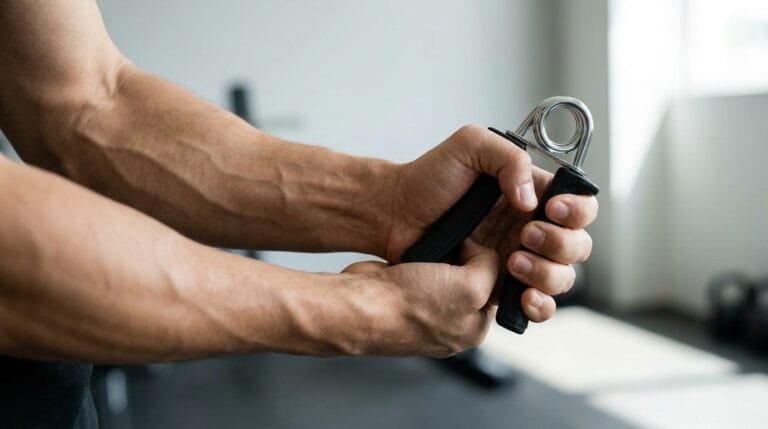
Shoulder-friendly technique supports long-term confidence with pressing and raising movements (Bent Arms vs. Straight Arms in Lateral Raises, The Hidden Mistake in Lateral Raises, and 3 Lateral Raise Modifications). Grip strength grows naturally through rows and carries and can be trained more directly as confidence increases (Do Hand Grippers Really Work?).
Step-by-Step Confidence-Building Process
- Clear the space and set safety rules
Ensure enough room to move, a stable floor, and a plan for setting weights down safely. - Begin with the lightest effective load
Bodyweight, empty hands, or the lightest dumbbells that still allow the movement pattern. - Film every set in the first 2–4 weeks
Review for neutral spine, controlled tempo, and joint alignment. This provides objective feedback. - Use a 3-second eccentric as the default
Slow lowering increases control and reduces the chance of losing positions. - Stop every set with 1–3 repetitions in reserve
Finishing strong reinforces competence instead of creating failure experiences. - Master one pattern at a time
Spend several sessions on a single movement until it feels repeatable and stable. - Add load only after technique is consistent
Increase weight when you can complete the target reps with good form and repetitions left in reserve. - Track both performance and subjective confidence
Note loads and reps alongside a simple 1–5 rating of how controlled the set felt. - Celebrate process wins
Successful technique, improved range, or better stability count as progress even when the load stays the same. - Gradually expand the menu
Once the core patterns feel reliable, introduce variations or moderate load increases.
Sample Confidence-Building Workouts
Phase 1 – Movement Ownership (Weeks 1–3)
- Box squat or goblet squat (light) – 3 × 8–10
- Hip hinge or light RDL – 3 × 8–10
- Elevated push-up or floor press – 3 × 8–10
- Supported single-arm row – 3 × 10–12 per arm
- Short suitcase carry – 2 × 20–30 seconds
Phase 2 – Controlled Loading (Weeks 4–6)
Same patterns with slightly heavier loads or slower tempos. Continue filming and leaving repetitions in reserve.
Phase 3 – Expansion
Add unilateral variations, moderate load increases, or a second pushing/pulling exercise while maintaining the same technical standards.
Progressive Overload Methods That Protect Confidence
- Add repetitions within a comfortable range
- Slow the eccentric phase further
- Insert pauses at the most challenging point
- Increase range of motion once control is solid
- Move to unilateral versions
- Raise density only after technique is automatic
These methods allow measurable progress without large jumps in load that can undermine confidence.
Addressing Common Confidence Barriers
Fear of dropping the weight
Practise setting dumbbells down deliberately on every repetition. Use a mat or platform so the landing is controlled and quiet.
Fear of looking awkward
Everyone starts with imperfect coordination. Filming privately and focusing on process metrics removes external judgment.
Fear of injury
Stay within pain-free ranges, use controlled tempos, and progress only when the current level feels stable. Most beginner injuries come from doing too much too soon, not from free weights themselves.
Uncertainty about form
Use a mirror or video, reduce the load, and simplify the movement until the key positions are clear. Seek professional form checks if uncertainty persists.
Environment and Equipment Choices That Support Confidence
- Clear floor space with easy access to set weights down
- A mat for floor work and noise reduction
- Light-to-moderate dumbbells or adjustable pairs that allow small increments
- Resistance bands for assistance or lighter progressive options
- A simple notebook or app for tracking
Avoid overly heavy starting weights or complex machines that add decision fatigue.
Integrating Free Weights into a Sustainable Home Routine
Confidence grows fastest when sessions are short, frequent, and successful. Two to three full-body sessions per week of 25–40 minutes allow enough practice without overwhelming recovery or motivation. Keep the exercise menu small at first so each movement receives adequate attention. As competence rises, the same sessions naturally support higher loads and greater complexity.
Common Mistakes That Undermine Confidence
| Mistake | Result | Better Approach |
|---|---|---|
| Starting too heavy | Form breakdown and fear | Light loads until technique is automatic |
| Training to failure early | Negative associations with the lifts | Leave 1–3 reps in reserve |
| Changing exercises too often | No skill mastery | Master a small menu first |
| Skipping video feedback | Undetected technique issues | Film sets regularly in the early phase |
| Comparing to advanced lifters | Discouragement | Measure against your own previous sessions |
| Neglecting recovery | Fatigue that makes lifts feel harder | Protect sleep and rest days |
Strength training with free weights is highly effective for building both physical capacity and self-efficacy when approached progressively (strength training guidance). Practical home-gym approaches emphasise starting simple and expanding only after competence is established (home gym equipment prioritisation and budget home gym principles).
Frequently Asked Questions
How light should I start?
Light enough that you can focus entirely on technique and finish every set with repetitions in reserve. For many beginners this is bodyweight or the lightest dumbbells available.
How long before free weights start to feel natural?
Most people notice a clear increase in comfort and control within 3–6 weeks of consistent practice with good form.
Do I need a spotter at home?
For dumbbell and kettlebell work, a spotter is rarely necessary if you choose loads you can control and have a clear plan for setting the weights down. Avoid maximal barbell attempts without safety equipment or a spotter.
What if I feel unsteady?
Reduce the load, shorten the range of motion, or hold onto a stable surface for support until balance improves. Unilateral work can be introduced later.
Should I use machines first?
Machines can help some people learn basic patterns, but they are not required. Free-weight confidence is built most directly by practising free-weight movements with appropriate loads.
How do I know when to add weight?
When you can complete the target repetitions with solid technique and 1–3 reps left in reserve for two or three consecutive sessions.
Is it normal to feel awkward at first?
Yes. Coordination and stability improve rapidly with focused practice. The awkward phase is temporary and expected.
Can older beginners build confidence with free weights?
Yes. The same principles apply: light loads, controlled tempos, gradual progression, and emphasis on technique. Many older adults thrive with dumbbell and kettlebell training.
Final Recommendation
Confidence with free weights at home is built through repeated successful experiences with good technique, not through early heavy lifting. Start lighter than you think necessary, master a small number of fundamental patterns, film your sets, leave repetitions in reserve, and progress one variable at a time. Treat the first weeks as skill practice and let competence drive intensity.
Clear your training space today, choose one exercise for each main pattern, and perform a short session focused entirely on control. Track both the performance numbers and how stable the movements felt. When free-weight training is approached this way, confidence compounds alongside strength, and the home becomes a place of growing capability rather than uncertainty. Begin with mastery—the heavier loads will come naturally once the movements are owned.