First 30 Days Home Training Plan That Prevents Common Beginner Mistakes
Quick Answer
A successful first 30 days of home training focuses on mastering fundamental movement patterns with controlled technique, using light loads or bodyweight, training 2–3 full-body sessions per week, and progressing only through added repetitions or slower tempos. This approach prevents the most common beginner mistakes: starting too heavy, skipping recovery, neglecting technique, and programme-hopping. Consistency and form in month one create the foundation for long-term strength and injury-free progress.
Why the First 30 Days Determine Long-Term Success
Most beginners who quit or get injured do so because of errors made in the opening weeks: excessive volume or intensity, poor movement quality, inadequate recovery, or constant programme changes. The first 30 days should be treated as a skill-acquisition and habit-formation phase rather than a strength-maximisation phase. When technique, consistency, and recovery are prioritised, confidence rises, tissues adapt, and the trainee enters month two prepared for progressive overload.
Core Principles for the First 30 Days
- Movement quality before load – Own the pattern with light resistance.
- Full-body frequency – 2–3 sessions per week practise every major pattern often enough to improve.
- Leave repetitions in reserve – Stop most sets 1–3 reps before failure.
- Controlled tempos – A 3-second lowering phase builds strength and protects joints.
- Simple progression – Add reps first; only then consider harder variations or light load increases.
- Recovery is mandatory – Sleep, protein, and rest days are part of the plan.
- Track everything – Logging sessions makes progress visible and mistakes obvious.
Common Beginner Mistakes and How This Plan Prevents Them
| Common Mistake | Typical Result | How the 30-Day Plan Prevents It |
|---|---|---|
| Starting too heavy | Form breakdown, fear, joint stress | Bodyweight or very light loads only |
| Training to failure | Excess fatigue, poor technique | 1–3 reps left in reserve on every set |
| Changing programmes weekly | No skill mastery | Same core movements for the full 30 days |
| Skipping warm-ups | Higher injury risk | Short, specific warm-up every session |
| Neglecting pulling movements | Shoulder and posture imbalance | Equal or greater pulling volume |
| Inadequate recovery | Lingering soreness, stalled progress | 2–3 sessions only + sleep and protein focus |
| No tracking | Invisible progress, lost motivation | Simple log of sets, reps, and how it felt |
Essential Movement Patterns for the First 30 Days
| Pattern | Beginner Exercise Options | Key Technique Focus |
|---|---|---|
| Squat / Sit-to-Stand | Box squat, sit-to-stand from chair, bodyweight squat | Knees track over toes, upright torso |
| Hinge | Hip hinge with stick, glute bridge, light RDL | Neutral spine, hips move back |
| Push | Elevated push-up, wall push-up, knee push-up | Full body line, controlled lowering |
| Pull | Band row, towel row, single-arm dumbbell row | Scapulae move first, no shrugging |
| Core / Carry | Dead bug, bird dog, short suitcase carry | Continuous breathing, stable trunk |
Shoulder-friendly technique supports safe pressing and raising as capacity grows (Bent Arms vs. Straight Arms in Lateral Raises, The Hidden Mistake in Lateral Raises, and 3 Lateral Raise Modifications). Grip strength develops through rows and carries (Do Hand Grippers Really Work?).
The 30-Day Plan Structure
Frequency
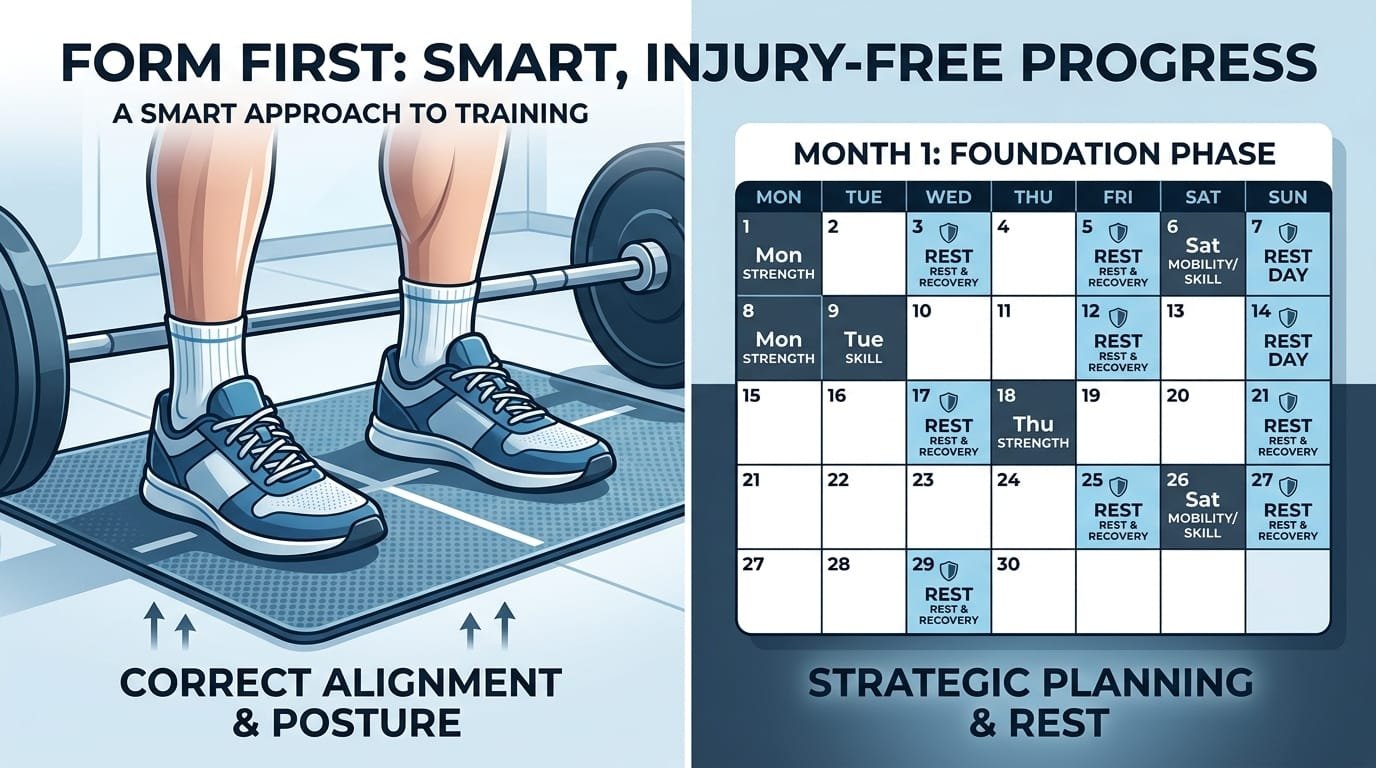
2–3 full-body sessions per week (e.g., Monday / Thursday / Saturday or Monday / Wednesday / Friday).
Session Length
25–40 minutes including a short warm-up.
Progression Rule
When you complete all sets with good form and 1–3 reps in reserve, add 1–2 repetitions the next session. Only after the top of the rep range feels solid should you consider a slightly harder variation or very light load increase.
Sample Weekly Schedule
Session A
- Box squat or sit-to-stand – 2–3 × 8–12
- Glute bridge or light RDL – 2–3 × 8–12
- Elevated push-up – 2–3 × 8–12
- Band or single-arm row – 2–3 × 10–15
- Dead bug – 2 × 6–8 per side
Session B
- Bodyweight squat or reverse lunge – 2–3 × 8–12
- Single-leg glute bridge or hip hinge – 2–3 × 8–12
- Knee push-up or full push-up from knees – 2–3 × 8–12
- Single-arm row or band face pull – 2–3 × 10–12 per arm
- Bird dog or short carry – 2 × 20–30 seconds
Alternate A and B across the week. If training only twice, use one of each.
Week-by-Week Focus
Weeks 1–2: Movement Ownership
- Lightest effective loads
- Film sets for technique review
- Perfect the 3-second eccentric
- Establish the habit of logging every session
Weeks 3–4: Controlled Progression
- Add repetitions when form allows
- Maintain the same exercises
- Continue filming key sets
- Note improvements in stability and confidence
Step-by-Step Daily Session Flow
- Clear the space and prepare equipment (2 minutes).
- Perform a 3–5 minute warm-up: easy marching, arm circles, bodyweight versions of the first pattern.
- Complete the planned exercises with full attention to technique.
- Rest as needed to keep every repetition controlled.
- Log sets, reps, and a brief note on form or energy.
- Tidy the space immediately.
- Prioritise protein intake and sleep that evening.
Recovery Rules for the First 30 Days
- Sleep 7–9 hours most nights.
- Eat a protein-containing meal or snack within a few hours of training.
- Keep at least one full rest day between sessions.
- Use light walking on off days if desired.
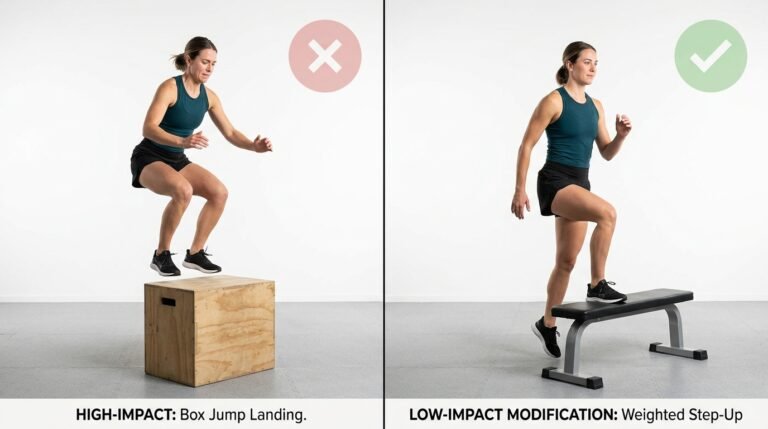
- Reduce volume immediately if joint discomfort appears.
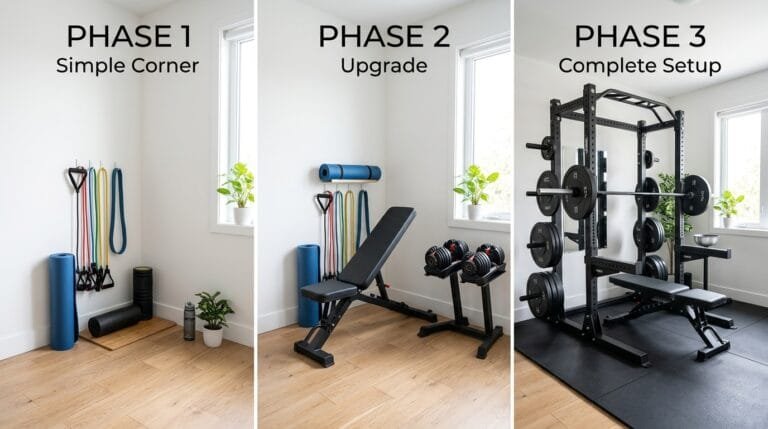
Equipment Needed for the Plan
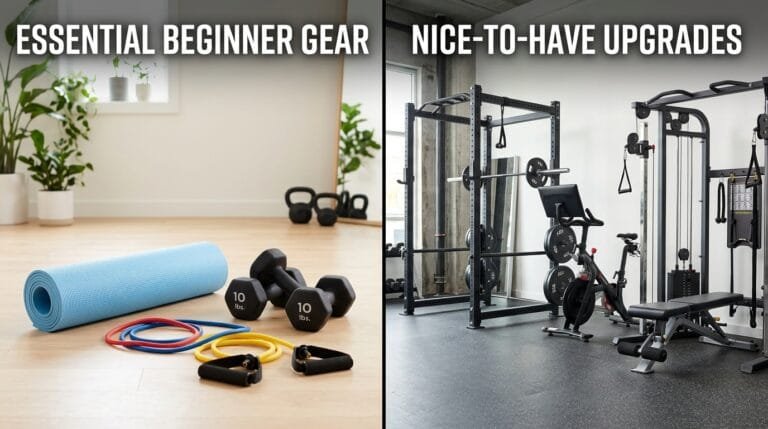
- Exercise mat
- Resistance bands with door anchor (highly recommended)
- Optional: light dumbbells or a backpack for load
- Sturdy chair or box for depth control
No other equipment is required to complete a highly effective first 30 days.
Tracking Template (Simple)
Date:
Session (A or B):
Exercise | Sets × Reps | Notes on form/energy
Overall confidence (1–5):
Review the log every Sunday to confirm consistency and small improvements.
Common Pitfalls During the First Month and Corrections
| Pitfall | Consequence | Correction |
|---|---|---|
| Adding extra exercises | Fatigue and diluted focus | Stick to the five patterns |
| Training on consecutive days | Incomplete recovery | Keep scheduled rest days |
| Ignoring video feedback | Repeated technique errors | Film at least one set per exercise weekly |
| Comparing to others | Discouragement | Measure only against your own log |
| Skipping sessions without a plan | Lost momentum | Have a minimum viable 15-minute version ready |
Strength training produces reliable results when beginners prioritise consistency and technique (strength training guidance). Practical home-gym approaches emphasise starting simple and building sustainable habits (home gym equipment prioritisation and budget home gym principles).
Frequently Asked Questions
What if I miss a session?
Simply resume with the next scheduled workout. Do not try to “make up” volume.
How sore should I be?
Mild muscle soreness is normal. Sharp joint pain or soreness that worsens across sessions is not—reduce range or volume.
Can I train more than three days per week?
Not in the first 30 days. Two to three sessions allow better recovery and technique focus.
What if the exercises feel too easy?
Add repetitions first. Only when you reach the top of the range with solid form should you progress the variation or load.
Do I need to stretch?
A short dynamic warm-up is sufficient. Long static stretching is optional and not required for progress.
How do I know if my form is correct?
Film from the side and front. Check for neutral spine, controlled movement, and joints tracking properly. Seek professional feedback if uncertain.
Is this plan suitable for complete beginners?
Yes. It is specifically designed for people with little or no strength-training experience.
What comes after 30 days?
Continue the same patterns, keep progressing reps or load, and consider adding one new variation or a third set if recovery remains good.
Final Recommendation
The first 30 days of home strength training succeed when movement quality, consistency, and recovery take priority over intensity and variety. Train 2–3 full-body sessions per week using the fundamental patterns, keep loads light, control every repetition, leave reps in reserve, and log every session. This approach prevents the mistakes that cause most beginners to stall or quit.
Print or save the session templates today, clear a training space, and complete your first workout with full attention to technique. Track the session, protect your sleep, and show up for the next one. When the opening month is handled this way, the foundation for long-term strength and confidence is firmly established. Start simply—the strongest progress begins with the discipline of doing the basics well.