Fixed vs Adjustable Kettlebells: Long-Term Value for Most People
Quick Answer
Fixed kettlebells generally deliver better long-term value for most people who train seriously with kettlebells, because they offer superior feel, durability, balance, and longevity with no moving parts to wear out. Adjustable kettlebells provide better short-term value and space efficiency for beginners, travellers, or highly space-constrained lifters who need multiple loads in one footprint. The optimal choice depends on training frequency, available storage, budget timeline, and how central kettlebells are to the overall program. Many home lifters eventually own one or two fixed bells plus a simple adjustable option for flexibility.
Understanding the Real Decision
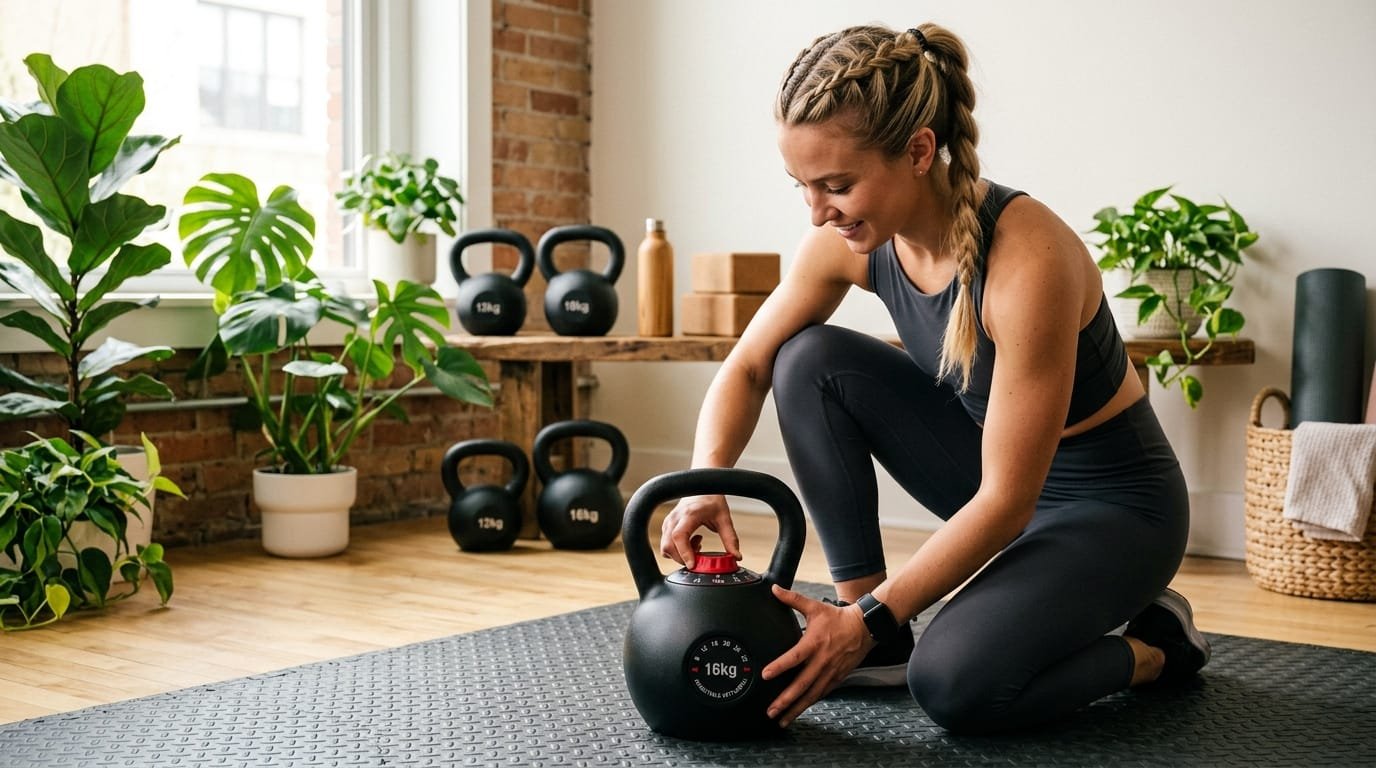
The choice between fixed and adjustable kettlebells is not purely about which is “better.” It is about which tool solves the largest number of problems over several years of home training. Fixed kettlebells are single-cast or welded implements of one weight. Adjustable kettlebells use plates, dials, or locking mechanisms to change load within one unit. Each design creates different trade-offs in cost, space, training experience, durability, and progression.
Direct Comparison Across Key Factors
| Factor | Fixed Kettlebells | Adjustable Kettlebells | Edge for Most Long-Term Users |
|---|---|---|---|
| Feel & balance during swings & cleans | Excellent – stable centre of mass | Good to very good – can feel less fluid | Fixed |
| Durability & longevity | Excellent – no moving parts | Good – mechanisms can wear | Fixed |
| Space efficiency | Poor if multiple weights needed | Excellent – one unit replaces several | Adjustable |
| Upfront cost for a useful range | High (multiple bells) | Lower (one unit) | Adjustable |
| Cost over 5+ years | Often lower if training is consistent | Higher if mechanism fails or range is outgrown | Fixed (usually) |
| Progressive overload convenience | Requires buying next bell | Quick load changes | Adjustable |
| Noise & floor friendliness | Depends on coating and handling | Similar, plus potential plate rattle | Slight fixed edge |
| Travel / portability | Low | Moderate to high | Adjustable |
| Exercise versatility | High for classic kettlebell work | High for most patterns | Tie |
| Resale value | Generally strong | Variable | Fixed |
Shoulder-friendly technique and overall upper-back health support sustainable kettlebell training (Bent Arms vs. Straight Arms in Lateral Raises, The Hidden Mistake in Lateral Raises, and 3 Lateral Raise Modifications). Grip strength is heavily trained by kettlebell work and can be supplemented directly (Do Hand Grippers Really Work?).
Deep Dive: Fixed Kettlebell Advantages
Training Experience
Fixed bells have a consistent centre of mass and no internal movement. This produces a smoother arc during swings, cleans, and snatches and more predictable behaviour during presses and Turkish get-ups. Many experienced kettlebell users consider this feel irreplaceable.
Durability
With no pins, dials, or nested plates, fixed kettlebells rarely fail. A quality cast or competition-style bell can last decades of hard use. This longevity improves long-term value when the implement is used frequently.
Simplicity and Reliability
There is nothing to adjust, loosen, or break mid-session. For high-frequency or high-intensity kettlebell practice, this reliability reduces friction and safety concerns.
Resale and Longevity Economics
A well-maintained fixed kettlebell holds value and does not become obsolete when strength increases. Lifters simply add the next size rather than discarding a unit that no longer challenges them.
Deep Dive: Adjustable Kettlebell Advantages
Space Efficiency
One adjustable unit can replace four to eight fixed bells. For apartments, small spare rooms, or multi-use living areas, this is often the decisive factor.
Lower Entry Cost for Range
A single adjustable kettlebell provides a wide load range for the price of roughly two fixed bells. Beginners can progress through multiple increments without repeated purchases.
Convenience of Load Changes
Changing weight takes seconds rather than walking to a rack or storage area. This supports efficient supersets, complexes, and fine-tuned progression.
Portability
Some adjustable designs pack more easily than a set of fixed bells, making them useful for travel or temporary living situations.
Long-Term Value Analysis
Scenario 1: Kettlebells as a Primary Tool
If swings, cleans, presses, and Turkish get-ups form a large part of training for years, fixed kettlebells usually win on value. The superior feel and near-zero maintenance cost compound over time. Most serious users eventually prefer a small fleet of fixed bells (e.g., 16 kg, 24 kg, 32 kg or the equivalent in pounds).
Scenario 2: Kettlebells as a Secondary Tool
If the main work is dumbbells, barbells, or bodyweight and kettlebells are used occasionally for conditioning or variety, an adjustable unit often provides better value. The space and cost savings outweigh the slight compromise in feel.
Scenario 3: Extreme Space or Budget Constraints
Adjustable kettlebells solve immediate problems that fixed bells cannot. In these cases the adjustable option is the higher-value choice even if fixed bells would be preferred in an ideal environment.
Scenario 4: Progressive Strength Focus
Lifters who need frequent small load jumps may find adjustable bells more practical until they reach the upper end of the adjustable range, at which point fixed bells become necessary.
Step-by-Step Decision Process
- Estimate how central kettlebells will be to your training for the next 3–5 years.
- Measure available storage and decide how many fixed bells you can realistically keep.
- Calculate the cost of a useful fixed range versus one quality adjustable unit.
- Determine whether the feel of swings and cleans is a high priority.
- Assess travel or relocation frequency.
- Choose the option that removes the largest constraints without creating new ones.
- Start with one implement (either a mid-range fixed bell or a good adjustable) and add later if needed.
- Apply progressive overload methods that work with the chosen tool.
- Re-evaluate after 6–12 months of consistent use.
- Avoid collecting redundant tools that do not improve training outcomes.
Recommended Approaches for Different Lifters
Beginner with Limited Space and Budget
Start with one adjustable kettlebell or a single mid-weight fixed bell (often 12–20 kg for many women and 16–24 kg for many men, adjusted for individual strength). Add later as needed.
Intermediate Lifter Who Enjoys Kettlebell Training
Two or three fixed bells in logical progressions usually provide the best long-term experience and value.
Advanced or High-Frequency Kettlebell User
A small set of fixed competition or hardstyle bells is typically the highest-value solution.
Mixed-Tool Home Gym User
One adjustable kettlebell plus bands and a pair of dumbbells covers almost every need without excess clutter.
Progressive Overload with Either Type
Fixed Kettlebells
- Increase repetitions
- Slow the eccentric or add pauses
- Move to more demanding variations (single-arm, double-bell complexes when available)
- Improve density
- Eventually purchase the next size
Adjustable Kettlebells
- Increase load in available increments
- Use all of the same tempo, pause, and variation methods
- Combine with bands for added tension if the top weight is reached
Both styles support long-term progress when programming is intelligent.
Durability and Maintenance Considerations
Fixed kettlebells require almost no maintenance beyond occasional cleaning and floor protection. Adjustable units need periodic checks of locking mechanisms, threads, or dial systems. Dropping adjustable kettlebells is generally more risky for the mechanism than dropping fixed bells. Proper handling extends the life of both, but fixed bells are inherently more tolerant of hard use.
Common Buying Mistakes
| Mistake | Consequence | Better Approach |
|---|---|---|
| Buying too many fixed sizes at once | Unnecessary cost and storage pressure | Start with one or two logical weights |
| Choosing a low-quality adjustable mechanism | Frustration and early failure | Research locking reliability and user feedback |
| Expecting an adjustable to feel identical to fixed | Disappointment with swing quality | Accept a small compromise or prioritise fixed for swings |
| Ignoring storage before purchase | Clutter and reduced adherence | Measure and plan storage first |
| Chasing maximum adjustable range at the expense of stability | Poor feel and potential safety issues | Prioritise secure, well-reviewed designs |
Strength training with kettlebells remains highly effective for building power, strength, and conditioning when the tool matches the user’s constraints (strength training guidance). Practical home-gym approaches emphasise selecting equipment that stays usable for years (home gym equipment prioritisation and budget home gym principles).
Frequently Asked Questions
Which type is better for beginners?
An adjustable kettlebell or a single mid-range fixed bell both work well. Choose based on space and budget. Learn technique with a manageable load before emphasising progression.
Do adjustable kettlebells feel noticeably different during swings?
Yes. Many users report a less fluid feel compared with fixed bells because the mass distribution is not identical. The difference is acceptable for most general training but noticeable for technique-focused practice.
How many fixed kettlebells do most people actually need?
Two or three well-chosen sizes cover the majority of training needs for years. More is rarely necessary unless kettlebell sport or very high-volume practice is the goal.
Are competition kettlebells worth the extra cost?
For frequent swinging, cleaning, and snatching, yes. The uniform size and balance improve technique consistency. For general fitness, standard cast bells are usually sufficient.
Can I build significant strength with only adjustable kettlebells?
Yes for most people. When the top weight is reached, combine with tempo work, unilateral variations, density training, or additional tools such as dumbbells and bands.
What is the biggest long-term cost of adjustable kettlebells?
Potential mechanism wear and the possibility of outgrowing the maximum weight, which may force a second purchase.
What is the biggest long-term cost of fixed kettlebells?
The cumulative expense and storage required if many sizes are collected unnecessarily.
Should I buy used kettlebells?
Fixed kettlebells are often excellent used purchases if they are not cracked or excessively rusted. Adjustable units should be inspected carefully for mechanism integrity.
Final Recommendation
Fixed kettlebells typically provide superior long-term value for people who train regularly with kettlebells and have space for two or three sizes, because of better feel, durability, and lower lifetime complications. Adjustable kettlebells provide superior short-to-medium-term value and space efficiency for beginners, highly constrained environments, or lifters who use kettlebells as a secondary tool. The highest-leverage approach for many home lifters is to start with one quality option (either a mid-range fixed bell or a reliable adjustable), master the fundamental movements, and only expand when a clear limitation appears.
Assess your available storage, budget timeline, and how central kettlebells will be to your training over the next several years. Choose the option that removes the largest current constraints without creating new ones. Apply progressive overload consistently, protect the implement with basic care, and reassess after a year of use. When the tool matches the actual training context, kettlebell work remains productive and enjoyable for the long term. Make the decision based on your real environment and goals rather than an idealised setup—the consistent work you do with the chosen implement matters more than the implement itself.