Resistance Bands vs Dumbbells: Which Solves More Problems for Home Lifters?
Quick Answer
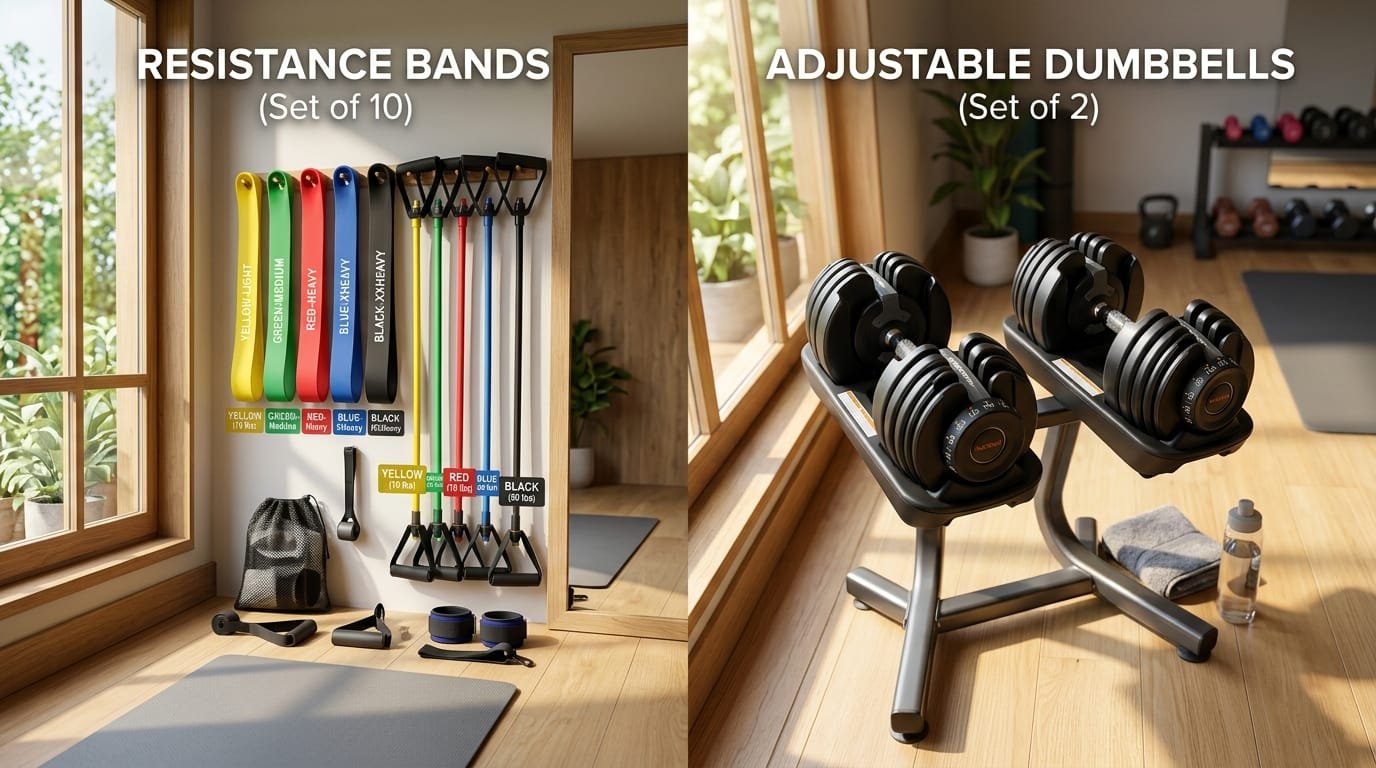
Resistance bands solve more problems related to space, cost, portability, joint-friendliness, and travel, while dumbbells solve more problems related to progressive loading precision, strength development at higher intensities, and exercise stability. For most home lifters the optimal solution is not choosing one exclusively, but using bands as the foundation for accessibility and variety and adding a single pair of adjustable or fixed dumbbells when linear loading and heavier tension become limiting factors. The combination covers the widest range of training problems with the least clutter and cost.
Understanding the Core Problems Home Lifters Face
Home lifters typically wrestle with a predictable set of constraints: limited floor space and storage, budget limits, the need for progressive overload without constant new purchases, joint comfort, exercise variety, noise, portability, and long-term adherence. Resistance bands and dumbbells each address different parts of this list. Understanding which tool solves which problems prevents unnecessary purchases and creates a more efficient home setup.
Direct Comparison Across Key Home-Training Problems
| Problem | Resistance Bands Advantage | Dumbbells Advantage | Winner for Most Home Lifters |
|---|---|---|---|
| Storage space & visual clutter | Extremely low footprint, store in a drawer | Low–moderate footprint with one pair | Bands |
| Upfront cost | Very low for a full set | Moderate to high for a useful range | Bands |
| Progressive overload precision | Good via band strength, stretch, and tempo | Excellent via small load increments | Dumbbells |
| Joint-friendly loading | Variable resistance often feels easier on joints | Constant load; form must be controlled | Bands (slight edge) |
| Exercise variety | Excellent for pull-aparts, face pulls, assisted work, rotation | Excellent for presses, rows, squats, hinges, carries | Tie / Combination |
| Portability & travel | Near-perfect | Limited unless very light pairs | Bands |
| Noise & apartment friendliness | Silent | Low if set down controlled | Bands |
| Heavy strength stimulus | Limited at advanced levels | Superior for higher absolute loads | Dumbbells |
| Durability & longevity | Consumable; require periodic replacement | Very high if quality | Dumbbells |
| Beginner accessibility | Extremely high | High once basic form is learned | Bands |
| Unilateral & corrective work | Excellent | Excellent | Tie |
Shoulder-friendly technique remains important regardless of tool choice (Bent Arms vs. Straight Arms in Lateral Raises, The Hidden Mistake in Lateral Raises, and 3 Lateral Raise Modifications). Grip strength can be trained effectively with both tools and dedicated implements (Do Hand Grippers Really Work?).
Deep Dive: Problems Resistance Bands Solve Best
Space and Storage
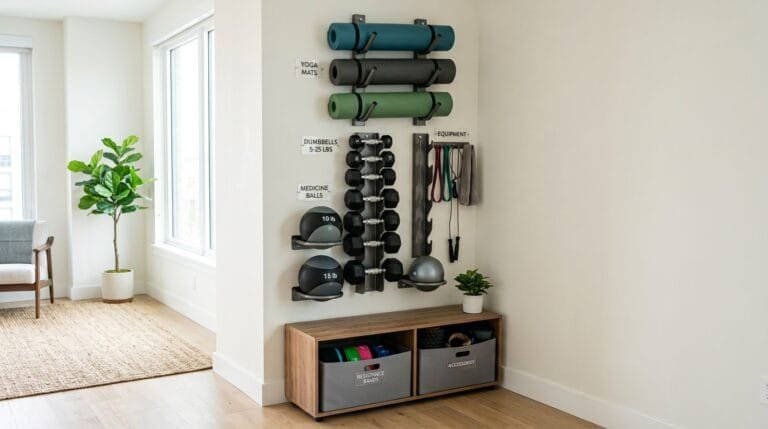
A full set of bands occupies less volume than a single pair of moderately heavy dumbbells. They hang on hooks, fit in drawers, or travel in a small pouch. For apartments, shared living spaces, and multi-use rooms, this is often the decisive advantage.
Cost of Entry
A quality set of loop and tube bands with door anchors costs a fraction of even a basic adjustable dumbbell set. Beginners can start effective full-body training with minimal financial risk.
Joint Comfort and Variable Resistance
Bands increase tension as they stretch, which many people find more comfortable for pressing, rowing, and leg work. The accommodating resistance can reduce stress at the bottom of certain movements where joints are more vulnerable.
Portability
Bands turn any hotel room or temporary space into a functional gym. This removes the common interruption of travel from training consistency.
Exercise Variety for Upper-Back and Corrective Work
Face pulls, pull-aparts, banded distractions, and rotational anti-movement drills are often easier and more effective with bands than with dumbbells.
Deep Dive: Problems Dumbbells Solve Best
Precise Progressive Overload
Once a trainee can perform high repetitions with the strongest available bands, further progress becomes harder to quantify. Dumbbells allow clear, incremental loading that supports continued strength development for years.
Higher Absolute Tension
For lower-body hinges, goblet squats, floor presses, and loaded carries, dumbbells (or a single kettlebell) provide loading that bands struggle to match at advanced levels.
Stability and Motor Control
Dumbbells require the lifter to control the load in space, building stabiliser strength and coordination that translates well to real-world tasks.
Durability
A good pair of dumbbells lasts decades with basic care. Bands are consumable and require ongoing replacement.
Certain Strength Patterns
Heavy single-arm rows, floor presses, Romanian deadlifts, and farmer carries are simply more effective with solid external load than with bands alone.
Step-by-Step Decision Framework for Home Lifters
- List your primary constraints
Space, budget, noise, travel frequency, and current strength level. - Identify your main training goals
General strength, muscle gain, joint-friendly consistency, fat loss support, or travel-proof training. - Start with the tool that removes the largest barriers
Most beginners and space-constrained lifters should begin with bands. - Add dumbbells when progression stalls
When strongest bands no longer provide adequate tension for key patterns, introduce a single pair of adjustable or fixed dumbbells. - Keep the total toolkit small
Bands + one pair of dumbbells solves the majority of home-training problems without clutter. - Apply progressive overload to both tools
Bands: stronger bands, greater stretch, slower tempos, pauses, unilateral work.
Dumbbells: added load, tempo, pauses, unilateral versions, density. - Store both properly
Bands protected from sun and sharp edges; dumbbells in a stable, designated location. - Inspect both regularly
Bands before every use; dumbbells for handle and head integrity monthly. - Reassess every 4–6 months
Determine whether additional load range or band strengths are actually needed. - Avoid collecting redundant equipment
More tools rarely equal better results; better use of existing tools does.
Sample Minimalist Setups
Bands-Only Setup (Maximum Simplicity)
- Light, medium, and heavy loop bands
- Tube bands with handles and door anchor
- Covers squat, hinge, push, pull, carry, and core patterns via creative anchoring and body position
Bands + Single Dumbbell Pair (Highest Overall Problem-Solving)
- Full band set as above
- One pair of adjustable dumbbells or a modest fixed pair (e.g., 10–25 kg range depending on strength)
- Enables precise loading for presses, rows, hinges, and squats while retaining all band advantages
Dumbbell-Primary Setup
- Adjustable dumbbells with sufficient range
- A few bands for face pulls, pull-aparts, and warm-up or corrective work
- Best when storage allows and progressive strength is the dominant goal
Progressive Overload Methods for Each Tool
Bands
- Move to a stronger band
- Increase pre-stretch
- Slow the eccentric
- Add pauses at peak tension
- Use unilateral stances or grips
- Increase density (more work in less time)
Dumbbells
- Increase load in smallest available increments
- Add repetitions
- Slow the eccentric
- Add pauses
- Progress to more demanding variations (e.g., single-leg, deficit)
- Improve density
Both tools support years of progress when these methods are applied systematically.
Common Misconceptions
| Misconception | Reality |
|---|---|
| “Bands cannot build real strength” | Bands build meaningful strength, especially for beginners and intermediates; advanced trainees often benefit from adding external load |
| “Dumbbells are always better” | Dumbbells excel at linear loading but lose to bands on space, cost, and portability |
| “I need a full dumbbell rack” | One pair of adjustable or carefully chosen fixed dumbbells covers most needs |
| “Bands are only for activation or rehab” | Bands are fully capable of providing primary training stimulus when progressed properly |
| “I must choose one” | The highest-leverage solution for most home lifters is both, used for complementary purposes |
Cost and Longevity Considerations
Bands have very low entry cost but require periodic replacement. Dumbbells have higher upfront cost yet last decades. Over a five-year period the combined approach (bands + one dumbbell pair) is usually more economical and far more versatile than repeatedly expanding a dumbbell collection or relying solely on bands after progression plateaus.
Strength training remains highly effective with either or both tools when progressive overload and consistency are present (strength training guidance). Practical home-gym approaches emphasise minimal effective equipment that solves real constraints (home gym equipment prioritisation and budget home gym principles).
Frequently Asked Questions
Can I build a strong physique with only bands?
Yes, especially as a beginner or early intermediate. Advanced trainees may eventually need additional loading methods for continued progress on certain patterns.
Are adjustable dumbbells worth the investment?
Yes if budget and storage allow. They replace an entire rack and pair extremely well with bands.
Which is better for beginners?
Bands are usually the better starting point due to cost, space, and joint-friendly resistance. Dumbbells can be introduced once basic movement patterns are solid.
Which is better for apartments and shared spaces?
Bands win clearly on noise, storage, and visual impact. Controlled dumbbell work is still viable but requires more care.
How do I progress when my strongest band becomes easy?
Combine bands with bodyweight leverage changes, slow tempos, pauses, unilateral work, or add dumbbells for the patterns that need more load.
Do I need both tube bands and loop bands?
Useful but not mandatory. Loop bands are highly versatile; tube bands with handles improve some pressing and rowing angles. A door anchor significantly expands options.
Which tool is better for lower-body strength?
Dumbbells generally allow higher loading for squats, hinges, and lunges. Bands can still provide effective stimulus, especially with clever anchoring and tempo work.
How long do quality bands last?
With proper care and storage, several months to a couple of years depending on frequency of use and band quality. Inspect before every session.
Final Recommendation
Resistance bands solve more problems related to space, cost, portability, and joint-friendly access, while dumbbells solve more problems related to precise progressive overload and higher-intensity strength stimulus. For the majority of home lifters, the highest-leverage solution is to start with a quality set of bands and add a single pair of adjustable or fixed dumbbells when linear loading becomes the limiting factor. This combination addresses the widest range of real-world constraints without creating clutter or unnecessary expense.
Assess your current space, budget, and strength level today. If you own neither tool, begin with bands. If you already have bands and progression is stalling on key lifts, add one versatile dumbbell pair. Apply progressive overload methods to both, store them properly, and inspect them regularly. When the tools match the actual problems you need to solve, home training becomes simpler, more sustainable, and more effective. Start with the setup that removes your largest barriers—the results will follow from consistent progressive work.