Home Training Focused on Strength and Bone Health for Women
Quick Answer
Home training focused on strength and bone health for women centres on progressive resistance exercises that load the major muscle groups and skeleton, performed 2–4 times per week. Prioritise compound movements such as squats, hinges, pushes, pulls, and carries using bodyweight, resistance bands, dumbbells, or a single kettlebell. Progressive overload through added repetitions, slower tempos, or increased load stimulates both muscle and bone. Consistency, adequate protein, and recovery habits multiply the benefits for long-term strength, posture, and skeletal resilience.
Why Strength and Bone Health Training Matters for Women
Women experience accelerated bone-mineral-density loss after menopause and can lose muscle mass earlier and faster than many realise. Progressive resistance training is one of the most effective non-pharmacological tools for preserving and improving both muscle strength and bone density. It also supports metabolic health, posture, balance, and the ability to perform daily tasks independently. Training at home removes common barriers of time, cost, and gym intimidation, making consistent progressive loading more achievable.
Core Principles for Strength and Bone Health
- Progressive mechanical loading – Bone and muscle respond to gradually increasing demands.
- Compound, multi-joint movements – These create higher forces through the skeleton and train functional strength.
- Full-body frequency – 2–4 sessions per week provide repeated stimulus without excessive fatigue.
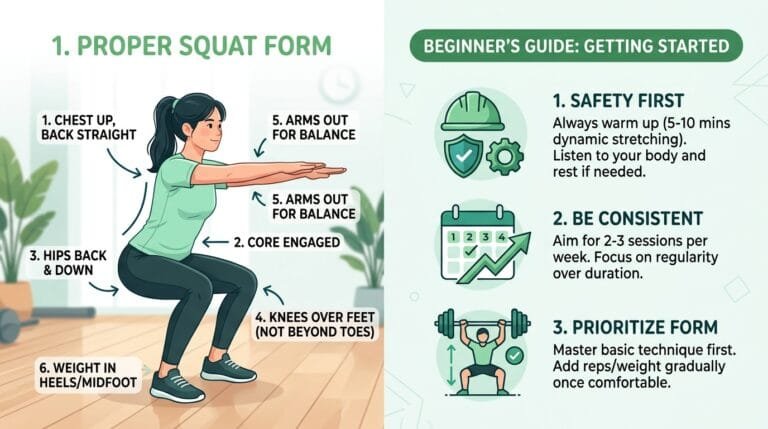
- Controlled technique – Quality movement protects joints while still loading bone and muscle effectively.
- Adequate recovery and nutrition – Sleep and protein intake support tissue adaptation.
- Long-term consistency – Benefits accumulate over months and years, not weeks.
Essential Movement Patterns for Strength and Bone Stimulus
| Pattern | Bone & Strength Benefit | Home-Friendly Options | Progression Methods |
|---|---|---|---|
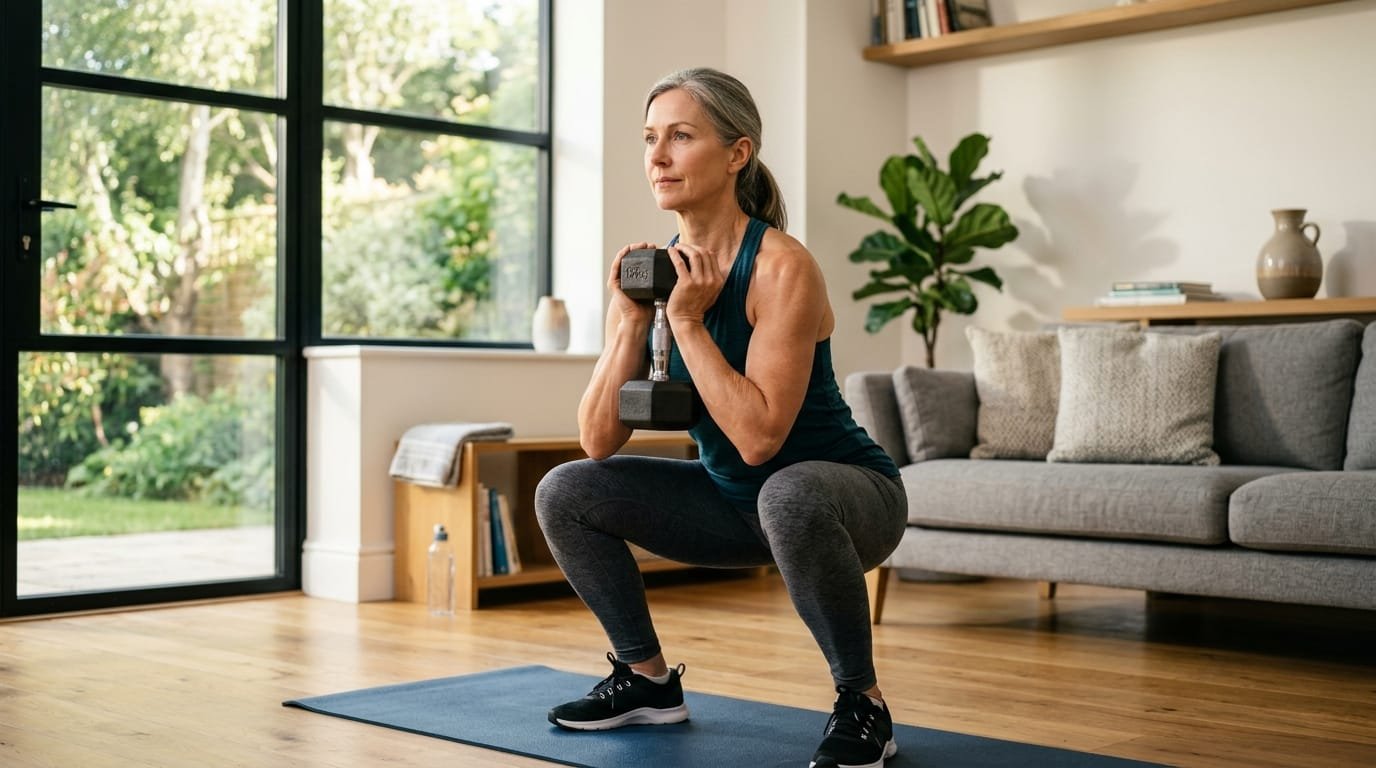
| Squat / Sit-to-Stand | Loads spine, hips, and femurs | Goblet squat, box squat, sit-to-stand, reverse lunge | Depth, tempo, load, single-leg |
| Hinge | Posterior chain and hip loading | Romanian deadlift, single-leg RDL, hip thrust, glute bridge | Range, tempo, load |
| Horizontal Push | Upper-body strength and shoulder stability | Floor press, push-up variations, band press | Elevation, tempo, load |
| Horizontal Pull | Posture, upper-back strength, balanced development | Single-arm row, band row, inverted row | Load, tempo, pause |
| Carry / Loaded Walk | Whole-body loading and grip | Suitcase carry, farmer carry with bags or dumbbells | Distance, load, duration |
| Optional Impact or Power | Additional bone stimulus when appropriate | Controlled step-ups, low box step-downs, or short hops (only if joints allow) | Height, volume, control |
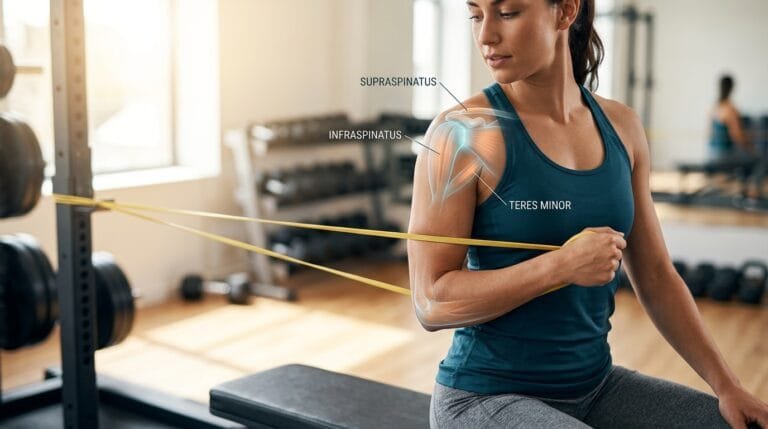
Shoulder-friendly technique supports long-term upper-body training (Bent Arms vs. Straight Arms in Lateral Raises, The Hidden Mistake in Lateral Raises, and 3 Lateral Raise Modifications). Grip strength contributes to overall function and can be trained directly (Do Hand Grippers Really Work?).
Step-by-Step Home Program Design
- Obtain medical clearance if needed
Especially important with existing osteoporosis, osteopenia, joint issues, or recent injuries. - Choose 4–6 compound exercises
Cover squat/lunge, hinge, push, pull, and carry patterns. - Start with manageable loads or bodyweight
Focus on full pain-free range and controlled tempo. - Train 2–4 times per week
Full-body sessions work best for most women. - Use 2–4 sets of 6–12 repetitions
Leave 1–3 repetitions in reserve on most sets. - Progress systematically
Add repetitions first, then slow the tempo, then increase load or difficulty. - Include balance and posture work
Single-leg stands, bird dogs, or face pulls improve function and reduce fall risk. - Prioritise recovery
Sleep 7–9 hours and consume adequate protein (roughly 1.6–2.2 g per kg of body weight). - Track sessions
Log exercises, sets, reps, and how the movements felt. - Reassess every 4–6 weeks
Adjust exercises or volume based on progress and recovery.
Sample Home Workouts for Strength and Bone Health
Session A – Foundation
- Goblet squat or box squat – 3 × 8–12
- Romanian deadlift or single-leg RDL – 3 × 8–12
- Floor press or elevated push-up – 3 × 8–12
- Single-arm row – 3 × 8–12 per arm
- Suitcase carry or dead bug – 2–3 sets
Session B – Progression Focus
- Reverse lunge or split squat – 3 × 8–12 per leg
- Hip thrust or glute bridge – 3 × 8–12
- Push-up variation – 3 × 8–12
- Band or inverted row – 3 × 10–15
- Farmer carry or bird dog – 2–3 sets
Rest as needed to maintain good form. Sessions typically last 30–45 minutes.
Progressive Overload Methods Suitable for Home Training
- Add repetitions within the target range
- Slow the eccentric phase (3–4 seconds)
- Insert pauses at the hardest point
- Increase range of motion under control
- Move to unilateral versions
- Add external load (dumbbells, bands, backpack, or kettlebell)
- Improve density (more work in the same time)
These methods allow continuous progress even with limited equipment.
Equipment Recommendations for Women Training at Home
| Equipment | Priority | Why It Helps | Storage Notes |
|---|---|---|---|
| Resistance bands with door anchor | High | Variable resistance, joint-friendly | Very low |
| Adjustable or fixed dumbbells | High | Progressive loading for most patterns | Low–moderate |
| Exercise mat | High | Comfort and floor protection | Low |
| Single kettlebell | Medium | Hinge and carry variations | Low |
| Optional foldable bench | Low–medium | Supported pressing and hip thrusts | Only if storage allows |
Start with bands and bodyweight if equipment is limited. Add dumbbells when ready for external load.
Special Considerations for Women
Bone density and impact
Resistance training provides the primary stimulus. Low-level impact (controlled step-ups or short hops) can be added only if joints and any existing bone-density diagnosis allow it. Always follow professional guidance.
Pelvic floor and core
Coordinate breathing with bracing. Avoid chronic breath-holding under heavy loads if pelvic-floor symptoms are present. Consult a specialist if needed.
Hormonal transitions
Strength training remains effective and beneficial across perimenopause and postmenopause. Recovery may require slightly more attention to sleep and stress management.
Joint health
Controlled tempos and full pain-free ranges protect joints while still delivering effective loading.
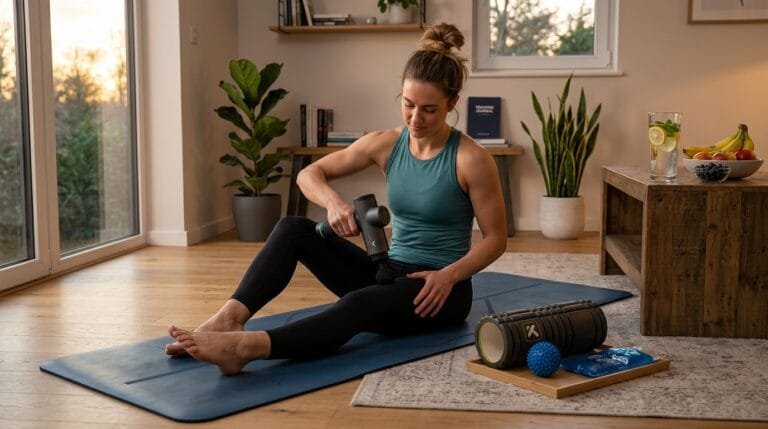
Recovery and Lifestyle Factors That Amplify Results
- Consistent sleep of 7–9 hours
- Protein distributed across meals
- Daily walking or light movement
- Stress management
- Planned deloads every 4–8 weeks
These factors determine how well the body adapts to the training stimulus.
Common Mistakes That Limit Strength and Bone Benefits
| Mistake | Result | Better Approach |
|---|---|---|
| Staying with the same light weights indefinitely | Minimal progressive stimulus | Apply systematic overload |
| Excessive isolation work | Lower overall loading | Prioritise compound movements |
| Skipping lower-body loading | Missed bone stimulus at key sites | Include squats, hinges, and carries |
| Poor technique under fatigue | Joint stress and reduced effectiveness | Leave reps in reserve, film sets |
| Inadequate protein or sleep | Impaired adaptation | Treat recovery as part of the program |
| Inconsistent training | Limited cumulative benefit | Schedule 2–4 sessions most weeks |
Strength training remains one of the highest-leverage activities for long-term health and function (strength training guidance). Practical home-gym approaches emphasise accessible systems that support consistent progressive loading (home gym equipment prioritisation and budget home gym principles).
Frequently Asked Questions
How often should women train for strength and bone health?
Two to four full-body sessions per week produce excellent results for most women.
Can I build bone density with home equipment only?
Yes. Progressive resistance through compound movements provides effective loading. Consistency and gradual overload matter more than specific machines.
Is heavy lifting necessary?
Loads should be challenging relative to your current capacity. Progressive increase over time is more important than any absolute number.
What if I have osteopenia or osteoporosis?
Medical clearance and possibly professional guidance are recommended. Many women still train effectively with modified ranges and controlled loading.
Do I need to do impact exercises?
Not required. Resistance training is the foundation. Impact can be added cautiously if appropriate for your joints and bone status.
How long before I notice improvements?
Strength and confidence often improve within 4–8 weeks. Bone-density changes occur more slowly and are measured over longer periods.
Is training during perimenopause or postmenopause still effective?
Yes. Progressive resistance training remains one of the most beneficial activities during these transitions.
Can I start with only bodyweight?
Yes. Bodyweight movements can be progressed through tempo, pauses, unilateral variations, and range of motion for an extended period before external load is needed.
Final Recommendation
Home training focused on strength and bone health for women succeeds when progressive compound movements are performed consistently 2–4 times per week. Prioritise squats, hinges, pushes, pulls, and carries, apply systematic overload through repetitions, tempo, or load, and support the work with adequate protein and sleep. Technique stays controlled and pain-free at every stage.
Choose 4–6 fundamental exercises today, schedule two or three sessions this week, and begin with manageable loads or bodyweight. Track your workouts, progress one variable at a time, and treat recovery as part of the program. When strength training is approached this way, the benefits for muscle, bone, posture, and daily function compound over months and years. Start with the next available session—the long-term return on consistent progressive loading is among the highest available for women’s health.