
Is a Bent Arm Safer? Lateral Raises and Shoulder Impingement Risks
Quick answer: A bent arm is generally lower-risk than a straight arm for lateral raises, since it reduces the torque your shoulder joint has to control — but “safer” isn’t an absolute, permanent label. Current shoulder rehabilitation research emphasizes that appropriate, progressive loading (not avoidance) is what actually builds a resilient shoulder over time, so the more useful question is “safer for my current shoulder, right now” rather than “safer, period.”
Researched and written by the GymGoodies team, fact-checked against manufacturer specs and current fitness guidance.
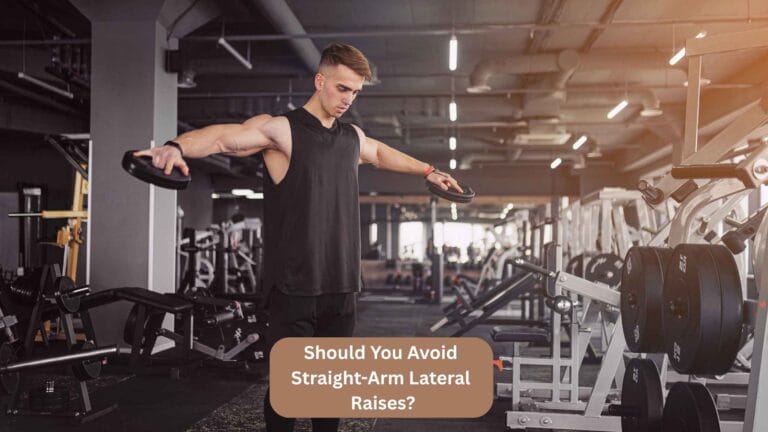
“Is a bent arm safer?” gets asked as if it has one universal answer, but shoulder safety isn’t fixed — it depends on your current shoulder health, how you’re loading the movement, and how you progress over time. This article breaks down what “safer” actually means in this context, and why avoiding straight-arm work forever isn’t necessarily the right long-term goal.
Why Bent Arm Is the Generally Safer Default
Mechanically, a bent arm shortens the lever arm between your shoulder joint and the weight you’re holding, reducing the torque your shoulder’s stabilizing structures need to control throughout the movement. This is well-established biomechanics, not a matter of opinion — less torque generally means less demand on the rotator cuff and surrounding tissue for the same external load.
This is why a bent-arm position is commonly recommended as a starting point, particularly for beginners, people returning from injury, or anyone with current shoulder sensitivity. Our Bent-Arm Lateral Raises guide and our physiotherapist’s take on straight-arm raises both cover this mechanic in more detail.
Why “Safer” Isn’t the Same as “Should Avoid Forever”
Here’s where the conversation often goes wrong: treating a bent arm as the permanently “safe” choice and straight-arm work as something to avoid indefinitely. Current research on rotator cuff tendinopathy management pushes back on this kind of permanent-avoidance thinking. According to a clinical review published in the Journal of Orthopaedic & Sports Physical Therapy, effective management of rotator cuff issues centers on controlled reloading and gradual progression from simple to complex shoulder movements — not indefinite avoidance of demanding positions. Research also suggests that well-structured, graduated exercise programs consistently improve symptoms and function over time, similar to outcomes seen with surgical treatment in some cases.
The practical implication: if your shoulder is currently sensitive or recovering, starting with the lower-torque, bent-arm position makes sense — but the long-term goal for most people is gradually building enough capacity to tolerate more demanding positions, not avoiding them permanently.
A More Useful Framework Than “Bent = Safe, Straight = Risky”
Instead of a fixed rule, consider these questions:
- What’s my current shoulder status? No pain/history — a straighter arm and more lateral path are reasonable options. Current sensitivity or a recent injury — start with the bent-arm, scapular-plane combination and progress deliberately.
- Am I progressing load appropriately, or jumping levels too fast? Injury often comes from a sudden increase in demand (jumping straight to a fully straight arm with heavy weight) rather than from straight-arm training itself being inherently dangerous.
- Is pain or discomfort part of my current picture? If so, a graduated, professionally guided reloading approach — not permanent avoidance — is what the current research on tendinopathy management actually supports.
How to Progress Safely If Your Goal Is Eventually Training Straight-Arm
- Establish pain-free, well-controlled bent-arm raises first. Confirm you can maintain good scapular positioning (no shrugging) through a full set before progressing.
- Gradually straighten the arm over time rather than jumping from fully bent to fully straight in one session — our guide on how arm angle affects joint stress breaks down the specific angle combinations and their relative demand.
- Keep the scapular-plane angle (slightly forward) even as you straighten your arm, since this is a separate variable from elbow bend that also affects joint stress.
- Monitor for pain or unusual discomfort, not just fatigue — normal muscular fatigue is expected; pinching, catching, or sharp pain is a signal to scale back, not push through.
- Progress load and rep range gradually, rather than changing multiple variables (arm angle, weight, volume) all at once.
When Staying With Bent-Arm Permanently Makes Sense
For some people, there’s no strong reason to ever progress to straight-arm lateral raises — it depends entirely on your goals:
- If your priority is joint health and longevity over maximizing deltoid isolation, staying with bent-arm work indefinitely is a completely reasonable choice.
- If you have a chronic shoulder condition that’s well-managed with bent-arm training and you have no specific reason to change, there’s no requirement to progress toward straight-arm work.
- If your training goals don’t specifically require the added isolation straight-arm raises provide, sticking with what works and feels good is a valid long-term approach.
When It’s Worth Working Toward Straight-Arm Capacity
- If you’re specifically training for aesthetic deltoid definition, where the increased isolation of a straight arm offers a real training benefit
- If you’re returning from injury and want to eventually restore full functional capacity rather than permanently limiting your training options
- If you’re simply curious and have no shoulder issues limiting you — there’s no inherent reason to avoid it if your shoulder tolerates it well
Common Mistakes in How People Approach This Question
- Treating “bent = safe forever” as a permanent rule rather than a starting point that can be progressed from, if desired.
- Jumping straight to advanced positions after time away from training, without accounting for reduced current capacity.
- Ignoring pain signals during progression, assuming any discomfort just needs to be pushed through rather than treated as useful feedback.
- Avoiding professional guidance when there’s an actual injury history, rather than working with a physical therapist to progress appropriately.
Frequently Asked Questions
Should everyone start with bent-arm lateral raises?
It’s a reasonable default, especially for beginners or anyone with shoulder sensitivity, but healthy lifters with good shoulder control and no injury history can reasonably choose either position based on their goals.
If I have shoulder pain, does that mean I should stop lateral raises entirely?
Not necessarily — current research generally favors appropriately modified, progressive loading over complete avoidance, but this should be guided by a physical therapist or doctor rather than self-directed trial and error when pain is present.
Is there a “correct” endpoint everyone should progress toward?
No — the right endpoint depends on your specific goals, shoulder history, and preferences. There’s no universal requirement to progress toward straight-arm training if bent-arm work continues to serve your goals well.
Bottom Line
A bent arm is generally the safer default for lateral raises, largely because it reduces the torque demand on your shoulder. But “safer” doesn’t mean straight-arm work is something to avoid forever — current shoulder rehabilitation research favors appropriate, progressive loading over permanent avoidance for most people. The most useful approach is matching your current arm position to your current shoulder status, and progressing deliberately if your goals call for it, rather than treating either position as a fixed, universal rule.
Do you stick with bent-arm lateral raises by choice, or are you working to progress toward straight-arm training? Let us know in the comments where you’re at in that process.