Progressive Pull-Up Program from Zero to 10 Strict Reps
Quick Answer
The pull-up is one of the most effective upper-body strength exercises available, developing the lats, upper back, biceps, rear delts, and core while building relative strength and grip. To go from zero to proficient, follow a clear progression: dead hangs → scapular pull-ups → inverted rows → eccentric (negative) pull-ups → band-assisted pull-ups → full strict pull-ups → weighted and advanced variations. Train the movement or its regressions 2–4 times per week with controlled technique, full range of motion, and progressive overload. Most beginners can achieve their first strict pull-up in 4–16 weeks depending on starting strength, bodyweight, sex, and consistency.
Why the Pull-Up Is Worth Mastering
Pull-ups build functional upper-body pulling strength that transfers to climbing, gymnastics, combat sports, and everyday tasks. They develop a strong, wide back, improve posture, strengthen the grip, and require significant core stability. Because they use bodyweight as resistance, they automatically scale with your strength-to-weight ratio and require only a sturdy bar — making them ideal for home gyms.
Unlike lat-pulldown machines, pull-ups demand coordinated scapular movement, full-body tension, and control through a large range of motion. This makes them both more challenging and more rewarding.
Muscles Worked in Detail
- Primary movers: Latissimus dorsi, teres major, rhomboids, middle and lower trapezius
- Secondary movers: Biceps brachii, brachialis, brachioradialis, posterior deltoids
- Stabilisers: Core musculature (especially anti-extension and anti-rotation), rotator cuff, forearm flexors
Grip strength is a frequent limiting factor. Dedicated grip work accelerates pull-up progress — see grip strength guidance.
Strict Pull-Up Technique – Step-by-Step
- Grip the bar with an overhand (pronated) grip slightly wider than shoulder-width.
- Begin from a dead hang with arms fully extended.
- Create slight tension by depressing and retracting the scapulae (avoid a completely passive hang).
- Initiate the pull by driving the elbows down and back while continuing to pull the shoulder blades together and down.
- Continue until the chin clearly clears the bar.
- Lower under control through the full range until the arms are fully extended again.
- Maintain a braced core and relatively neutral spine; minimise excessive swinging or kipping unless specifically training those variations.
Breathing cue: Exhale during the concentric (pulling) phase or brace and breathe as needed while maintaining tension.
Complete Progression Ladder
| Phase | Exercise | Primary Goal | Target Sets & Volume | Frequency | Advancement Criteria |
|---|---|---|---|---|---|
| 1 | Dead Hang | Grip endurance & shoulder tolerance | 3 × 20–60 seconds | 3×/week | 3 × 45–60 sec holds |
| 2 | Scapular Pull-Up | Scapular depression & initiation strength | 3 × 8–12 controlled | 3×/week | 3 × 12 with 1–2 sec pause |
| 3 | Inverted Row | Horizontal pulling strength | 3–4 × 8–15 | 2–3×/week | Clean higher-rep sets |
| 4 | Eccentric Pull-Up | Eccentric strength through full ROM | 3–5 × 3–5 (3–8+ sec lower) | 2–3×/week | 5 controlled slow reps |
| 5 | Band-Assisted Pull-Up | Technique & volume accumulation | 3 × 5–10 | 2–3×/week | Ability to reduce band assistance |
| 6 | Strict Pull-Up | Unassisted strength | Build toward 3 × 5–8 | 2–4×/week | Consistent sets of 5+ |
| 7 | Advanced Variations | Continued overload | Weighted, archer, typewriter, one-arm progressions | 2–3×/week | As strength allows |
Structured progressions that emphasise scapular control and eccentric loading are among the most efficient routes to the first pull-up (research-backed beginner progression systems).
Detailed Phase-by-Phase Guide
Phase 1 – Dead Hangs
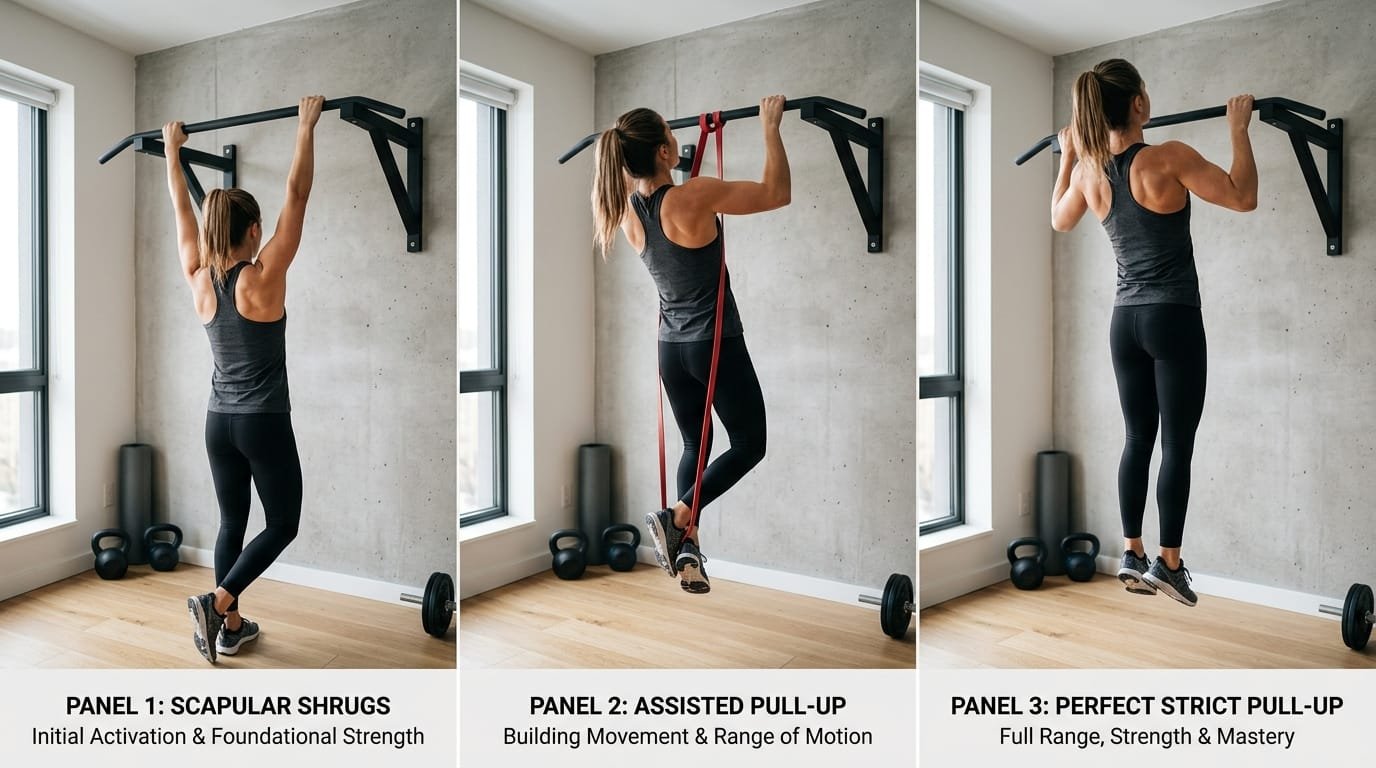
Hang with arms extended. Build from short holds to longer ones. Progress by adding time or moving to active hangs (slight scapular depression).
Phase 2 – Scapular Pull-Ups
From a dead hang, depress and retract the scapulae without bending the elbows, then return to the start. This teaches the critical initiation pattern many beginners skip.
Phase 3 – Inverted Rows
Set a bar or rings at approximately waist height. Lie underneath, grip the bar, and pull the chest toward it while keeping the body rigid. Elevate the feet or lower the bar to increase difficulty.
Phase 4 – Eccentric (Negative) Pull-Ups
Jump or step to the top position (chin over bar), then lower as slowly as possible (aim for 3–8+ seconds). This builds high levels of strength through the full range and is one of the most effective tools for achieving the first pull-up.
Phase 5 – Band-Assisted Pull-Ups
Loop a resistance band over the bar and place one or both feet/knees in it. Perform full-range pull-ups with assistance. Gradually use lighter bands.
Phase 6 – Strict Pull-Ups
Once you can perform several controlled eccentrics and/or lightly assisted reps, begin testing and building unassisted strict pull-ups. Focus on quality over quantity.
Phase 7 – Advanced Progressions
Add weight via a dip belt or backpack, move to archer pull-ups, typewriter pull-ups, towel pull-ups, or work toward one-arm variations.
Programming Recommendations by Goal
Goal: First Pull-Up
- Frequency: 3× per week
- Emphasis: Phases 1–5
- Keep most sets away from complete failure
- Test unassisted attempts every 1–2 weeks
Goal: Building Volume (once you have 3–5 strict reps)
- 3–5 sets of quality reps (leave 1–2 in reserve on most sets)
- Frequency: 2–4× per week
- Mix grips (pronated, neutral, supinated)
Goal: Maximum Strength
- Weighted pull-ups in the 3–6 rep range
- Lower frequency or careful volume management
- Include variation work for balanced development
Practical weekly pulling volume of 6–15 hard sets suits most trainees. Beginners stay at the lower end; advanced trainees may go higher with proper recovery.
Important Variations and When to Use Them
- Chin-up (supinated grip): Greater biceps involvement; often easier for beginners
- Neutral-grip pull-up: Frequently the most joint-friendly option
- Wide-grip pull-up: Emphasises lat stretch
- Close-grip pull-up: Increases arm contribution
- Towel pull-up: Exceptional grip developer
- Weighted pull-up: Primary long-term strength progression
- Archer / Typewriter / Eccentric one-arm: Advanced unilateral strength
Sample Training Templates
Beginner Template (Toward First Pull-Up) – 3× per week
- Dead hang – 3 × max time
- Scapular pull-ups – 3 × 8–12
- Inverted rows – 3 × 8–12
- Eccentric pull-ups – 3–4 × 3–5 (slow)
- Optional band-assisted – 2 × 6–8
Intermediate Template
- Strict pull-ups – 4 sets of max quality reps (or fixed 5–8 reps)
- Neutral-grip or chin-ups – 3 × 6–10
- Inverted rows or single-arm rows – 3 × 8–12
- Optional grip or core finisher
Advanced Template
- Weighted pull-ups – 4 × 3–6
- Variation work (wide, archer, towel) – 3 sets
- High-volume bodyweight or isometric holds at the top/mid-range
Supporting Factors That Accelerate Progress
- Progressive overload and training consistency
- Sufficient protein intake and overall energy balance
- Dedicated grip training
- Scapular and thoracic mobility work
- Bodyweight management (lower body fat percentage improves relative strength)
- Adequate recovery between hard pulling sessions
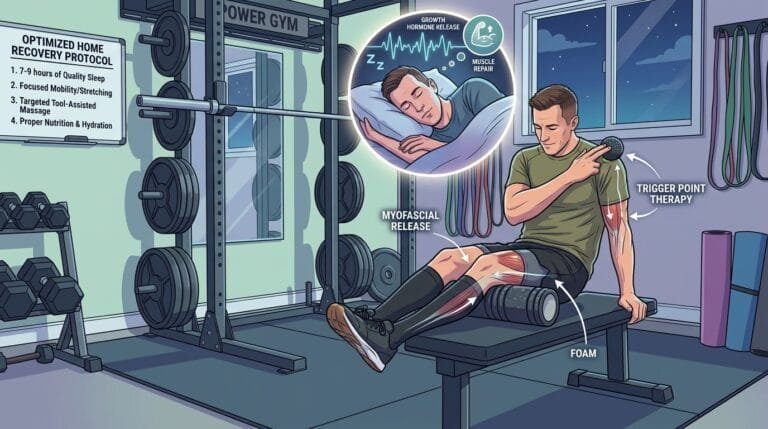
Maintain healthy shoulder function in all upper-body training by applying the principles in safe lateral-raise technique. Kettlebell rows, cleans, and carries are excellent complementary pulling and grip work (kettlebell sizing guide). Core strength from hanging carries over to better total-body control; progressions toward an ab roller are useful additions. Low-impact conditioning options are covered in manual treadmill guidance. A budget massage gun can help manage upper-back, forearm, and lat tension.
Additional structured progression systems and form resources are available (pull-up progression frameworks and research-supported beginner protocols).
Common Mistakes and How to Correct Them
- Incomplete range of motion → Ensure full elbow extension at the bottom and chin clearly over the bar at the top
- Excessive swinging or kipping → Slow the tempo and increase core bracing
- Neglecting the eccentric portion → Make slow lowers a priority
- Training to failure every set → Leave 1–2 reps in reserve on the majority of sets
- Skipping scapular initiation → Practise scapular pull-ups regularly
- Inconsistent training frequency → Aim for 2–4 quality sessions per week
- Relying only on bands without building eccentric strength → Include negatives
Frequently Asked Questions
How long does it typically take to achieve the first pull-up?
Most men reach it in 4–12 weeks and most women in 8–16 weeks with consistent training, though individual results vary based on starting strength and bodyweight.
Are chin-ups easier than pull-ups?
Yes for the majority of people because of increased biceps contribution. Both variations are valuable and should eventually be trained.
Are eccentrics or bands better for beginners?
Both are effective. Eccentrics are particularly powerful for building strength through the full range; bands allow higher volume and repeated technique practice. Many successful programmes use both.
What are reasonable pull-up standards?
Beginner: 1–5 strict reps · Intermediate: 8–12 · Advanced: 15+. These are general guidelines and vary with bodyweight and training history.
Can I train pull-ups every day?
Possible with very low volume and easy variations, but most people make better long-term progress with 2–4 focused sessions and adequate recovery.
Do pull-ups build a wide back?
Yes. They are one of the highest-value exercises for lat development and overall upper-back strength when performed with full range of motion and progressive overload.
What if I cannot yet perform inverted rows?
Begin with band face pulls, supported dumbbell rows, or machine pulldowns, then progress to inverted rows as strength improves.
How important is grip strength?
Very. Weak grip frequently limits pull-up performance. Dedicated grip training produces noticeable carry-over.
Final Recommendation
Master the pull-up by following a structured, progressive path: develop hang capacity and scapular control, build eccentric strength, use assistance intelligently, then accumulate strict volume and advance to harder variations. Train the movement or its regressions 2–4 times per week with clean technique and consistent progressive overload.
Patience and consistency produce results. Start at the phase that matches your current ability, record your hang times, eccentric control, and eventual strict repetitions, and keep progressing. The pull-up is both a powerful strength builder and a satisfying skill — with the right approach, nearly anyone can achieve their first strict rep and continue advancing for years. Begin today at your appropriate level and move forward one phase at a time.