
How Heavy Should My Adjustable Kettlebell Be?
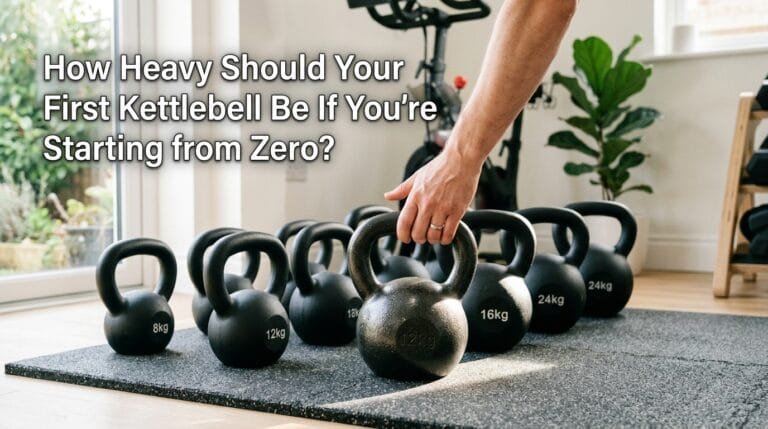
Quick answer: Most beginners should start with an 8-12 kg (18-26 lb) kettlebell for general training, while those with some strength training experience can usually start at 12-16 kg (26-35 lb). Your ideal weight depends on the exercise, your goals, and your current strength — swings and carries need heavier bells than presses and get-ups.
Researched and written by the GymGoodies team, fact-checked against manufacturer specs and current fitness guidance.
Choosing the right kettlebell weight is one of the most common questions new lifters run into, especially with adjustable kettlebells, where you actually have a range to pick from rather than being locked into one fixed size. This guide covers how to choose based on experience level, body type, training goals, and the specific movements you’re doing — plus the mistakes that trip most people up.
How Kettlebell Weight Affects Different Exercises
Kettlebell training isn’t one-size-fits-all, because different movements load your body very differently:
- Swings, cleans, and carries rely on hip drive and posterior chain strength, and can generally handle heavier weight — many lifters use 16-24 kg here even if they use lighter bells for other movements.
- Presses, snatches, and get-ups require more shoulder stability, balance, and control, so a lighter weight (often 8-14 kg) lets you build proper technique before adding load.
- High-rep conditioning circuits generally call for lighter weight than low-rep strength-focused work, since fatigue accumulates faster across many reps.
- Single-arm work (rows, presses) often needs to be lighter than double-arm or two-handed movements, since you lose the stability of a symmetrical base.
This is exactly why an adjustable kettlebell is genuinely useful rather than a gimmick — you’re not stuck buying four or five separate bells to cover this whole range. If you’re looking to put that range to work, our 20-Minute Kettlebell Arm Masterclass is a good next read for a focused, time-efficient routine.
Starting Weight by Experience Level
- Complete beginners: roughly 8-10 kg (18-22 lb) for women, 10-12 kg (22-26 lb) for men, as a general starting point. This varies with your existing strength background, not just body size or gender.
- Some training experience: 12-16 kg (26-35 lb) is a common working range once basic hip-hinge and pressing form is solid.
- Experienced lifters: 16-24 kg (35-53 lb) or higher, depending on the specific movement and training goal.
Treat these as starting points, not rules. Someone with an existing dumbbell or barbell training background can often start meaningfully higher than someone completely new to resistance training, since general strength and body awareness transfer over.
How Your Goal Changes the Right Weight
- General fitness/conditioning: favors moderate weight with higher reps — err toward the lighter end of your range so form holds up across a full circuit.
- Strength building: favors heavier weight with lower reps (5-8 per set), which usually means sitting toward the top of your experience-level range.
- Fat loss/conditioning-focused programs: often use moderate-to-light weight with continuous movement (swings, complexes) — the goal is sustaining output over a set period, not maxing out load.
- Rehab or return-to-training: should start noticeably lighter than the ranges above, regardless of prior experience, and progress slowly under guidance from a physical therapist or coach if you’re recovering from an injury.
Signs Your Kettlebell Is Too Heavy
- Your form breaks down before you hit your target reps
- You’re using momentum or swinging your torso to compensate on presses or get-ups
- You feel joint strain (wrist, elbow, shoulder, lower back) rather than muscle fatigue
- You have to “rest-pause” mid-set on movements meant to be continuous, like swings
Signs Your Kettlebell Is Too Light
- You can easily complete 20+ reps with no real fatigue by the final few
- You don’t feel challenged in the last 2-3 reps of a working set
- You’re not seeing strength or muscle progress after several consistent weeks of training
Common Mistakes People Make With Kettlebell Weight
- Jumping weight too fast. Progressing from 12 kg to 20 kg in one jump because a single session felt “too easy” often leads to form breakdown on the next session. Smaller, more frequent increases hold up better long-term.
- Using one weight for every movement. Because adjustable kettlebells make it easy to change loads, there’s little reason to press and swing with the exact same weight — match the load to the movement instead.
- Ignoring one-arm balance. Many lifters unconsciously favor their dominant side; periodically testing weight on both arms separately helps catch imbalances before they become nagging issues.
- Choosing weight based on what looks impressive rather than what’s sustainable. Consistency at an appropriate weight builds more long-term strength than occasional heavy sessions followed by burnout or injury.
Budget vs. Premium Adjustable Kettlebells: What Actually Changes
Not every adjustable kettlebell is built the same way, and the differences matter more as you increase weight and training frequency:
- Weight adjustment mechanism — dial-based systems tend to be faster mid-workout than screw-lock or plate-loading systems, though plate-loading options are often more budget-friendly.
- Increment size — smaller increments (2 kg / 4-5 lb jumps) allow more gradual progression than bells that jump in large steps.
- Handle diameter and shape — thicker handles tend to suit two-handed swings better, while thinner handles are often easier for one-handed pressing and snatch work. Bells of Steel’s adjustable kettlebell specs are a good example of how handle diameter is documented on a product page if you want to compare before buying.
- Build quality — cast iron or steel-shell designs with minimal moving parts tend to hold up better under frequent heavy use than lower-cost plastic-shell designs.
For a broader side-by-side of current options on the market, Garage Gym Reviews’ tested roundup of adjustable kettlebells is a solid independent reference.
Frequently Asked Questions
Can I use just one kettlebell for everything?
Yes, as long as it’s adjustable across a wide enough range to cover both your lightest movements (presses, get-ups) and heaviest (swings, carries). A fixed-weight kettlebell makes this much harder.
How often should I increase weight?
As a general guideline, once you can comfortably complete all planned sets and reps with good form and some reserve left, it’s usually reasonable to increase weight — often every 1-3 weeks depending on how frequently you train that movement.
Is it bad to start too light?
Not really — starting lighter than necessary mainly costs you some early progress speed, while starting too heavy risks injury and poor movement patterns that can take longer to correct. When in doubt, start lighter.
Bottom Line
Start conservative, prioritize form over load, and use the adjustability of your kettlebell to match weight to the specific movement and goal rather than searching for one “correct” number. If you’re unsure where to start, it’s almost always better to begin lighter and add weight once your technique is consistently solid.
Have you found a weight that works well for your training style? Let us know in the comments what you started at and where you’ve progressed to.