How to Keep Gains While Traveling with Only Portable Gear
Quick Answer
Keep gains while traveling with only portable gear by prioritising progressive bodyweight and resistance-band training, maintaining a minimum effective frequency of 2–4 sessions per week, and focusing on the same movement patterns you use at home. Use tempo, pauses, unilateral variations, and density methods to create overload without heavy weights. Protect protein intake and sleep as much as possible, and treat short, high-quality sessions as non-negotiable. Consistency of stimulus and recovery preserves strength and muscle far better than complete training stoppages.
Why Gains Can Be Maintained with Minimal Equipment
Muscle and strength are highly responsive to consistent mechanical tension and progressive overload. They are far less dependent on any specific tool. When travel removes access to dumbbells, barbells, or machines, the same principles still apply: train the major movement patterns, apply progressive difficulty, and recover adequately. Portable gear—primarily resistance bands, a suspension trainer, and bodyweight—can supply sufficient tension for maintenance and even modest continued progress across typical trip lengths of one to four weeks. The limiting factors are usually planning and adherence, not the equipment itself.
Core Principles for Travel Training That Protects Gains
- Minimum effective dose – Two to four focused sessions per week are enough to maintain most of your strength.
- Pattern continuity – Keep training squat, hinge, push, pull, and core patterns.
- Progressive difficulty without load – Tempo, pauses, unilateral work, and density replace added weight.
- Protein and sleep still matter – These recovery factors influence how well gains are retained.
- Low friction setup – The routine must be simple enough to perform in hotel rooms or limited spaces.
- Immediate restart after travel – Know exactly how you will return to normal training.
Portable Gear Ranked by Travel Value
| Gear | Space in Luggage | Training Value | Best Uses | Notes |
|---|---|---|---|---|
| Resistance bands + door anchor | Very low | Very high | Rows, presses, hinges, face pulls, core | Highest overall return |
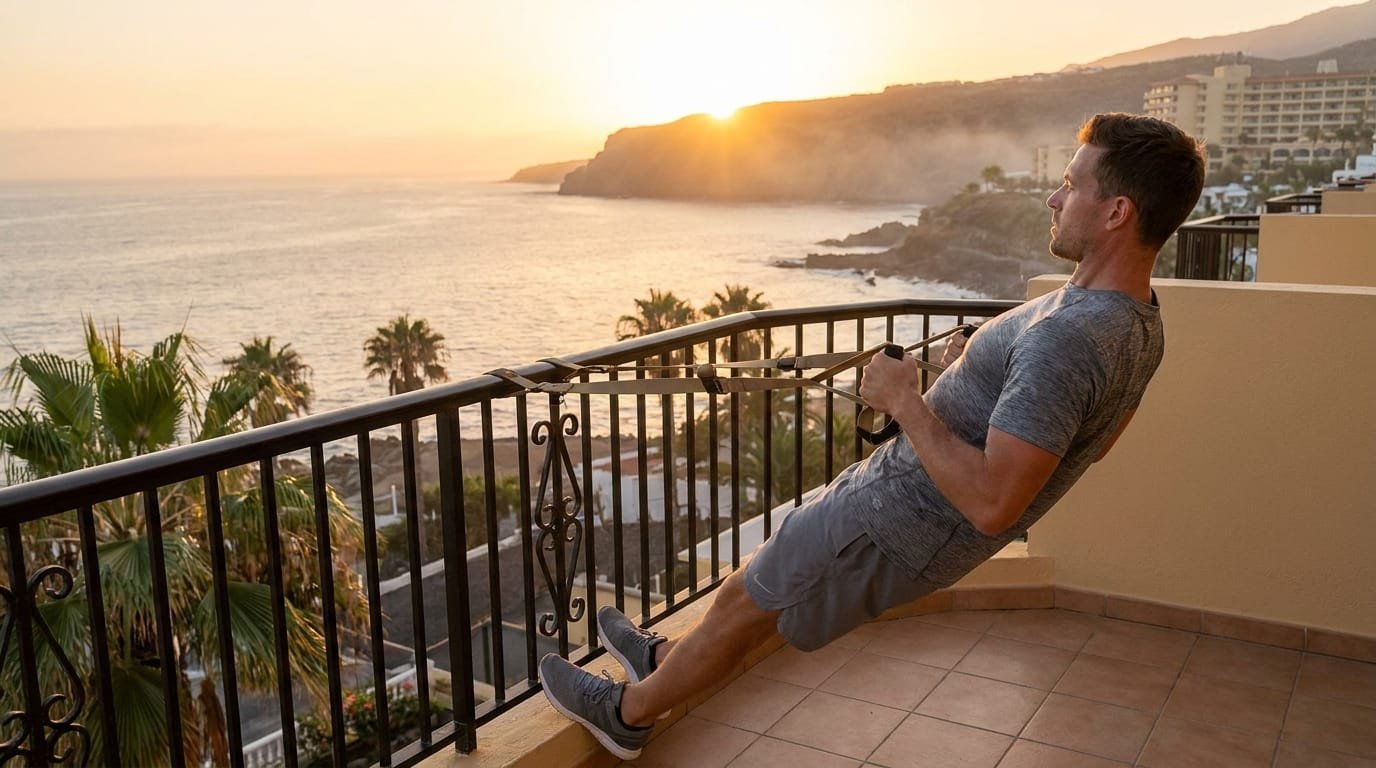
| Suspension trainer | Low | High | Rows, push-up variations, core | Excellent for inverted rows |
| Bodyweight only | None | High | All patterns via leverage and tempo | Always available |
| Jump rope | Very low | Moderate | Conditioning | Optional |
| Light portable handles or grips | Very low | Moderate | Grip and carrying variations | Optional |
Shoulder-friendly technique keeps upper-body work productive even with limited tools (Bent Arms vs. Straight Arms in Lateral Raises, The Hidden Mistake in Lateral Raises, and 3 Lateral Raise Modifications). Grip strength can be maintained with towel hangs, band work, or portable grippers (Do Hand Grippers Really Work?).
Step-by-Step Travel Training System
- Define the minimum viable session before you leave
Choose 4–6 exercises that cover the main patterns and require only bands or bodyweight. - Pack the gear in your carry-on
Bands and a door anchor weigh almost nothing and remove dependence on hotel gyms. - Schedule sessions in the travel calendar
Treat them as fixed appointments, preferably at consistent times of day. - Prioritise movement quality over intensity
Controlled tempos protect joints and create effective tension. - Use progressive methods that travel well
Slow eccentrics, pauses, unilateral stances, and shorter rest periods. - Maintain protein distribution
Aim for a protein source at most meals even when food options are irregular. - Protect sleep where possible
Even modest consistency supports recovery and next-day training willingness. - Log only the essentials
Exercises, sets, reps, and a quick note on how the session felt. - Plan the first week back at home
Know exactly what normal training will look like so there is no decision fatigue on return. - Accept imperfect conditions
A shortened or simplified session still maintains momentum.
Sample Portable Workouts
Session A – Full-Body Strength Focus (25–35 minutes)
- Band or bodyweight squat / reverse lunge – 3 × 8–12
- Single-leg RDL or band good-morning – 3 × 8–12
- Push-up variation – 3 × 8–15
- Single-arm band row – 3 × 10–15 per arm
- Dead bug or hollow body hold – 2–3 sets
Session B – Upper-Bias + Core (20–30 minutes)
- Band face pulls or pull-aparts – 3 × 12–20
- Band or inverted row – 3 × 8–15
- Band chest press or push-up variation – 3 × 8–12
- Band triceps extension or overhead press variation – 2–3 × 10–15
- Side plank or pallof press – 2–3 sets per side
Session C – Lower + Conditioning Density (20–30 minutes)
- Split squat – 3 × 8–12 per leg
- Glute bridge or single-leg bridge – 3 × 10–15
- Band or bodyweight hinge – 3 × 8–12
- Controlled mountain climbers or marching – 30–40 seconds
- Suitcase carry with bag or band resistance – 2 sets
Rest as needed to keep form solid. These sessions can be performed in a hotel room with a door anchor or open floor space.
Progressive Overload Methods That Travel
- Increase repetitions within the target range
- Slow the eccentric phase to 3–5 seconds
- Add 1–3 second pauses at the hardest point
- Move to unilateral versions
- Reduce rest periods between exercises or rounds
- Combine bands for higher tension
- Improve density (more work in the same time)
These methods allow maintenance and even small improvements without access to heavier loads.
Managing the Most Common Travel Obstacles
| Obstacle | Impact | Solution |
|---|---|---|
| No suitable door for anchor | Limited band rows and presses | Use suspension trainer, towel rows under a sturdy table, or pure bodyweight leverage |
| Very small room | Restricted movement | Choose stationary variations (split squats, floor press, dead bugs) |
| Irregular schedule | Missed sessions | Train at the first available window, even if short |
| Poor sleep | Reduced recovery | Shorten sessions and emphasise controlled technique |
| Limited protein options | Potential muscle retention risk | Prioritise protein at available meals; consider a portable protein source if necessary |
| Social or work demands | Time pressure | Deploy the minimum viable session without negotiation |
Nutrition and Recovery on the Road
Muscle retention is supported by total protein intake and overall energy availability more than by perfect meal timing. Aim for a protein source at most meals and avoid prolonged severe deficits. Sleep quality often declines during travel; protect it where possible by managing light exposure, caffeine timing, and late-night screen use. Even partial success on these fronts improves the return on every training session.
Returning Home Without Losing Momentum
The first week back is critical. Have the exact sessions planned before you travel. Begin with slightly reduced volume if recovery feels incomplete, then resume normal progression. Because movement patterns and training frequency were maintained, strength typically returns within a few sessions.
Common Mistakes That Cause Unnecessary Loss of Gains
| Mistake | Result | Better Approach |
|---|---|---|
| Complete training stoppage | Faster strength and habit loss | Maintain 2–4 minimum sessions |
| Waiting for perfect hotel gym | Repeated delays | Use portable gear immediately |
| Overly complex travel programs | Decision fatigue and abandonment | Keep 1–2 simple templates |
| Ignoring protein and sleep | Reduced retention | Treat both as part of the plan |
| No pre-planned return week | Slow restart | Schedule the first home sessions before departure |
| All-or-nothing intensity | Burnout or skipped sessions | Focus on completion and quality |
Strength training remains highly effective for maintaining muscle and strength when the basic principles are applied consistently, even with limited tools (strength training guidance). Practical home- and travel-gym approaches emphasise portable systems that survive real-world disruption (home gym equipment prioritisation and budget home gym principles).
Frequently Asked Questions
How long can I maintain gains with only portable gear?
Most people can maintain the majority of their strength and muscle for 2–4 weeks with consistent band and bodyweight training. Longer periods are possible but may require more creative progression.
Will I lose strength if I cannot lift heavy?
Some temporary reduction in absolute strength is common, but it returns quickly once normal loading resumes—especially when movement patterns and training frequency were preserved.
Is a hotel gym better than portable gear?
Sometimes, but hotel gyms are often limited or crowded. Portable gear guarantees you can train regardless of facility quality.
How many sessions per week are realistic while traveling?
Two to four is sufficient for maintenance. Even two well-executed sessions protect momentum better than zero.
What if I have no door for a band anchor?
Use a suspension trainer, perform towel rows under a sturdy table or bed, emphasise push-up and squat variations, and rely more on unilateral lower-body work.
Do I need to do the same volume as at home?
No. Maintenance requires less volume than progressive training. Focus on quality and frequency.
Can I improve while traveling?
Yes, especially if you apply progressive tempo, pause, and density methods consistently. Many people return home with better movement control.
What is the single most important factor?
Performing some version of the main movement patterns multiple times per week without long complete stoppages.
Final Recommendation
Keeping gains while traveling with only portable gear is achieved by maintaining training frequency, movement-pattern continuity, and progressive difficulty through tempo, pauses, unilateral work, and density. Pack resistance bands and a door anchor, define a minimum viable session before departure, schedule the sessions, and protect protein intake and sleep as much as circumstances allow. Plan the first week of normal training before you leave so the return is automatic.
Prepare your portable toolkit and write down two simple session templates today. Place the training appointments in your travel calendar and commit to the minimum frequency. When the system is this simple, gains are protected and momentum continues across almost any trip. Start with the next travel session—the consistency you maintain on the road determines how strong you feel when you return home.