How to Make a Shared Living Space Work for Serious Training
Quick Answer
Make a shared living space work for serious training by combining clear communication, strict spatial boundaries, quiet controlled movements, rapid setup/teardown systems, and a flexible but non-negotiable weekly training target. Prioritise multi-use, vertically stored equipment, keep sessions to 20–40 minutes, and treat household harmony as a core part of the programme. When the gym appears only when needed and disappears completely afterward, serious training becomes compatible with shared living.
Shared living environments—apartments with partners, family homes, houseshare arrangements—introduce constraints that commercial gyms and private garages do not: competing schedules, noise sensitivity, limited permanent floor space, and the need to preserve the room’s primary living function. Serious training is still possible, but only when the system is deliberately designed around these realities rather than imposed on them. The goal is a setup that household members can live with comfortably for years, not a temporary compromise that creates ongoing friction.
- Communication before equipment – Align expectations on timing, noise, and space use.
- Temporary occupation only – The training zone must appear and disappear quickly.
- Quiet by default – Controlled tempos, no dropping, no jumping.
- Vertical and under-furniture storage – Everything has a home that does not intrude on living areas.
- Short, efficient sessions – 20–40 minutes protects both training quality and household goodwill.
- Flexible scheduling – Weekly frequency targets rather than rigid daily appointments.
- Household benefit framing – Position training as supporting energy, mood, and long-term health for the whole home.
Space Management Strategies
Define a convertible zone
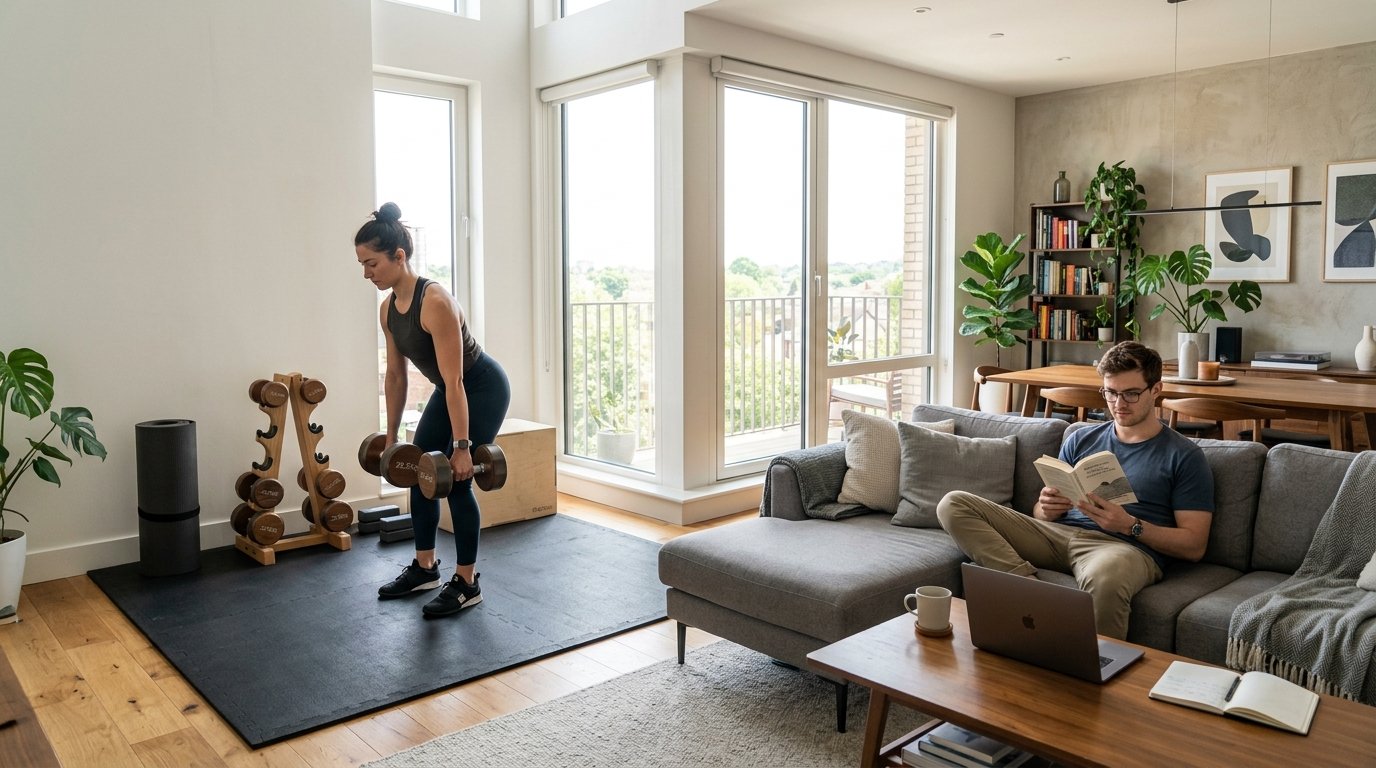
Identify the smallest area that still allows full range of motion for the main lifts. Mark it mentally or with a mat that is removed after every session. The rest of the room remains living space at all times.
Storage that respects the household
- Over-door hooks and organisers for bands and suspension straps
- Under-bed or under-sofa containers for dumbbells and mats
- A single rolling cart or basket that holds the entire kit and can be moved in one trip
- Wall-mounted solutions only where they are aesthetically acceptable and structurally sound
Furniture as equipment
Sturdy chairs, sofas, and tables can serve as benches, supports for Bulgarian split squats, or anchors for inverted rows—provided they are used carefully and returned to normal use immediately.
Noise and Vibration Control
Shared walls, floors, and ceilings transmit sound easily. The primary solutions are technique and equipment choice:
- Default to 3–4 second eccentric phases on every lift
- Eliminate dropping of weights and all jumping or ballistic movements
- Prefer bands, bodyweight progressions, and carefully lowered dumbbells
- Use thick mats or interlocking rubber tiles that are stored when not in use
- Schedule higher-effort sessions at times that minimise impact on others
Shoulder-friendly, controlled technique further reduces both noise and joint stress (Bent Arms vs. Straight Arms in Lateral Raises, The Hidden Mistake in Lateral Raises, and 3 Lateral Raise Modifications). Grip work can stay quiet with towel holds or short band work (Do Hand Grippers Really Work?).
Scheduling and Communication Systems
Weekly frequency target
Agree on a realistic number of sessions (usually 2–4) rather than fixed days and times. This allows training to move when family or work demands shift.
Visible but non-intrusive calendar
A shared digital or paper calendar with training blocks marked helps avoid conflicts without constant negotiation.
Minimum viable session
A 15–20 minute version that still covers the main patterns ensures the habit survives the busiest days without claiming large blocks of shared time.
Pre- and post-session communication
Simple signals (“training in 10 minutes,” “finished and cleared”) reduce surprises and build trust.
Step-by-Step Implementation Plan
- Discuss priorities, noise sensitivity, and preferred quiet hours with everyone who shares the space.
- Measure the largest area that can be temporarily claimed without blocking essential living functions.
- Select only multi-use, easily stored equipment that fits the measured storage options.
- Create three workout templates: standard, short, and density/circuit.
- Establish a fixed setup and teardown routine that takes under two minutes each way.
- Install soft flooring solutions that can be removed or stored.
- Set a weekly session target and a minimum viable workout for high-demand days.
- Begin with conservative volume and controlled tempos while the household adjusts.
- Review the arrangement with household members after two weeks and adjust.
- Reassess equipment and storage every 4–6 weeks; remove anything that is not earning its place.
Standard 30-Minute Full-Body
- Goblet or bodyweight squat – 3 × 8–12 (slow eccentric)
- Single-leg Romanian deadlift – 3 × 8–12 per leg
- Push-up variation – 3 × 8–15
- Single-arm row or suspension row – 3 × 8–12 per arm
- Optional plank or short carry – 2 sets
Minimum Viable 15-Minute Session
- Squat or lunge – 2 sets
- Hinge – 2 sets
- Push – 2 sets
- Pull – 2 sets
Quiet Density Option
Set a timer for 20–25 minutes. Rotate through the four patterns with controlled repetitions. Rest only as needed to maintain form and silence.
Progressive Overload Without Expanding the Footprint
- Slow the eccentric phase
- Add pauses at the hardest point
- Increase range of motion under control
- Move to unilateral variations
- Improve density while keeping noise low
- Add light band resistance where helpful
These methods allow continued progress without requiring additional equipment or permanent space claims.
| Equipment | Shared-Space Suitability | Storage Method | Notes |
|---|---|---|---|
| Resistance bands | Excellent | Drawer, bag, or over-door hooks | Primary tool for many movements |
| Adjustable or fixed dumbbells | High | Under-bed or vertical rack | Controlled lowering essential |
| Suspension trainer | High | Door anchor + small bag | Excellent for rows and face pulls |
| Thick rollable mat | High | Closet or corner | Softens noise and protects floors |
| Foldable bench | Conditional | Under-bed or vertical | Only if storage is truly solved |
| Barbell + plates | Low | Difficult to hide | Generally avoid in shared living areas |
Common Challenges and Solutions
| Challenge | Typical Result | Practical Solution |
|---|---|---|
| Competing schedules | Missed sessions | Weekly frequency target + minimum viable workout |
| Noise complaints | Household tension | Controlled tempos, thick mats, considerate timing |
| Visual clutter | Pressure to abandon the gym | Strict teardown routine + vertical storage |
| Limited floor space | Compromised exercise selection | Unilateral work + multi-use equipment |
| Guilt about shared space | Inconsistent training | Communicate benefits and keep sessions short |
| Equipment creep | Gradual takeover | Periodic purge of unused items |
Strength training with efficient, low-disruption methods remains highly effective for building and maintaining muscle and strength (strength training guidance). Practical home-gym approaches emphasise systems that respect real living arrangements (home gym equipment prioritisation and budget home gym principles).
Frequently Asked Questions
Can I train seriously without a dedicated room?
Yes. Many people make excellent long-term progress with convertible zones, compact equipment, and disciplined storage.
How do I handle a partner or roommate who is sensitive to noise?
Default to slow eccentrics, eliminate dropping and jumping, use thick mats, and agree on training windows. Communication prevents most conflicts.
What is the minimum equipment needed for serious training?
A set of resistance bands with a door anchor, one pair of adjustable or fixed dumbbells, and a quality mat. Bodyweight progressions can fill most gaps.
How long should sessions be in a shared space?
20–40 minutes is the practical range. Shorter sessions reduce friction and are easier to protect.
Should I try to hide the gym completely?
Ideally yes. The faster the space returns to pure living use, the lower the ongoing resistance from household members.
How do I progress when I cannot add heavy equipment?
Tempo, pauses, unilateral variations, range of motion, and density provide progressive overload for years.
What if the shared space includes children?
Train during predictable low-demand windows, keep sessions short, and occasionally make training visible as positive modelling. Safety and supervision remain priorities.
How often should I reassess the setup?
Every 4–6 weeks. Remove anything not being used and confirm the arrangement is still acceptable to everyone who shares the space.
Final Recommendation
Serious training in a shared living space succeeds when communication, rapid setup/teardown, quiet technique, and compact storage are treated as non-negotiable parts of the programme. Define a convertible zone, choose multi-use equipment that stores vertically or under furniture, keep sessions short and controlled, and maintain a flexible weekly frequency target. When the gym appears only when needed and disappears completely afterward, household harmony and training consistency reinforce each other.
Start by discussing expectations with the people who share the space, measure the usable temporary footprint, select the minimum effective equipment, and write both a standard and a minimum viable workout. Implement a sub-two-minute deployment and teardown routine from the first session. Designed this way, a shared living space can support years of serious strength training without becoming a source of conflict. Begin with the next available window—the system will adapt around the rest of your life.