Garage vs Spare Room Gym: Solving Space, Temperature, and Noise Issues
Quick Answer
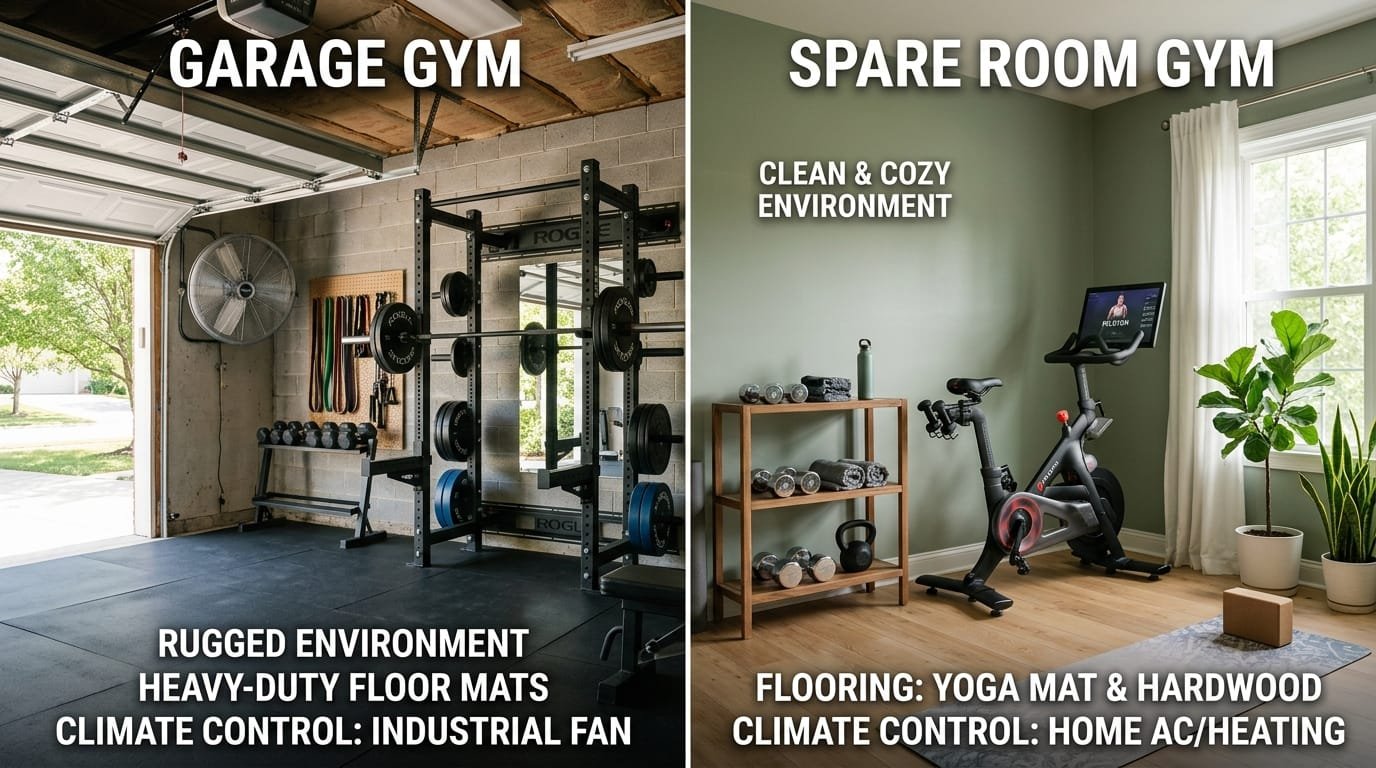
A garage gym usually offers more space and higher weight capacity but struggles with temperature extremes, moisture, and potential noise transfer to the house or neighbours. A spare-room gym provides better climate control and lower noise impact on the household yet faces stricter limits on floor load, ceiling height, and permanent fixtures. Choose the garage when you need room for racks, barbells, and heavier lifting; choose the spare room when year-round comfort, quieter sessions, and easier daily access matter more. Both can work well once space, temperature, and noise are deliberately managed.
Decision Framework: Garage or Spare Room?
| Factor | Garage Advantage | Spare Room Advantage | Key Decision Question |
|---|---|---|---|
| Space & layout | High – easier for racks, platforms, multiple stations | Limited by room size and existing furniture | Do you need a full rack or large footprint? |
| Temperature | Poor without insulation/HVAC | Usually good (existing home climate) | Can you tolerate or fix seasonal extremes? |
| Noise & vibration | Can affect house and neighbours | Easier to contain within the home | Who lives above, below, or next door? |
| Access & convenience | Often requires going outside | Steps away from living areas | Will weather or extra steps reduce adherence? |
| Floor load capacity | Generally higher | Must respect residential floor limits | Planning heavy barbell work or machines? |
| Moisture & dust | Higher risk | Lower risk | Willing to manage rust and air quality? |
| Resale & permanence | More flexible / removable | May require more cosmetic restoration | How permanent is the setup? |
Space Solutions
Garage
- Map the available clear floor area after parking and storage needs.
- Use wall-mounted storage for bumper plates, bars, and accessories to keep the floor open.
- Consider a modular rack that can be folded or partially disassembled if the garage is shared.
- Create zones (lifting platform, conditioning area, storage wall) so the space remains usable for other purposes.
Spare Room
- Measure usable floor space excluding closets, doors, and windows.
- Prioritise multi-use, vertical-storage equipment (adjustable dumbbells, bands, foldable bench, suspension trainer).
- Keep a strict setup/teardown routine so the room can still function as a guest room or office.
- Use mirrors and lighting strategically to make the limited area feel larger and safer.
In both locations, choose exercises and equipment that match the actual footprint rather than forcing a commercial-gym layout into a constrained space.
Temperature Solutions
Garage Challenges and Fixes
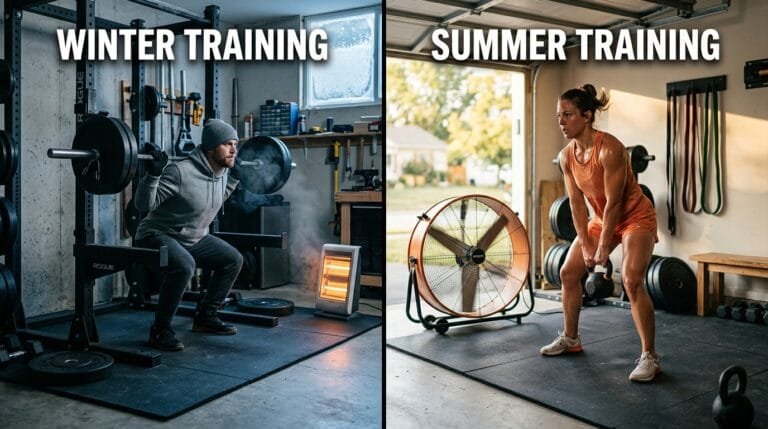
- Summer heat: Insulation on walls and ceiling, reflective barriers, industrial fans, and evaporative coolers. Schedule heavier sessions for cooler parts of the day.
- Winter cold: Insulate, seal gaps, add a safe space heater or infrared panels, and warm up thoroughly before loading the spine or shoulders.
- Humidity and moisture: Dehumidifier, vapour barriers, and rust-prevention routines for metal equipment.
Spare Room Advantages and Refinements
- Existing HVAC usually keeps temperatures moderate.
- Supplement with a portable fan or small heater only if needed.
- Maintain airflow to manage body-heat and moisture during sessions.
- Avoid blocking vents with equipment or mats.
Temperature extremes reduce both performance and adherence. Solving them is often more important than adding another piece of equipment.
Noise and Vibration Solutions
Garage
- Install a proper lifting platform with dense rubber and a wood core to absorb impact.
- Use controlled eccentric tempos and avoid unnecessary dropping of weights.
- Add weatherstripping and seals around doors to reduce sound escape.
- Consider timing of sessions relative to neighbours’ quiet hours.
Spare Room
- Thick interlocking rubber tiles or horse-stall mats over the existing floor.
- Prefer dumbbells, kettlebells, and bands over barbell work that requires dropping.
- Slow all lowering phases and eliminate jumping or ballistic movements.
- Place the room’s noisier activities away from shared walls when possible.
Shoulder-friendly, controlled technique further reduces noise and joint stress (Bent Arms vs. Straight Arms in Lateral Raises, The Hidden Mistake in Lateral Raises, and 3 Lateral Raise Modifications). Grip work can stay quiet with towels or short band holds (Do Hand Grippers Really Work?).
Step-by-Step Decision and Setup Process
- List your must-have exercises and equipment (rack, barbell, dumbbells only, bands, etc.).
- Measure both potential spaces accurately, including ceiling height and door clearance.
- Score each location on space, temperature control cost, noise risk, and daily convenience.
- Calculate realistic upgrade costs (insulation, flooring, flooring protection, HVAC adjustments).
- Choose the location that wins on the factors you cannot easily change.
- Design storage and layout so the space remains functional for its original purpose when possible.
- Install flooring and noise-mitigation measures before bringing in heavy equipment.
- Address temperature extremes early—performance and consistency depend on them.
- Establish session rules (controlled tempos, no unnecessary dropping, considerate timing).
- Re-evaluate after 4–6 weeks of real use and adjust layout, storage, or equipment.
Equipment Recommendations by Location
Garage-Friendly
- Power rack or squat stand
- Barbell and bumper plates
- Adjustable or full dumbbell set
- Conditioning tools that can handle temperature swings
Spare-Room-Friendly
- Adjustable dumbbells or a small fixed set
- Resistance bands with door anchor
- Suspension trainer
- Foldable bench (if storage allows)
- High-quality mat system
Both locations support effective full-body training when the exercise selection matches the constraints.
Progressive Overload in Either Space
- Slow eccentric tempos
- Paused repetitions
- Unilateral variations
- Increased range of motion under control
- Density improvements
- Band-added resistance
These methods work regardless of location and keep progress alive without constant equipment expansion.
Common Pitfalls and How to Avoid Them
| Pitfall | Garage Risk | Spare Room Risk | Solution |
|---|---|---|---|
| Ignoring temperature | Low adherence in extreme seasons | Rarely an issue | Insulate / schedule smartly |
| Underestimating noise | Neighbour complaints | Household friction | Platform + controlled tempos |
| Over-building the space | Wasted money on under-used gear | Room becomes unusable for other purposes | Start minimal, expand only with use |
| Poor storage | Clutter and safety hazards | Visual takeover of living space | Vertical and under-furniture solutions |
| No teardown plan | Garage becomes unusable for cars | Room permanently “gym only” | Fixed put-away routine |
Strength training remains highly effective in both settings when the environment supports consistency (strength training guidance). Practical home-gym approaches emphasise matching the space to real constraints rather than forcing a commercial layout (home gym equipment prioritisation and budget home gym principles).
Frequently Asked Questions
Which location is better for long-term progress?
The one you will use most consistently. Comfort and convenience often outperform pure space.
Can I put a power rack in a spare room?
Only if floor load capacity, ceiling height, and noise can be managed. Most spare rooms are better suited to dumbbells, bands, and bodyweight progressions.
How expensive is it to climate-control a garage?
Costs vary widely. Basic insulation, sealing, and a good fan or heater are often enough for usable conditions; full HVAC is a larger investment.
What flooring works best in each location?
Garage: dedicated lifting platform plus rubber. Spare room: thick interlocking rubber tiles or horse-stall mats over the existing floor.
Is noise a bigger issue in the garage or spare room?
Garage noise can travel to neighbours and into the house. Spare-room noise mainly affects the household. Both require deliberate mitigation.
Can I switch locations later?
Yes. Many people start in a spare room and move to a garage (or vice versa) as needs and budgets change. Choose equipment that can relocate.
How do I keep a garage gym from becoming a storage dump?
Defined zones, wall storage, and a rule that non-gym items have their own place. Clutter kills training consistency.
What is the minimum viable setup in each space?
Garage: rack or stand, bar, plates, and a mat. Spare room: adjustable dumbbells or bands, a quality mat, and a door anchor.
Final Recommendation
The choice between garage and spare-room gym depends on which constraints you can solve most effectively. Garages win on space and heavy-loading potential but require real work on temperature and moisture. Spare rooms win on climate and convenience but demand stricter equipment selection and noise control. Measure both spaces, score them against your must-have exercises and daily realities, then commit to solving space, temperature, and noise deliberately.
Start with the location that removes the largest barriers to consistent training, install flooring and storage first, and choose equipment that matches the environment. When space, temperature, and noise are managed, either setting can support years of effective strength training. Make the decision based on honest assessment rather than idealised plans—the better environment is the one you will actually use.