Mobility Routine to Pair with Strength Training for Better Form
Quick Answer
A targeted mobility routine paired with strength training improves lifting form by increasing usable, controllable range of motion in the ankles, hips, thoracic spine, and shoulders — the four regions that most frequently limit squat depth, hinge quality, overhead lockout, and scapular control. Perform 10–15 minutes of active mobility work before training sessions or on recovery days. Prioritise ankle dorsiflexion drills, hip flexor and rotational work, thoracic extension and rotation, and shoulder flexion/external-rotation exercises. When mobility and strength are trained together, compensatory patterns decrease, force transfer improves, and progressive overload becomes safer and more effective.
Why Mobility Is a Force Multiplier for Strength Training
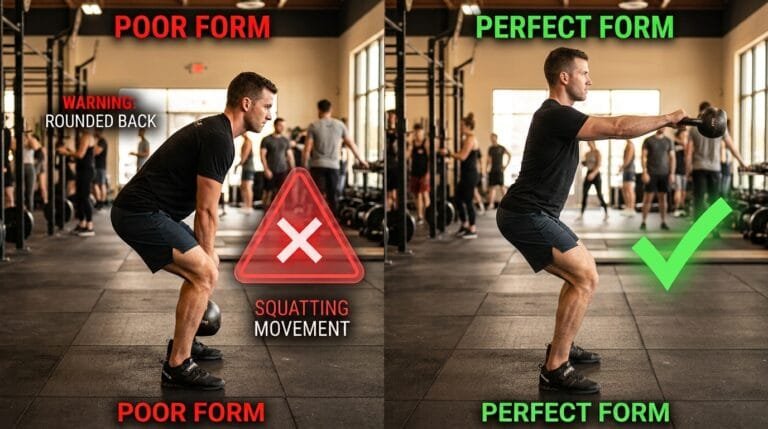
Strength exercises are only as good as the positions in which they can be performed. Limited joint range forces the body to compensate. Heels rise or knees collapse inward when ankle dorsiflexion is restricted. The pelvis tucks under or the lumbar spine rounds when hip mobility is poor. The lower back hyperextends or the shoulders shrug when thoracic extension and shoulder flexion are lacking. These compensations reduce training quality, limit load progression, and elevate injury risk over time.
Mobility is the ability to actively control range of motion through muscular effort, distinct from passive flexibility. Improving it allows lifters to reach deeper, stronger, and more stable positions under load. Consistent mobility work combined with full-range strength training “owns” the new ranges and makes them available during heavy sets. The result is cleaner technique, better muscle recruitment, and more sustainable progress.
Priority Joint Regions and Their Impact on Common Lifts
| Joint / Region | Typical Restriction | Effect on Strength Form | Highest-Value Mobility Drills | Primary Tools |
|---|---|---|---|---|
| Ankle | Limited dorsiflexion | Heels elevate, excessive forward lean, knee valgus in squats and lunges | Wall ankle stretch, knee-to-wall rockers, banded ankle distractions | Wall, light band |
| Hip | Tight flexors, limited internal/external rotation | Anterior pelvic tilt, reduced hinge depth, poor single-leg stability | 90/90 hip stretch, couch stretch, pigeon variations, active hip rotations | Floor, bench or couch |
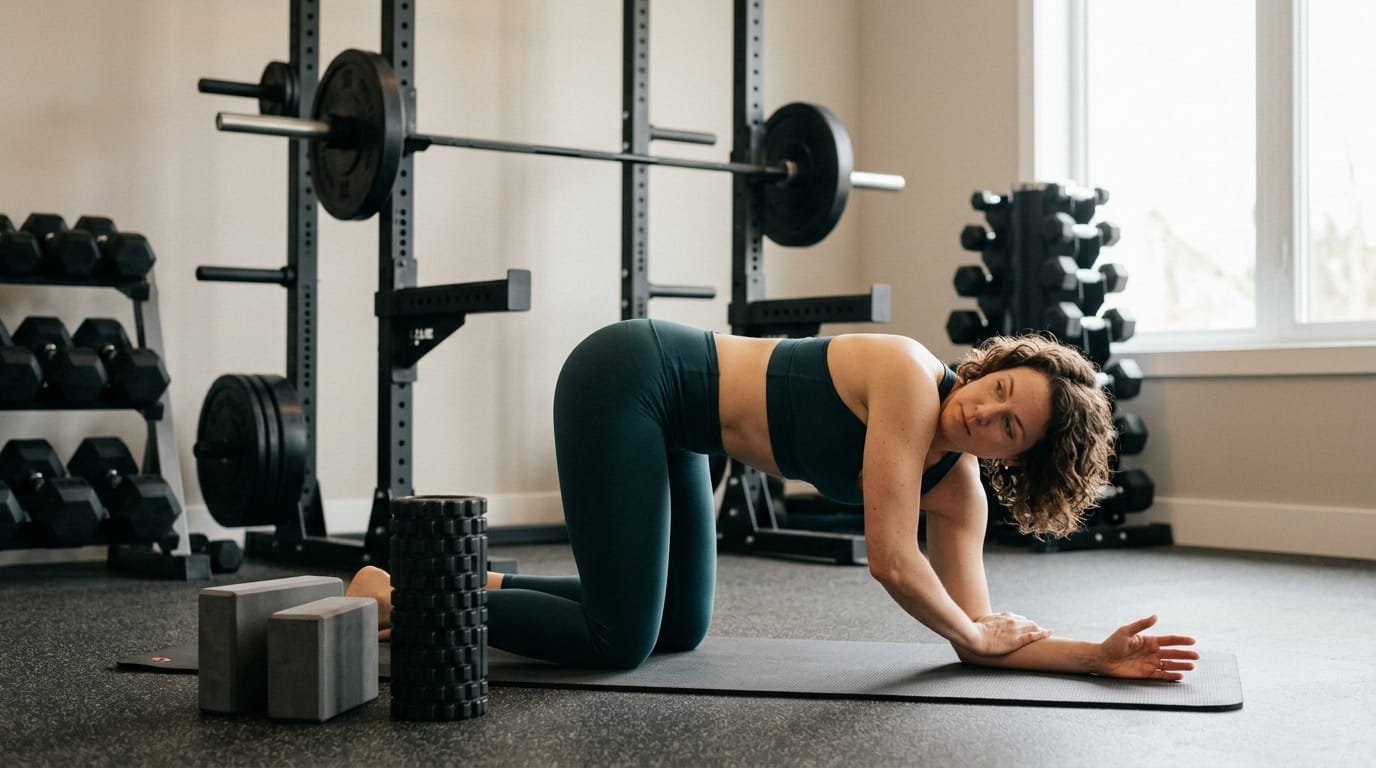
| Thoracic Spine | Limited extension and rotation | Rounded upper back, lumbar compensation, incomplete overhead positions | Foam-roller extensions, open-book rotations, quadruped rotations, cat-cow | Foam roller, floor |
| Shoulder Complex | Limited flexion and external rotation | Incomplete lockout, early shrugging, impingement risk on presses and raises | Band dislocates, wall slides, external-rotation stretches, controlled arm circles | Light band, wall |
| Wrist & Elbow | Stiffness or limited extension | Compromised rack positions, front-rack discomfort, reduced pressing stability | Wrist circles, prayer stretch, banded wrist extensions | None or light band |
Detailed Mobility Exercise Library
1. Wall Ankle Dorsiflexion Stretch (Knee-to-Wall)
Stand facing a wall. Place one foot so the big toe is 8–12 cm from the wall. Keep the heel firmly planted and drive the knee forward toward the wall, tracking over the second toe. Move slowly in and out of the end range or hold.
Duration: 60–90 seconds per side
Coaching cues: Heel stays down, knee tracks straight, torso remains tall.
Why it matters: Directly improves the ankle range required for upright, deep squats and lunges.
2. 90/90 Hip Stretch with Active Transitions
Sit on the floor with the front leg bent at 90° in front of you and the back leg bent at 90° behind. Keep the torso long and gently hinge forward over the front shin. After the hold, actively rotate and switch sides with control.
Duration: 60–90 seconds per side
Progressions: Add torso rotations or reach the arms overhead.
Why it matters: Addresses both hip rotation and flexor length that restrict hinging and single-leg work.
3. Couch Stretch (Half-Kneeling Hip Flexor Opener)
Place the rear foot on a couch, bench, or against a wall in a lunge position. Tuck the pelvis under (posterior pelvic tilt) and gently shift the body forward while keeping the torso upright. Squeeze the glute on the rear leg side.
Duration: 60–90 seconds per side
Why it matters: Lengthens the hip flexors that pull the pelvis into anterior tilt and limit glute activation during hinges and squats.
4. Thoracic Extension on Foam Roller
Lie on your back with a foam roller positioned across the mid-back. Support the head with the hands, keep the ribs down, and gently extend over the roller. Move the roller up and down the thoracic spine in controlled segments.
Duration: 60–90 seconds total
Why it matters: Restores the upper-back extension required for overhead pressing, front-rack positions, and maintaining a neutral spine in squats.
5. Open-Book Thoracic Rotation
Lie on your side with knees and hips flexed to approximately 90°. Keep the knees stacked and open the top arm across the body, following the hand with the eyes and allowing the thoracic spine to rotate. Return with control.
Repetitions: 8–10 per side
Why it matters: Improves rotational mobility and helps the scapulae move freely during pulling and pressing.
6. Band Shoulder Dislocates / Pass-Throughs
Hold a light resistance band or stick with a wide grip. Slowly move the band from the front of the thighs, over the head, to the lower back, and reverse the motion. Keep the elbows relatively straight and move through the largest comfortable range.
Repetitions: 8–12
Why it matters: Enhances shoulder flexion and external rotation simultaneously — critical for overhead work and lateral raises.
7. Wall Slides (Scapular Wall Slides)
Stand with the entire back, head, and arms against a wall in a “goal-post” or “W” position. Slide the arms upward while maintaining contact with the wall as long as possible, focusing on scapular upward rotation. Lower under control.
Repetitions: 8–12
Why it matters: Trains the coordination of thoracic extension and scapular movement needed for healthy pressing and raising patterns.
8. Active Hip Flexor to Glute Bridge Flow (Optional Finisher)
Alternate a short couch-stretch position with a glute bridge, emphasising pelvic control and glute activation through the newly available range.
Full 12–15 Minute Routine Structure
- Wall ankle dorsiflexion – 60–90 s each side
- 90/90 hip stretch – 60–90 s each side
- Couch stretch – 60–90 s each side
- Thoracic foam-roller extension – 60–90 s
- Open-book rotations – 8–10 each side
- Band dislocates – 8–12 reps
- Wall slides – 8–12 reps
- Optional short flow or breathing reset
Move continuously with minimal rest. Total time stays inside 15 minutes when performed efficiently.
Customising the Routine by Training Emphasis
| Strength Session Focus | Prioritise These Drills | Secondary Focus |
|---|---|---|
| Squats & Lunges | Ankle dorsiflexion, 90/90, couch stretch | Thoracic extension |
| Hinges, Deadlifts, Kettlebell Swings | Couch stretch, 90/90, thoracic extension | Ankle mobility |
| Overhead Press & Pull-Ups | Thoracic extension, band dislocates, wall slides | Hip openers |
| Lateral Raises & Upper-Body Pushing | Band dislocates, wall slides, external-rotation work | Thoracic rotation |
| Full-Body Sessions | Complete routine as written | — |
Step-by-Step Implementation Plan
- Schedule mobility work 4–6 days per week (before strength sessions or on recovery days).
- Perform drills slowly and stay inside pain-free end ranges; mild stretch sensation is normal, sharp pain is not.
- Breathe deeply and avoid breath-holding.
- Immediately follow the routine with strength training so the new ranges are used under load.
- Re-test key positions (deep squat hold, overhead reach, hip hinge) every 2–3 weeks to quantify progress.
- Progress by increasing hold times, adding light active contractions at end range, or moving into more demanding variations.
- Combine with a dynamic band warm-up for additional activation and tissue temperature increase (Pre-Workout Warm-Up Routine Using Only Resistance Bands).
- Maintain consistency; mobility adaptations reverse relatively quickly when neglected.
- Spend extra time on your personally most restricted area each session.
- Reinforce new ranges by performing strength exercises through the fullest controlled range of motion available.
How Improved Mobility Translates to Better Form
- Greater ankle dorsiflexion allows the knees to travel forward without the heels rising, producing a more upright and balanced squat.
- Open hip flexors and better hip rotation permit a cleaner hinge and stronger glute contribution in Romanian deadlifts and kettlebell swings (kettlebell sizing guide).
- Restored thoracic extension reduces lumbar compensation and improves the ability to maintain a neutral spine under load.
- Increased shoulder flexion and external rotation support safer overhead pressing and lateral-raise mechanics. Apply the form principles detailed in How to Perform Safe Lateral Raises if You Have Shoulder Impingement History and reinforce them with the Shoulder Health Routine to Pair with Lateral Raise Training.
Scapular and thoracic mobility also enhance rowing and hanging performance, which further benefits grip strength development (grip strength guidance). Better pelvic control from hip mobility work carries over to core progressions such as the ab roller. Band-assisted drills integrate naturally with the equipment discussed in Resistance Bands Buying Guide: Loop vs. Tube vs. Fabric – Which Wins?.
Soft-tissue tools and recovery practices support the mobility process (Best Post-Workout Recovery Tools for Home Lifters and Best Massage Gun for Post-Workout Recovery on a Budget). Sleep quality determines how well new ranges are retained and adapted (Sleep and Recovery Strategies When Training with Heavy Home Weights). Overall training consistency and progressive overload remain essential (Best Ways to Track Progress Without a Gym or Personal Trainer).
External resources confirm that systematic work on ankles, hips, thoracic spine, and shoulders removes the most common mobility restrictions that degrade lifting form (mobility routines for lifters).
Programming Variables and Progression
- Frequency: 4–6 days per week for most trainees
- Duration: 10–15 minutes per session
- Intensity: Mild to moderate stretch sensation; never sharp pain
- Progression hierarchy: Improve control and comfort → increase hold times → add end-range active contractions → advance to more demanding variations
- Integration: Always pair mobility gains with full-range strength training so the new ranges become usable under load
Common Mistakes and Corrections
- Forcing ranges into pain → reduce the range and focus on control
- Relying only on passive stretching → emphasise active mobility and end-range strength
- Skipping sessions when short on time → keep a condensed 5–6 minute version for busy days
- Neglecting thoracic spine and ankles → these two areas cause a disproportionate number of form breakdowns
- Expecting rapid changes → consistent work over 4–12 weeks produces meaningful results
- Failing to use new ranges under load → immediately follow mobility work with strength exercises performed through full available range
Frequently Asked Questions
How long before I notice better form?
Improvements in comfort and available range often appear within 2–4 weeks. Visible changes in lifting technique typically require 6–12 weeks of consistent practice paired with strength training.
Should mobility work replace my warm-up?
No. Use the mobility routine as part of, or immediately before, a dynamic warm-up. The band-based warm-up pairs especially well with these drills.
Can I perform this routine every day?
Yes for the large majority of people. Short daily sessions are frequently more effective than infrequent longer ones.
What if a position feels extremely restricted?
Reduce the range, elevate the body, or use support. Spend extra time on that area without pushing into sharp pain.
Is a foam roller required?
Helpful for thoracic extension but not essential. Many drills can be performed with only bodyweight and a light band.
Will better mobility automatically make me stronger?
Indirectly yes. Cleaner positions allow better muscle recruitment, higher-quality volume, and safer progressive overload, all of which drive strength gains.
Should older trainees prioritise mobility more?
Yes. Maintaining usable range of motion becomes increasingly important with age for both performance and injury resilience.
How does mobility work fit with recovery days?
Mobility is low-fatigue and ideal for recovery days. It promotes blood flow and maintains range without adding meaningful training stress.
Final Recommendation
Pair every strength-training block with a focused mobility routine that systematically addresses the ankles, hips, thoracic spine, and shoulders. Spend 10–15 minutes on controlled drills — wall ankle stretches, 90/90 hip work, couch stretch, thoracic extensions and rotations, band dislocates, and wall slides — before training or on recovery days. Immediately use the newly available ranges under load during your strength session.
Improved mobility produces cleaner squats, stronger and safer hinges, more stable overhead positions, and better overall technique. Consistency over weeks and months delivers the greatest return. Begin with the full routine, give extra attention to your most restricted areas, and keep the practice sustainable. Better movement quality is one of the highest-leverage investments you can make for long-term strength progress and joint health. Start before your next session and build the habit — your form and future progress will reflect the difference.