How to Train Legs Effectively Without Machines or Heavy Barbells
Quick Answer
Train legs effectively without machines or heavy barbells by emphasising unilateral exercises, controlled tempos, full ranges of motion, and progressive overload through added repetitions, pauses, slower eccentrics, or modest external loads from dumbbells, kettlebells, or bands. Prioritise squats, lunges, hinges, and single-leg variations performed 2–4 times per week. Consistency, progressive tension, and good technique produce strong, resilient legs with minimal equipment.
Why Machines and Heavy Barbells Are Not Required
Machines provide guided movement and heavy barbells allow high absolute loads, but neither is essential for leg development. The legs respond to mechanical tension, metabolic stress, and progressive overload—stimuli that can be created with bodyweight, single-leg work, tempo manipulation, and light-to-moderate free weights. Unilateral exercises increase the relative load on each leg, improve balance and stability, and often allow deeper ranges of motion. When programmed intelligently, these methods build strength, muscle, and function comparable to machine- or barbell-based training for most people.
Core Principles for Effective Machine-Free Leg Training
- Unilateral work is a primary tool – Single-leg exercises raise the challenge without heavy bilateral loading.
- Tempo and pauses increase difficulty – Slow eccentrics and deliberate pauses create high tension with lighter loads.
- Full pain-free range matters – Deeper controlled ranges recruit more muscle and improve mobility.
- Progressive overload remains non-negotiable – Track and advance at least one variable over time.
- Frequency supports progress – 2–4 leg-focused or full-body sessions per week work well.
- Recovery enables adaptation – Sleep and protein intake determine results as much as the workouts.
High-Value Leg Exercises Without Machines or Heavy Barbells
| Pattern | Exercise Options | Equipment Needed | Progression Methods | Primary Benefits |
|---|---|---|---|---|
| Squat | Goblet squat, box squat, heel-elevated squat | Dumbbell, kettlebell, or bodyweight | Depth, tempo, pause, load | Quad and glute strength |
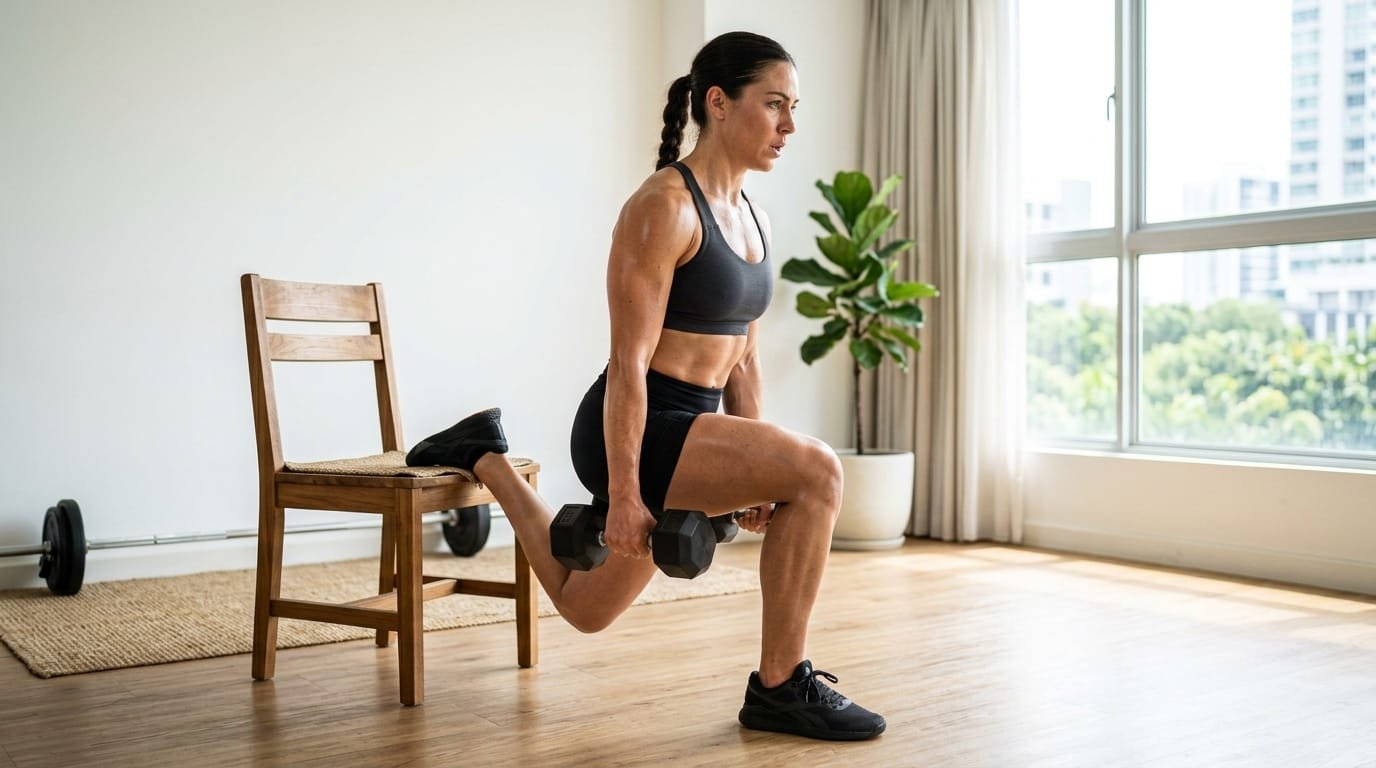
| Lunge / Split Squat | Reverse lunge, walking lunge, Bulgarian split squat | Bodyweight or dumbbells | Front-foot elevated, tempo, load | Unilateral strength, balance |
| Hinge | Romanian deadlift, single-leg RDL, hip thrust | Dumbbells, kettlebell, or band | Range, tempo, single-leg, load | Hamstrings and glutes |
| Single-Leg Squat Progression | Assisted pistol, shrimp squat, step-down | Bodyweight or light support | Depth, assistance reduction | High relative loading |
| Bridge / Thrust | Glute bridge, single-leg bridge, hip thrust | Bodyweight, band, or dumbbell | Feet elevated, pause, load | Glute isolation and strength |
| Carry | Suitcase carry, farmer carry | Dumbbells or household items | Distance, load | Overall leg and core stability |
Shoulder and upper-back health support overall training capacity when full-body sessions are used (Bent Arms vs. Straight Arms in Lateral Raises, The Hidden Mistake in Lateral Raises, and 3 Lateral Raise Modifications). Grip strength aids loaded carries and hinge work (Do Hand Grippers Really Work?).
Step-by-Step Framework for Machine-Free Leg Training
- Select 3–5 leg exercises
Cover squat/lunge, hinge, and single-leg patterns. - Choose available equipment
Bodyweight alone is viable; bands, dumbbells, or a kettlebell expand options. - Train legs 2–4 times per week
Full-body sessions or lower-body emphasis both succeed. - Use 2–4 sets of 6–15 repetitions
Leave 1–3 repetitions in reserve on most sets. - Default to controlled tempos
A 3-second eccentric increases difficulty and control. - Progress systematically
Add reps, slow the tempo, add pauses, move to harder variations, or increase load. - Include unilateral work regularly
At least one single-leg exercise per session improves balance and relative intensity. - Track performance
Log exercises, sets, reps, and how the movements felt. - Recover adequately
Prioritise sleep and protein. - Reassess every 4–6 weeks
Adjust volume or exercise selection based on progress and recovery.
Sample Leg-Focused Workouts
Session A – Squat and Hinge Emphasis
- Goblet squat or box squat – 3 × 8–12
- Romanian deadlift – 3 × 8–12
- Reverse lunge – 3 × 8–12 per leg
- Glute bridge or hip thrust – 3 × 10–15
- Optional: suitcase carry – 2 × 30–40 seconds
Session B – Unilateral Focus
- Bulgarian split squat – 3 × 8–12 per leg
- Single-leg RDL – 3 × 8–12 per side
- Single-leg glute bridge – 3 × 8–12 per side
- Step-up or reverse lunge – 3 × 8–12 per leg
- Optional: calf raise or short carry – 2 sets
Rest as needed to maintain good form. Sessions typically last 30–45 minutes.
Progressive Overload Without Heavy Barbells
- Increase repetitions within the target range
- Slow the eccentric phase to 3–5 seconds
- Add a 1–3 second pause at the bottom or hardest point
- Elevate the front or rear foot to change leverage
- Move from bilateral to unilateral versions
- Add modest external load (dumbbell, kettlebell, or band)
- Reduce rest periods once technique is reliable (density)
These methods create continuous challenge with light-to-moderate loads.
Technique Priorities for Safety and Results
Squat Variations
- Knees track roughly in line with toes
- Spine stays neutral
- Depth is controlled and pain-free
- Weight stays mid-foot to heel
Lunge and Split Squat
- Front shin stays relatively vertical or knees track properly
- Torso remains stable
- Back knee lowers under control
Hinge Patterns
- Hips move backward first
- Spine stays neutral
- Feel the load in the hamstrings and glutes
Single-Leg Work
- Pelvis stays level
- Movement is controlled on both the lowering and rising phases
Common Mistakes That Limit Leg Development
| Mistake | Result | Better Approach |
|---|---|---|
| Relying only on light bilateral squats | Insufficient stimulus | Add unilateral work and tempo |
| Rushing repetitions | Reduced tension and control | Slow the eccentric phase |
| Neglecting the hinge pattern | Hamstring and glute under-development | Include RDLs or single-leg RDLs |
| Inconsistent progression | Stagnation | Track and advance one variable |
| Ignoring recovery | Persistent soreness or stalled gains | Protect sleep and protein intake |
| Avoiding single-leg exercises | Imbalances and lower relative intensity | Include them regularly |
Equipment Options Ranked for Leg Training
| Equipment | Effectiveness | Storage | Best Applications |
|---|---|---|---|
| Bodyweight | High (with progression) | Perfect | All patterns via tempo, pauses, unilateral work |
| Resistance bands | High | Excellent | Assisted or resisted squats, hinges, bridges |
| Dumbbells | Very high | Good | Goblet squats, RDLs, lunges, loaded bridges |
| Kettlebell | Very high | Good | Goblet squats, swings, RDLs, carries |
| Sturdy chair or bench | Medium–high | Conditional | Bulgarian split squats, elevated bridges, step-ups |
Most people achieve excellent results with bodyweight plus one form of external load.
Recovery and Supporting Factors
- Sleep 7–9 hours most nights
- Adequate protein intake (approximately 1.6–2.2 g per kg of body weight)
- Daily walking for recovery and blood flow
- Planned deloads every 4–8 weeks
- Management of overall training stress
Strength training with progressive compound movements remains highly effective for building lower-body strength and muscle (strength training guidance). Practical home-gym approaches emphasise minimal effective equipment and sustainable progression (home gym equipment prioritisation and budget home gym principles).
Frequently Asked Questions
Can I build significant leg strength without heavy barbells?
Yes. Unilateral exercises, tempo manipulation, and progressive overload with modest loads produce meaningful strength and muscle gains for most trainees.
How often should I train legs?
Two to four times per week is effective. Adjust volume per session according to frequency and recovery.
Are Bulgarian split squats really that effective?
Yes. They create high relative loading on each leg, improve balance, and require minimal equipment.
What if I have knee discomfort?
Reduce range of motion, emphasise controlled tempos, prefer reverse lunges over forward lunges, and ensure knees track properly. Seek professional advice if pain persists.
Do I need to train calves separately?
Not required for most people. Many leg exercises already involve the calves. Add standing or single-leg calf raises if desired.
How long before I see results?
Strength and control improvements often appear within 3–6 weeks. Visible muscle changes depend on consistency, progressive overload, and nutrition.
Can pure bodyweight training be enough long-term?
It can take beginners and intermediates far, especially with advanced variations and tempo work. Most people eventually benefit from some external load for continued progress.
Is it better to do full-body or leg-focused sessions?
Both work. Full-body sessions are often easier to schedule; leg-focused days allow higher volume if recovery permits.
Final Recommendation
Effective leg training without machines or heavy barbells relies on unilateral exercises, controlled tempos, full ranges of motion, and systematic progressive overload. Prioritise goblet squats, lunges, Romanian deadlifts, single-leg variations, and glute bridges or hip thrusts. Train these patterns 2–4 times per week, progress through repetitions, tempo, pauses, or modest added load, and support the work with adequate sleep and protein.
Select 3–5 of the recommended exercises today, schedule two sessions this week, and begin with variations you can perform for 8–12 controlled repetitions. Track your workouts and advance one variable at a time. When legs are trained this way, strength, muscle development, and functional capacity improve steadily without the need for machines or maximal barbell loads. Start with the next session—the combination of smart exercise selection and consistent progressive tension delivers reliable results.