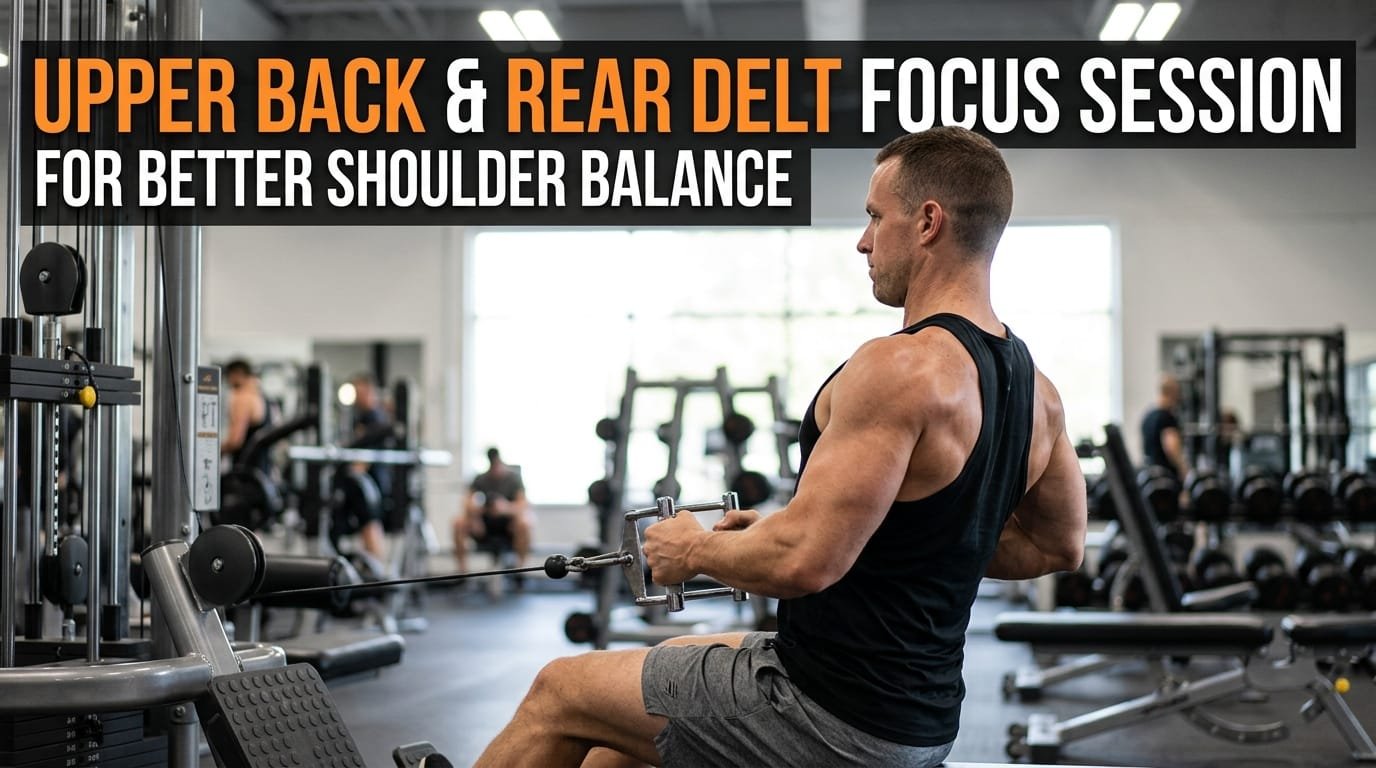
Upper Back and Rear Delt Focus Session for Better Shoulder Balance
Quick Answer
An upper back and rear delt focus session restores shoulder balance by strengthening the posterior deltoids, mid and lower trapezius, rhomboids, and external rotators — muscles that are frequently under-trained relative to the front delts and chest. The highest-value exercises are face pulls, band pull-aparts, reverse flyes (dumbbell or band), chest-supported or bent-over rows, prone Y-T-W raises, and external rotations. Perform this work 2–4 times per week with resistance bands, light dumbbells, or a pull-up bar. Consistent training improves posture, supports healthier lateral raises and pressing, enhances scapular control, and reduces common shoulder irritation.
Why Upper Back and Rear-Delt Training Is Non-Negotiable
Modern training and lifestyle patterns heavily favour pressing, pushing, and forward-oriented postures. Over time this creates a muscular imbalance: the anterior deltoids and pectorals become relatively dominant while the rear delts, mid-back retractors, and external rotators lag behind. The visible results are rounded shoulders, forward head posture, and reduced scapular stability. Functionally, the imbalance increases the risk of irritation during lateral raises, overhead pressing, and even simple reaching movements.
Strengthening the posterior shoulder girdle and upper back restores muscular balance, improves the position of the scapulae, centres the humeral head more effectively, and allows safer progressive overload on lateral raises and other deltoid work. Rear-delt and upper back training also improves performance in every pulling movement and contributes to complete, three-dimensional shoulder development.
Key Muscles and Their Roles in Shoulder Balance
| Muscle / Group | Primary Actions | Benefit for Shoulder Health & Balance | Highest-Value Exercises |
|---|---|---|---|
| Posterior Deltoid | Horizontal abduction, external rotation | Counters front-delt dominance, improves posture | Face pulls, reverse flyes, pull-aparts |
| Mid & Lower Trapezius | Scapular retraction, depression, upward rotation | Better scapular positioning & control | Band pull-aparts, prone Y raises, face pulls |
| Rhomboids | Scapular retraction | Pulls shoulders back and down | Rows, pull-aparts, face pulls |
| Infraspinatus & Teres Minor | External rotation, humeral head centring | Reduces superior migration & impingement risk | External rotation, face pulls |
| Overall rear upper back | Postural support & force transfer | Stable base for all pressing and raising | Combined rowing + isolation work |
Complete Exercise Library with Detailed Execution
1. Face Pull (Band or Cable-Style)
Anchor a band at approximately face or upper-chest height. Grip with a neutral or slightly externally rotated hand position. Pull toward the face or forehead while driving the elbows high and finishing with clear external rotation (thumbs point backward). Pause and squeeze the rear delts and mid-back before returning under control.
Sets/Reps: 3–4 × 12–20
Why it is essential: Simultaneously trains rear delts, external rotators, and scapular retractors in a highly functional pattern.
2. Band Pull-Apart
Hold a light-to-moderate band at shoulder height with arms extended. Pull the band apart by retracting and slightly depressing the scapulae while externally rotating the arms. Keep the ribcage down and avoid shrugging the upper traps. Pause briefly at peak contraction.
Sets/Reps: 3 × 15–25
Ideal for high-frequency activation and daily posture work.
3. Reverse Fly (Bent-Over or Chest-Supported)
Hinge at the hips with a flat back or lie chest-down on an incline bench. With a soft elbow bend, raise the dumbbells or band handles outward until the arms are roughly in line with the torso. Focus on moving through the frontal plane and squeezing the rear delts rather than swinging the weights.
Sets/Reps: 3 × 12–15
Excellent isolation for the posterior deltoid.
4. Chest-Supported or Single-Arm Dumbbell/Band Row
Support the chest on a bench or maintain a strong hip hinge. Pull the elbow back while allowing the shoulder blade to move freely. Emphasise the end-range contraction in the mid-back and rear delt.
Sets/Reps: 3–4 × 8–12 per side
Builds overall upper back thickness and strength.
5. Prone Y-T-W Raises
Lie face-down on the floor or a bench. Raise the arms into a Y position (arms at roughly 45 degrees, thumbs up), lower with control, then into a T (arms straight out to the sides), then into a W (elbows bent, squeezing the shoulder blades together). Use bodyweight or very light dumbbells.
Sets/Reps: 2–3 × 8–12 each position
One of the highest lower- and mid-trapezius activation exercises available.
6. External Rotation (Side-Lying or Standing Band)
Side-lying: Lie on the non-working side with the working elbow bent to 90° and pinned against the ribs. Rotate the forearm upward against light resistance.
Standing: Anchor a band at elbow height and externally rotate while keeping the elbow fixed at the side.
Sets/Reps: 2–3 × 12–15 per side
Directly strengthens the infraspinatus and teres minor that keep the humeral head centred.
7. Scapular Pull-Ups or Active Hangs
From a dead hang on a pull-up bar, depress and retract the scapulae without bending the elbows. Hold briefly and return to the start. Builds foundational scapular strength that supports all other upper back work.
Sample Focus Sessions
Session A – Balanced Upper Back & Rear-Delt (Most Recommended)
- Face Pull – 3–4 sets of 12–15
- Band Pull-Apart – 3 sets of 15–20
- Reverse Fly – 3 sets of 12–15
- Single-Arm or Chest-Supported Row – 3 sets of 10–12 per side
- External Rotation – 2–3 sets of 12–15 per side
Session B – Higher Rear-Delt Volume
- Face Pull – 4 sets of 12–20
- Bent-Over Reverse Fly – 3–4 sets of 12–15
- Prone Y-T-W – 2–3 sets of 8–10 each
- Band Pull-Apart – 3 sets of 15–25
- Optional scapular pulls – 2–3 sets
Session C – Strength + Control Emphasis
- Chest-Supported Row – 4 sets of 8–12
- Face Pull with 1–2 second pause – 3 sets of 10–12
- Reverse Fly – 3 sets of 12–15
- External Rotation – 3 sets per side
- Band Pull-Apart – 2–3 sets
Rest 45–90 seconds between sets. Keep loads moderate so that form, full range of motion, and mind-muscle connection remain excellent.
Step-by-Step Implementation Plan
- Schedule the session 2–4 times per week — either as a short standalone workout or after main upper-body training.
- Begin with light band pull-aparts or face pulls as activation.
- Perform the main exercises with controlled tempos and complete range of motion.
- Focus on the contraction in the rear delts and mid-back rather than using momentum or upper-trap shrugging.
- Progress by increasing band tension, adding light dumbbells, slowing the eccentric phase, or inserting pauses.
- Pair this work with strict lateral-raise technique. Detailed form cues and impingement-friendly modifications are available in How to Perform Safe Lateral Raises if You Have Shoulder Impingement History.
- Integrate the broader Shoulder Health Routine to Pair with Lateral Raise Training for comprehensive cuff and scapular work.
- Monitor posture, shoulder comfort, and performance over time.
- Maintain overall pulling volume while carefully managing total weekly shoulder stress.
- Support recovery with adequate protein intake and sleep; reassess every 4–6 weeks.
Programming Variables
- Frequency: 2–4 times per week
- Volume: 8–16 total hard sets directed at rear delts and upper back retractors is effective for most trainees
- Intensity: Moderate — prioritise control and peak contraction over heavy loading
- Progression hierarchy: Improve control and mind-muscle connection → increase resistance modestly → add pauses or slower eccentrics → increase total sets
Rear delts and mid-back muscles often respond well to higher frequencies and moderate-to-high rep ranges because they recover relatively quickly.
Integration with the Rest of Your Training
This session directly supports healthier lateral-raise training and overall shoulder balance. Use it consistently alongside the dedicated shoulder health work linked above.
Grip strength improves control during rows and band exercises — develop it with the methods in grip strength guidance. Kettlebell rows, cleans, and carries provide excellent complementary upper-back and grip stimulus (kettlebell sizing guide). For selecting appropriate bands, refer to Resistance Bands Buying Guide: Loop vs. Tube vs. Fabric – Which Wins?.
Core stability enhances bracing during rows; progressions toward an ab roller are useful. Low-impact conditioning options appear in manual treadmill guidance. A budget massage gun can help manage residual tension in the upper back, rear delts, and rotator cuff area.
External resources confirm the importance of rear-delt and upper back training for shoulder balance and posture (rear delt exercise recommendations and upper-back exercise libraries).
Common Mistakes and Corrections
- Using excessive momentum on face pulls and reverse flyes → slow the tempo and reduce the load
- Allowing the upper traps to dominate (shrugging) → focus on “down and back” scapular movement
- Neglecting pure external rotation work → include side-lying or band external rotation regularly
- Training rear delts only with very heavy loads and low reps → favour moderate loads and higher reps for most sets
- Inconsistent frequency → treat these sessions as non-negotiable 2–4 times per week
- Ignoring daily posture → reinforce training gains with awareness of sitting and standing position
Frequently Asked Questions
How often should upper-back and rear-delt work be performed?
2–4 times per week is optimal for the majority of trainees. These muscles tolerate and often benefit from higher frequency when volume per session is kept moderate.
Can this session be done on the same day as lateral raises?
Yes. Perform the upper back and rear-delt work first as activation or after the main lateral-raise sets. Keep the focus work controlled so residual fatigue does not compromise form.
What is the single most effective exercise for rear delts?
Face pulls and reverse flyes consistently rank among the highest for rear-delt activation and overall shoulder benefit.
Do I need heavy weights for rear-delt development?
No. Moderate loads with higher repetitions (12–20) and strict control are usually more effective and joint-friendly than heavy, low-rep loading.
How long until better shoulder balance becomes noticeable?
Improved awareness and reduced residual tension often appear within 2–4 weeks. Visible postural improvements and greater resilience typically require 6–12 weeks of consistent training.
Should I still perform rows if I already train back?
Yes. Specific rear-delt and mid-trap focused movements (face pulls, reverse flyes, pull-aparts) address regions that standard rows often under-emphasise.
Is this session sufficient to correct rounded shoulders?
It is a major and necessary component. Combine it with daily postural awareness, chest mobility work, and long-term consistency for the best results.
Can beginners perform this routine?
Yes. Start with lighter bands, higher control, and the simpler variations (pull-aparts, face pulls, supported rows) before progressing to more demanding versions.
Final Recommendation
Restore and maintain shoulder balance by dedicating regular sessions to the upper back and rear delts. Prioritise face pulls, band pull-aparts, reverse flyes, rows, prone Y-T-W raises, and external rotations using resistance bands, light dumbbells, or a pull-up bar. Train these patterns 2–4 times per week with controlled technique and progressive overload.
This work directly supports healthier lateral raises, better posture, and more resilient shoulders. Begin with Session A, emphasise quality contractions over load, and remain consistent. When the posterior shoulder and upper back are strong and balanced, pressing and raising movements become safer, more productive, and sustainable for the long term. Start today, focus on control, and build the muscular foundation that keeps your shoulders healthy for years of training.