Best Ways to Track Progress Without a Gym or Personal Trainer
Quick Answer
The most effective ways to track progress without a gym or personal trainer are a consistent workout log (notebook, spreadsheet, or free app), progressive overload metrics (load, reps, sets, tempo, or exercise difficulty), body measurements, standardised progress photos, performance benchmarks, and subjective recovery markers such as RPE and sleep quality. Record every working set, review the data weekly, and make small adjustments based on trends. This system turns home training with dumbbells, kettlebells, resistance bands, and bodyweight into measurable long-term strength and physique improvements.
Why Tracking Is Essential When You Train Alone
Without a coach providing real-time feedback or machines that clearly display load, it is easy to repeat the same sessions for months and wonder why results have stalled. Tracking creates objective feedback, enforces progressive overload, reveals early plateaus, and supplies the information needed to adjust volume, intensity, or recovery. Lifters who consistently log their training almost always progress faster and more reliably than those who rely on memory. At home, where external accountability is limited, a simple tracking system becomes your most valuable training partner.
Comprehensive Comparison of Tracking Methods
| Method | Primary Metrics | Tools Required | Best Goal Fit | Recommended Frequency | Limitations |
|---|---|---|---|---|---|
| Workout Log | Load, reps, sets, volume | Notebook, phone, spreadsheet | Strength & hypertrophy | Every session | Requires consistency |
| Progressive Overload Tracking | Ability to do more over time | Same as log | All strength goals | Every session + weekly review | Must be deliberate |
| Body Measurements | Circumference changes | Soft tape measure | Physique & recomposition | Every 2–4 weeks | Technique must be standardised |
| Progress Photos | Visual composition & shape | Smartphone | Motivation & long-term change | Every 2–4 weeks | Lighting & posing consistency needed |
| Performance Benchmarks | Relative strength & endurance | None or basic equipment | Overall fitness | Every 2–4 weeks | Skill and motivation affect scores |
| RPE & Subjective Markers | Effort, recovery, readiness | None | Autoregulation | Every session | Subjective by nature |
| Scale Weight | Body mass trends | Bathroom scale | Fat loss or controlled bulk | 2–3× per week (weekly average) | Fluctuates with water & glycogen |
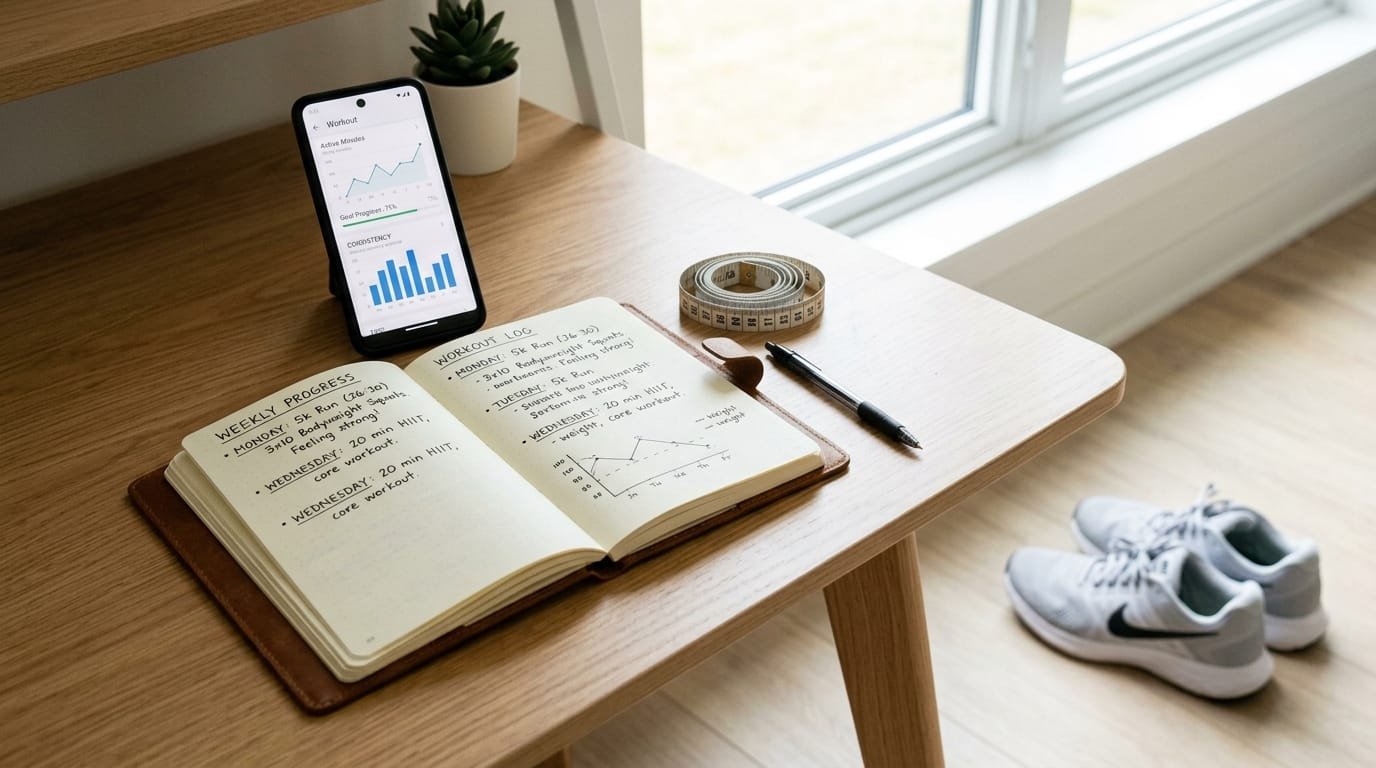
1. The Workout Log – Your Non-Negotiable Foundation
Log every working set immediately after you complete it. Minimum data points:
- Exact exercise name (e.g., “Bulgarian Split Squat – rear foot elevated” rather than “legs”)
- Load (dumbbell weight, kettlebell size, band colour/tension, bodyweight, or assistance level)
- Sets and reps actually completed
- Optional but highly useful: RPE (1–10 scale), rest time, and a one-line form or energy note
Practical tools that work well at home
- Dedicated paper notebook
- Notes app or Google Keep
- Free spreadsheet (Google Sheets or Excel)
- Simple free lifting apps (Strong, Hevy, or similar)
The exact tool matters less than consistency. Review the log once a week and identify the next small progression opportunity.
2. Tracking Progressive Overload in a Home Setting
Progressive overload is the gradual increase of training stress over time. At home you have multiple levers:
- Increase external load (heavier dumbbell or kettlebell)
- Move to a stronger resistance band
- Add repetitions with the same load
- Add an extra working set
- Slow the eccentric phase (e.g., 3–4 seconds)
- Increase range of motion
- Advance to a harder variation (regular push-up → decline or archer; glute bridge → single-leg)
- Reduce rest periods while maintaining performance
Record which method you used. Over weeks these incremental changes produce substantial cumulative progress. For example, adding one rep per set each week on a goblet squat, or moving from a medium to a strong band on lateral walks, compounds into meaningful strength and muscle gains.
3. Body Measurements – Objective Physique Feedback
Use a flexible, non-stretch tape measure and record under identical conditions (time of day, hydration status, lighting):
- Chest / shoulder circumference
- Waist at the navel
- Hips at the widest point
- Upper arm (flexed and relaxed)
- Thigh at mid-point
- Optional: calves, neck
Measure every 2–4 weeks. Circumference changes frequently appear before scale weight moves and are especially useful during body recomposition phases when muscle is gained while fat is lost.
4. Progress Photos – The Visual Record
Take front, side, and back photos every 2–4 weeks:
- Same location and lighting
- Same time of day
- Same clothing (or minimal clothing)
- Both relaxed and flexed poses if desired
Store images in a dedicated album dated clearly. Photos often reveal improvements in posture, muscle shape, and definition that numbers alone miss. Many home trainees find photos more motivating than any other metric.
5. Performance Benchmarks – Equipment-Free Tests
Retest these every 2–4 weeks under similar conditions:
- Maximum strict push-ups (full range, controlled)
- Maximum bodyweight squats in 60–90 seconds
- Dead-hang time or number of strict pull-ups / inverted rows
- Plank hold to technical failure
- Farmer carry distance or time with a fixed weight
- Single-leg glute bridge or pistol-squat progress
These tests require almost no equipment and directly reflect improvements in relative strength, muscular endurance, and control.
6. Subjective and Recovery Metrics
- Session RPE (overall workout difficulty 1–10)
- Muscle soreness duration and severity
- Sleep quality and duration
- Daily energy and motivation to train
- Resting heart rate trends (optional)
A rising RPE for the same workout, prolonged soreness, or declining motivation frequently signals the need for reduced volume or a deload.
Step-by-Step Home Tracking System
- Select one primary logging method and commit to it.
- Record every working set immediately after completion.
- At the end of each week, review the log and plan the next micro-progression.
- Every two weeks, take body measurements and/or progress photos under standardised conditions.
- Every two to four weeks, re-test one or two performance benchmarks.
- If fat loss or controlled gaining is a goal, weigh yourself 2–3 times per week and calculate a weekly average.
- Keep a brief weekly note on sleep, stress, and energy.
- Every four to six weeks, evaluate the bigger picture and adjust training volume, exercise selection, or recovery practices.
- Celebrate both process wins (consistent logging, better form) and outcome wins (new reps, measurements, photos).
- Keep the entire system simple enough that you maintain it for months and years.
Sample Logging Templates
Session Log Example
Date: 2026-08-31
Exercise | Load | Set 1 | Set 2 | Set 3 | RPE | Notes
Goblet Squat | 24 kg | 10 | 10 | 9 | 7.5 | Depth solid
Single-Arm Row | 18 kg | 12/11 | 11/11 | 10/10 | 8 | Controlled
Band Pull-Apart | Medium | 15 | 15 | 15 | 6 | —
Weekly Review Example
- Strength: Added 2 total reps on rows; goblet squat load increased
- Volume: 17 hard sets
- Recovery: Average sleep 7.5 h; DOMS mild and resolved by 48 h
- Next week: Increase row to 20 kg or add a fourth set; maintain squat load and chase one more rep
Linking Tracking to Your Existing Home Track progress Programme
Log lateral raises and all shoulder work while applying the form principles in safe lateral-raise technique and the shoulder health routine.
Track kettlebell swings, clean & presses, and goblet squats using the loading guidelines in kettlebell sizing guide. Grip-focused work (hangs, farmer carries, grippers) should include time or resistance notes (grip strength guidance).
Band exercises are easily tracked by colour/tension and reps (Resistance Bands Buying Guide). Core progressions such as the ab roller benefit from range-of-motion and rep logging. Conditioning work can be recorded by time, distance, or effort (manual treadmill guidance). Recovery practices and sleep metrics complete the picture (Best Post-Workout Recovery Tools and Sleep and Recovery Strategies).
External guidance consistently shows that systematic logging of load, reps, and volume is one of the highest-leverage habits for sustained progress (home progress tracking methods and practical tracking without a trainer).
Common Tracking Mistakes and How to Fix Them
- Logging only when motivated → Make logging automatic and non-negotiable after every session
- Changing multiple variables at once → Adjust only one factor at a time so you can identify cause and effect
- Obsessing over scale weight → Combine it with measurements, photos, and strength data
- Never reviewing the log → Schedule a weekly 10-minute review
- Creating an overly complex system → Start minimal and add detail only if it remains sustainable
- Ignoring recovery feedback → Treat rising RPE or prolonged soreness as data that requires action
Frequently Asked Questions
Do I really need to track if I only train at home?
Yes. Memory is unreliable. Objective records are the most effective way to guarantee progressive overload and to understand what is driving results.
What is the absolute minimum effective system?
Write down the exercise, the load, and the reps for every working set, then review the log once a week to plan the next small increase.
How often should I take photos and measurements?
Every 2–4 weeks under identical conditions is sufficient for the large majority of trainees.
Should I weigh myself every day?
No. Weigh 2–3 times per week and use the weekly average to filter out normal water and glycogen fluctuations.
What should I do when progress stalls?
Examine the log for lack of overload, insufficient recovery, or excessive volume. Change one variable, continue tracking, and reassess after 2–3 weeks.
Are paid apps required?
No. Free apps, spreadsheets, or a paper notebook work extremely well when used consistently.
How soon will I see measurable progress?
Strength and performance improvements frequently appear within 2–4 weeks. Visible physique changes typically require 6–12 weeks of consistent progressive training and tracking.
Can I track bodyweight exercises effectively?
Yes. Log variations, tempo, pauses, range of motion, and maximum reps. These variables provide clear progression pathways.
Final Recommendation
Track progress without a gym or personal trainer by combining a simple but consistent workout log, deliberate progressive overload, body measurements, standardised progress photos, and periodic performance benchmarks. Record every working set, review the data weekly, and make small, evidence-based adjustments. Keep the system sustainable so it becomes a permanent habit.
Consistent tracking converts home training with dumbbells, kettlebells, bands, and bodyweight into a clear, upward trajectory of strength, muscle, and confidence. Start today: choose your logging method, record your next session in detail, and review it at the end of the week. The information you collect will guide better decisions than any external coach could provide in your absence.