Pre-Workout Warm-Up Routine Using Only Resistance Bands
Quick Answer
A complete pre-workout warm-up using only resistance bands takes 8–12 minutes and prepares the entire body for strength training by raising tissue temperature, activating key stabilisers, and improving movement quality. The most effective routine combines band pull-aparts, face pulls or over-and-backs, external rotations, glute bridges, clamshells, lateral band walks, and light banded squats or good mornings. Perform 1–2 sets of 10–15 controlled repetitions per exercise with a light-to-moderate band. This active approach outperforms static stretching for performance and injury-risk reduction while requiring minimal space and equipment.
Why a Resistance Band Warm-Up Works
An effective warm-up increases muscle temperature, enhances blood flow, activates stabilising muscles, and rehearses the movement patterns you are about to load. Static stretching alone does little to raise tissue temperature and can temporarily reduce force output. In contrast, light dynamic resistance band work achieves all of the above goals simultaneously.
Bands provide accommodating resistance that increases as the muscle shortens, making them ideal for activation without fatigue. Research and practical coaching experience show that active warm-ups reduce injury risk and improve subsequent performance compared with no warm-up or passive stretching. Bands are portable, inexpensive, joint-friendly, and perfect for home training environments.
Benefits Specific to Resistance Band Warm-Ups
| Benefit | How Bands Deliver It | Practical Advantage for Home Lifters |
|---|---|---|
| Muscle activation | Light tension forces stabilisers (rear delts, glute medius, rotator cuff) to fire | Better joint centring before heavy presses, raises, or squats |
| Increased blood flow & temperature | Dynamic movement under light load | Faster readiness without cardio equipment |
| Movement pattern rehearsal | Mimics pulling, hinging, squatting, and abduction patterns | Improves technique quality from the first working set |
| Joint stability | Variable resistance challenges control | Especially useful for shoulders and hips |
| Portability & convenience | One light band fits in a drawer | No gym machines or large space required |
| Low fatigue cost | Light loads and moderate reps | Does not impair strength or power in the main session |
Complete Resistance Band Warm-Up Routine (8–12 Minutes)
Perform the following sequence with a light or extra-light band. Focus on control, full range of motion, and quality contractions rather than speed or high tension.
1. Band Pull-Apart
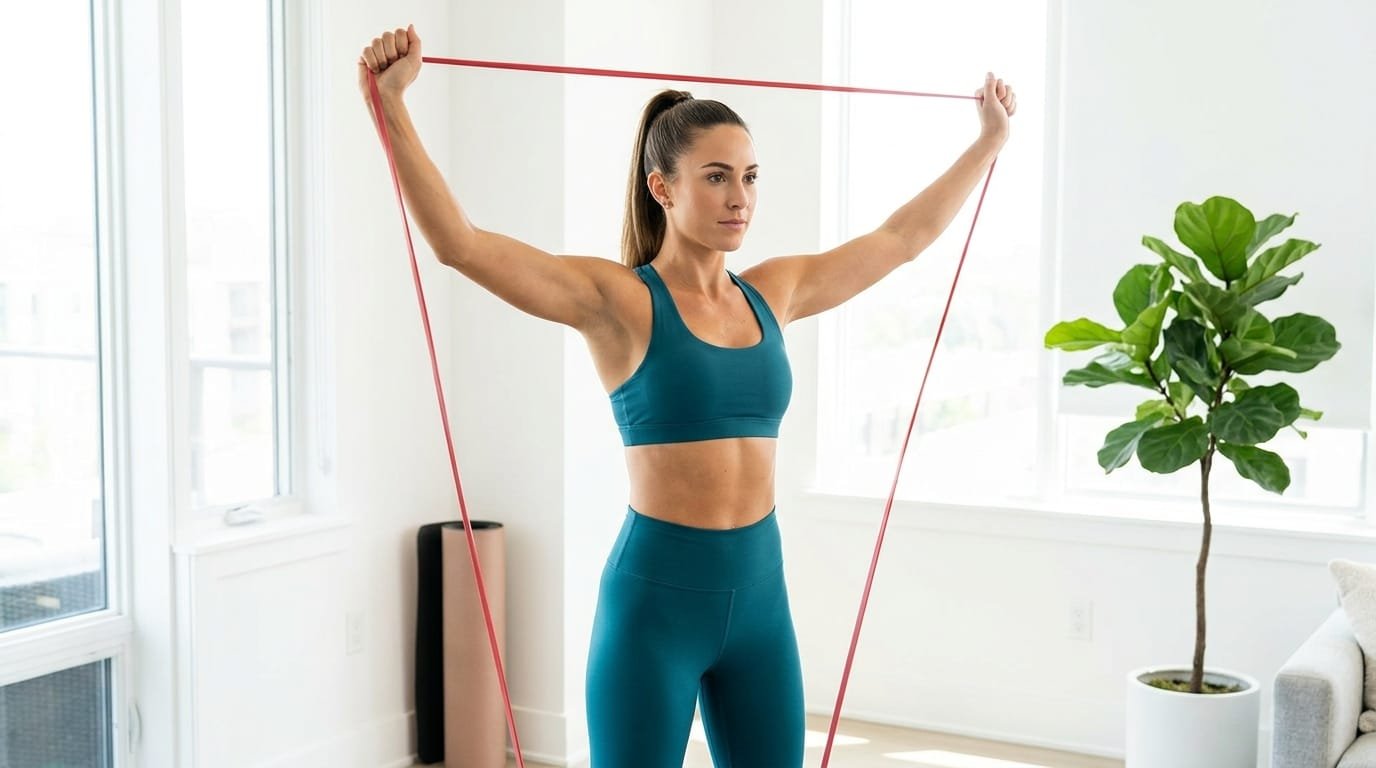
Hold the band at shoulder height with arms extended. Pull the band apart by retracting the scapulae and slightly externally rotating the arms until it touches the chest. Return under control.
Sets/Reps: 2 × 12–15
Targets: Rear delts, mid/lower traps, rhomboids
2. Band Face Pull or Over-and-Back
Anchor or hold the band and pull toward the face with high elbows, finishing with external rotation, or perform controlled over-and-backs for shoulder mobility and activation.
Sets/Reps: 2 × 10–12
Targets: Rear delts, external rotators, scapular stabilisers
3. Band External Rotation
Anchor the band at elbow height or hold it with the opposite hand. Keep the elbow pinned to the side and externally rotate the forearm against resistance.
Sets/Reps: 1–2 × 10–12 per side
Targets: Infraspinatus, teres minor (rotator cuff)
4. Banded Glute Bridge
Place a mini-band just above the knees. Lie on your back, drive through the heels, and extend the hips while pushing the knees outward against the band. Squeeze the glutes at the top.
Sets/Reps: 2 × 12–15
Targets: Glute maximus, hamstrings, core
5. Clamshell
Lie on your side with the mini-band above the knees. Keep feet together and open the top knee against the band while stabilising the pelvis.
Sets/Reps: 1–2 × 10–12 per side
Targets: Glute medius, external rotators
6. Lateral Band Walk (or Monster Walk)
Place the mini-band above the knees or around the ankles. Assume a quarter-squat position and step sideways while maintaining constant tension.
Sets/Reps: 2 × 8–12 steps each direction
Targets: Glute medius, hip stability, knee control
7. Light Banded Squat or Good Morning
Stand on the band and hold the ends at the shoulders for squats, or place the band across the upper back for good mornings. Perform controlled repetitions through a full comfortable range.
Sets/Reps: 1–2 × 8–10
Targets: Quads, glutes, hamstrings, pattern rehearsal
Optional Additions
- Banded shoulder dislocates / pass-throughs for thoracic and shoulder mobility
- Single-arm band rows for additional upper-back activation
- Banded dead bugs for core bracing practice
Customising the Warm-Up by Training Focus
| Training Focus | Emphasise These Exercises | Reduce or Skip |
|---|---|---|
| Upper-body push / lateral raises | Pull-aparts, face pulls, external rotations, over-and-backs | Lateral walks, heavy glute work |
| Lower-body / squat or hinge | Glute bridges, clamshells, lateral walks, banded squats/good mornings | Excessive upper-body volume |
| Full-body | Full routine as written | — |
| Pulling or grip-focused | Pull-aparts, face pulls, light rows | — |
| Shoulder health priority | External rotations, face pulls, pull-aparts, over-and-backs | — |
Step-by-Step Implementation Guide
- Choose a light or extra-light resistance band (you should complete all reps with excellent control and no fatigue).
- Perform the routine at the start of every strength session.
- Move continuously with minimal rest between exercises (15–30 seconds).
- Focus on quality of movement and muscle activation rather than speed.
- Progress only by improving control or slightly increasing band tension once the current level feels too easy.
- Follow the warm-up immediately with your first working sets.
- On upper-body days, spend extra time on pull-aparts, face pulls, and external rotations.
- On lower-body days, prioritise glute bridges, clamshells, and lateral walks.
- Keep total warm-up time to 8–12 minutes so it remains sustainable.
- Pair the warm-up with the same band you use for activation or light accessory work later in the session.
Programming Tips and Progression
- Frequency: Perform before every resistance-training session.
- Intensity: Light — the goal is activation and temperature increase, not fatigue.
- Progression: Improve range of motion and control first; only then move to a slightly stronger band.
- Variation: Rotate face-pull variations, add pauses, or change stance widths to keep the warm-up fresh.
This routine integrates seamlessly with the rest of your home training. It prepares the shoulders for safe lateral-raise performance (How to Perform Safe Lateral Raises if You Have Shoulder Impingement History and Shoulder Health Routine to Pair with Lateral Raise Training). It activates the posterior chain and hips for kettlebell swings, goblet squats, and hinges (kettlebell sizing guide).
Grip and forearm readiness benefit from the pulling movements (grip strength guidance). Core bracing practice carries over to advanced movements such as the ab roller. For band selection and types, refer to Resistance Bands Buying Guide: Loop vs. Tube vs. Fabric – Which Wins?. Low-impact conditioning options appear in manual treadmill guidance. A budget massage gun can be used after training for recovery.
External resources confirm that active band-based warm-ups improve muscle activation, movement quality, and readiness for subsequent loading (resistance band warm-up routines and practical band activation sequences).
Common Mistakes to Avoid
- Using a band that is too heavy and creating fatigue
- Rushing through the movements with poor control
- Skipping external rotation and scapular work on upper-body days
- Treating the warm-up as optional when short on time
- Performing static stretching instead of dynamic band work before heavy lifting
- Allowing the upper traps to dominate pull-aparts and face pulls
Frequently Asked Questions
How long should the band warm-up take?
8–12 minutes is ideal for most sessions. It is long enough to raise temperature and activate key muscles without cutting into training time.
Can I use the same band for the warm-up and the workout?
Yes. Use a light band for the warm-up and progress to stronger bands for working sets if needed.
Is this warm-up enough before heavy lifting?
Yes for the majority of home training sessions. Add 1–2 light ramp-up sets of your first main exercise if loads are particularly heavy.
Should I stretch statically before lifting?
Save most static stretching for after training or separate mobility sessions. Dynamic band work is superior pre-workout.
How often should I change the routine?
The core exercises can stay consistent. Small variations in tempo, pauses, or exact variations keep it effective long-term.
Can beginners use this routine?
Absolutely. Start with the lightest band available and focus on learning the movement patterns.
Does a band warm-up help prevent injury?
Active warm-ups that raise tissue temperature, activate stabilisers, and rehearse movement patterns are associated with lower injury risk compared with no warm-up or static stretching alone.
Final Recommendation
A pre-workout warm-up using only resistance bands is one of the most efficient ways to prepare for home strength training. Perform band pull-aparts, face pulls or over-and-backs, external rotations, glute bridges, clamshells, lateral walks, and light banded squats or good mornings for 8–12 minutes before every session. Keep the resistance light, emphasise control, and customise the emphasis according to the day’s training focus.
This simple routine improves muscle activation, movement quality, and readiness while requiring almost no space or equipment. Pair it with progressive training, solid recovery, and balanced programming for long-term progress and resilience. Start your next session with this band warm-up — your joints, stabilisers, and working sets will thank you.