Home Glute and Hamstring Builder Using Resistance Bands and Bodyweight
Quick Answer
You can effectively build stronger, more muscular glutes and hamstrings at home using only resistance bands and bodyweight by prioritising hip-extension movements (glute bridges, hip thrusts, Romanian deadlift variations), hip-abduction work (clamshells, lateral walks, side-lying abductions), and hamstring-focused patterns (slider or towel curls, single-leg bridges, good mornings). Train 2–4 times per week with progressive overload through harder band tensions, slower tempos, elevated positions, single-leg variations, and increased volume. This approach develops the gluteus maximus, medius, and minimus plus the hamstring group for strength, shape, posture, and injury resilience without weights or machines.
Why Target Glutes and Hamstrings Together
The glutes and hamstrings form the primary posterior chain. Strong glutes improve hip extension power, pelvic stability, and aesthetics, while robust hamstrings support knee flexion, hip extension, and sprinting or hinging performance. Weakness or imbalance in these muscles is linked to lower-back discomfort, knee issues, and reduced athletic output.
Resistance bands provide accommodating resistance that increases as the muscle shortens, matching the strength curve of many glute and hamstring actions. Bodyweight variations allow high control, unilateral work, and easy progression through leverage and tempo. Studies indicate that elastic resistance can produce comparable strength and hypertrophy outcomes to conventional loading when progressive overload is applied (resistance band lower-body effectiveness).
Anatomy Overview
Gluteal Muscles
- Gluteus maximus: primary hip extender and external rotator
- Gluteus medius and minimus: hip abductors and stabilisers (critical for single-leg control and “side glute” development)
Hamstrings
- Biceps femoris, semitendinosus, semimembranosus: hip extensors and knee flexors
Effective programmes include both bilateral and unilateral hip-extension patterns plus dedicated abduction and knee-flexion work.
Best Exercises Using Bands and Bodyweight
| Exercise | Primary Target | Equipment | Key Benefit | Progression Options |
|---|---|---|---|---|
| Banded Glute Bridge / Hip Thrust | Glute max + hamstrings | Band + floor/bench | Peak contraction under load | Heavier band, single-leg, elevated shoulders/feet, pause |
| Single-Leg Glute Bridge | Glute max + stability | Bodyweight or band | Unilateral strength & balance | Band, elevated, slower eccentric |
| Banded Romanian Deadlift (RDL) | Hamstrings + glute max | Band | Long-length hamstring loading | Heavier band, single-leg (kickstand), slower tempo |
| Slider / Towel Hamstring Curl | Hamstrings (knee flexion) | Towel/slider on floor | Isolated hamstring strength | Single-leg, slower eccentric, elevated hips |
| Clamshell | Glute medius + external rotators | Mini-band | Upper glute & hip stability | Heavier band, pause, side-lying variations |
| Lateral / Monster Band Walk | Glute medius | Mini-band | Functional abduction strength | Heavier band, lower stance, longer distance |
| Side-Lying Hip Abduction | Glute medius | Band or bodyweight | Isolated side-glute work | Band, ankle weight alternative, tempo |
| Donkey Kick / Fire Hydrant | Glute max + medius | Band or bodyweight | Isolation with control | Band, pulse, hold at top |
| Bodyweight Good Morning | Hamstrings + glute max | Bodyweight | Hinge pattern practice | Band across shoulders, slower tempo |
| Frog Pump | Glute max | Bodyweight or band | High-rep burnout & mind-muscle | Band, elevated, pulse |
Detailed Exercise Execution
Banded Glute Bridge / Hip Thrust
Lie on your back (or elevate shoulders on a couch/bench for thrusts). Place a band just above the knees or across the hips. Drive through the heels, extend the hips fully, and squeeze the glutes at the top. Lower under control. Actively push the knees outward against the band.
For maximum glute bias, pause at full extension and avoid overarching the lower back.
Single-Leg Glute Bridge
Same setup but with one foot elevated or extended. Keep hips level throughout. This dramatically increases demand on the working side.
Banded Romanian Deadlift
Stand on the band with feet hip-width, holding the handles or ends. Hinge at the hips while keeping a soft knee bend, push the hips back, and feel the stretch in the hamstrings. Drive the hips forward to stand tall. Keep the spine neutral.
Slider or Towel Hamstring Curl
Lie on your back, heels on a towel or sliders. Lift hips into a bridge, then curl the heels toward the glutes while maintaining hip height. Extend the legs slowly. Excellent for isolated hamstring strength at home (bodyweight and minimal-equipment hamstring options).
Clamshell
Lie on your side with a mini-band above the knees, knees bent, feet together. Open the top knee against the band while keeping the pelvis stable and feet in contact. Control the return.
Lateral Band Walk / Monster Walk
Place a mini-band above the knees or around the ankles. Assume a quarter-squat position and step sideways while maintaining tension. Keep toes pointed forward and avoid letting the knees cave in.
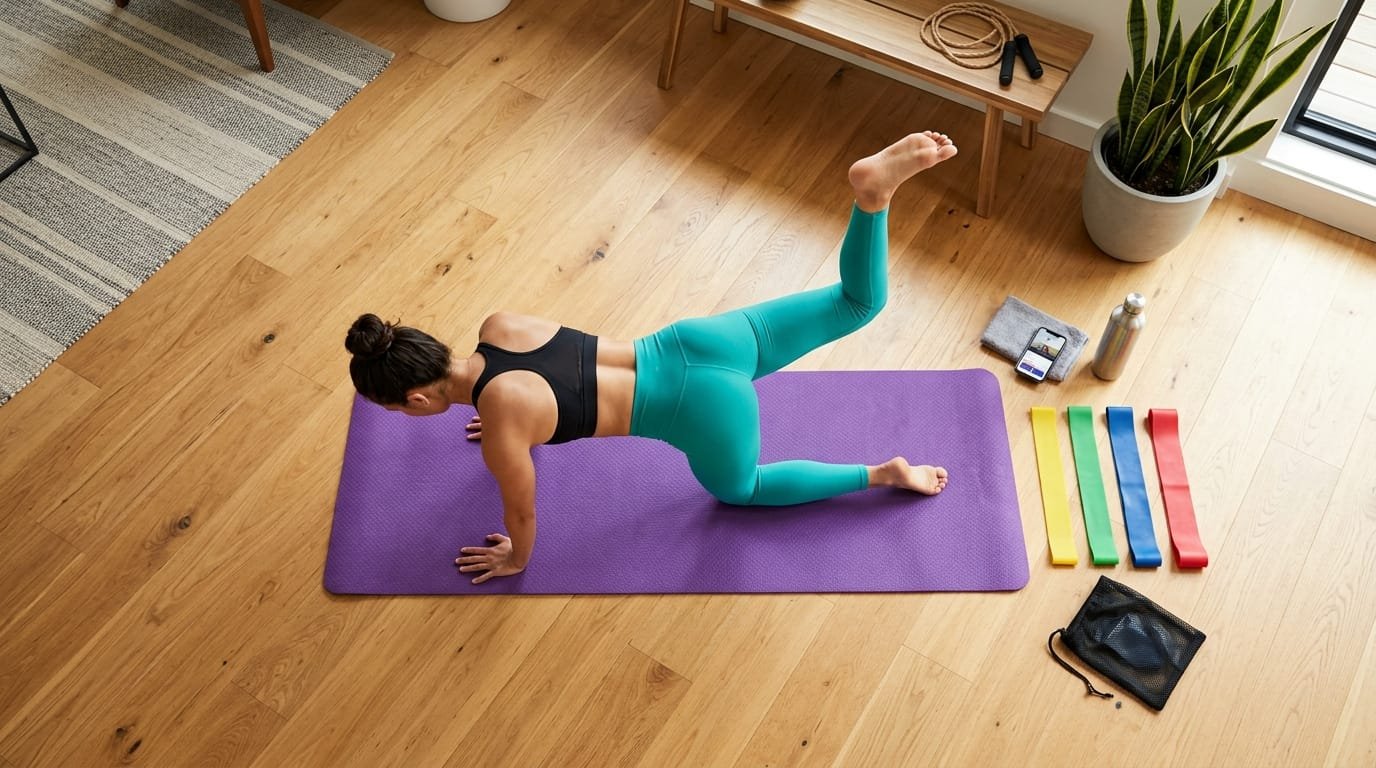
Donkey Kick
On all fours, place a band around the feet or above the knees. Keep the knee bent and drive the heel toward the ceiling, squeezing the glute at the top. Avoid rotating the hips or arching the lower back.
Sample Home Programmes
Beginner Full Glute + Hamstring Session (2–3× per week)
- Banded Glute Bridge – 3 sets of 12–15
- Clamshell – 3 sets of 12–15 per side
- Banded RDL – 3 sets of 10–12
- Lateral Band Walk – 3 sets of 10–12 steps each direction
- Single-Leg Glute Bridge – 2–3 sets of 8–10 per side
Rest 45–75 seconds between sets.
Intermediate Session
- Elevated Banded Hip Thrust – 4 sets of 10–15
- Single-Leg Glute Bridge – 3 sets of 10–12 per side
- Banded RDL or Kickstand RDL – 3 sets of 8–12 per side
- Slider Hamstring Curl – 3 sets of 8–12
- Clamshell or Side-Lying Abduction – 3 sets of 12–15 per side
- Frog Pump or Donkey Kick – 2 sets of 15–20
Advanced or High-Volume Finisher
Superset style:
- Single-leg hip thrust × 10–12 per side
- Slider curl × 8–10
- Lateral walk × 12 steps each way
Repeat 3–4 rounds with minimal rest.
Progressive Overload Without Weights
- Move to a stronger band
- Slow the eccentric phase (3–4 seconds)
- Add pauses at peak contraction
- Elevate the shoulders or feet
- Switch to single-leg versions
- Increase total sets or weekly frequency
- Reduce rest periods while maintaining form
- Combine methods (e.g., single-leg + pause + heavier band)
Track your band colour/tension, reps, and tempo. Small weekly improvements compound into significant strength and size gains.
Programming Guidelines
Train glutes and hamstrings 2–4 times per week. Beginners can start with full sessions; intermediates may split emphasis (one more glute-dominant day, one more hamstring-dominant). Total weekly sets of 10–20 per major muscle group is a practical range when recovery is adequate.
Pair this work with upper-body training and maintain overall protein intake (approximately 1.6–2.2 g per kg of body weight) for optimal muscle growth.
Integration with Broader Training
Strong glutes and hamstrings improve performance in nearly every lower-body pattern and support better posture. Maintain healthy shoulder mechanics during any upper-body work by applying principles from safe lateral-raise technique.
Grip strength helps when holding bands under tension — develop it with methods from grip strength guidance. Kettlebell swings and hinges pair excellently once you progress beyond bands (kettlebell sizing guide). Core stability from bridges and anti-rotation work carries over; advance toward ab-roller variations when ready.
For band selection and types, refer to Resistance Bands Buying Guide: Loop vs. Tube vs. Fabric – Which Wins?. Low-impact conditioning options appear in manual treadmill guidance. A budget massage gun can assist with recovery in the glutes, hamstrings, and hips.
Additional evidence on regional glute activation and band effectiveness is available through systematic reviews and practical exercise libraries (gluteus maximus regional activation findings and band glute/hamstring exercise collections).
Common Mistakes and Corrections
- Using momentum instead of controlled tension → slow the tempo and focus on the squeeze
- Allowing the lower back to arch on bridges/thrusts → maintain posterior pelvic tilt and brace
- Letting the knees cave inward on band walks → actively push outward against the band
- Neglecting single-leg work → include unilateral variations for balance and strength
- Staying with the same light band indefinitely → progress tension or difficulty
- Skipping hamstring isolation → include curls or RDLs for complete posterior-chain development
Frequently Asked Questions
Can I really build bigger glutes and hamstrings with only bands and bodyweight?
Yes. Progressive overload through band tension, leverage, tempo, and volume produces measurable hypertrophy and strength, especially for beginners and intermediates. Long-term advanced trainees may eventually benefit from heavier free weights, but this method delivers excellent results for most people.
How often should I train glutes and hamstrings?
2–4 times per week is optimal for most. Allow at least one recovery day between hard sessions.
What band strength should I start with?
Choose a band that makes the last few reps of each set challenging while preserving form. Have a range of tensions available for progression.
Are clamshells and band walks enough for side glutes?
They are highly effective for glute medius activation and stability. Combine them with compound hip-extension work for complete development.
How long until I see results?
Improvements in muscle activation and endurance often appear within 2–4 weeks. Visible shape and strength changes typically become noticeable after 6–12 weeks of consistent progressive training.
Do I need a bench for hip thrusts?
No. Floor bridges are effective. Elevating the shoulders on a couch or sturdy chair increases range and difficulty when you are ready.
Should I feel these exercises in my lower back?
No. Proper bracing and pelvic control should keep the work in the glutes and hamstrings. Reduce range or regress the exercise if the lower back takes over.
Final Recommendation
Build stronger, more developed glutes and hamstrings at home by combining resistance-band and bodyweight exercises that emphasise hip extension, hip abduction, and hamstring loading. Prioritise banded bridges and thrusts, single-leg variations, RDLs, slider curls, clamshells, and lateral walks. Train 2–4 times per week with deliberate progressive overload through harder bands, slower tempos, elevated positions, and unilateral work.
Master technique, track your progressions, and support training with adequate protein and recovery. When these elements are consistent, resistance bands and bodyweight become a highly effective system for posterior-chain development — no gym or heavy weights required. Start with the beginner routine, focus on quality contractions, and advance systematically for lasting strength and shape.