How Older Adults Can Use Hand Grippers and Light Equipment Effectively
Quick Answer
Older adults can safely and effectively build grip strength, forearm endurance, hand function, and overall physical resilience using hand grippers together with light equipment such as resistance bands, light dumbbells, soft balls, and bodyweight exercises. Begin with very low resistance (soft stress balls, therapy putty, or the lightest grippers), perform short controlled sessions 2–4 times per week, stay strictly within pain-free ranges (especially important with arthritis), and progress gradually through higher repetitions, longer isometric holds, slower tempos, or slightly stronger tools. Combine dedicated grip work with simple full-body movements that support balance, posture, and daily independence. Consistency with light, joint-friendly loading produces meaningful improvements in function and confidence without requiring heavy equipment or high injury risk.
Why Grip Strength Is a Critical Biomarker for Healthy Aging
Grip strength is far more than the ability to open a stubborn jar. Researchers describe it as an “indispensable biomarker for older adults.” It reflects overall muscle function, predicts mobility limitations, correlates with fall risk, and is associated with broader health outcomes including frailty and longevity (What Grip strength says about your Health).
Grip strength typically begins a noticeable decline around age 50 (sometimes earlier). People who maintain stronger grip tend to preserve strength elsewhere in the body, move more confidently, and retain independence longer. Everyday tasks—carrying shopping, gardening, using hand tools, rising from a chair while holding objects, or recovering balance after a stumble—all rely on adequate hand and forearm strength.
Fortunately, grip is highly trainable at any age. Targeted, low-cost interventions using hand grippers and light equipment can produce measurable gains in maximal strength and muscular endurance within 8–12 weeks when performed consistently.
Evidence-Based Benefits for Older Adults
| Benefit Category | Specific Advantages | Supporting Context |
|---|---|---|
| Daily function | Easier opening of jars, bottles, doors; better control of utensils and tools | Direct transfer from crush and pinch strength |
| Overall strength & frailty reduction | Grip serves as a proxy for whole-body muscle capacity | Linked to walking speed, stair climbing, and lower frailty scores |
| Joint health & arthritis management | Controlled loading can support hand function when kept pain-free | Higher grip associated with lower risk of symptomatic hand osteoarthritis in some data |
| Fall prevention & balance recovery | Stronger hands and arms aid in grabbing supports and stabilising the body | Functional carry-over to real-world stability |
| Independence & quality of life | Reduced need for assistance with common tasks | Greater confidence and autonomy |
| Training accessibility | Minimal space, low cost, short sessions, seated options available | High adherence potential for home use |
Resistance training improves muscle strength even among the very elderly, with low rates of adverse events when programmes are appropriately designed (Effects of Resistance Training on Muscle Size and Strength in Very Elderly Adults). Specialised handgrip programmes using grippers and similar tools have been shown to increase maximal grip strength and endurance in older adults within 8 weeks (specialised handgrip strength training study).
Selecting Appropriate Hand Grippers and Supporting Light Equipment
Hand Grippers and Squeeze Tools
- Beginners or those with sensitive hands/arthritis: soft stress balls, therapy putty, or foam grippers.
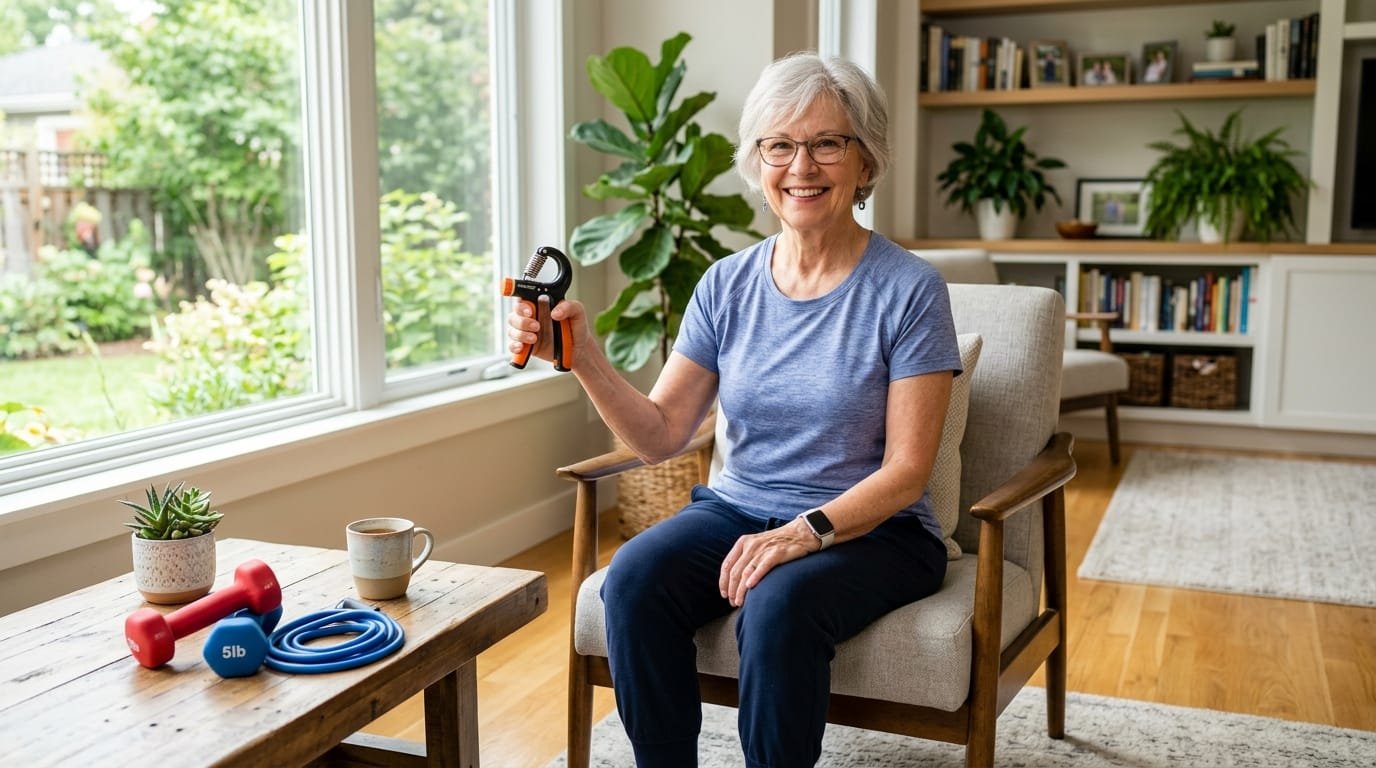
- Next stage: adjustable or light-resistance spring grippers with comfortable handles.
- Avoid high-tension “captain of crush” style grippers until substantial base strength and tendon tolerance exist.
- Key features: smooth action, non-slip handles, progressive resistance options.
Complementary Light Equipment
- Resistance bands (light and medium strengths) – ideal for warm-ups, pull-aparts, rows, and joint-friendly loading (Resistance Bands Buying Guide).
- Light dumbbells (1–5 kg / 2–12 lb range to start).
- Sturdy chair for seated work and balance support.
- Soft towel or cloth for wringing variations.
- Optional light kettlebell for carries once grip capacity improves (kettlebell sizing guide).
Home Safety Setup
- Non-slip flooring or mat.
- Clear pathways free of trip hazards.
- Adequate lighting.
- Chair or counter within easy reach for support.
- Good ventilation and comfortable room temperature.
Proper Technique for Hand Grippers and Squeeze Work
- Sit or stand with tall posture and relaxed shoulders.
- Place the gripper so the handle sits comfortably across the palm; wrap fingers securely without excessive wrist deviation.
- Squeeze slowly and deliberately to a comfortable end range (full closure is not required if limited by arthritis or mobility).
- Hold the peak contraction for 2–5 seconds when starting; build toward 5–10 seconds as tolerance allows.
- Release with the same control used on the squeeze—avoid letting the spring snap open.
- Keep the wrist generally neutral; avoid extreme flexion or extension.
- Breathe continuously and rhythmically.
- Stop immediately if sharp joint pain, numbness, or unusual swelling appears.
Arthritis-Friendly Adjustments
- Reduce range of motion to the pain-free zone.
- Use higher repetitions with very light resistance rather than maximal squeezes.
- Include open-hand finger spreads and gentle wrist circles for balance.
- Prefer softer tools on high-irritability days.
- Apply heat before training and gentle movement afterward if helpful.
Comprehensive Exercise Library
Pure Grip & Forearm Work
- Soft-ball or putty squeezes
- Light-to-medium gripper repetitions
- Isometric gripper holds
- Towel wringing (both directions)
- Finger extensions against a light band
- Wrist curls and reverse wrist curls with very light dumbbell or band
- Rice-bucket or putty digs (if available) for multi-planar hand strength
Integrated Light-Equipment Movements
- Sit-to-stand from a chair (progress by holding light weights)
- Supported bodyweight or band squat
- Seated or standing band / light-dumbbell row
- Wall or counter push-up
- Glute bridge (progress to single-leg when ready)
- Farmer carry or suitcase carry with light dumbbells
- Band pull-aparts and face-pull variations
- Scapular-plane lateral raises with very light resistance (follow form principles in safe lateral-raise guidance and shoulder health routine)
Core & Stability Additions
- Seated or standing marches
- Dead bugs or bird-dogs
- Controlled ab-roller progressions only after basic stability is established
Sample Training Programmes
Beginner Grip Emphasis (10–15 minutes, 2–3 days per week)
- Soft-ball or light-gripper squeezes – 2–3 sets of 10–15 controlled reps per hand
- Short isometric holds (3–5 seconds) – 2 sets of 4–6 per hand
- Finger spreads / extensions – 2 sets of 10
- Gentle wrist circles and forearm stretches
Intermediate Combined Session (20–30 minutes, 3 days per week)
- Warm-up: arm circles, shoulder rolls, easy marching (3–5 min)
- Medium gripper work – 3 sets of 8–12 reps + 1–2 hold sets
- Sit-to-stand or supported squat – 2–3 sets of 8–12
- Band or light-dumbbell row – 2–3 sets of 10–12
- Wall / counter push-up – 2–3 sets of 6–12
- Glute bridge – 2–3 sets of 10–15
- Light farmer carry – 2 sets of 20–40 seconds
- Optional band pull-aparts or light lateral-raise variation
Maintenance / Daily Micro-Session (5–8 minutes most days)
- Easy ball squeezes or light gripper while watching television or sitting
- Focus on quality and blood flow rather than fatigue
Rest between sets as needed. Quality of movement always takes priority over quantity or load.
Progressive Overload Strategies Suitable for Older Adults
Because connective tissue adapts more slowly than muscle, progression should be conservative:
- Increase repetitions first.
- Lengthen isometric hold times.
- Slow the tempo of both the squeeze and the release.
- Move to a slightly stronger gripper or band only after current work feels manageable for 2–3 weeks.
- Reduce rest periods modestly once work capacity improves.
- Add light carries or integrated full-body movements.
- Introduce a second short daily session of very easy squeezes.
Track both training numbers (reps, hold duration, resistance level) and real-world function (ease of opening jars, carrying shopping, gardening). Simple tracking methods are outlined in Best Ways to Track Progress Without a Gym or Personal Trainer.
Full Integration with Home Strength and Conditioning
Grip training multiplies the effectiveness of other home exercises. Stronger hands improve:
- Kettlebell and dumbbell carries, swings, and rows (kettlebell sizing guide).
- Band pulling and pushing patterns (Resistance Bands Buying Guide).
- Hanging or supported pull-up progressions when appropriate.
- Overall upper-body strength and posture work, including the shoulder-health practices linked earlier.
Low-impact conditioning such as walking or treadmill use complements strength work (manual treadmill guidance). Recovery practices—including soft-tissue work and prioritising sleep—support adaptation (Best Post-Workout Recovery Tools, Best Massage Gun for Post-Workout Recovery on a Budget, and Sleep and Recovery Strategies).
External evidence confirms that resistance training improves strength in older adults and that specialised handgrip programmes can meaningfully raise maximal grip strength and endurance.
Detailed Safety Guidelines for Older Adults
- Consult a physician before beginning if you have significant arthritis, recent hand/wrist surgery, uncontrolled cardiovascular disease, severe osteoporosis, or major balance impairments.
- Start well below perceived capacity; tendon and joint tolerance often lag behind muscle.
- Distinguish between productive muscle fatigue and joint pain—stop the latter immediately.
- Maintain neutral wrist positions and avoid end-range forcing.
- Use support (chair, counter, wall) whenever balance feels uncertain.
- Keep sessions short initially (10 minutes can be highly productive).
- Include both closing (crush) and opening (extension) movements for muscular balance.
- Monitor for swelling, persistent aching, or loss of function and regress if they appear.
- Progress on a timescale of weeks, not days.
- Combine grip work with lower-body and postural exercises for comprehensive benefit.
Step-by-Step 8-Week On-Ramp Plan
Weeks 1–2
Focus on technique and habit. Soft ball or lightest gripper, 2 sessions per week, 2–3 sets of 8–12 controlled squeezes. Add sit-to-stands and gentle band rows.
Weeks 3–4
Increase to 3 sessions. Add short isometric holds. Introduce wall push-ups and glute bridges.
Weeks 5–6
Progress resistance slightly or add reps/holds. Begin light farmer carries. Include band pull-aparts.
Weeks 7–8
Consolidate gains. Aim for consistent 3 sessions weekly. Test real-world tasks (jar opening, carrying) and note improvements. Adjust programme for the next phase.
Common Mistakes and Corrections
| Mistake | Risk | Correction |
|---|---|---|
| Starting with too-heavy grippers | Tendon irritation or joint flare | Begin with soft tools and build slowly |
| Ignoring pain signals | Worsening arthritis or overuse | Stay in pain-free ranges; regress promptly |
| Training only crushing grip | Muscular imbalance | Add finger extension and open-hand work |
| Neglecting full-body movement | Limited functional transfer | Pair grip work with sit-to-stands, rows, and carries |
| Inconsistent practice | Minimal adaptation | Schedule short sessions as non-negotiable appointments |
| Holding the breath | Blood-pressure spikes | Maintain steady rhythmic breathing |
| Expecting rapid transformation | Discouragement | Focus on 8–20 week timelines |
Frequently Asked Questions
Are hand grippers safe if I have hand osteoarthritis?
Many older adults use them successfully when resistance is kept light and movement stays within comfortable ranges. Soft balls or putty are often better starting points. Stop if joints become more painful or swollen and consider professional guidance.
How frequently should grip be trained?
Two to four dedicated short sessions per week work well. Brief daily easy squeezes (for example while reading or watching television) can provide additional benefit.
How long does it take to notice improvement?
Some people feel functional differences in daily tasks within 4–6 weeks. Measurable strength and endurance gains commonly appear between 8 and 20 weeks of consistent training.
Will stronger grip help with other exercises?
Yes. Improved grip reduces a common limiting factor in rows, carries, hangs, and many daily activities, allowing better overall training quality.
Do I need to buy expensive equipment?
No. A basic light gripper or even a tennis ball / soft stress ball, plus inexpensive resistance bands, can deliver excellent results.
Should grip training replace other forms of strength work?
No. Treat it as a high-value addition to simple lower-body, upper-body, and core exercises.
Is grip strength really linked to broader health?
Yes. It serves as a practical indicator of general muscle function and is associated with better mobility, lower frailty risk, and other positive aging outcomes.
What if one hand is significantly weaker?
Train both hands and consider a modest extra volume of easy work for the weaker side, while respecting any injury history or asymmetry advice from a healthcare professional.
Can I train grip every day?
Very light technique or blood-flow work can be performed daily. More challenging sessions benefit from recovery days.
How does grip training fit with balance or fall-prevention goals?
Stronger hands and forearms improve the ability to grasp supports and stabilise the upper body, complementing lower-body and core stability work.
Final Recommendation
Older adults can use hand grippers and light equipment with excellent effectiveness by beginning conservatively, emphasising slow controlled repetitions and isometric holds in pain-free ranges, progressing gradually, and integrating grip work into simple full-body routines. This combination builds practical strength for daily living, supports independence, enhances confidence, and contributes to healthier aging—all with minimal cost, space requirements, and injury risk.
Start with a soft ball or light gripper, schedule two to four short sessions each week, master clean technique, and progressively layer in sit-to-stands, rows, glute bridges, and light carries. Track both training metrics and real-world function. Support the programme with adequate protein, quality sleep, and enjoyable movement such as walking.
Small, consistent inputs compound powerfully over months. Begin today with the simplest tool available—your hands and a basic squeeze implement—and build steadily from there. The improvements in strength, ease of daily tasks, and overall resilience are among the highest-return investments an older adult can make in long-term function and quality of life.