Women’s Home Gym Essentials Focused on Strength and Bone Health
Quick Answer
The most effective home gym essentials for women prioritising strength and bone health are progressive resistance tools that support compound, weight-bearing movements: adjustable or fixed dumbbells, a kettlebell, resistance bands, a sturdy bench or elevated surface, and optional items such as a weighted vest. Focus on squats, hinges, pushes, pulls, and loaded carries performed 2–4 times per week with progressive overload. Resistance training is one of the best non-pharmacological strategies for preserving and improving bone mineral density (especially at the spine and hip) while building functional strength, muscle, balance, and confidence. Start conservatively, prioritise form, and progress gradually for sustainable long-term results.
Why Strength Training Is Essential for Women’s Bone Health
Women face a significantly higher lifetime risk of osteoporosis than men. Peak bone mass is typically reached in the twenties or early thirties; after that, bone density gradually declines. The drop accelerates markedly after menopause because of reduced oestrogen, which plays a protective role in bone metabolism. The result is increased risk of osteopenia, osteoporosis, and fragility fractures—particularly at the spine, hip, and wrist.
Resistance training counters this process by applying mechanical stress to bone through two main mechanisms: the pulling force of muscle on bone and the ground-reaction forces generated during weight-bearing movements. These forces stimulate osteoblasts (bone-building cells) and help maintain or increase bone mineral density (BMD).
Multiple meta-analyses and systematic reviews confirm that progressive resistance training improves BMD at key sites. Combined programmes that include resistance work often produce the strongest effects on the lumbar spine, femoral neck, and total hip in postmenopausal women. Consistent training frequency (commonly two to three or more sessions per week) and progressive loading are important factors. (Impact of exercise modalities on bone health in postmenopausal women and Cochrane review on exercise for preventing and treating osteoporosis).
Beyond bone density, strength training delivers additional benefits that matter greatly for women: increased muscle mass and strength, better balance and posture, improved metabolic health, enhanced daily function, and greater confidence and independence. These qualities reduce fall risk and support long-term quality of life.
Core Home Gym Essentials for Strength and Bone Health
A well-chosen minimal setup allows effective progressive training without requiring a large dedicated space or expensive machines.
| Equipment | Primary Role for Strength & Bone | Key Advantages | Priority Level |
|---|---|---|---|
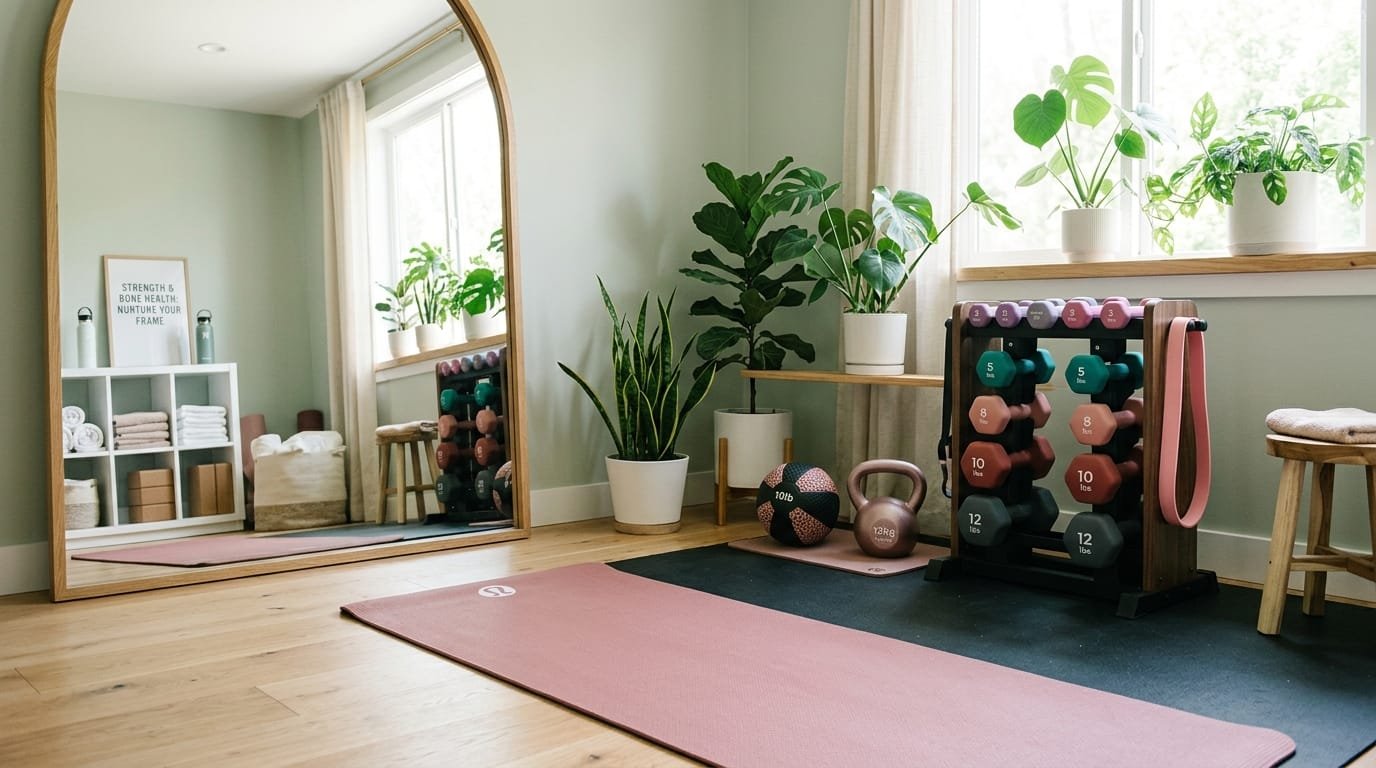
| Adjustable or fixed dumbbells | Progressive loading for squats, presses, rows, hinges, carries | Precise load progression, highly versatile, relatively compact | Highest |
| Kettlebell (one or two weights) | Swings, goblet squats, hinges, carries | Combines dynamic loading, axial stress, grip work, and posterior-chain emphasis | High |
| Resistance bands (multiple strengths) | Joint-friendly resistance, activation, regressions, accessory work | Low cost, portable, excellent for beginners or sensitive joints | High |
| Sturdy bench, step, or elevated surface | Hip thrusts, step-ups, Bulgarian split squats, incline pressing | Enables greater lower-body loading variety and progression | High |
| Optional weighted vest | Added axial loading during walking, step-ups, or bodyweight movements | Convenient way to increase bone-loading stimulus | Medium |
| Optional doorway pull-up bar or rings | Vertical pulling and hanging | Upper-body strength, grip, and posture support | Medium |
| Exercise mat and non-slip flooring | Comfort, joint protection, stability, safety | Foundational for floor-based work and injury prevention | Essential |
With dumbbells (or a kettlebell) plus bands and a sturdy elevated surface, most women can run a complete, progressive strength programme focused on both muscle and bone for years.
How These Tools Create Osteogenic (Bone-Building) Stimulus
Bone responds best to progressive, site-specific mechanical loading. The most relevant sites for fracture prevention are the spine and proximal femur (hip).
- Squats, step-ups, and lunges load the legs, hips, and spine.
- Hinges (Romanian deadlifts, kettlebell swings) load the posterior chain and spine.
- Hip thrusts and glute bridges emphasise the posterior hip.
- Upper-body presses and rows load the arms, shoulders, and upper back.
- Farmer and suitcase carries add grip demand and whole-body loading.
Dumbbells and kettlebells allow clear progressive overload—the gradual increase in load that continues to challenge bone and muscle. Bands provide accommodating resistance that many find comfortable on joints. When appropriate and cleared by a professional, controlled impact or higher-velocity movements can add further stimulus. Muscle strength itself increases the forces transmitted to bone during everyday movement, creating a positive cycle.
Key Movement Patterns and Recommended Exercises
Lower-Body and Posterior-Chain Emphasis (Highest Bone Relevance)
- Goblet squat or dumbbell front squat
- Romanian deadlift or single-leg Romanian deadlift
- Kettlebell swing or hinge variation
- Hip thrust or shoulder-elevated glute bridge (progress to weighted)
- Step-ups or reverse lunges
- Calf raises (straight- and bent-knee)
Upper-Body Patterns
- Dumbbell floor press, bench press, or push-up variations
- Single-arm dumbbell row or band row
- Overhead press or landmine press (only as tolerated and with good control)
- Lateral raises performed with attention to technique and joint comfort — detailed comparisons of bent-arm versus straight-arm variations and common technique errors are covered in Bent Arms vs. Straight Arms in Lateral Raises, The Hidden Mistake in Lateral Raises, and 3 Lateral Raise Modifications
Carries, Grip, and Core
- Farmer carries or suitcase carries — excellent for grip, core, and loading; grip strength itself responds well to targeted work (Do Hand Grippers Really Work?)
- Dead bugs, bird-dogs, side planks, or other anti-extension/anti-rotation drills
- Optional controlled core progressions once basic stability is solid
These patterns cover the major muscle groups and the skeletal sites most important for bone health and daily function.
Sample Weekly Training Structure
Recommended frequency: 2–4 resistance sessions per week (for example Monday / Wednesday / Friday, or a flexible equivalent).
Session template (approximately 35–50 minutes)
- Warm-up (5–7 minutes)
Light cardio or marching, band pull-aparts, bodyweight squats, hip hinges, and gentle shoulder mobility. - Main strength work (choose 4–6 exercises)
- Goblet or dumbbell squat – 3–4 sets of 6–10
- Romanian deadlift or kettlebell hinge – 3–4 sets of 6–10
- Hip thrust or glute bridge – 3 sets of 8–12
- Press variation – 3 sets of 6–12
- Row variation – 3 sets of 8–12
- Optional carry (20–40 seconds) or core work
- Optional short finisher
Weighted-vest walk, additional band work, or light conditioning.
Rest 60–120 seconds between sets according to the goal and how demanding the set felt. Focus on controlled tempo, especially the lowering phase, and stop each set with 1–3 repetitions in reserve while learning the movements.
Progression Principles for Strength and Bone
Progressive overload remains the central driver. Practical ways to progress at home include:
- Adding load when the top of the rep range is achieved with solid form
- Increasing repetitions within the target range
- Adding a set
- Slowing the eccentric portion of the lift
- Advancing to a harder variation (for example, from bilateral to single-leg work)
- Increasing training density by modestly reducing rest periods
For bone health, the key is sustained progressive loading over months and years rather than any single dramatic session. Strength gains typically appear within weeks; measurable changes in bone mineral density require longer consistent exposure (often 6–12 months or more).
Equipment Comparison for Bone and Strength Goals
| Tool | Bone-Loading Potential | Strength Potential | Joint Friendliness | Space & Cost Efficiency | Ideal Use Case |
|---|---|---|---|---|---|
| Adjustable dumbbells | High | High | Good | Excellent | Primary progressive tool for most women |
| Kettlebell | High (dynamic + axial) | High | Good | Excellent | Swings, squats, carries, hinges |
| Resistance bands | Moderate | Moderate to High | Excellent | Outstanding | Beginners, joint sensitivity, travel, accessory work |
| Weighted vest | High (axial during locomotion) | Moderate | Good | Good | Walking, step-ups, bodyweight progressions |
| Bodyweight only | Moderate (progression ceiling) | Moderate | Excellent | Free | Starting point or travel sessions |
A practical and highly effective combination for most women is a pair of adjustable dumbbells (or a small selection of fixed weights), one or two kettlebells, and a set of resistance bands.
Safety Considerations Specific to Bone Health
- Obtain medical clearance before beginning or significantly intensifying training if you have diagnosed osteoporosis, a history of fragility fractures, or multiple risk factors.
- Emphasise controlled technique and full attention to form, particularly in the early months.
- Prefer neutral-spine hinge patterns and supported variations if bone density is known to be low.
- Introduce higher-impact or higher-velocity movements only when strength, balance, and professional guidance support it.
- Include dedicated balance and posture work.
- Monitor joint response and regress promptly if symptoms increase.
- Pair training with fall-prevention measures (home safety, adequate lighting, strength, and balance).
- Support the programme with appropriate nutrition (protein, calcium, vitamin D) and recovery.
Step-by-Step Implementation Plan
- Clarify goals, available space, budget, and any medical considerations.
- Acquire the highest-priority tools (dumbbells or kettlebell + resistance bands + a sturdy elevated surface).
- Learn the fundamental movement patterns using light loads or bodyweight until technique is reliable.
- Schedule two to three full-body sessions per week as a sustainable starting point.
- Focus on consistent progressive overload while maintaining high-quality form.
- After 4–6 weeks, add variety (different implements, unilateral work, carries).
- Reassess strength, technique, and how you feel every 8–12 weeks and adjust the programme.
- Layer in balance training, mobility work, and recovery practices.
- Consider adding a weighted vest or pulling option as capacity improves.
- Commit to the long term—bone and strength adaptations accumulate over months and years of consistent effort.
Frequently Asked Questions
What is the single most valuable piece of equipment for bone health at home?
A progressive resistance tool such as adjustable dumbbells or a kettlebell that allows loaded squats, hinges, hip thrusts, and carries.
How many days per week should women train for bone-density benefits?
Two to four resistance sessions per week that include loading of the spine and hips, performed consistently over months, produce meaningful results.
Can resistance bands alone improve bone density?
They contribute valuable stimulus, especially for beginners or those with joint limitations, but progressive free-weight loading generally provides a stronger osteogenic signal.
Is strength training safe if I already have low bone density or osteoporosis?
Many women with osteopenia or osteoporosis can train safely and beneficially when exercise selection, technique, and progression are appropriate. Medical clearance and, ideally, guidance from a knowledgeable professional are recommended.
Do I need high-impact exercise such as jumping?
Impact can be beneficial when tolerated and properly progressed, but progressive resistance training alone delivers substantial benefits for both bone and muscle.
How long does it take to see changes in bone density?
Strength and muscle improvements often appear within weeks. Measurable changes in bone mineral density typically require consistent training over 6–12 months or longer.
Should walking or other cardio be included?
Yes. Weight-bearing cardio such as walking complements resistance training and supports overall cardiovascular and bone health.
How important is nutrition alongside training?
Very important. Adequate protein, calcium, vitamin D, and overall energy intake support both muscle and bone adaptation.
Can I start with bodyweight only?
Yes. Bodyweight movements are an excellent entry point. Plan to add external resistance once you can perform the basic patterns with good control for the target repetitions.
What if I have limited space or budget?
A single kettlebell or pair of dumbbells plus a set of bands and a sturdy chair or step can form a highly effective minimal setup.
Final Recommendation
Women who want to build strength and protect or improve bone health at home should prioritise progressive resistance tools—adjustable dumbbells or kettlebells, resistance bands, and a sturdy surface for hip thrusts and step-ups—and organise training around compound, weight-bearing movements performed consistently two to four times per week. This approach develops functional muscle, supports bone mineral density at the sites that matter most, improves balance and posture, and enhances long-term independence and confidence.
Begin with the essentials that fit your space and budget, master technique with manageable loads, and apply progressive overload steadily. Support the training with solid nutrition, recovery habits, and enjoyable movement such as walking. The cumulative effect of consistent, intelligently loaded strength training is one of the highest-return investments a woman can make in lifelong physical resilience and quality of life. Start with what you have available today, progress deliberately, and allow the benefits to compound over the coming months and years.