How to Build a Compact Apartment Gym That Fits in a Closet
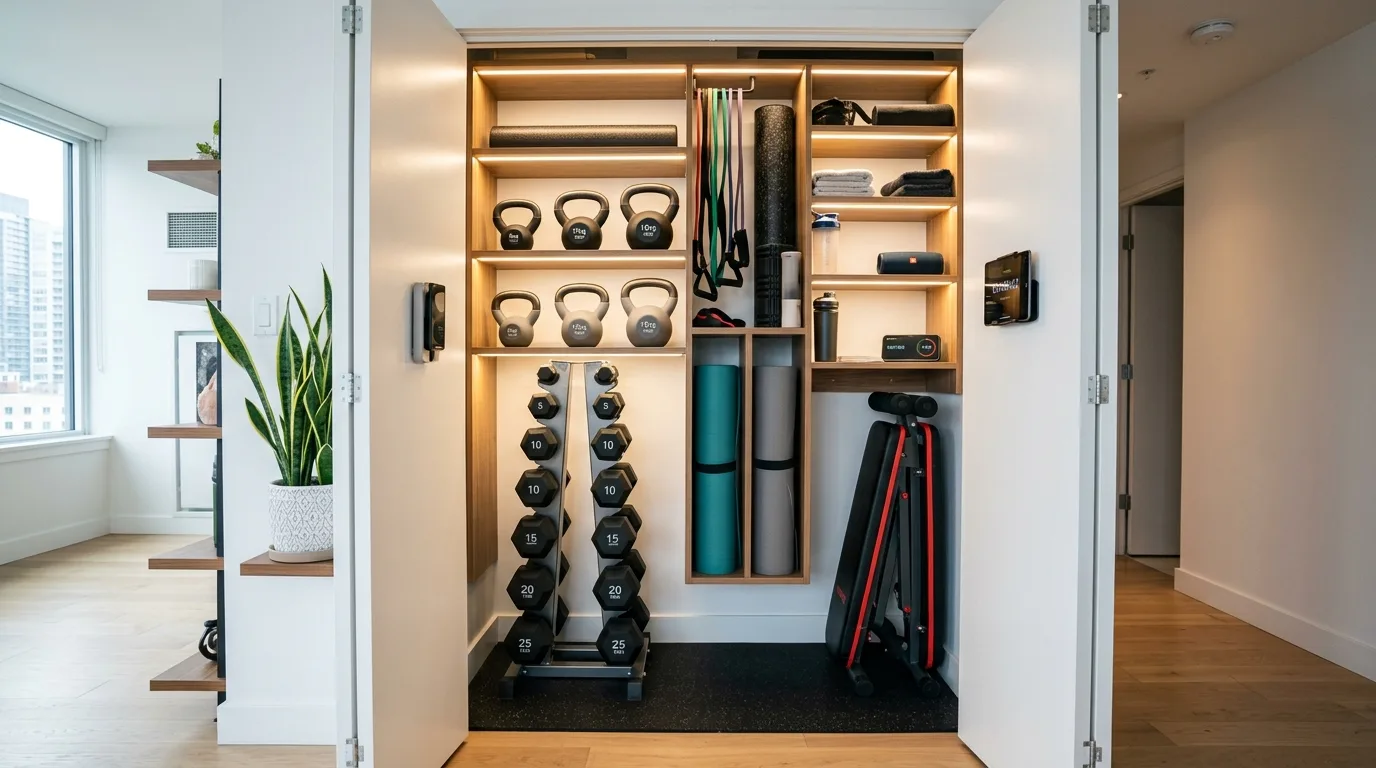
Quick Answer Yes, you can build a complete gym, progressive strength and conditioning gym that stores entirely inside a standard closet (or equivalent small footprint of roughly 2 × 3 to 3 × 4 feet) when not in use. The highest-value formula is a pair of adjustable dumbbells + a foldable bench + a removable doorway pull-up bar + a resistance-band set + a roll-up mat. These five items cover every major movement pattern — push, pull, squat, hinge, carry, and core — while allowing months to years of progressive overload. Total cost for quality versions typically lands between $350 and $650. Success depends on choosing multi-use, foldable, or vertically storable equipment and establishing fast set-up/pack-away routines so the apartment remains fully livable.
Why a Closet-Compatible Gym Is Realistic in 2026
Apartment living imposes strict constraints: limited floor area, noise transmission to neighbours, lease rules against permanent modifications, and the need for the space to function as a normal living area most of the time. Traditional gym equipment fails these tests. Modern compact solutions solve them by prioritising:
- Items that fold flat, stack vertically, or hang
- Zero or near-zero permanent installation
- Quiet operation
- Transition from storage to ready-to-train in under three minutes
Practical small-space guides and real-world apartment builds consistently demonstrate that a carefully chosen set of four to six pieces can deliver full-body strength, hypertrophy, and conditioning results comparable to much larger setups for beginners through early intermediates.
Core Equipment That Actually Fits in a Closet
| Item | Stored Footprint | Typical Cost (2026) | Apartment-Friendly Features | Training Role |
|---|---|---|---|---|
| Adjustable dumbbells (5–50 lb+) | 1–2 sq ft stacked | $150–$300 | Compact selector/dial design | Primary progressive strength tool |
| Foldable weight bench | 6–12 inches thick folded | $90–$160 | Folds flat or stands vertically | Presses, rows, step-ups, support |
| Removable doorway pull-up bar | Near zero (removes completely) | $25–$50 | No drilling, multi-grip | Vertical pulling, hangs, core |
| Resistance band set (loops + tubes) | Small bag or drawer | $20–$45 | Lightweight, highly portable | Assistance, mobility, added resistance |
| Roll-up exercise mat | Cylinder ~6–8 inches diameter | $20–$45 | Easy to stand in corner | Floor protection, core, mobility |
| Optional: One kettlebell or jump rope | Small shelf or floor corner | $15–$70 | Minimal footprint | Swings, carries, conditioning |
When packed correctly, the entire collection fits inside most standard coat or storage closets, under a bed, or behind a door.
In-Depth Equipment Selection and Storage Strategy
1. Adjustable Dumbbells – The Non-Negotiable Core One pair replaces an entire rack of fixed weights and occupies less floor space than a laundry basket. Prioritise secure locking mechanisms, comfortable handles, and a weight range that supports progression for at least 12–18 months (ideally starting at 5–10 lb and reaching 40–50+ lb per hand).
Store them stacked on the closet floor or on a low, sturdy shelf. For detailed criteria on weight range, adjustment speed, durability, and common failure points, see our complete guide: How to Choose the Best Adjustable Dumbbells for Home Gyms in 2026.
2. Foldable Bench A bench transforms dumbbells from limited tools into a near-complete station. It enables flat and incline presses, seated shoulder work, chest-supported rows, hip thrusts, Bulgarian split squats, and step-ups.
Choose models that fold to roughly 8–12 inches in thickness and can stand vertically or slide under furniture. Look for a total weight capacity of at least 500–600 lb. When folded, it should consume minimal closet depth.
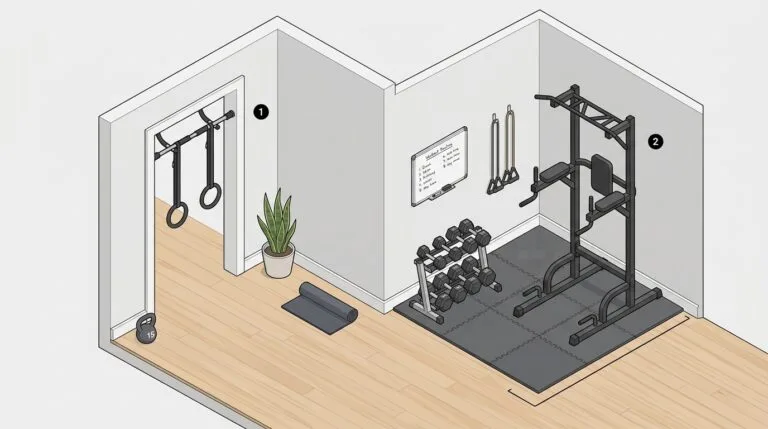
3. Pull-Up Solution A doorway pull-up bar that installs and removes in seconds is ideal for renters. Multi-grip designs (wide, narrow, neutral) increase exercise variety. Store it hanging inside the closet or flat against an interior wall. Pair it with bands for assistance progressions. This single item dramatically improves upper-back, biceps, and core development.
4. Resistance Bands Among the most space-efficient tools available. A combination of loop bands and tube bands with handles covers face pulls, band pull-aparts, assisted pull-ups, lateral walks, monster walks, and added resistance for lower-body work.
Store the entire set in a small pouch or drawer. Different styles serve different purposes — full comparison and recommendations are here: Resistance Bands Buying Guide: Loop vs. Tube vs. Fabric – Which Wins?.
5. Mat A quality roll-up mat protects floors, provides cushioning, and creates a clean surface for floor-based exercises. Store it rolled and standing in a closet corner or under the bench.
High-Value Optional Additions
- One mid-weight kettlebell (25–53 lb range) for swings, cleans, and carries. Sizing guidance: How Heavy Should My Adjustable Kettlebell Be?.
- Speed jump rope for efficient conditioning.
- Compact foam roller or massage tool for recovery.
Step-by-Step: From Empty Closet to Functional Gym
- Measure the closet precisely (width, depth, height) and the clear floor area you can temporarily use for training.
- Allocate the largest share of the budget to adjustable dumbbells.
- Purchase a foldable bench that matches your storage constraints.
- Add a removable pull-up bar and a complete resistance-band set.
- Include a roll-up mat for protection and floor work.
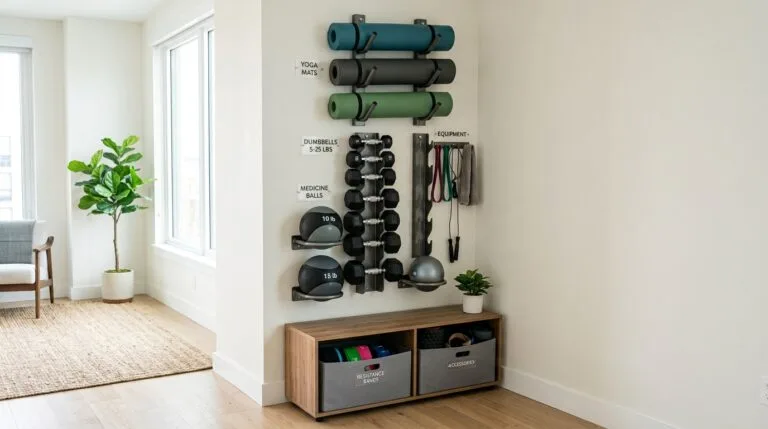
- Install simple vertical storage inside the closet (over-door hooks, narrow shelves, or a small rolling cart).
- Designate one consistent training zone in the apartment (living-room corner, cleared bedroom space, etc.).
- Practice and refine a rapid set-up routine until it takes under three minutes.
- Establish an equally fast pack-away routine so the space returns to normal appearance immediately after training.
- Begin with a simple progressive programme and track loads/reps so progression remains objective.
Sample Space-Efficient Programming
3-Day Full-Body Rotation (Minimal Footprint)
Day A – Squat & Push Focus Goblet squat or dumbbell front squat – 3–4 sets of 8–12 Dumbbell floor press or bench press – 3–4 sets of 8–12 Dumbbell overhead press – 3 sets of 8–12 Rear-foot-elevated split squat – 3 sets of 8–10 per leg Band face pulls – 3 sets of 15–20
Day B – Hinge & Pull Focus Romanian deadlift – 3–4 sets of 8–12 Pull-ups or band-assisted pull-ups – 3 sets near failure Single-arm dumbbell row – 3 sets of 10–12 per side Hanging knee raises or lying leg raises – 3 sets of 10–15 Optional kettlebell swings – 3 sets of 12–15
Day C – Mixed / Conditioning Emphasis Dumbbell thruster or squat-to-press – 3 sets of 10–12 Chin-ups or neutral-grip pull-ups – 3 sets near failure Walking lunges or reverse lunges – 3 sets of 10 per leg Band pull-aparts + face pulls – 3 sets of 15–20 Jump rope or high-rep band complex – 8–12 minutes
Keep rest periods moderate (60–90 seconds) and transitions short so the working footprint stays small. Progress by adding weight, increasing repetitions, or advancing to harder variations (e.g., from assisted to full pull-ups, from goblet to front-loaded squats).
Noise, Neighbour, and Lease Management
- Favour controlled tempos and avoid dropping weights.
- Always place a mat under the bench and dumbbells.
- Schedule heavier sessions during daytime hours when possible.
- Prefer equipment that requires no permanent wall anchors.
- Doorway bars, freestanding benches, and bands are generally lease-safe.
- If noise is a concern, emphasise higher-rep, slower-tempo work and band-assisted variations.
Long-Term Progression and Upgrade Path
With consistent progressive overload, many trainees use this exact setup productively for 12–24 months. When you begin to outgrow the dumbbell weight range, options include:
- Higher-capacity adjustable dumbbells
- Adding a second kettlebell
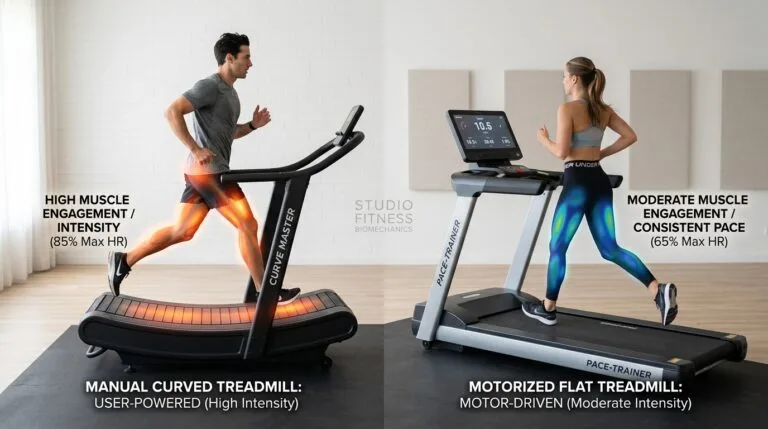
- Introducing a compact foldable walking pad for conditioning (stored vertically or under furniture)
- A single pair of gymnastics rings hung from the pull-up bar
Upgrade only one element at a time so storage remains manageable.
Integrating Technique, Grip, Core, and Recovery
Maintain healthy shoulder mechanics on all pressing and isolation work by applying the principles in safe lateral-raise technique. Develop grip strength to improve pull-up performance and loaded carries. Build core stability with ab-roller progressions once basic control is established.
Low-impact conditioning can be added later via outdoor walking or a compact option such as a foldable walking pad. Recovery tools like a budget massage gun store easily alongside the main kit.
External real-world examples of closet and ultra-compact apartment builds appear in current small-space guides, including detailed equipment and layout discussions from Home Gym Foundry and practical apartment setup resources.
Common Mistakes That Ruin Closet Gyms
- Buying bulky fixed dumbbells instead of adjustable ones
- Choosing a non-folding bench that cannot be stored
- Neglecting a pull-up solution and therefore under-training the back
- Failing to create a fast pack-away habit, so equipment permanently invades living space
- Ignoring floor protection and creating noise or damage issues
- Programming sessions that require large clear floor areas
- Upgrading too early before maximising the current equipment
Frequently Asked Questions
Can a genuinely effective strength programme fit inside a closet? Yes. Adjustable dumbbells, a foldable bench, pull-up bar, and bands provide progressive full-body training that stores completely when not in use.
How much clear floor space is required during workouts? Most sessions can be performed in a 6 × 4 ft to 8 × 6 ft area. The rest of the apartment remains available.
Is a foldable bench essential? Highly recommended. It multiplies exercise options while storing nearly flat.
How do I handle noise in an upstairs apartment? Use controlled tempos, a good mat, avoid dropped weights, and schedule sessions considerately. Bands and higher-rep work are essentially silent.
How long do set-up and pack-away actually take? With practice, 1–3 minutes each direction is realistic and sustainable.
Will I outgrow this setup quickly? With progressive overload, many people train effectively for 12–24 months before needing heavier resistance or one additional compact item.
Can cardio be included without losing closet space? Jump rope, outdoor walking or running, and highly compact foldable walking pads (stored vertically or under furniture) are the most space-efficient solutions.
What is the realistic total cost? A high-quality functional version typically ranges from $350 to $650 depending on the exact dumbbell and bench models chosen.
Final Recommendation
A compact apartment gym that fits entirely inside a closet is not only possible — it is one of the most practical and sustainable ways to train consistently in limited space. Prioritise adjustable dumbbells, a foldable bench, a removable pull-up bar, resistance bands, and a roll-up mat. These items deliver complete full-body progressive training while respecting space, noise, and lease constraints.
Master rapid set-up and pack-away routines, follow a simple progressive full-body programme, and track your loads and variations. Focus on consistency rather than accumulating more equipment. When these elements are in place, even the smallest apartment supports serious, long-term strength and fitness development without sacrificing living space or neighbour relations. Start with the core five items, refine the logistics, and expand only when the current setup is genuinely maxed out — your closet gym will remain both highly effective and completely invisible when not in use.