Folding vs Fixed Bench: Solving the Storage Problem in Small Homes
Quick Answer
For small homes the folding bench usually solves the storage problem more effectively than a fixed bench because it collapses to a fraction of its in-use size and can be stored vertically, under a bed, or against a wall. A quality folding adjustable bench still provides flat and incline positions for pressing, step-ups, and hip thrusts while freeing floor space when training ends. Fixed benches offer superior long-term stability and simpler construction but permanently occupy valuable square footage. Choose a folding model when storage and multi-use rooms are the priority; choose a fixed bench only when the training area is dedicated and space is not constrained.
The Core Problem: Space in Small Homes
In apartments, studio flats, spare bedrooms, and multi-purpose rooms every piece of equipment must justify its footprint. A traditional fixed weight bench (often 45–55 inches long and 12–18 inches wide) becomes a permanent obstacle. It blocks walking paths, prevents the room from serving other functions, and creates visual clutter that reduces motivation to train.
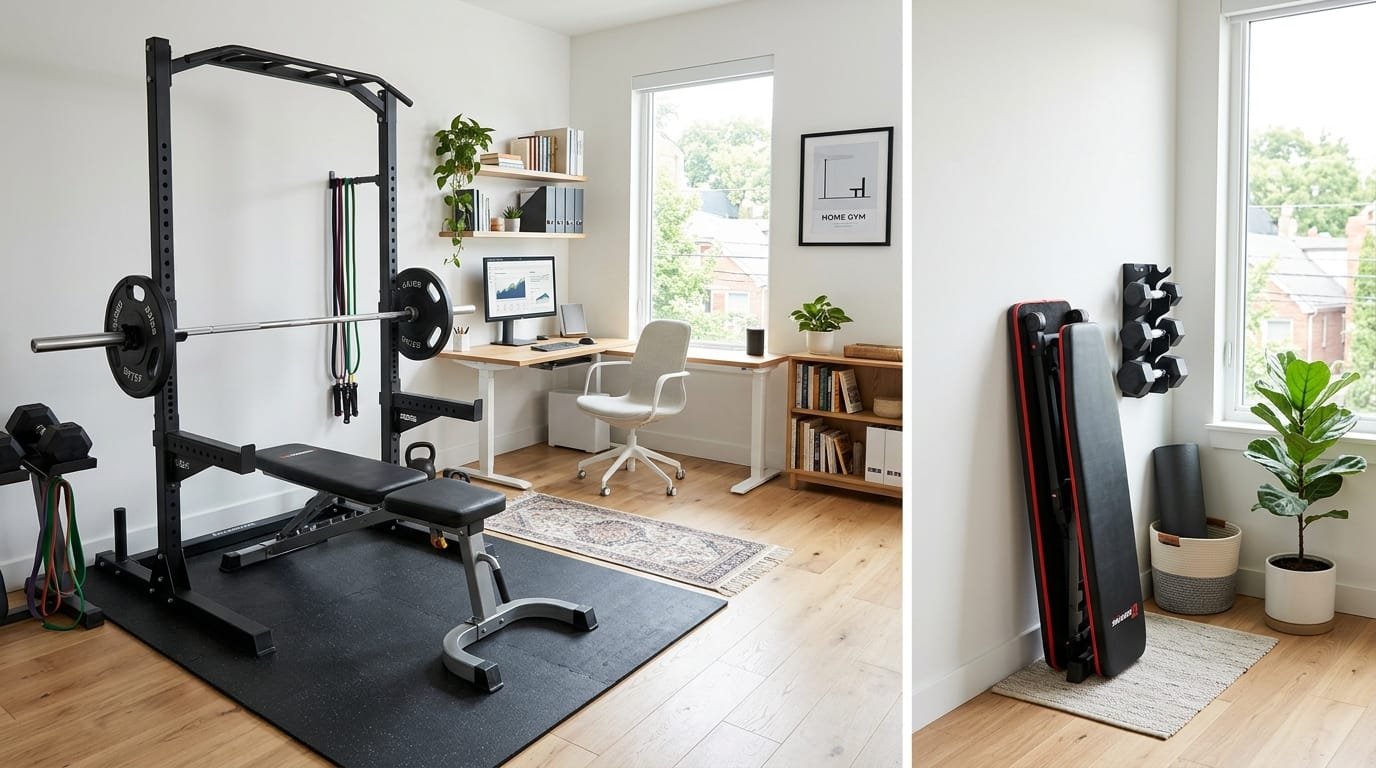
Folding benches were designed precisely for this constraint. When the session finishes they reduce to a slim profile that can disappear into a closet, slide under furniture, or stand against a wall. The decision between folding and fixed therefore hinges less on training performance and more on whether the bench can live in the space without dominating it.
Clear Definitions
Fixed Bench
A non-collapsible frame with a permanent pad. It may be flat-only or adjustable (FID – flat, incline, decline). The structure stays fully assembled at all times.
Folding Bench
A bench whose frame is engineered to collapse. Most modern versions are adjustable and lock securely in flat and incline positions, then fold for storage. Some fold completely flat; others collapse into a more compact vertical or upright shape.
Direct Comparison for Small-Home Use
| Factor | Folding Bench | Fixed Bench | Advantage for Small Homes |
|---|---|---|---|
| In-use footprint | Similar to fixed | Full size | Equal |
| Stored footprint | Dramatically smaller | Unchanged | Folding |
| Storage flexibility | Vertical, under bed, closet, against wall | Requires dedicated floor space | Folding |
| Stability under load | Good to very good on quality models | Excellent | Fixed (slight edge) |
| Adjustability | Usually flat + multiple inclines | Can be flat-only or full FID | Comparable |
| Weight capacity | 500–1000 lb+ on reputable models | Often higher | Fixed (minor) |
| Setup / takedown time | 10–30 seconds | None | Fixed (for storage) |
| Long-term durability | Hinges and locks are potential wear points | Fewer moving parts | Fixed |
| Cost | Mid-range | Budget to premium | Depends on model |
| Best suited for | Multi-use rooms, apartments, temporary setups | Dedicated gym rooms | Folding |
For the majority of people living in small homes the storage advantage of a folding bench outweighs the marginal stability edge of a fixed design.
What Makes a Folding Bench Actually Work in Limited Space
Not every folding bench solves the problem equally well. Key features that matter:
- True compact folded dimensions – Look for models that fold to roughly 10–16 inches in depth or stand vertically at a manageable height.
- Secure locking mechanisms – Pop-pins, spring locks, or dual-locking systems that eliminate wobble when the bench is in use.
- Reasonable weight – Light enough to move easily yet heavy enough to feel stable.
- Pad quality – Firm 2–2.5 inch pads that do not require excessive bulk.
- Leg design – Wide enough base for safety without creating an oversized footprint.
- Transport handles or wheels – Helpful when the bench must be moved daily.
A folding bench that still feels flimsy or takes up nearly as much space when collapsed defeats the purpose.
Stability Realities of Folding Benches
Early folding benches earned a reputation for flex and wobble. Modern designs have closed much of that gap. When the locking system is properly engaged, a well-engineered folding bench supports heavy dumbbell presses, hip thrusts, and step-ups with confidence.
The remaining differences appear mainly at the extremes: very heavy barbell work or explosive movements. For the typical small-home trainee using dumbbells, kettlebells, and bodyweight, a quality folding bench provides more than adequate stability.
Training Capability: What You Can Still Do
Both bench types support the essential movement patterns required for a complete home programme:
- Flat and incline pressing
- Supported rows (one-arm dumbbell rows)
- Hip thrusts and glute bridges
- Step-ups and Bulgarian split-squat rear-foot elevation
- Seated shoulder work
- Core exercises that benefit from elevation
Shoulder-friendly pressing and raising technique remains important regardless of bench type. Detailed guidance is available in Bent Arms vs. Straight Arms in Lateral Raises, The Hidden Mistake in Lateral Raises, and 3 Lateral Raise Modifications. Grip strength also influences dumbbell control on pressing and rowing movements (Do Hand Grippers Really Work?).
Step-by-Step Decision Process for Small Homes
- Measure the exact floor area available during training and the potential storage locations (closet depth, under-bed clearance, wall space).
- Decide whether the room must return to non-gym use after every session.
- List the exercises you perform most frequently and confirm both bench types support them.
- Set a budget that prioritises locking quality and pad firmness over maximum features.
- Shortlist folding models whose folded dimensions fit your storage measurements.
- Read recent owner reviews that specifically mention stability during heavy dumbbell work and ease of folding.
- Check weight capacity and warranty terms.
- Confirm the return policy in case the bench feels different in your actual space.
- Once purchased, practise the fold/unfold sequence until it becomes automatic.
- Establish a consistent storage habit so the bench never becomes permanent clutter.
Storage Strategies That Maximise the Folding Advantage
- Vertical storage against a wall or inside a closet
- Sliding under a bed or sofa (measure clearance first)
- Standing beside a power rack or in a corner
- Hanging on a heavy-duty wall bracket if the design allows
- Combining with a wall-mounted or fold-away rack system for a near-invisible setup
The easier the storage process, the more consistently the bench will be put away—and the more willingly you will train.
When a Fixed Bench Still Makes Sense
A fixed bench remains the better choice when:
- You have a dedicated room that does not need to serve other purposes
- You regularly perform very heavy barbell pressing and want maximum rigidity
- You prefer zero setup time and the simplest possible construction
- Storage space is genuinely not a constraint
In every other small-home scenario the folding design solves the larger practical problem.
Cost and Long-Term Value
Folding benches typically cost more than basic fixed flat benches but less than premium commercial fixed FID benches. The real value calculation includes the opportunity cost of lost floor space. A cheaper fixed bench that forces you to rearrange furniture before every session or reduces training frequency is more expensive in the long run.
Home-gym planning resources consistently recommend space-efficient, multi-use equipment for apartments and shared living situations (home gym equipment prioritisation and budget home gym principles). Strength training itself remains highly effective for building muscle and resilience when the equipment supports consistent use (strength training guidance).
Maintenance Differences
Folding benches require occasional attention to hinges, locks, and pivot points. Keep them clean and lightly lubricated according to the manufacturer’s instructions. Check locking pins for wear.
Fixed benches need little more than pad cleaning and occasional bolt checks.
Neither type demands significant time if basic care is performed.
Common Mistakes When Choosing for Small Homes
| Mistake | Result | Better Approach |
|---|---|---|
| Buying a folding bench that barely folds smaller | Minimal space savings | Verify exact folded dimensions |
| Choosing the lightest possible folding model | Excessive flex under load | Prioritise locking quality and user reviews on stability |
| Assuming all fixed benches are more stable | Unnecessary space sacrifice | Test or research modern folding designs |
| Ignoring storage pathway | Bench becomes hard to move | Measure the full route to the storage location |
| Neglecting pad firmness | Discomfort on longer sets | Look for dense 2–2.5 inch pads |
| Failing to establish a storage routine | Bench stays out permanently | Make putting it away part of the workout habit |
Frequently Asked Questions
Are folding benches stable enough for heavy dumbbell presses?
Yes, provided the model has a solid frame and secure locks. Many users successfully perform heavy floor-press and incline work on quality folding benches.
How small do folding benches actually get?
Good designs fold to roughly the thickness of a large suitcase or stand vertically in a closet-friendly height. Always check the manufacturer’s folded dimensions.
Can I do hip thrusts on a folding bench?
Yes. Most folding benches support hip thrusts when the pad is secure and the frame is locked.
Is a fixed flat bench better than a folding adjustable if I only need flat?
Only if space is truly unlimited. Even a flat folding bench can free the room after training.
Do folding benches last as long as fixed ones?
High-quality folding benches last many years with basic maintenance. The hinges and locks are the main wear points to monitor.
What weight capacity should I look for?
A rating of 600 lb or higher covers the majority of home dumbbell and bodyweight use with a safety margin.
Can a folding bench fit inside a power rack?
Many can, but measure both the bench and the rack’s internal dimensions carefully.
Should I buy used folding benches?
Only if you can verify the condition of the locks, hinges, and frame. Safety-critical wear is harder to assess on used adjustable folding models.
Final Recommendation
In small homes the folding bench is the practical solution to the storage problem. It delivers the essential training functions of a fixed bench while collapsing into a fraction of the space when the session ends. Prioritise secure locking mechanisms, verified folded dimensions, and firm padding over maximum features or the absolute lowest price.
Measure your training and storage areas, choose a folding design that fits both, and make the fold-and-store process automatic. The result is a usable living space and a bench you actually set up consistently. Pair it with sound technique on pressing and accessory movements, progressive training, and basic equipment care.
A well-chosen folding bench removes one of the biggest barriers to sustainable home training in limited square footage. Select the model that disappears when you need the room and supports your lifts when you need to train—the combination of space efficiency and training capability is what makes long-term progress possible in a small home.