
How to Stay Consistent with Home Workouts When Motivation Drops
Quick Answer
When motivation drops, consistency with home workouts is maintained by systems rather than feelings. Schedule sessions like non-negotiable appointments, define a minimum viable workout for low-energy days, reduce environmental friction, stack training onto existing habits, track progress visibly, and never miss twice in a row. Motivation fluctuates; well-designed habits and environment do not. Implement these strategies and training with dumbbells, kettlebells, resistance bands, and bodyweight becomes sustainable even when you do not feel like exercising.
Why Motivation Is Unreliable and Systems Are Not
Motivation is a temporary emotional state influenced by sleep quality, stress, workload, weather, and dozens of other variables. Exercise-adherence research consistently shows that a large percentage of people who begin a new training programme drop out within the first several months. The separating factor between those who continue and those who stop is rarely willpower or innate discipline — it is the presence of robust behavioural systems that make showing up easier than skipping.
Home training eliminates some barriers (travel time, gym fees, crowds) but creates others: the couch is only a few steps away, there is no external social pressure, and the boundary between living space and training space can blur. The solution is deliberate habit design, environmental engineering, and pre-commitment strategies that function when motivation is low.
High-Leverage Consistency Strategies
| Strategy | Psychological Mechanism | Practical Application | Long-Term Effect |
|---|---|---|---|
| Fixed schedule | Removes daily decision fatigue | Block exact days/times on calendar | High adherence |
| Minimum viable workout | Protects the habit loop | Pre-define a 5–10 min version | Prevents zero days |
| Friction reduction | Makes starting the path of least resistance | Prepare clothes & equipment in advance | Higher start rate |
| Habit stacking | Uses existing cues | Link training to coffee, work end, etc. | Faster automaticity |
| Visible tracking | Provides feedback & streak motivation | Simple log or calendar | Sustains momentum |
| Never miss twice | Stops single misses from becoming patterns | Prioritise the next session aggressively | Protects long-term behaviour |
| Identity-based framing | Shifts focus from outcomes to self-concept | “I am someone who trains at home” | Deeper resilience |
1. Schedule Workouts as Non-Negotiable Appointments
Decide in advance the exact days and times you will train and enter them into your calendar with the same priority as work meetings or important personal commitments. Implementation-intention research demonstrates that people who create specific plans for when, where, and how they will exercise are significantly more likely to follow through than those who set only vague goals (“I should work out more”).
Begin with three sessions per week if you are rebuilding consistency. Once the pattern is established, adding a fourth or fifth day becomes far easier.
2. Define and Use a Minimum Viable Workout
On low-motivation days the full planned session can feel overwhelming, leading to complete abandonment. Counter this by writing down a minimum viable workout that you commit to completing no matter what:
- 8–10 minutes of band pull-aparts, glute bridges, bodyweight squats, and a short plank or hang
- One challenging set each of a squat/hinge, push, and pull pattern
- A brisk walk plus five minutes of mobility
Completing even a fraction of the intended work preserves the behavioural pattern of showing up. Studies indicate that partial completion protects the habit loop far better than skipping the session entirely.
3. Reduce Friction to Near Zero
Every additional step between you and the first repetition increases the probability of skipping. Apply choice-architecture principles:
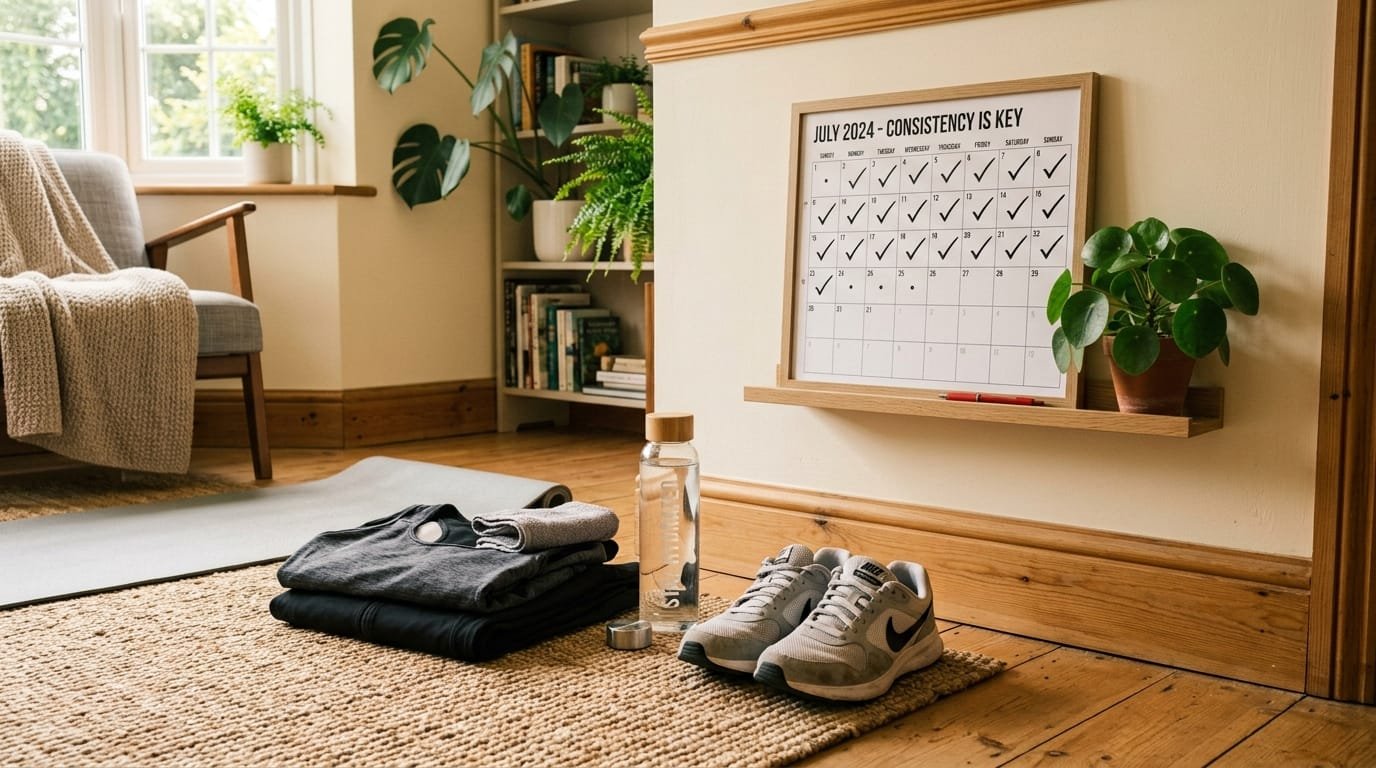
- Lay out training clothes the night before
- Keep dumbbells, kettlebells, bands, and mat in a visible, ready-to-use location
- Prepare the training space so zero setup is required
- Choose a consistent time of day so the cue becomes automatic
Proximity and convenience are among the strongest predictors of exercise frequency. Design the environment so the easiest available action is to begin training.
4. Habit Stacking – Anchor Training to Existing Behaviours
Attach the workout to a habit you already perform reliably:
- After morning coffee → begin the training session
- Immediately after finishing work → change clothes and train before sitting down
- After putting children to bed → short evening session
The established habit serves as the cue, dramatically reducing the need for motivation or conscious decision-making.
5. Track Progress Visibly and Simply
A basic workout log, wall calendar with completed-session marks, or simple phone app supplies immediate feedback and creates a visual chain most people are reluctant to break. Record load, repetitions, and a quick note on how the session felt. Review the log weekly. Visible progress is one of the most reliable sources of sustainable drive. Comprehensive methods are detailed in Best Ways to Track Progress Without a Gym or Personal Trainer.
6. Enforce the “Never Miss Twice” Rule
One missed session is simply a rest day. Two consecutive missed sessions begin to form a new pattern. When a session is missed, elevate the next scheduled workout to near-highest priority for that day. This single rule prevents temporary setbacks from becoming permanent derailments.
7. Move from Outcome Goals to Identity-Based Goals
Outcome goals (lose a certain amount of weight, lift a specific load) are useful but fragile when progress slows. Identity-based goals (“I am someone who trains at home consistently”) create more durable behaviour. Every completed session becomes evidence supporting the identity you are constructing.
Step-by-Step System for Low-Motivation Periods
- Set a fixed weekly schedule and treat it as non-negotiable.
- Write down your minimum viable workout and keep it visible.
- Prepare clothes, equipment, and space the night before.
- Stack the session onto a reliable existing habit.
- Begin with the smallest possible action (put on training shoes, roll out the mat).
- Complete at least the minimum viable version.
- Log the session immediately.
- If a session is missed, protect the next one at all costs.
- Review weekly and change only one variable at a time.
- Revisit your identity statement regularly.
Practical Low-Motivation Session Templates
5–10 Minute Minimum
- Band pull-aparts – 2 × 15
- Glute bridges – 2 × 12
- Bodyweight squats – 2 × 10
- Dead hang or plank – 20–40 seconds
15–20 Minute “Good Enough” Session
- Goblet squats or kettlebell swings – 3 sets
- Push-ups or band rows – 3 sets
- Hip hinges or single-leg work – 3 sets
- Brief core finisher
These sessions maintain the habit and still deliver a meaningful stimulus when energy is limited.
Linking Consistency Strategies to Your Full Home Programme
Apply the same scheduling, minimum-viable, and friction-reduction principles across all training elements: lateral raises and shoulder work (safe lateral-raise technique and shoulder health routine), kettlebell sessions (kettlebell sizing guide), grip training (grip strength guidance), band work (Resistance Bands Buying Guide), core progressions (ab roller), and conditioning (manual treadmill guidance).
Recovery practices, sleep, and mobility become easier to sustain when they are also scheduled and tracked (Sleep and Recovery Strategies, Best Post-Workout Recovery Tools, Best Massage Gun for Post-Workout Recovery on a Budget, and Mobility Routine to Pair with Strength Training for Better Form).
External behavioural research consistently demonstrates that reducing friction, forming implementation intentions, protecting the habit loop with minimum sessions, and preventing consecutive misses are among the highest-leverage approaches for long-term exercise adherence (workout consistency strategies and practical home-workout habit formation guidance).
Common Consistency Killers and Evidence-Based Fixes
- All-or-nothing thinking → Pre-define and use the minimum viable workout
- Daily decision fatigue → Fix the schedule in advance and treat it as non-negotiable
- Environmental friction → Prepare space and equipment ahead of time
- Lack of feedback → Track sessions and review weekly
- Fragile outcome-only goals → Add identity-based framing
- Allowing one miss to cascade → Strictly enforce the never-miss-twice rule
Frequently Asked Questions
What should I do if I miss an entire week?
Restart with the minimum viable workout and the original schedule. Do not attempt to “make up” missed volume; simply resume the pattern.
How long does it take for home workouts to feel automatic?
Many people report that the behaviour begins to feel normal after 8–16 weeks of consistent repetition, although individual timelines vary.
Is it better to train every day while building the habit?
No. Three to five well-spaced sessions per week with recovery days is more sustainable and productive for most individuals.
What time of day produces the highest adherence?
The best time is the one you can protect most reliably. Morning sessions often show higher consistency because fewer competing obligations have accumulated, but the optimal slot is personal.
Can apps improve consistency?
Yes, provided they reduce friction rather than add complexity. Simple, reliable logging is more important than advanced features.
How do I maintain the habit during travel or disrupted schedules?
Pack a resistance band or plan bodyweight minimum sessions. Protect the behavioural pattern even if the training stimulus is reduced.
Does motivation ever play a useful role?
Yes. When motivation is present, use it to drive progressive overload and harder sessions. Build systems so that progress continues on the days motivation is absent.
What is the single most important rule?
Never miss twice in a row. Protecting the next session after a miss prevents temporary lapses from becoming permanent.
Final Recommendation
Stay consistent with home workouts when motivation drops by replacing dependence on feelings with robust systems: a fixed schedule treated as non-negotiable, a pre-defined minimum viable session, deliberate reduction of environmental friction, habit stacking, simple visible tracking, and the never-miss-twice rule. Shift part of your focus from pure outcome goals to the identity of someone who trains at home regularly.
These strategies transform training with dumbbells, kettlebells, bands, and bodyweight into a resilient practice that survives busy periods, low energy, and fluctuating motivation. Begin today by blocking your next three sessions on the calendar, writing down your minimum workout, and preparing the environment tonight. Consistency is built one protected session at a time — start now and let the system carry you forward.