Treadmill vs. Elliptical vs. Rower: Which Burns More Calories for the Time?
Quick Answer
When intensity and duration are matched, the treadmill (running or brisk incline walking) typically produces the highest calorie burn, followed by the rower, with the elliptical generally ranking third. Calorie expenditure is driven more by how hard you work and how much muscle mass you recruit than by the machine itself. At the same rating of perceived exertion, research shows the treadmill often elicits greater energy expenditure and higher maximal fat-oxidation rates than the elliptical or rower. The best machine for you is the one you can use consistently at a challenging intensity while recovering well.
Why Calorie Burn Differs Between These Machines
Energy expenditure during cardio depends on four main factors:
- Total muscle mass recruited
- Force production against gravity or resistance
- Exercise economy and technique
- Sustainable intensity for a given individual
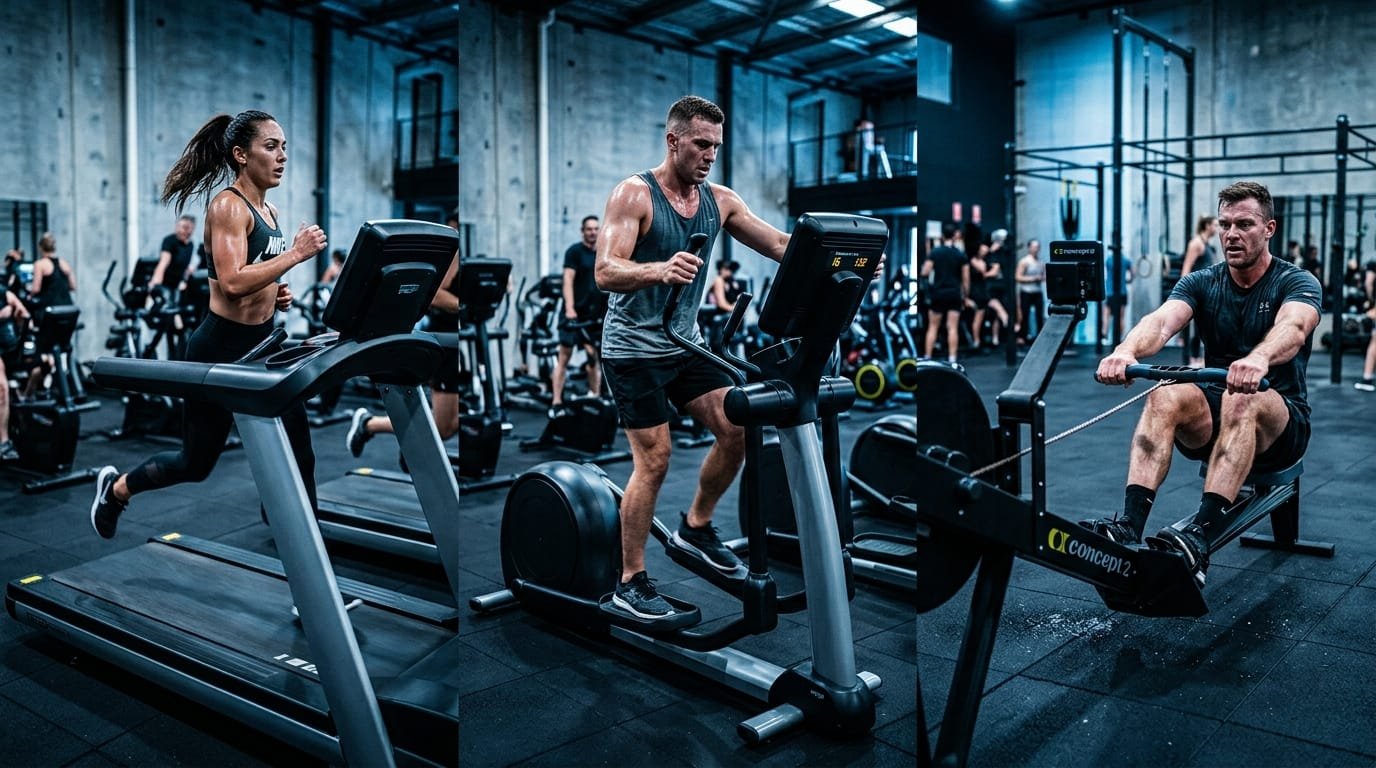
The treadmill requires continuous support of full body weight and large lower-body force production, especially during running or steep incline walking. Rowing is a true full-body movement (legs drive, core stabilises, back and arms pull) performed in a seated, low-impact environment. The elliptical supports body weight on a fixed path and typically involves less total force production unless resistance and arm action are deliberately maximised.
Studies comparing the three modalities at matched relative intensities consistently place the treadmill at or near the top for both total energy expenditure and maximal fat oxidation.
Evidence-Based Calorie and Metabolic Comparison
| Machine | Approx. Calories (30 min, ~70–80 kg person, moderate–hard effort) | Relative Energy Expenditure Ranking | Maximal Fat Oxidation | Impact Level | Muscle Recruitment |
|---|---|---|---|---|---|
| Treadmill (run / incline walk) | 300–500+ kcal | Highest in most matched-RPE studies | Highest | Higher | High (lower-body dominant) |
| Rower | 250–450 kcal | High | Lower than treadmill | Low | Very high (full body) |
| Elliptical | 200–350 kcal | Moderate | Lower than treadmill | Low | Moderate–High |
These ranges are estimates. Actual values scale with body weight, exact intensity, and technique. ACE-sponsored research comparing ten indoor machines found the treadmill among the highest for energy expenditure across effort levels. A dedicated study on maximal fat oxidation reported significantly higher rates on the treadmill (0.61 g/min) than on the elliptical (0.41 g/min) or rower (0.40 g/min), even though peak oxygen consumption was similar across the three modes (maximal fat oxidation comparison).
Detailed Analysis of Each Machine
Treadmill
Running or fast incline walking produces high ground-reaction forces and continuous large-muscle activation. Incline walking can approach running calorie burn with reduced impact. Speed and grade are easy to quantify and progress.
Advantages: Highest average calorie burn at matched effort, excellent specificity for outdoor running, precise intensity control.
Drawbacks: Greater joint loading for some users; form breakdown under fatigue can increase injury risk.
Best uses: Maximum calorie expenditure in limited time, running-specific training, incline walking for lower-impact high burn.
Rower
A proper rowing stroke sequences leg drive, hip hinge, core bracing, and arm pull. Because so much muscle mass works in coordination, metabolic demand is high relative to the low-impact nature of the exercise. Technique strongly influences power output and calorie burn — inefficient strokes reduce both.
Advantages: Full-body recruitment, low impact, simultaneous cardio and muscular endurance stimulus, easy to perform intervals.
Drawbacks: Learning curve for efficient technique; lumbar spine requires good bracing and hip mobility.
Best uses: Time-efficient full-body conditioning, low-impact high-calorie sessions, mixed strength-endurance training.
Elliptical
The elliptical supports body weight and constrains movement to a fixed path, lowering impact forces. Calorie burn is meaningful but usually lower than treadmill running or hard rowing at the same perceived exertion because total mechanical work is often less. Actively pushing and pulling the handles increases upper-body contribution and energy cost.
Advantages: Very low impact, easy to sustain for longer durations, joint-friendly for many users.
Drawbacks: Easier to under-challenge intensity; lower average calorie burn at matched RPE in comparative studies.
Best uses: Active recovery, longer steady-state sessions, training when joints need protection.
What Matters More Than Machine Choice
Intensity
Raising speed, resistance, incline, or stroke rate increases calorie burn on every machine more than switching machines at an easy pace. A hard elliptical session can out-burn an easy treadmill walk.
Body Weight
Heavier individuals expend more energy at the same workload. Absolute calorie numbers scale with mass.
Duration and Frequency
Four 40-minute sessions per week on any machine will outperform two “higher-burn” sessions. Consistency multiplies results.
Technique and Economy
Efficient rowing or proper running mechanics maximise power output. Poor form either wastes energy or forces intensity down.
Individual Enjoyment and Recovery
The machine you use hard and recover from is the one that produces long-term calorie expenditure and fitness gains.
Practical Decision Guide
| Primary Goal | Recommended Machine | Secondary Option | Reason |
|---|---|---|---|
| Max calories per minute | Treadmill (run or steep incline) | Rower | Highest EE at matched effort |
| Full-body low-impact training | Rower | Elliptical | High muscle recruitment, low joint stress |
| Joint-friendly longer sessions | Elliptical | Incline treadmill walking | Lowest impact, easy to sustain |
| Beginner or return from layoff | Elliptical or easy incline walk | Rower with light resistance | Controllable intensity |
| Mixed cardio + strength stimulus | Rower or treadmill intervals | — | High metabolic demand |
Step-by-Step Protocol to Maximise Calorie Burn
- Select the machine you will use most consistently.
- Warm up 3–5 minutes at easy intensity.
- Work at a challenging sustainable effort (RPE 6–8/10, speaking only short phrases).
- Use intervals if desired (e.g., 1–3 min hard / 1–2 min easy).
- Progress duration, intensity, or both weekly.
- Track time, workload metrics (speed/grade, stroke rate/resistance, resistance level), and session RPE.
- Occasionally weigh before and after longer sessions to understand sweat rate and intensity.
- Pair cardio with strength training for superior body-composition outcomes.
- Prioritise sleep and recovery so hard sessions remain productive.
- Reassess every 4–6 weeks and adjust machine or programming as needed.
Integrating Machine Cardio with Home Strength Training
Calorie burn is only one variable. Combining cardio with progressive strength work improves body composition more effectively than cardio alone. Maintain shoulder health during any upper-body or raising work by applying the principles in safe lateral-raise technique and the shoulder health routine.
Kettlebell swings, complexes, and carries provide high-calorie metabolic conditioning that complements machine sessions (kettlebell sizing guide). Grip strength directly supports better rowing performance and loaded carries (grip strength guidance.
Band work and core training remain valuable on cardio-focused days (Resistance Bands Buying Guide and ab-roller progressions). Treadmill-specific considerations are covered in Does a Manual Treadmill Burn Belly Fat?.
Recovery tools, sleep, and hydration determine how well you adapt to higher-calorie sessions (Best Post-Workout Recovery Tools, Best Massage Gun for Post-Workout Recovery on a Budget, Sleep and Recovery Strategies, and Hydration and Electrolyte Needs for Intense Home Cardio Sessions). Tracking ensures intensity stays progressive (Best Ways to Track Progress Without a Gym or Personal Trainer).
External comparative data from ACE and metabolic research confirm that the treadmill frequently leads in energy expenditure and fat oxidation, while the rower offers an excellent full-body alternative and the elliptical provides the lowest impact option (ACE machine energy-expenditure study and fat-oxidation findings).
Common Myths Debunked
- “The machine that feels hardest always burns the most.” → Perceived exertion can be high on the elliptical while absolute mechanical work remains lower.
- “Rowing always beats running for calories.” → Not at matched relative intensity; body-weight support and impact forces on the treadmill often produce higher expenditure.
- “Low-impact equals low calorie burn.” → Hard rowing disproves this.
- “Machine calorie counters are accurate.” → They are estimates and frequently optimistic. Use them for trends, not absolute numbers.
- “One machine is universally best.” → Individual biomechanics, joint health, and adherence matter more than average rankings.
Frequently Asked Questions
Which machine burns the most calories in 30 minutes?
At matched hard effort, the treadmill (running or steep incline walking) usually ranks highest, followed by the rower, then the elliptical. Individual physiology and technique cause variation.
Is the rower better for overall fitness?
It delivers excellent full-body muscular and cardiovascular stimulus with low impact, making it one of the most time-efficient options available.
Can the elliptical match treadmill calorie burn?
Only if resistance and pace are pushed substantially higher. At the same perceived effort, the elliptical typically expends fewer calories.
Should calorie burn be the main decision factor?
No. Consistency, joint comfort, enjoyment, and recovery determine long-term results more than small differences in calories per session.
How accurate are the on-machine calorie readouts?
They are rough estimates. Heart-rate-based or laboratory measurements are more accurate but unnecessary for most home users. Track trends rather than absolute numbers.
What if I have knee or hip issues?
Begin with the elliptical or rower. Incline walking on the treadmill is frequently better tolerated than flat running.
Do intervals change the ranking?
High-intensity intervals raise calorie burn on all three machines. The relative order often remains similar, although absolute differences can shift depending on the protocol and individual strengths.
How should I combine these machines with strength training?
Use cardio sessions on separate days or after strength work. Keep total weekly stress manageable and prioritise recovery so both qualities improve.
Final Recommendation
For maximum calorie burn per unit of time at matched effort, the treadmill generally leads, the rower is a close full-body alternative, and the elliptical trails while offering the lowest impact. Choose the machine that lets you work hard, recover well, and train consistently. Intensity and adherence outweigh small differences in average energy expenditure.
Combine regular cardio with progressive strength training, solid recovery practices, and simple tracking for the best body-composition and fitness outcomes. Test each machine for several weeks at challenging intensities, monitor performance and recovery, and select the one you will use most often. The highest-calorie machine in practice is the one you actually use hard, week after week. Start with the option that fits your joints and schedule, push the intensity, and stay consistent — results follow.