
How to Program Around Lingering Aches Without Stopping Completely
Quick Answer
Program around lingering aches without stopping completely by reducing or removing the specific movements that aggravate symptoms, substituting pain-free alternatives that train the same pattern, lowering volume and intensity on affected areas, and maintaining training frequency for the rest of the body. Keep sessions productive by emphasising non-aggravating patterns, controlled tempos, and recovery habits. Most minor aches improve when the irritating stress is temporarily reduced while overall activity continues.
Understanding Lingering Aches vs. Serious Injury
Lingering aches are low-grade, persistent discomforts that appear during or after certain movements but do not involve sharp pain, significant swelling, instability, or loss of function. They are common in consistent trainees and often result from accumulated stress, minor technique issues, sudden increases in volume, or incomplete recovery. Complete rest is rarely required and can sometimes slow resolution by reducing tissue capacity. The goal is intelligent modification: remove or reduce the aggravating stress while continuing to train everything else.
Core Principles for Training Around Aches
- Pain-free or near pain-free movement only – Discomfort that changes movement quality or worsens during the set is a signal to modify.
- Maintain training frequency – Keep showing up; change the content of the sessions.
- Preserve the movement pattern when possible – Find a variation that trains the same pattern without symptoms.
- Reduce volume and intensity on the affected area – Lower stress while tissues calm.
- Train the rest of the body normally – Overall fitness and momentum continue.
- Support recovery deliberately – Sleep, protein, and stress management influence how quickly aches resolve.
- Reintroduce gradually – Return to the original movement only after symptoms have been stable.
Decision Framework: Push, Modify, or Regress
| Symptom Presentation | Recommended Action | Example Adjustment |
|---|---|---|
| Mild ache that does not worsen during the set and disappears quickly | Continue with reduced volume or slower tempo | Fewer sets or 3-second eccentrics |
| Ache that increases during the set or alters form | Modify the exercise or range of motion | Switch to a different variation or partial range |
| Ache that appears the next day and lingers | Reduce frequency or volume for that pattern | Train the pattern once per week or use an alternative |
| Sharp pain, swelling, instability, or night pain | Stop the aggravating movement and seek professional assessment | Full regression or medical evaluation |
| Ache only at the end of long sessions | Shorten sessions or improve recovery between sets | Lower total volume |
Shoulder-friendly technique is especially important when upper-body aches are present (Bent Arms vs. Straight Arms in Lateral Raises, The Hidden Mistake in Lateral Raises, and 3 Lateral Raise Modifications). Grip work can often continue even when larger upper-body movements need modification (Do Hand Grippers Really Work?).
Step-by-Step Programming System for Lingering Aches
- Identify the exact aggravating movements
Note which exercises, ranges, or loads consistently produce symptoms. - Rate the severity honestly
Use the decision framework above to decide whether to modify, reduce, or temporarily remove the movement. - Select a pain-free alternative that trains the same pattern
Keep the training effect as close as possible while eliminating the irritant. - Adjust volume and intensity on the affected area
Cut sets by 30–50 % or reduce load until symptoms stay stable. - Keep the rest of the program intact
Continue progressive work on non-affected patterns. - Add recovery support
Prioritise sleep, protein intake, and low-level movement such as walking. - Test the original movement periodically
Every 7–14 days, try a low-volume version to assess readiness. - Reintroduce gradually
Begin with reduced volume, controlled tempos, and perfect technique. - Monitor for 48 hours after reintroduction
Symptoms should remain stable or improve. - Document what worked
Build a personal list of successful modifications for future aches.
Pattern-Specific Modification Strategies
Squat Pattern Aches (Knees or Hips)
- Reduce depth to a pain-free range
- Switch to box squats or reverse lunges
- Emphasise tempo and control
- Use single-leg variations with shorter range if bilateral loading aggravates
Hinge Pattern Aches (Lower Back or Hamstrings)
- Shorten range of motion
- Switch to glute bridges, hip thrusts, or single-leg Romanian deadlifts with reduced load
- Focus on bracing and controlled tempo
- Temporarily emphasise upper-body and squat-pattern work
Push Pattern Aches (Shoulders or Elbows)
- Reduce range or switch to floor press
- Use neutral-grip or incline variations
- Emphasise band or light dumbbell work with strict control
- Maintain pulling volume to support shoulder balance
Pull Pattern Aches (Elbows, Shoulders, or Upper Back)
- Switch to neutral-grip rows or chest-supported variations
- Reduce load and emphasise scapular control
- Use band face pulls and pull-aparts for higher-rep, lower-stress work
Core-Related Aches
- Replace flexion-based movements with anti-extension and anti-rotation drills (dead bugs, planks, pallof presses)
- Keep bracing practice on compound lifts within pain-free limits
Sample Modified Weekly Structure
When Lower-Body Aches Are Present
- Session 1: Upper-body push/pull focus + pain-free core + light hinge alternative
- Session 2: Pain-free squat or lunge variation + upper-body work + walking
- Session 3: Full upper-body + glute-bridge focus + carry variations
When Upper-Body Aches Are Present
- Session 1: Lower-body strength + pain-free pulling + core
- Session 2: Lower-body + modified pushing (floor or neutral) + easy band work
- Session 3: Lower-body + higher-rep band pulling and face pulls
Keep overall frequency at 2–4 sessions so momentum continues.
Volume and Intensity Guidelines During Modification
- Reduce aggravating pattern volume by 30–60 %
- Keep non-affected patterns at normal or near-normal volume
- Favour controlled tempos over heavy loads on sensitive movements
- Avoid training to failure on the affected area
- Maintain or slightly increase walking and easy movement for blood flow
Recovery Habits That Support Resolution
- Consistent 7–9 hours of sleep
- Adequate protein intake distributed across the day
- Daily low-intensity movement (walking)
- Stress management so that overall load remains manageable
- Avoidance of sudden spikes in training stress once symptoms improve
Common Mistakes When Training Around Aches
| Mistake | Result | Better Approach |
|---|---|---|
| Complete rest for minor aches | Loss of capacity and momentum | Modify and continue training |
| Pushing through worsening pain | Delayed recovery or flare-up | Regress immediately |
| Changing the entire program | Unnecessary disruption | Modify only the aggravating elements |
| Returning to full volume too quickly | Symptom return | Gradual reintroduction |
| Ignoring recovery basics | Prolonged symptoms | Prioritise sleep and protein |
| Treating every ache the same | Over- or under-reaction | Use a clear decision framework |
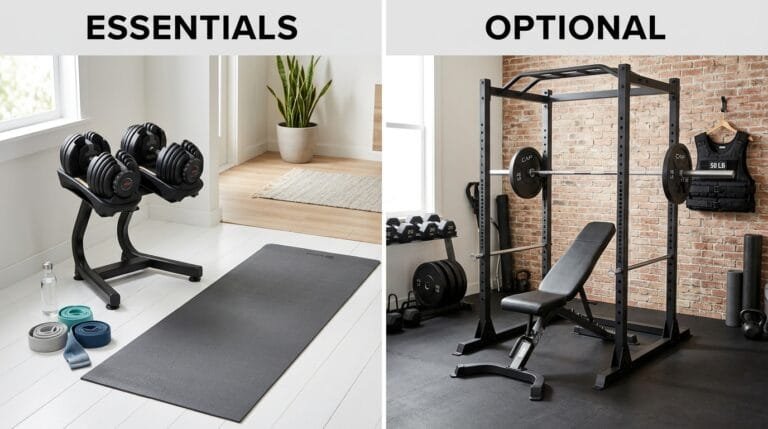
Strength training remains highly beneficial when it is adjusted intelligently rather than abandoned (strength training guidance). Practical home-gym approaches emphasise sustainable systems that accommodate normal fluctuations in how the body feels (home gym equipment prioritisation and budget home gym principles).
Frequently Asked Questions
How long should I modify a movement before trying the original again?
Most minor aches respond within 1–3 weeks of reduced stress. Test a low-volume version every 7–14 days.
Is it okay to train if there is mild discomfort?
Yes, if the discomfort does not worsen during the set, does not alter form, and settles quickly afterward. When in doubt, regress.
Should I stop all training if one area hurts?
Almost never. Train everything that remains pain-free and modify only the aggravating pattern.
Can I still make progress while modifying?
Yes. Non-affected patterns can continue progressive overload, and the affected area can often maintain capacity with reduced stress.
When should I see a professional?
Seek assessment for sharp pain, swelling, instability, night pain, progressive worsening, or symptoms that do not improve after 2–3 weeks of intelligent modification.
Do I need special equipment for modifications?
No. Most effective modifications use the same bands, dumbbells, or bodyweight variations you already have, simply performed with adjusted range, tempo, or load.
How do I know if the ache is improving?
Symptoms become less intense, occur later in the set, resolve faster after training, or allow slightly more range or load without provocation.
Is complete rest ever the right choice?
Yes for acute injuries or when even the most modified versions provoke significant symptoms. For typical lingering aches, relative rest (modification) is usually more effective.
Final Recommendation
Programming around lingering aches without stopping completely requires identifying the aggravating movements, substituting pain-free alternatives that train the same patterns, reducing volume on the sensitive area, and continuing to train the rest of the body. Support the process with solid recovery habits and reintroduce the original movements gradually once symptoms are stable.
Map your current aches to specific exercises today, choose pain-free alternatives, and adjust the next session accordingly. Keep training frequency intact and track how symptoms respond over the following week. When modification is applied intelligently, momentum continues and most minor aches resolve without the setbacks that come from complete stoppages. Start with the next session—the ability to train around normal aches is one of the most valuable skills a long-term trainee can develop.