Yoga-Inspired Lateral Raises: Blending Bent-Arm Stability with Mobility
Quick answer: Combining a slight bent-arm position with yoga-style breath control and slower tempo can improve shoulder stability and control during lateral raises, particularly for people who feel “wobbly” or unstable during the movement — the focus shifts from lifting heavier to moving with more control.
Researched and written by the GymGoodies team, fact-checked against manufacturer specs and current fitness guidance.
If your shoulders feel unstable or “wobbly” during lateral raises, the usual assumption is weak deltoids — but it’s often more about a disconnect between strength and mobility. Yoga has long emphasized this connection between stability and controlled movement, and borrowing a few of its principles can make lateral raises feel more controlled and joint-friendly, without needing to overhaul your whole training approach.
Why Shoulders Feel Unstable During Lateral Raises
Shoulder instability during lateral raises usually isn’t purely a strength issue — it often comes down to under-engaged stabilizing muscles, particularly the rotator cuff and serratus anterior (a muscle along the side of your ribcage that helps control shoulder blade movement). When these stabilizers aren’t doing their job, the deltoid ends up compensating and moving in a less controlled path, which can feel “wobbly” even if you’re technically strong enough to lift the weight.
Scapular stabilization exercises — movements that specifically train control of the shoulder blade — are well-supported in physical therapy research as a way to improve shoulder function and reduce impingement risk. A systematic review on scapular stabilization exercises found they’re commonly combined with rotator cuff strengthening as an effective approach for restoring healthy shoulder movement patterns. If you want to try dedicated scapular exercises before adding lateral raise load, Hinge Health’s guide to scapular stabilization exercises walks through several simple options.
Why Breath Matters More Than People Realize
In yoga practice, breath is used deliberately to sync with movement and support stability, and this same idea carries over well to strength training. Exhaling during the exertion phase of a lift (the lateral raise itself) tends to naturally engage your core and stabilizing muscles more than holding your breath or breathing randomly through the set.
A simple drill to feel this:
- Hold light dumbbells (or even water bottles) with elbows bent at roughly 90 degrees.
- Inhale to prepare, then exhale slowly as you raise your arms out to shoulder height.
- Notice whether your core and shoulders feel more “connected” and controlled on the exhale-timed rep compared to your normal pace.
Why Bent Elbows Tend to Work Well Here
A common assumption is that fully straight arms create more tension on the deltoid — and while straight-arm raises do work the muscle, keeping a slight bend in the elbow (think holding a beach ball) shortens the lever arm your shoulder has to control. This tends to reduce joint strain while still keeping meaningful tension on the deltoid, which makes the bent-arm position a good match for this slower, control-focused approach. For a more traditional strength-focused breakdown of this mechanic, see our Bent-Arm Lateral Raises guide.
A Simple Progression to Build Toward This
Rather than jumping straight into loaded lateral raises, building shoulder stability first tends to pay off:
Phase 1 — Activation (roughly a week): Bent-arm scapular slides (standing in a doorframe, elbows bent, sliding your shoulder blades up and down without shrugging) to help wake up the serratus anterior and rotator cuff.
Phase 2 — Pattern practice (roughly a week): Yoga-inspired lateral raises themselves — elbows around 90 degrees, exhaling as you lift to shoulder height, using light dumbbells or resistance bands if that feels more stable.
Phase 3 — Progression: Add a brief pause at the top of the movement, focusing on alignment (ears stacked over shoulders, ribs drawn down rather than flared) before gradually increasing load.
The Concept: Stability Meets Flow
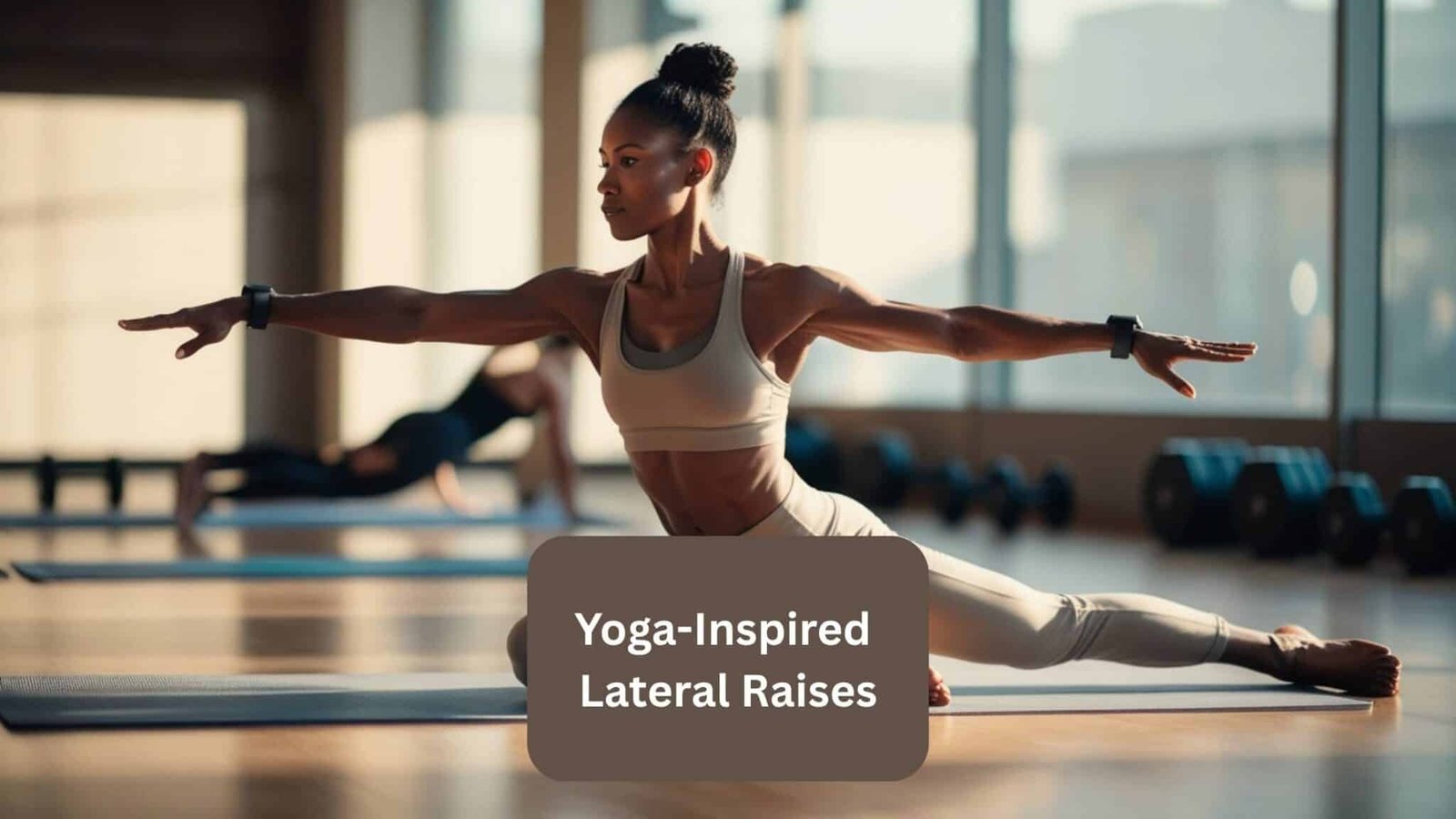
Yoga-inspired lateral raises blend the static strength of traditional resistance training with the fluid mobility of yoga. In this hybrid approach, the arms are slightly bent — roughly 15 to 30 degrees — creating a stable base while reducing strain on the shoulder joints. This bent-arm position echoes poses like Warrior II or T-pose, promoting shoulder stabilization without overextension. The goal isn’t just hypertrophy but mindful movement: unlike rigid bodybuilding-style form, this approach encourages controlled motion, breath coordination, and joint awareness, turning a simple lateral raise into more of a full-body, posture-conscious movement.
Mobility with Purpose
Mobility in this context isn’t just about range of motion — it’s about functional range. Raising the arms through a full arc with conscious breath and shoulder engagement supports better scapular movement and can reduce the risk of impingement over time. The bent-arm structure supports shoulder integrity while still activating the mid-deltoid and upper back muscles safely. This approach adapts well to slower eccentric holds or paused reps for added time under tension, and can be especially useful for people rehabbing a shoulder issue or transitioning from stiffness toward more traditional strength training.
Integration for Lifelong Strength
This isn’t meant to replace traditional lateral raise training — it’s a complementary approach. Traditional lateral raises often isolate the deltoid in a fairly mechanical way; blending in yoga-informed principles allows for a more holistic integration of movement quality alongside muscle-building work. With bent-arm positioning and a rhythmic, breath-linked tempo, the exercise becomes more adaptable across age groups and fitness levels — useful for athletes building shoulder durability and for desk workers looking to improve posture and reduce tightness alike. If you’re weighing this against a more traditional training style, our Bodybuilding vs. Functional Fitness article covers that broader comparison.
Frequently Asked Questions
Do I need to be flexible or do yoga already to try this?
No — this borrows a few specific principles (breath timing, controlled tempo, bent-arm position) rather than requiring any yoga background or flexibility.
Will this build as much shoulder size as heavier, faster lateral raises?
Not necessarily at the same speed — this approach prioritizes control and joint health over maximum load. It works well alongside heavier, more traditional lateral raise sessions on other days rather than replacing them entirely.
How long before I notice a difference in shoulder stability?
Most people notice improved control within a couple of weeks of consistent practice, particularly if instability was coming from under-engaged stabilizing muscles rather than a structural issue — if shoulder pain persists, it’s worth checking in with a physical therapist.
Bottom Line
Feeling unstable during lateral raises is common, and it’s often more about stability and control than raw strength. Borrowing yoga’s emphasis on breath, tempo, and bent-arm positioning can help build a more controlled, joint-friendly version of the movement — one that complements, rather than replaces, traditional strength-focused training.
Have you tried slowing down your lateral raises with breath-focused control? Let us know in the comments whether it changed how stable your shoulders felt.