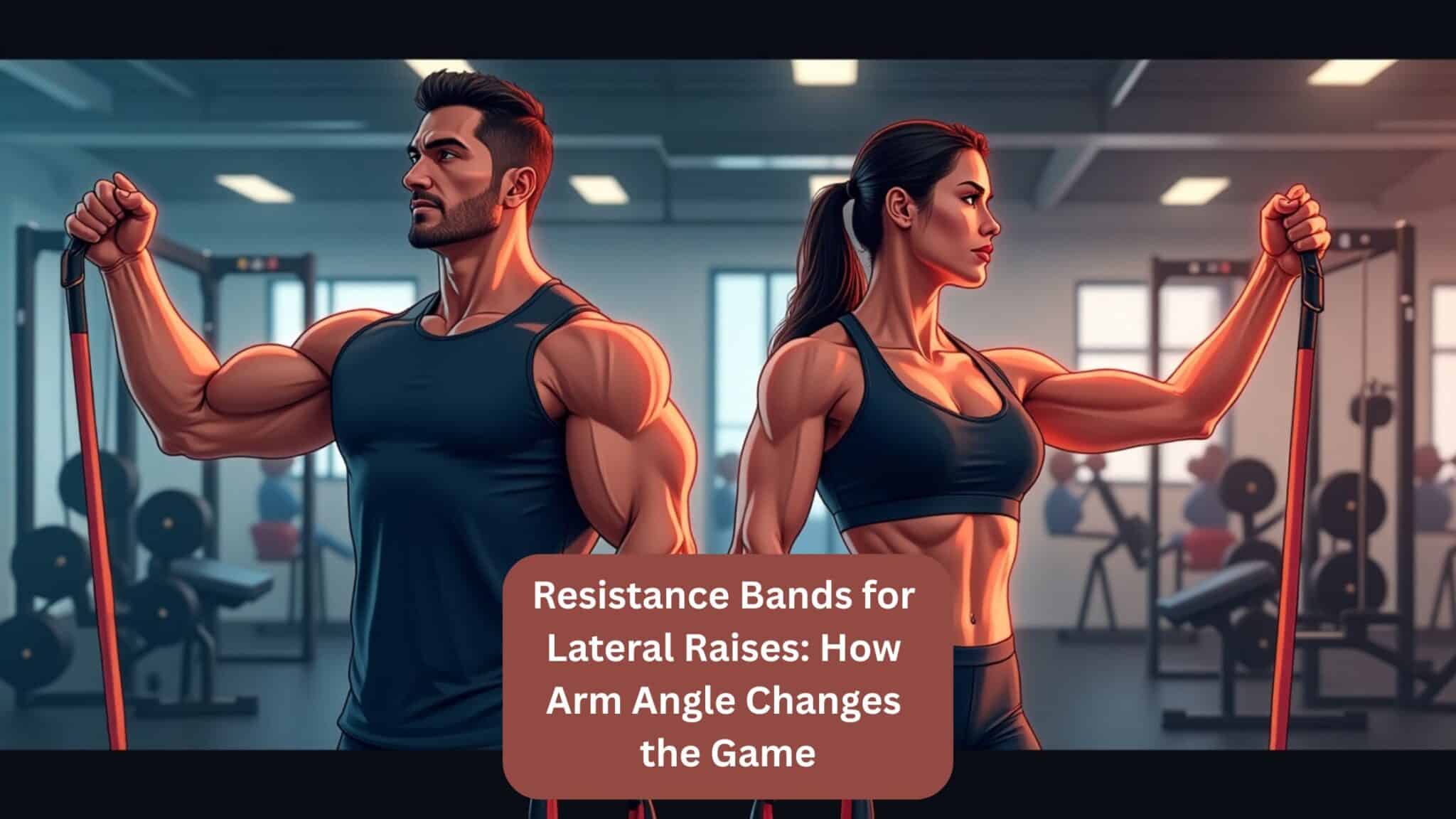
Resistance Bands for Lateral Raises: How Arm Angle Changes the Game
Quick answer: Resistance bands create “accommodating resistance” — tension increases as the band stretches, meaning the load is lightest at the bottom of a lateral raise and heaviest near the top. This is the opposite resistance curve from dumbbells, which are hardest at the midpoint. Combined with your arm angle, this changes exactly where in the movement your shoulder works hardest.
Researched and written by the GymGoodies team, fact-checked against manufacturer specs and current fitness guidance.
Switching from dumbbells to resistance bands for lateral raises often feels different in a way that’s hard to pin down at first — usually because the exercise doesn’t get harder and easier at the same points in the movement. That difference comes down to how bands generate resistance, and how your arm angle interacts with that resistance curve.
Why Bands and Dumbbells Feel So Different
Dumbbells rely on gravity, so resistance is highest when your arm is roughly parallel to the floor (fighting gravity most directly) and lowest at the very top and bottom of the movement. Resistance bands work differently: tension increases the more the band stretches, meaning resistance is lowest at the bottom of the raise and highest near the top, once the band is fully extended.
Research directly comparing these two tools on upper-body isolation exercises found meaningful differences in how muscles activate through the range of motion. A study published via PubMed comparing elastic bands and free weights measured muscle activation using EMG in the deltoids and trapezius during reverse fly-type movements, and found that the two tools produced different activation patterns across the concentric and eccentric phases of the lift — neither tool was simply “better,” but they clearly loaded the muscles differently through the movement.
How Arm Angle Changes the Effect
Your arm angle during a lateral raise interacts directly with this resistance curve:
- Arms angled slightly forward (toward the scapular plane, roughly 30-45 degrees) tends to keep tension more aligned with the deltoid’s natural line of pull, which can feel more effective with a band’s increasing-tension curve, especially near the top of the movement.
- Arms raised directly out to the side shifts more emphasis toward the trapezius as you approach shoulder height, which combined with a band’s peak tension at that same point can make the top portion of the rep feel especially trap-dominant if your scapular positioning isn’t controlled.
- Bent vs. straight elbow still matters with bands the same way it does with free weights — a slight bend reduces the lever arm and joint stress, while a straighter arm increases both muscle isolation and joint demand.
Why This Resistance Curve Can Be an Advantage
Because bands load the top of the movement hardest, they can help address a common lateral raise weakness: many lifters lose tension and control right as their arms approach shoulder height, often “cheating” the last few degrees with momentum. A band’s increasing resistance makes that top portion harder to fake your way through, which can reinforce a proper, controlled finish position.
A Simple Band-Based Lateral Raise Protocol
- Anchor the band under both feet, standing on it shoulder-width apart, or loop it around a low, stable anchor point.
- Choose an arm angle — slightly forward toward the scapular plane is a reasonable default for most people.
- Raise your arms with control, focusing on maintaining tension especially through the top third of the movement, where the band resistance peaks.
- Pause briefly at the top before lowering with control — resist the urge to let the band “snap” your arms back down.
- Aim for 12-15 controlled reps, since the accommodating resistance curve often makes lower-rep, heavier-load work less practical with bands compared to free weights.
When Bands Make Sense Over Dumbbells
- Travel or home training where dumbbells aren’t available — bands are lightweight and portable.
- Rehab or joint-sensitive training, since bands generally allow more control over the lightest part of the range of motion (the bottom), which can ease into the movement more gradually than a dumbbell’s constant load.
- Addressing a “cheating at the top” habit, since the band’s peak resistance right at shoulder height reinforces control precisely where lifters often lose it.
When Dumbbells Might Be the Better Choice
- If you want maximum tension at the mid-range of the movement specifically, since that’s where dumbbells are hardest and bands are relatively easier.
- If precise, incremental weight progression matters to you — dumbbells offer exact, known weights, while band resistance varies by brand, thickness, and how much stretch you’re applying, making it harder to track progressive overload precisely.
For a broader look at how arm position interacts with the bent-vs-straight debate more generally (independent of equipment), see our Bent Arms vs. Straight Arms in Lateral Raises guide, and if you’re deciding between free weights and cables specifically, our Dumbbells vs. Cables guide covers that comparison in more depth.
Common Mistakes When Using Bands for Lateral Raises
- Choosing a band that’s too light or too heavy for your strength level — since bands aren’t as precisely labeled as dumbbell weights, it often takes some trial and error to find the right tension.
- Losing control at the bottom of the rep, where band tension is lowest — this is where bands can tempt you into using momentum, since the resistance doesn’t “hold you accountable” the way a dumbbell’s constant weight does.
- Anchoring the band unevenly under your feet, which can create uneven tension between your left and right arm during the set.
Frequently Asked Questions
Are resistance bands as effective as dumbbells for lateral raises?
Research generally shows bands and free weights produce broadly comparable strength and activation outcomes when training volume and intensity are matched, though they load the muscle differently through the range of motion — neither is strictly superior for every goal.
What resistance band strength should I start with?
Start lighter than you might expect, since it can be hard to judge band tension accurately at first — you should be able to complete 12-15 controlled reps with the band feeling genuinely challenging by the last few, not by the middle of the set.
Can I combine bands and dumbbells in the same routine?
Yes — some lifters use bands specifically to target the top-range weakness common in lateral raises, then use dumbbells for more standardized, trackable overload elsewhere in a program.
Bottom Line
Resistance bands change lateral raises by shifting peak tension to the top of the movement instead of the middle, which can help address the common habit of losing control near shoulder height. Combined with your chosen arm angle, this creates a genuinely different training stimulus than dumbbells — not better or worse, just a different tool suited to different goals.
Have you tried resistance bands for lateral raises? Let us know in the comments whether you noticed a difference in where you felt the burn.