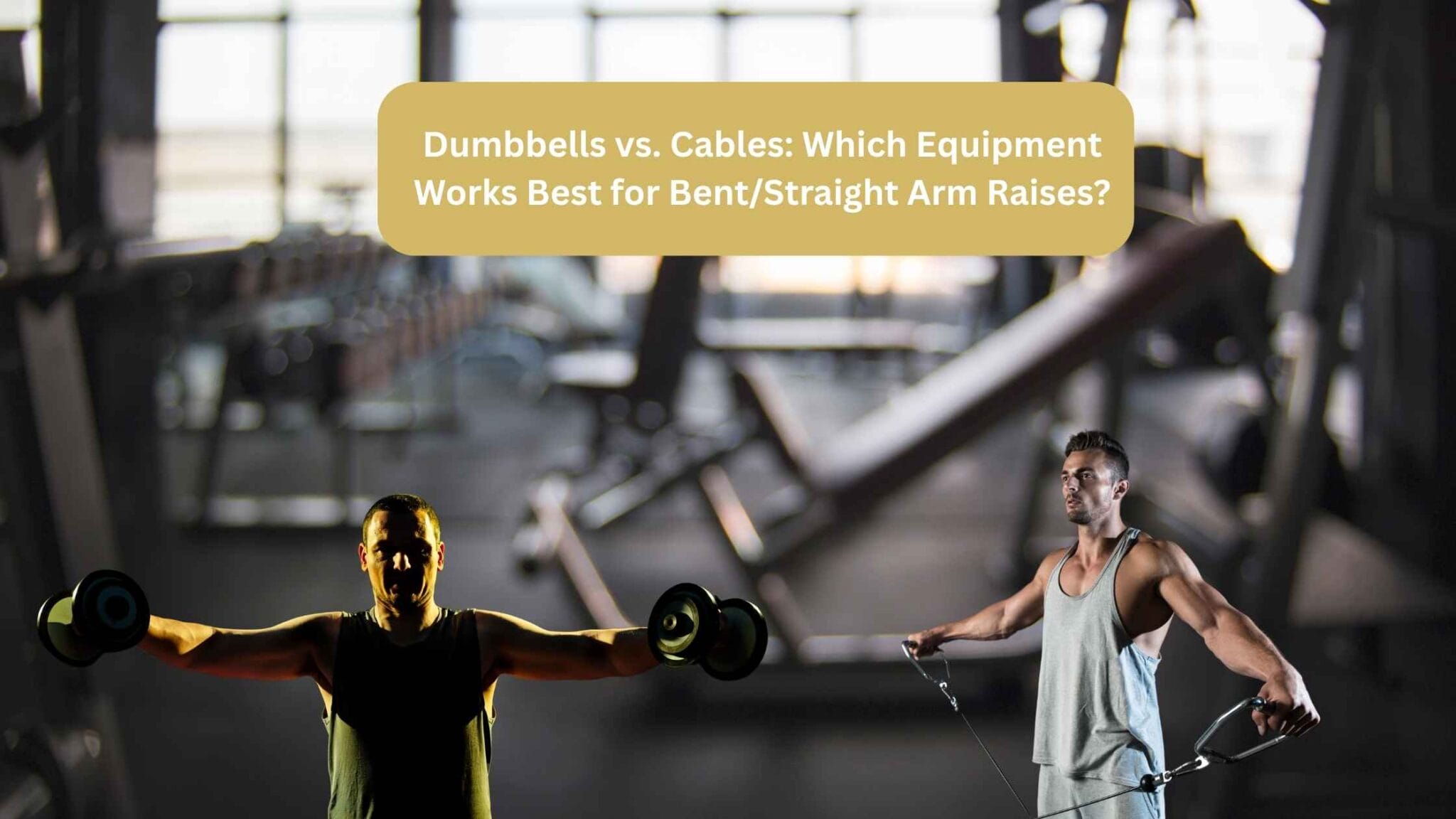
Dumbbells vs. Cables: Which Equipment Works Best for Bent/Straight Arm Raises?
Quick answer: Research directly comparing dumbbell and cable lateral raises over an 8-week training period found no meaningful difference in lateral deltoid muscle growth between the two — meaning equipment choice matters less than consistent training. The real difference between them is where in the movement the resistance feels hardest, not which one builds more muscle.
Researched and written by the GymGoodies team, fact-checked against manufacturer specs and current fitness guidance.
Dumbbells and cables are the two most common tools for lateral raises, and lifters often assume one must be objectively superior. The honest answer, backed by recent research, is that both work — the real decision comes down to which resistance profile and arm position suits your goals and current joint health.
What the Research Actually Found
A recent controlled study comparing dumbbell versus cable lateral raises measured lateral deltoid muscle thickness via ultrasound in resistance-trained men and women over an eight-week program. The study, published and available via PMC, standardized range of motion between both conditions and found that muscle thickness increased similarly in both groups, with the statistical analysis providing strong support for essentially no meaningful difference between dumbbells and cables for building the lateral deltoid.
This matters because it reframes the “dumbbells vs. cables” debate: rather than one tool being superior for muscle growth, the honest takeaway is that consistent training volume and effort matter more than which tool you pick.
Where the Two Tools Genuinely Differ
Even though muscle growth outcomes were similar, the resistance profile of each tool is genuinely different, and this affects how the exercise feels and where you’re challenged most:
- Dumbbells rely on gravity, so resistance is lowest at the very bottom and top of the movement and highest around the mid-range, roughly when your arm is parallel to the floor.
- Cables provide more consistent tension throughout the entire range of motion, including at the bottom of the movement where dumbbells provide little resistance at all.
This is why cables are often described as feeling more continuously challenging, even when the measured muscle growth ends up comparable over time.
How Arm Position Interacts With Equipment Choice
Bent-vs-straight arm positioning applies to both tools, but interacts with them slightly differently:
- With dumbbells, a straight arm increases the lever arm and joint demand specifically at the mid-range point where dumbbell resistance already peaks — meaning straight-arm dumbbell raises tend to feel most demanding right in that middle section.
- With cables, because tension stays more consistent throughout, a straight arm increases joint demand more evenly across the whole movement rather than concentrating it at one point.
- A bent-arm position reduces the lever arm with either tool, which is why it’s often recommended for lifters managing shoulder sensitivity, regardless of which equipment they’re using. Our Bent-Arm Lateral Raises guide covers this mechanic in more depth.
When Dumbbells Make Sense
- Accessibility — dumbbells are available in virtually every gym and home setup, without needing a cable station.
- Simple progression tracking — fixed, known weight increments make it easy to track and progress load over time.
- Convenience for supersets or circuits — no need to adjust a cable machine’s pin or pulley height between exercises.
When Cables Make Sense
- Consistent tension through the full range, which some lifters find keeps the deltoid under more continuous load, particularly at the bottom of the rep where dumbbells go slack.
- Easier to adjust the angle of pull, since you can position your body relative to the cable to target the scapular plane or a straight lateral path more deliberately than a dumbbell’s fixed gravitational pull allows.
- Rehab or joint-sensitive training, since the more even resistance curve can feel more controllable than a dumbbell’s sudden peak tension at the mid-range.
If you’re weighing a third option, our Lateral Raise Machines guide covers how machines compare to both of these on tension consistency and forced arm position.
A Practical Way to Use Both
Rather than picking one exclusively, many lifters get good results alternating or combining both:
- Use dumbbells for the bulk of your training, since they’re accessible and easy to progressively overload with precise weight increments.
- Periodically substitute cables for a training block (4-6 weeks) if you want to emphasize continuous tension, particularly at the bottom of the range where dumbbells provide little resistance.
- Use bent-arm positioning with either tool if you’re managing joint sensitivity, and progress toward straighter-arm variations as strength and control improve.
Common Mistakes With Either Tool
- Using momentum to “throw” the weight up, which happens with both dumbbells and cables but is often more noticeable with dumbbells since gravity briefly assists at the top of a swung rep.
- Standing too close or too far from the cable stack, which changes the angle of resistance and can shift emphasis away from the deltoid.
- Assuming one tool is inherently superior and neglecting the other entirely, when the research suggests both can produce comparable muscle growth with consistent training.
Frequently Asked Questions
Do cables build more muscle than dumbbells for lateral raises?
Recent controlled research found no meaningful difference in lateral deltoid growth between the two over an eight-week training period — both are effective when trained consistently.
Which is better for beginners?
Dumbbells are often more accessible and simpler to learn technique on, since the movement path isn’t constrained by a cable’s angle — but either tool works well for beginners with proper coaching on form.
Should I switch between the two regularly?
It’s not necessary for muscle growth specifically, but some lifters do alternate to add variety or to specifically emphasize the bottom-range tension that cables provide and dumbbells don’t.
Bottom Line
The “dumbbells vs. cables” debate for lateral raises isn’t really about which one builds more muscle — recent research suggests they’re comparably effective. The real difference is in tension curve and feel: dumbbells peak at the mid-range, cables stay more consistent throughout, including at the bottom of the movement. Choose based on accessibility, joint comfort, and which resistance profile you prefer, rather than assuming one is objectively superior.
Which do you prefer for lateral raises — dumbbells or cables? Let us know in the comments what you’ve noticed about how each one feels through the movement.