
Creating Accountability in a Solo Home Training Environment
Quick Answer
Create accountability in a solo home training environment by combining written commitments, visible tracking, pre-scheduled sessions, minimum viable standards for difficult days, and simple external reporting (even if only to a calendar or trusted person). Design the environment so starting is easy, measure adherence weekly, and review progress on a fixed schedule. These systems replace the social pressure of a commercial gym with clear personal structures that keep training consistent when motivation fluctuates.
Why Solo Home Training Needs Deliberate Accountability
Commercial gyms provide built-in accountability through observation, scheduled classes, training partners, and the simple act of leaving the house. At home those external cues disappear. The result is often excellent intentions followed by skipped sessions when energy is low, work runs late, or the day feels busy. Accountability in a solo setting must be engineered rather than assumed. It comes from systems that make the planned behaviour obvious, measurable, and harder to abandon than to complete.
Core Principles of Effective Solo Accountability
- Make the commitment visible and specific – Vague intentions produce vague results.
- Reduce friction to start – The easier the session is to begin, the higher the completion rate.
- Track behaviour, not just outcomes – Sessions completed are the primary metric.
- Define the minimum acceptable standard – Hard days still need a clear success criterion.
- Create short feedback loops – Weekly reviews keep the system honest.
- Layer external and internal accountability – Personal standards plus light external reporting work best for most people.
Accountability Methods Compared
| Method | Strength | Weakness | Best Use Case | Effort to Maintain |
|---|---|---|---|---|
| Written training schedule | Clear intention | Easy to ignore if not reviewed | Foundation for all other methods | Low |
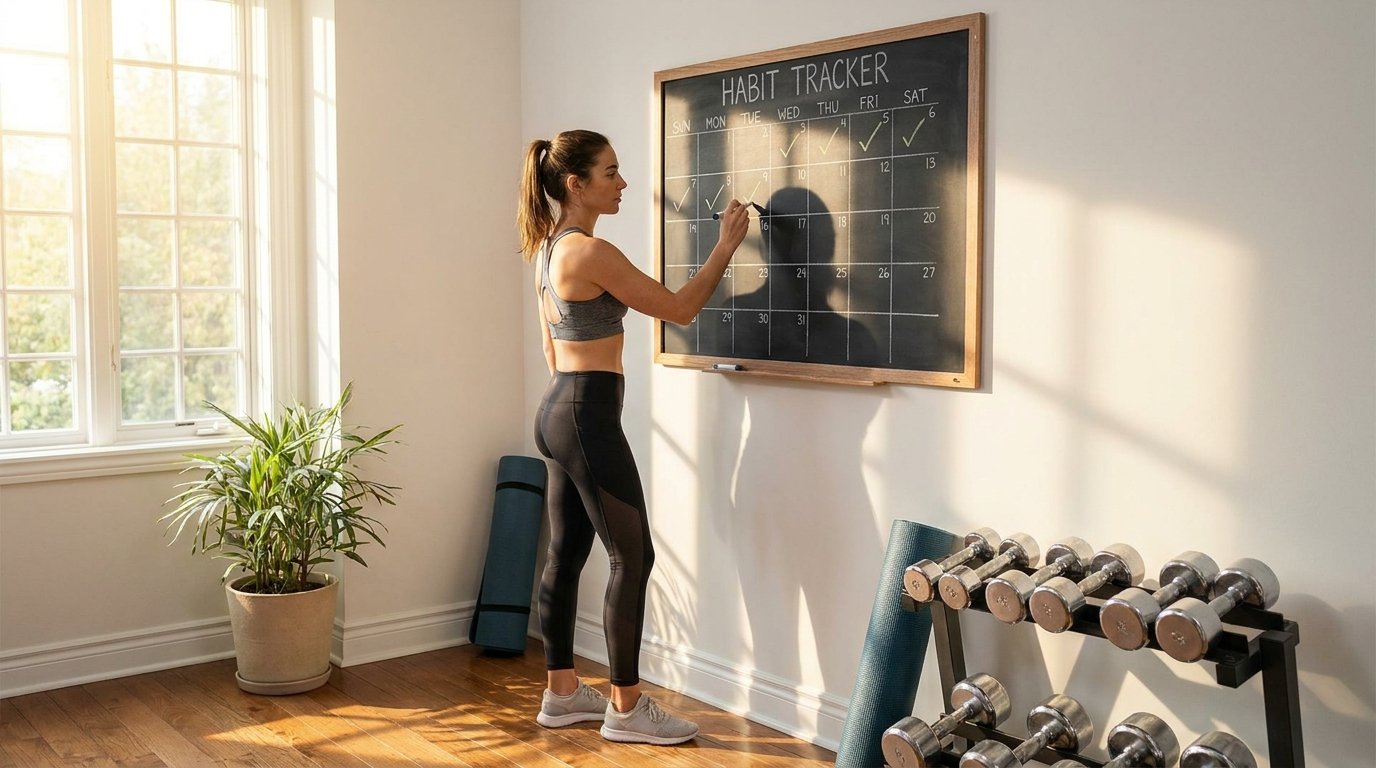
| Visible tracker (calendar/checkbox) | Immediate visual feedback | Requires consistent updating | Daily/weekly adherence | Low |
| Minimum viable session rule | Prevents all-or-nothing collapse | Must be defined in advance | Disrupted or low-energy days | Low |
| Habit stacking / anchor routine | Links training to existing behaviour | Needs a stable daily anchor | Morning or post-work sessions | Low |
| Public or partner check-in | Social consequence | Requires reliable person or group | Higher-stakes consistency | Moderate |
| Performance logging | Shows progress beyond attendance | Can become overly detailed | Strength and skill goals | Moderate |
| Environment design | Removes decision friction | One-time setup effort | Long-term automaticity | Low after setup |
| Scheduled weekly review | Course-correction mechanism | Easy to skip | Continuous improvement | Low |
Shoulder-friendly technique supports sustainable upper-body training once accountability systems keep you consistent (Bent Arms vs. Straight Arms in Lateral Raises, The Hidden Mistake in Lateral Raises, and 3 Lateral Raise Modifications). Grip work can serve as a simple, low-friction finisher that still feels like progress (Do Hand Grippers Really Work?).
Step-by-Step System for Building Solo Accountability
- Write a clear weekly training commitment
Specify the exact days, approximate times, and session type (e.g., “Full-body strength, Tuesday and Friday, 6:30–7:10 a.m.”). - Define the minimum viable session (MVS)
Decide in advance what still counts as success on a difficult day (for example, 15 minutes and three compound movements). - Create a visible tracking method
Use a wall calendar, whiteboard, or phone note with simple checkboxes for each planned session. - Design the environment for instant starts
Keep the mat, primary weights, and any bands ready so the first movement can begin within one minute. - Attach the session to a stable daily anchor
Link training to an existing habit such as morning coffee, finishing work, or putting children to bed. - Add light external accountability
Send a weekly summary to a friend, post completion in a private group, or simply mark a shared calendar. - Log only the essentials at first
Session completed (yes/no) is enough in the early stages. Add load and rep details once adherence is stable. - Schedule a weekly 10-minute review
Look at planned versus completed sessions and note any recurring friction points. - Pre-plan responses to common disruptions
Write the exact rule for late work days, poor sleep, or travel. - Protect the system for eight to twelve weeks
Consistency over this period is the foundation; intensity and complexity can increase afterward.
Designing the Minimum Viable Session for Accountability
A strong MVS has three characteristics:
- It is short enough to complete even when motivation is low (15–25 minutes).
- It covers the main movement patterns so it still feels like real training.
- It has a clear completion definition so there is no debate about whether it “counted.”
Example MVS:
- Squat or lunge variation – 2 sets
- Hinge or bridge variation – 2 sets
- Push variation – 2 sets
- Pull variation – 2 sets
Completing this sequence marks the session as done.
Environment Design That Supports Accountability
Physical setup
- Training tools live in a permanent, visible location
- Clothing and shoes are ready the night before if morning sessions are planned
- Lighting and temperature are acceptable without extra steps
Digital and social setup
- Calendar appointments with reminders
- Optional weekly check-in message to a trusted person
- Notifications silenced during the planned training window
Cognitive setup
- Implementation intention: “When it is 6:30 a.m. on Tuesday, I begin my minimum session.”
- Identity language: “I train at home on my scheduled days.”
Tracking Systems That Actually Work
The most effective solo tracking is simple and binary in the early stages:
- Planned session → Completed or Missed
Once the habit is stable, add:
- Primary lifts and loads
- Notes on energy or joint feeling
- Weekly adherence percentage
Avoid complex apps or excessive metrics until consistency is high. Friction in tracking often becomes friction in training.
Using External Accountability Without a Training Partner
Options that work well for solo trainees:
- Weekly text or email to a friend stating sessions completed
- Private social-media story or group check-in
- Shared digital calendar visible to a partner or family member
- Paid coaching or online community with check-in requirements
- Public commitment to a short challenge (e.g., 12 weeks of three sessions per week)
The key is that someone or something outside your own head expects a report.
Weekly Review Framework
Every seven days, answer three questions:
- How many planned sessions did I complete?
- What friction points appeared?
- What single adjustment will make next week easier?
This short review keeps the system honest and continuously improved.
Common Accountability Failures and Fixes
| Failure | Result | Fix |
|---|---|---|
| Vague commitment (“I’ll train more”) | No clear success standard | Write exact days and session type |
| No minimum viable session | All-or-nothing collapse | Define the 15–25 minute version in advance |
| Hidden or scattered equipment | High activation energy | Permanent, ready-to-use setup |
| Tracking only outcomes | Discouragement during slow progress phases | Track adherence first |
| No review process | Drift and repeated mistakes | Fixed weekly 10-minute review |
| Relying solely on motivation | Inconsistent execution | Rely on schedule + environment + tracking |
Strength training delivers reliable long-term benefits when it is performed consistently rather than perfectly (strength training guidance). Practical home-gym approaches emphasise systems that function without external supervision (home gym equipment prioritisation and budget home gym principles).
Frequently Asked Questions
How much external accountability do I need?
Many people succeed with only written schedules and visible tracking. Others benefit from a weekly check-in with another person. Start simple and add external reporting if adherence stays below 80 %.
What if I live alone and have no one to check in with?
Use a shared digital calendar, a private online community, or even a simple public commitment to a time-bound goal. The external record itself creates accountability.
Should I punish myself for missed sessions?
No. Focus on restarting with the next planned session and refining the system so the same disruption is less likely next time.
How long does it take for accountability systems to feel automatic?
Most people notice reduced friction after four to six weeks of consistent use. Eight to twelve weeks is a realistic period for the systems to become deeply established.
Is it better to track workouts in an app or on paper?
Whichever method you will actually use. Paper calendars and simple phone notes often have lower friction than feature-heavy apps.
What is the single highest-leverage accountability tool?
A written schedule plus a visible binary tracker (completed/missed) combined with a pre-defined minimum viable session.
Can accountability systems become too rigid?
Yes. Build in the minimum viable session precisely so the system bends without breaking on difficult days.
How do I handle vacations or unusually busy periods?
Decide the reduced standard in advance (for example, two minimum sessions per week) and treat that as full success for the period.
Final Recommendation
Accountability in a solo home training environment is created through clear written commitments, visible tracking, environment design that removes friction, a pre-defined minimum viable session, and light external reporting. Measure success primarily by sessions completed, review the system weekly, and protect consistency for eight to twelve weeks before emphasising intensity or complexity.
Write your weekly training schedule and minimum viable session today. Set up a visible tracker, prepare the training space for instant starts, and decide how you will report completion each week. When these structures are in place, motivation becomes less necessary and consistent training becomes the default. Start with the next planned session—the systems you build now determine whether home training remains temporary or becomes permanent.