Cable Machine vs. Resistance Bands for Home Strength Training
Quick Answer
Cable machines generally outperform resistance bands for muscle growth and progressive strength training at home because they deliver constant tension throughout the range of motion, smoother resistance curves, and precise, measurable load increases. Resistance bands remain highly effective for portability, joint-friendly training, warm-ups, activation, and specific patterns, but their ascending resistance curve (lowest tension at the stretched position of many lifts, highest at peak contraction) makes them less optimal as a primary hypertrophy tool. For most home lifters seeking maximal long-term muscle growth, a cable solution (functional trainer or single-stack unit) is the stronger foundation; bands excel as a low-cost, space-efficient complement or travel alternative.
Why Resistance Type Directly Influences Results
Hypertrophy is driven primarily by mechanical tension, especially when sets are taken close to failure across a full range of motion. The way resistance is applied changes how effectively that tension is delivered.
Cable systems redirect a weight stack or plates through pulleys. Resistance stays relatively constant (or can be angled precisely). The muscle must work hard in both the lengthened and shortened positions, and the eccentric phase remains fully loaded.
Resistance bands create linear variable (ascending) resistance. Tension is minimal when the band is slack and rises as the band stretches. On curls, pulldowns, and many other movements this unloads the muscle where it is strongest (the stretched position) and peaks where it is weakest. During the lowering phase tension drops as the band shortens, reducing eccentric stress that research links to greater growth.
These mechanical differences explain why constant-tension tools are generally preferred for pure hypertrophy while bands remain valuable for convenience, accommodating resistance, and joint comfort.
Detailed Head-to-Head Comparison
| Factor | Cable Machine / Functional Trainer | Resistance Bands | Clear Advantage |
|---|---|---|---|
| Tension curve | Constant or easily adjustable | Ascending (variable) | Cables |
| Eccentric loading | Full and consistent | Decreases as band shortens | Cables |
| Progressive overload precision | Excellent (stack pins or small plates) | Moderate (thicker bands, combinations, leverage changes) | Cables |
| Loading in stretched position | High | Often lowest | Cables |
| Exercise variety | Extremely high with attachments | High with creativity and solid anchors | Slight cables edge |
| Space requirement | Moderate to high | Minimal | Bands |
| Upfront cost | Higher | Low | Bands |
| Portability | Poor | Excellent | Bands |
| Joint stress | Moderate, highly angle-dependent | Often lower and more forgiving | Bands |
| Setup speed | Moderate | Very fast | Bands |
| Long-term progression ceiling | Very high | Good with advanced techniques | Cables |
| Beginner accessibility | High | High | Tie |
Muscle Growth and Strength Evidence
When training volume and proximity to failure are matched, both cables and bands can produce meaningful hypertrophy and strength gains. Constant-tension implements make it easier to maintain high mechanical tension through the full range and to progress in small, repeatable increments over years. Bands can match short-to-medium-term results if effort is high and difficulty is creatively advanced, but the variable curve requires more skill to keep the target muscle optimally challenged.
Cables are particularly effective for isolation movements (lateral raises, face pulls, flyes, pushdowns, curls) because tension remains high at peak contraction. Bands excel at activation, warm-ups, accommodating resistance when added to free weights, and any situation where portability or joint comfort is the priority. Expert commentary and practical reviews consistently note that cables provide more even loading while bands offer unique variable-resistance benefits and unmatched convenience (weights, cables, or bands comparison).
In-Depth Strengths and Limitations for Home Gyms
Cable Machines – Advantages
- Constant tension maximises productive time under tension.
- Precise micro-loading supports linear progression for years.
- Enormous exercise library via handles, ropes, bars, and ankle straps.
- Excellent unilateral loading and angle control.
- Smooth, full eccentric stress supports hypertrophy and tendon resilience.
- Easy to overload isolation movements that are awkward with free weights or bands.
Cable Machines – Limitations
- Higher cost and larger permanent footprint.
- Requires dedicated space and often solid mounting or a power-rack attachment.
- Not portable.
- Home units vary widely in quality, smoothness, and weight-stack range.
Resistance Bands – Advantages
- Extremely low cost and virtually zero storage needs.
- Highly portable — entire gym in a drawer or suitcase.
- Accommodating resistance feels joint-friendly for many users.
- Outstanding for daily activation (pull-aparts, face pulls, monster walks).
- Easy to combine with bodyweight, dumbbells, or barbells.
- Fast setup and minimal noise.
Resistance Bands – Limitations for Primary Strength Training
- Ascending curve is biomechanically suboptimal for many classic hypertrophy lifts.
- Progression is less granular and harder to quantify precisely.
- Elasticity degrades; bands can snap if worn or overstretched.
- Requires a reliable anchor point.
- Advanced trainees eventually need creative intensity techniques to keep progressing.
Goal-Based Recommendations
| Primary Goal or Constraint | Best Primary Tool | Best Supporting Tool | Reason |
|---|---|---|---|
| Maximal muscle growth | Cable machine | Bands for warm-ups & accessories | Constant tension + precise overload |
| Travel or tiny space | Resistance bands | Bodyweight progressions | Portability |
| Daily shoulder health & activation | Resistance bands | Light cable work | Convenience and ideal tension |
| Joint-sensitive training | Bands or light cables | Focus on control | Lower peak stress |
| Isolation emphasis (raises, flyes, pushdowns) | Cables | Bands for high-rep variety | Constant tension at peak contraction |
| Hybrid long-term home gym | Cables + bands | Free weights | Covers every need efficiently |
Sample Programming Applications
Cable-Focused Session Elements
- Cable lateral raises or upright variations
- Face pulls with external rotation
- Triceps pushdowns and overhead cable extensions
- Bayesian or cable biceps curls
- Seated or standing cable rows
- Cable chest flyes or crossovers
- Pallof press and anti-rotation holds
Band-Focused or Equal Elements
- Band pull-aparts and band face pulls
- Lateral band walks and monster walks
- Banded glute bridges and pull-throughs
- Band-resisted push-ups or inverted rows
- Band lateral raises (high-rep)
- Accommodating resistance added to free-weight lifts
- Full-body travel workouts
Step-by-Step Home Setup and Progression Plan
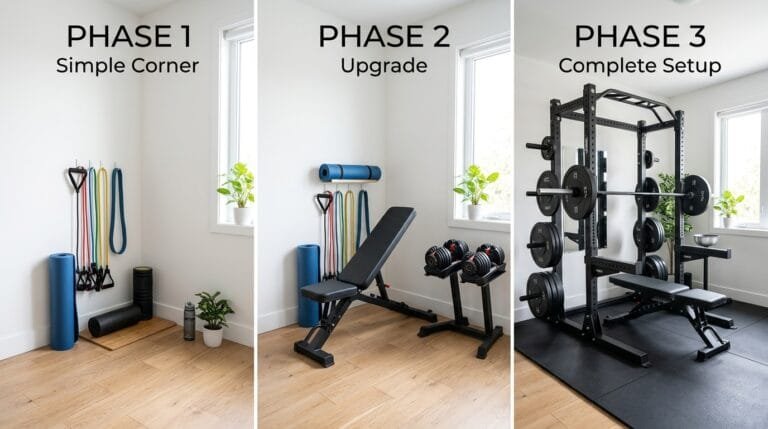
- Assess available floor space, ceiling height, and budget.
- If long-term muscle growth is the priority and space permits, invest in a functional trainer or quality single-stack cable unit.
- Purchase a progressive set of resistance bands (light to strong) regardless — they remain essential for warm-ups and accessories.
- Learn correct cable height, body position, and attachment selection for each movement.
- Log every working set (stack weight or band colour/tension + reps + RPE).
- Take most sets close to technical failure (0–3 reps in reserve).
- Progress cables by adding weight or improving control; progress bands by moving to thicker bands, combining bands, slowing tempo, or adding pauses.
- Use bands daily or near-daily for pull-aparts, face pulls, and external rotations to support shoulder balance.
- Occasionally combine tools (band-resisted cable movements or free-weight + band).
- Prioritise sleep, protein, and recovery so progressive overload remains productive.
Full Integration with Home Training Ecosystem
Both cables and bands support balanced, sustainable programming. Apply them to lateral raises while following strict form guidelines (How to Perform Safe Lateral Raises if You Have Shoulder Impingement History and the complementary Shoulder Health Routine to Pair with Lateral Raise Training).
Kettlebells add powerful hip-hinge and conditioning options that pair with either tool (kettlebell sizing guide. Grip strength improves cable-row performance and band control (grip strength guidance.
Detailed band selection advice is available in Resistance Bands Buying Guide: Loop vs. Tube vs. Fabric – Which Wins?. Core progressions such as the ab roller work with both. Conditioning options including treadmill work remain valuable (manual treadmill guidance and broader comparisons).
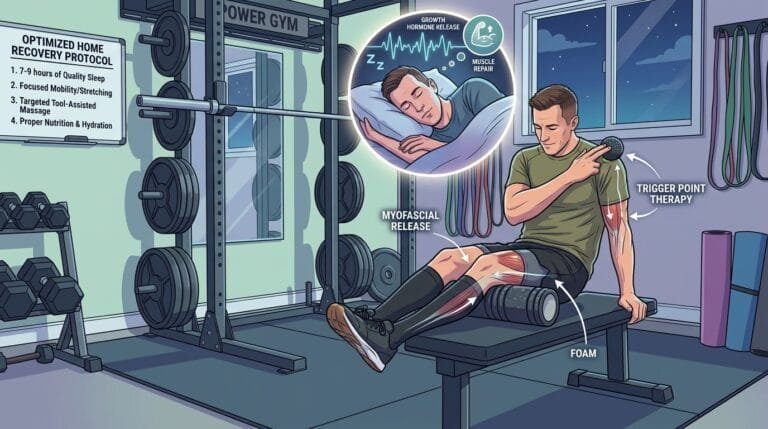
Recovery tools and sleep determine how well you adapt to progressive cable or band loading (Best Post-Workout Recovery Tools for Home Lifters, Best Massage Gun for Post-Workout Recovery on a Budget, and Sleep and Recovery Strategies When Training with Heavy Home Weights. Systematic tracking is essential regardless of implement (Best Ways to Track Progress Without a Gym or Personal Trainer.
External analyses emphasise that cables deliver more constant tension ideal for hypertrophy while bands provide unique variable resistance and superior practicality for home and travel use.
Common Mistakes and Corrections
- Expecting bands alone to match multi-year cable progression without intensity techniques → Add tempo, pauses, partials, or band combinations.
- Using cables with incorrect height or excessive momentum → Set the pulley so resistance stays challenging through the full range and control the weight.
- Neglecting the stretched position on either tool → Emphasise full range and controlled eccentrics.
- Failing to log resistance → Track stack weight or band tension every session.
- Relying on only one tool when a hybrid is superior → Use cables for primary progressive work and bands for daily activation and convenience.
- Anchoring bands to unstable points → Use a proper door anchor, rack, or heavy immovable object.
Frequently Asked Questions
Can I build significant muscle using only resistance bands at home?
Yes, particularly as a beginner or early intermediate, provided you train close to failure and progressively increase difficulty. Cables make long-term progression more efficient and measurable for most lifters.
Are home cable machines worth the investment?
For trainees serious about muscle growth who have the space, yes. The constant tension and exercise variety are difficult to fully replicate with bands alone.
Should I own both cables and bands?
This is the optimal setup for the majority of home lifters. Cables handle progressive constant-tension work; bands cover warm-ups, activation, travel, and high-rep accessories.
Which tool is better for lateral raises and face pulls?
Both are excellent. Cables provide more constant tension; bands are more convenient and often feel joint-friendlier for higher-rep work. Many lifters use both.
Do cables or bands build more strength?
Strength is specific to the tool and movement pattern. Cables usually allow heavier absolute loads and clearer progression on isolation and many compound patterns.
How do I keep progressing once I outgrow my strongest bands?
Move to thicker bands, combine multiple bands, slow the eccentric, add pauses at the hardest point, increase range of motion, or alter body position for greater leverage challenge.
Are cable machines safe when training alone at home?
Yes when properly assembled, regularly maintained, and used with good technique and appropriate loads. Respect weight limits and manufacturer guidelines.
Can bands replace a cable machine entirely?
They can serve as a complete primary tool for many people, especially with creative programming, but most lifters achieve better long-term hypertrophy efficiency with cables as the foundation and bands as the complement.
Final Recommendation
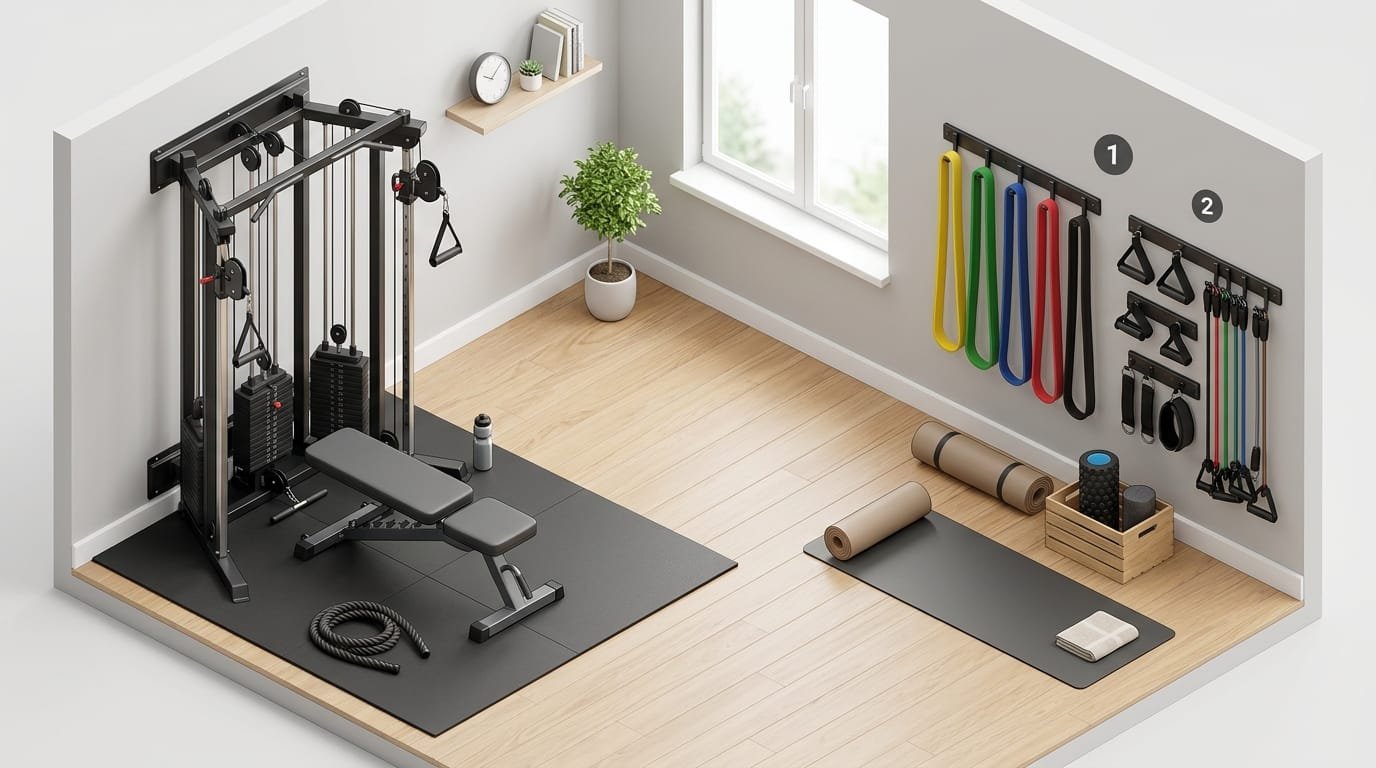
For home strength training focused on maximal muscle growth, a cable machine or functional trainer holds the advantage due to constant tension, precise progressive overload, and superior loading across the full range of motion. Resistance bands remain an outstanding low-cost, portable, and joint-friendly tool that excels at warm-ups, daily activation, certain isolation movements, and training when space or travel constrains options.
The most effective long-term solution for most home lifters is a quality cable setup paired with a progressive set of resistance bands. Use the cables for the bulk of progressive constant-tension and isolation work, and use the bands daily for shoulder health, warm-ups, and convenience. Track every set, train close to failure, progress systematically, and recover adequately. This hybrid approach delivers excellent strength and hypertrophy results without a commercial gym membership. Assess your space and budget, choose the foundation that fits, add the complementary tool, and commit to consistent progressive effort — muscle growth will follow.