
How to Maintain Training Momentum During the Holiday Season
Quick Answer
Maintain training momentum during the holiday season by defining a minimum viable session, scheduling training like any other important appointment, prioritising consistency over intensity, using portable or bodyweight options when equipment is limited, and protecting recovery through sleep and realistic expectations. Reduce volume or frequency temporarily if needed, but avoid complete stoppages. A flexible, lower-friction plan preserves strength, habit strength, and mental continuity so normal training resumes smoothly in January.
Why Holidays Disrupt Training Momentum
The holiday period typically combines travel, irregular schedules, social events, richer food, disrupted sleep, and reduced access to normal equipment. These factors raise the activation energy required to train. When sessions are missed repeatedly, the habit loop weakens and restarting later feels harder than maintaining a reduced version. The goal is not to replicate peak training; it is to keep the identity of someone who trains and to protect the physiological and psychological gains already made.
Core Principles for Holiday Momentum
- Minimum effective dose – A short, simple session is far better than nothing.
- Schedule first – Treat training as a fixed appointment rather than an optional extra.
- Flexibility over perfection – Environment and energy will vary; the plan must adapt.
- Preserve the habit loop – Frequency matters more than session length or intensity.
- Protect recovery – Sleep and stress management influence both performance and adherence.
- Plan the return – Know how training will ramp back up after the holidays.
Holiday Constraints and Practical Solutions
| Constraint | Impact on Training | Practical Solution | Equipment Needed |
|---|---|---|---|
| Travel / hotel rooms | No normal gym or equipment | Bodyweight circuits, band routines, suitcase workouts | Bands or none |
| Family or social events | Time scarcity | 15–25 minute minimum sessions | Bodyweight or dumbbells |
| Irregular schedule | Missed planned workouts | Train at whatever time is available; morning often works best | Any |
| Reduced sleep | Lower recovery and motivation | Shorten sessions, reduce intensity, prioritise sleep | — |
| Richer food / higher calories | Temporary body-composition change | Focus on consistency rather than compensation training | — |
| Limited private space | Self-consciousness or logistics | Quiet bodyweight or band work in a bedroom | Bands or none |
| Motivation dips | Skipped sessions | Lower the bar to the minimum viable session | Any |
Shoulder-friendly technique keeps upper-body work sustainable even when fatigue is higher (Bent Arms vs. Straight Arms in Lateral Raises, The Hidden Mistake in Lateral Raises, and 3 Lateral Raise Modifications). Grip strength can be maintained with simple hanging or towel work if equipment allows (Do Hand Grippers Really Work?).
Step-by-Step Holiday Momentum System
- Define your minimum viable session (MVS)
Choose 3–5 exercises that cover the main patterns and can be finished in 15–25 minutes. - Decide the lowest acceptable frequency
Two or three short sessions per week is enough to maintain momentum for most people. - Pre-schedule the sessions
Put them in the calendar before social events fill the days. - Prepare a portable toolkit
Resistance bands, a suspension trainer, or simply a known bodyweight routine. - Create environment-specific versions
One routine for home, one for hotels, one for family houses with limited space. - Lower intensity expectations
Focus on movement quality and completion rather than personal records. - Protect sleep where possible
Even modest improvements in sleep support recovery and next-day willingness to train. - Track only adherence
A simple “completed / missed” log is more useful than detailed performance metrics during this period. - Plan the first week back
Know exactly what the first normal training week will look like so there is no decision fatigue in January. - Review weekly
Adjust the minimum session or frequency if the original plan proves unrealistic.
Sample Minimum Viable Sessions
Home or Garage Version (20–30 minutes)
- Goblet squat or reverse lunge – 3 × 8–12
- Romanian deadlift or single-leg RDL – 3 × 8–12
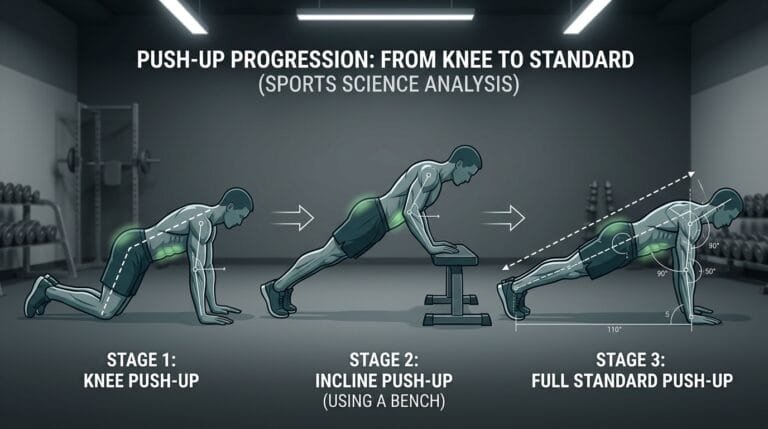
- Push-up variation – 3 × 8–12
- Single-arm row – 3 × 10–15 per arm
- Optional: short carry or plank – 2 sets
Hotel / Travel Version (15–25 minutes)
- Bodyweight squat or split squat – 3 × 10–15
- Single-leg glute bridge – 3 × 8–12 per side
- Push-up variation – 3 × 8–15
- Inverted row under a sturdy table or band row – 3 × 10–15
- Dead bug – 2 × 6–8 per side
Family-House / Low-Space Version (15–20 minutes)
- March or step-up in place – 2 minutes
- Bodyweight squat to a chair – 3 × 10–15
- Wall or elevated push-up – 3 × 8–12
- Band or towel row – 3 × 12–15
- Bird dog or dead bug – 2 sets
These sessions maintain movement patterns, blood flow, and psychological continuity without requiring high energy or perfect conditions.
Progression and Regression Rules During the Holidays
If energy and time are good
Perform the full minimum session and add one extra set or a short finisher.
If time is very limited
Cut to 2–3 exercises or reduce to two sets each. Completion still counts.
If sleep is poor or stress is high
Keep the session short and controlled; avoid high-intensity efforts.
If equipment is unavailable
Switch immediately to the bodyweight version without negotiation.
The key is that some version of training happens.
Managing Expectations Around Body Composition and Performance
Holiday periods often include higher calorie intake and reduced sleep. Temporary changes in scale weight or appearance are normal and do not erase training progress. Strength and muscle are retained far better by consistent low-volume training than by complete cessation followed by an aggressive restart. Focus on the process (sessions completed) rather than short-term outcomes.
Social and Family Strategies
- Communicate training times early so they are respected when possible.
- Offer to train at times that interfere least with shared activities.
- Accept that some days will be missed and return to the plan on the next available day.
- Avoid using social obligations as a blanket reason to stop entirely.
Recovery Priorities During the Season
- Protect sleep windows wherever feasible.
- Maintain protein intake even when meals are irregular.
- Use light walking as active recovery and stress reduction.
- Keep alcohol and late nights within limits that still allow training the next day when possible.
Common Holiday Momentum Killers
| Mistake | Result | Better Approach |
|---|---|---|
| All-or-nothing mindset | Complete stoppage after one missed week | Define and use the minimum viable session |
| Waiting for perfect conditions | Repeated delays | Train in whatever environment is available |
| Overly ambitious holiday program | Burnout or abandonment | Reduce volume and intensity deliberately |
| No pre-planned travel routine | Decision fatigue on the road | Prepare bodyweight and band options in advance |
| Neglecting the first week back | Slow or failed restart | Schedule the return week before the holidays end |
| Using food guilt to drive extra training | Poor relationship with both food and training | Separate nutrition and training decisions |
Strength training remains one of the highest-leverage habits for long-term health and function (strength training guidance). Practical home-gym approaches emphasise systems that survive real-life disruptions (home gym equipment prioritisation and budget home gym principles).
Frequently Asked Questions
How much training is enough to maintain momentum?
Two or three short sessions per week that cover the main movement patterns are sufficient for most people to retain strength and habit strength across several weeks.
Should I try to lose fat or make big strength gains during the holidays?
It is usually more effective to focus on maintenance and consistency. Aggressive goals increase friction and the likelihood of abandoning the plan.
What if I miss a whole week?
Resume with the minimum viable session on the next available day. Do not attempt to “make up” volume.
Is bodyweight training enough to maintain strength?
Yes for short periods, especially when intensity is kept high through tempo, pauses, or advanced variations. Free-weight strength may decline slightly but returns quickly once normal loading resumes.
How do I handle training when staying with family?
Use early morning or late evening slots, choose quiet bodyweight or band exercises, and keep sessions short so they do not disrupt the household.
Should I buy travel equipment?
A short set of resistance bands is the highest-leverage purchase for most people. Everything else is optional.
How quickly can I return to normal training after the holidays?
Most people can resume their regular program within one week if some momentum was maintained. Start with slightly reduced volume if recovery feels incomplete.
What is the biggest predictor of successful holiday training?
Having a pre-defined minimum session and treating it as non-negotiable on the scheduled days.
Final Recommendation
Maintaining training momentum during the holiday season requires a deliberate reduction in expectations combined with strong systems for consistency. Define a minimum viable session, schedule it in advance, prepare portable variations, and prioritise completion over intensity. Protect sleep where possible and plan the first week of normal training before the holidays end.
Write down your minimum viable session and the lowest acceptable weekly frequency today. Identify the most likely travel or family environments you will face and prepare a routine for each. Place the sessions in your calendar now. When the bar is low enough to clear on difficult days, momentum survives and the return to full training becomes straightforward. Start with the next scheduled minimum session—the habit you protect during this period is more valuable than any single workout.