How to Maintain Gains When Traveling with Portable Equipment Only
Quick Answer
You can successfully maintain gains, strength, muscle, and conditioning while traveling by using highly portable equipment—primarily resistance bands, a jump rope, a suspension trainer, or a single kettlebell/dumbbell if available—combined with bodyweight progressive movements. Focus on full-body sessions 3–5 times per week that cover squat, hinge, push, pull, and carry patterns, prioritise intensity and proximity to failure over volume, and accept that the goal is maintenance rather than peak progress. Consistency of stimulus, adequate protein, and daily walking preserve the large majority of gains for trips lasting from a few days to several weeks.
Why Maintenance Is Realistic and Important
Complete training cessation leads to measurable losses in strength and muscle size within 2–4 weeks, with detraining occurring faster in well-trained individuals. However, research and practical experience show that a reduced but consistent stimulus—especially when intensity remains high—preserves most adaptations for several weeks. Travel does not require progressive overload; it requires enough mechanical tension and training frequency to signal the body to keep the tissue it has already built.
Portable equipment makes this feasible in hotels, Airbnbs, airports, or family homes without relying on commercial gym access.
Best Portable Equipment for Travel Maintenance
| Equipment | Portability | Training Value | Best Uses | Priority |
|---|---|---|---|---|
| Resistance bands (multiple strengths) | Excellent | High | Rows, presses, squats, hinges, pull-aparts, assisted work | Highest |
| Jump rope | Excellent | High | Conditioning, warm-ups, finishers | High |
| Suspension trainer (TRX-style) | Very good | High | Rows, push-ups, squats, core, single-leg work | High |
| Single kettlebell or adjustable dumbbell | Good (if luggage allows) | Very high | Swings, squats, presses, rows, carries | Medium–High |
| Doorway pull-up bar (portable models) | Moderate | High | Pull-ups, hanging | Medium |
| Bodyweight only | Perfect | Moderate–High | Foundational patterns + advanced variations | Always available |
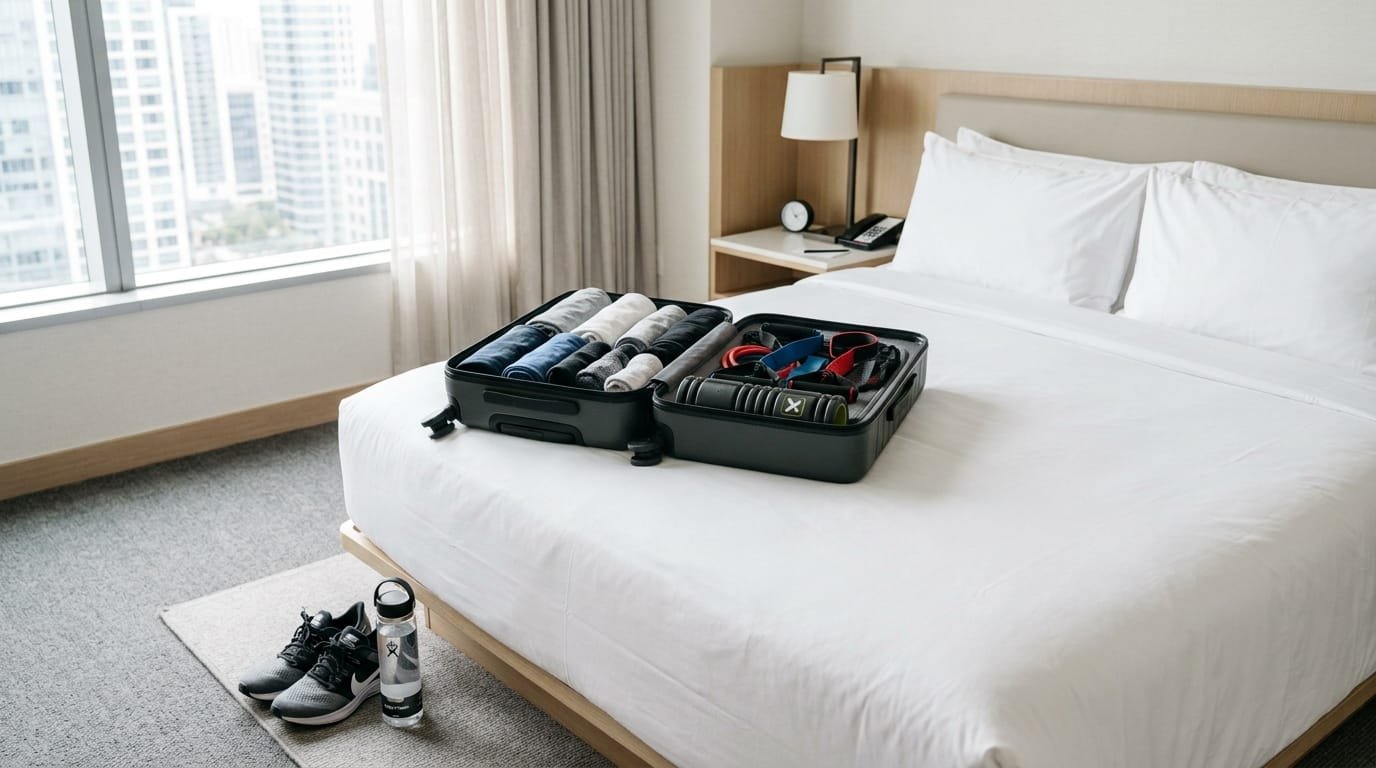
A set of bands plus a jump rope fits in any suitcase and covers nearly every need. Adding a suspension trainer or single kettlebell significantly expands options.
Core Movement Patterns to Prioritise
Maintain these five patterns in every training week:
- Squat / knee-dominant
- Hinge / hip-dominant
- Upper-body push
- Upper-body pull
- Carry, core anti-movement, or conditioning
When equipment is extremely limited, advanced bodyweight variations (pistol squat progressions, single-leg RDLs, archer push-ups, inverted rows under a sturdy table) still provide meaningful stimulus.
Sample Portable Workouts
Band-Only Full-Body (25–35 minutes)
- Band goblet squat or band-resisted squat – 3–4 × 10–15
- Band Romanian deadlift or good morning – 3 × 10–12
- Band chest press or push-up – 3 × 8–15
- Band row or face pull – 3 × 10–15
- Band pull-apart – 3 × 15–25
- Optional: suitcase carry with luggage or band-resisted plank
Suspension Trainer Session (30 minutes)
- Suspension squat or Bulgarian split squat – 3 × 8–12 per leg
- Suspension row – 3 × 8–12
- Suspension push-up – 3 × 8–15
- Single-leg RDL – 3 × 8–10 per side
- Core: mountain climbers or body saw – 3 × 20–40 seconds
Kettlebell or Dumbbell + Band Hybrid (if available)
- Swing or goblet squat – 4 × 10–15
- Single-arm row – 3 × 8–12 per side
- Floor press or overhead press – 3 × 8–12
- Band pull-apart – 3 × 15–20
- Farmer carry – 3 × 30–40 seconds
Bodyweight Emergency Session (hotel room, no gear)
- Chair or single-leg squat variation – 3 × 8–15
- Single-leg RDL – 3 × 8–12 per side
- Push-up variation – 3 × max controlled reps
- Inverted row under table or towel row – 3 × 8–12
- Plank or hollow hold – 3 × 20–40 seconds
Weekly Frequency and Structure While Traveling
| Trip Length | Recommended Frequency | Focus |
|---|---|---|
| 3–7 days | 2–4 sessions | Intensity and pattern coverage |
| 1–2 weeks | 3–5 sessions | Maintenance of strength + conditioning |
| 2–4 weeks | 3–5 sessions | Slight volume reduction, high effort |
| Longer | 3–4 sessions + daily walking | Sustainable maintenance |
Train full-body most sessions. This maximises frequency per muscle group with minimal total time.
Progressive Strategies When Equipment Is Limited
Even without heavier weights you can maintain (and sometimes improve) stimulus by:
- Increasing repetitions
- Slowing tempo (especially the eccentric)
- Adding pauses
- Reducing rest periods
- Moving to unilateral versions
- Elevating feet or changing leverage on push-ups and rows
- Increasing range of motion where mobility allows
Track sessions so you can match or exceed previous performance.
Shoulder Health and Grip on the Road
Travel often increases stiffness from sitting and sleeping in unfamiliar beds. Keep pressing and raising movements controlled. Technique details for lateral raises appear in Bent Arms vs. Straight Arms in Lateral Raises, The Hidden Mistake in Lateral Raises, and 3 Lateral Raise Modifications.
Grip can be challenged by bands, towels, and luggage carries; simple grip work helps preserve capacity (Do Hand Grippers Really Work?).
Step-by-Step Travel Training System
- Before departure, pack bands, a jump rope, and any other portable tools.
- Identify likely training locations (hotel room, park, family home).
- Choose 1–2 default workout templates that match available equipment.
- Schedule sessions in the travel calendar at realistic times.
- Warm up with light movement and band pull-aparts every session.
- Train with high intent—stop 1–2 reps short of technical failure.
- Walk daily; it supports recovery, digestion, and calorie balance.
- Prioritise protein at meals despite restaurant eating.
- Sleep as consistently as time zones allow.
- Upon return, resume normal programming with a short re-acclimation week if the trip was longer than 10–14 days.
Nutrition and Recovery While Traveling
- Target protein at each meal (aim for continuity with your normal intake).
- Stay hydrated, especially on flights and in dry hotel air.
- Accept some dietary variation without all-or-nothing thinking.
- Use walking and short mobility sessions to offset long periods of sitting.
- Protect sleep windows whenever possible—training quality and recovery both depend on it.
Strength training remains one of the most effective ways to preserve muscle during periods of disrupted routine (strength training guidance). Practical home- and travel-training resources emphasise that intensity and frequency matter more than perfect equipment (home gym and portable training principles and practical equipment guidance).
Common Travel Training Mistakes
| Mistake | Consequence | Solution |
|---|---|---|
| Waiting for a perfect gym | Missed sessions | Use the portable template immediately |
| Dropping intensity too far | Faster detraining | Stay close to failure on working sets |
| All-or-nothing mindset | Zero training after one missed day | Any session counts |
| Neglecting walking | Lower energy and poorer recovery | Walk after meals or during downtime |
| Poor protein distribution | Greater muscle loss risk | Include a protein source at most meals |
| Returning with excessive volume | Unnecessary soreness | Re-enter normal training gradually |
Frequently Asked Questions
How long can I maintain gains with only portable equipment?
Most people preserve the large majority of strength and muscle for 2–4 weeks with consistent, high-intent sessions. Longer periods are possible with disciplined effort.
What is the single most useful item to pack?
A set of resistance bands with multiple strengths. They cover push, pull, squat, and hinge patterns in the smallest possible package.
Do I need to train every day while traveling?
No. Three to five full-body sessions per week are sufficient for maintenance.
What if the hotel has a basic gym?
Use it when convenient, but keep a portable backup plan so you are never dependent on it.
Can bodyweight alone maintain strength?
Yes for shorter trips, especially if you use advanced variations and train close to failure. Bands or a suspension trainer make maintenance easier and more joint-friendly.
How should I handle time-zone changes?
Prioritise sleep first. Insert short sessions when energy is reasonable. Walking is always available.
Should I try to progress or just maintain?
Maintenance is the primary goal. If you feel good and equipment allows, modest progression is a bonus.
What is the best way to resume normal training after a long trip?
Begin with a slightly reduced volume week, then return to normal loads and volume. Avoid jumping straight into peak intensity.
Final Recommendation
Maintaining gains while traveling with portable equipment only is entirely achievable. Pack resistance bands and a jump rope as the foundation, add a suspension trainer or single kettlebell when luggage allows, and train full-body patterns 3–5 times per week with high intent. Cover squat, hinge, push, pull, and carry movements, stay close to technical failure, walk daily, and keep protein intake consistent.
Protect shoulder health with controlled technique, maintain grip capacity, and treat every completed session as a success. Upon return, re-acclimate briefly rather than forcing immediate personal records.
Preparation is the difference between losing momentum and preserving months of hard work. Pack the bands, schedule the first travel session, and keep the stimulus alive. The ability to train effectively anywhere is one of the highest-leverage skills a serious trainee can develop—start applying it on the next trip.