Best Way to Warm Up Rotator Cuff Before Heavy Shoulder Work
Quick Answer The most effective rotator cuff warm-up before heavy shoulder work combines light band external rotations (elbows at side and at 90° abduction), band pull-aparts, face pulls with external rotation, and controlled scapular activation drills. Perform 2–3 sets of 12–20 controlled repetitions with light resistance, focusing on quality and end-range holds rather than fatigue. This sequence increases blood flow, activates the infraspinatus, teres minor, and supraspinatus, improves scapular control, and prepares the shoulder for the demands of bench press, overhead press, or heavy dumbbell work—typically taking 6–10 minutes.
Why a Specific Rotator Cuff Warm-Up Matters
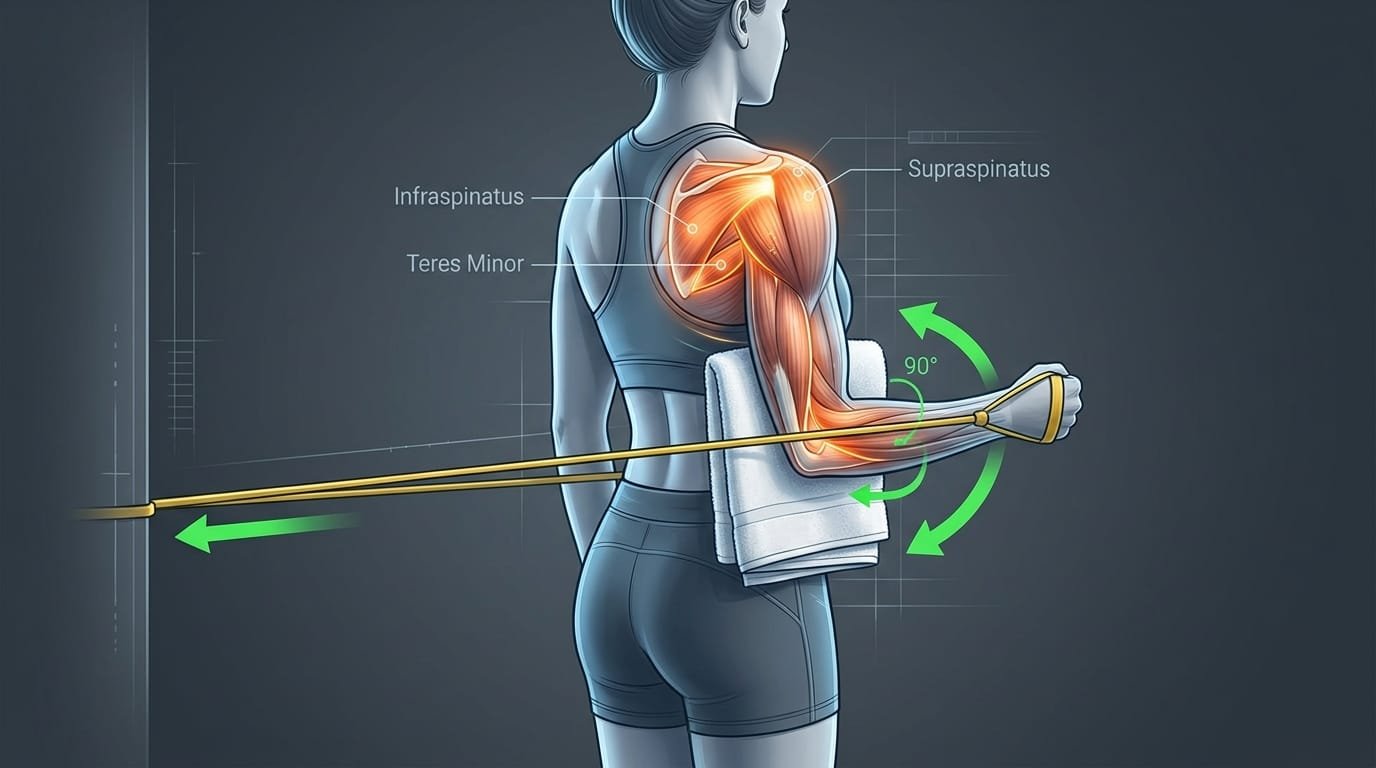
The rotator cuff consists of four small muscles—supraspinatus, infraspinatus, teres minor, and subscapularis—that stabilize the humeral head within the glenoid fossa during every pressing and overhead movement. When these muscles are under-activated or relatively weak, larger muscles such as the deltoids, pectoralis major, and latissimus dorsi dominate. This shift increases shear forces across the joint and raises the risk of impingement, tendinopathy, or acute strain.
Heavy shoulder work (bench press, overhead press, push press, or high-volume lateral raises) places particularly high demand on the cuff in both adducted and abducted positions. A targeted warm-up primes these stabilizers, improves neuromuscular recruitment, and raises the tissue’s tolerance to load. General arm circles or five minutes on a cardio machine are rarely enough.
Electromyography studies and clinical practice support prioritising external rotation, scapular control, and movements that challenge the cuff in positions similar to those encountered under the bar. Practical protocols and activation strategies are discussed in resources such as E3 Rehab and coaching guides on shoulder preparation.
Core Principles of an Effective Rotator Cuff Warm-Up
- Prioritise external rotation – The infraspinatus and teres minor are frequently under-trained relative to the internal rotators.
- Train both adducted and abducted positions – Elbows-at-side rotations emphasise different fibres than the 90/90 position.
- Include scapular control – Retraction, depression, and controlled protraction improve the platform the cuff works from.
- Use light resistance and high control – The goal is activation and blood flow, not muscular fatigue.
- Keep total duration short – 6–10 minutes is ideal so the warm-up does not impair performance on the main lifts.
- Remain completely pain-free – Any sharp or pinching sensation is a signal to reduce range or modify the exercise.
Detailed Step-by-Step Warm-Up Protocol
1. Band External Rotation – Elbows at Side (2 sets of 12–15 per side) Anchor a light band at approximately elbow height. Stand sideways to the anchor with the working elbow bent 90° and pinned firmly against the ribcage. Rotate the forearm outward against the band, pause for 1–2 seconds at full external rotation while squeezing the back of the shoulder, then return under control. This is the foundational drill for infraspinatus and teres minor activation.
2. Band External Rotation at 90° Abduction / 90/90 Position (2 sets of 10–12 per side) Raise the upper arm until it is parallel to the floor and bend the elbow to 90°. Externally rotate the forearm upward against light band or cable resistance. This position more closely matches the demands of overhead pressing and the upper portion of the bench press.
3. Band Pull-Aparts (2 sets of 15–20) Hold a light band at shoulder height with arms extended in front of you. Pull the band apart by actively retracting the scapulae and adding a slight external rotation at the end. Focus on the mid-back squeeze rather than swinging the arms.
4. Face Pulls with External Rotation Finish (2 sets of 12–15) Anchor a band or cable at roughly face height. Pull toward the face while leading with the elbows high and wide. At the end of the movement, externally rotate so the thumbs point backward or toward the ears. This combines rear-delt, rhomboid, mid-trap, and rotator cuff activation in one movement. Detailed form cues appear in resources such as Motra’s face-pull guide.
5. Optional Scapular Control Finisher (1–2 sets of 10–12) Scapular wall slides or light prone/banded Y-raises reinforce upward rotation and lower-trapezius engagement—critical for overhead readiness.
Perform the sequence with deliberate tempo (approximately 2 seconds out, 1-second hold, 2 seconds back). Total time should stay in the 7–9 minute range. Move immediately into specific warm-up sets for your main lift.
Comparison of Warm-Up Components
| Exercise | Primary Muscles Activated | Best Application | Recommended Volume |
|---|---|---|---|
| External Rotation (elbows in) | Infraspinatus, teres minor | General cuff activation | 2 × 12–15 per side |
| External Rotation (90/90) | Infraspinatus, teres minor + stabilizers | Overhead & abducted positions | 2 × 10–12 per side |
| Band Pull-Aparts | Rhomboids, mid-traps, rear delts | Scapular retraction & posture | 2 × 15–20 |
| Face Pulls | Rear delts, external rotators, traps | Combined posterior chain | 2 × 12–15 |
| Scapular Wall Slides / Y-Raises | Lower traps, serratus, upward rotation | Overhead readiness | 1–2 × 10–12 |
Programming Adjustments for Different Training Days
Before Heavy Bench Press Emphasise elbows-at-side external rotations and band pull-aparts. The cuff must stabilise the humeral head during the descent and the drive off the chest.
Before Overhead Press or Push Press Prioritise the 90/90 external rotation and face pulls. These better match the elevated, abducted demands of the lift.
Before High-Volume Lateral Raises or Isolation Work Include both external rotation variations plus light scapular drills to protect the joint during repeated abduction.
Minimalist Version (When Time Is Limited) 2 sets of band external rotations (elbows in) + 2 sets of face pulls. This still provides meaningful activation in under five minutes.
Common Mistakes That Reduce Effectiveness
- Selecting bands that are too heavy and turning activation into a strength exercise
- Performing fast, uncontrolled repetitions with no end-range pause
- Completely skipping the 90/90 position
- Turning face pulls into upright rows or pure shrugs
- Spending 15–20 minutes on the warm-up and arriving fatigued for the main work
- Focusing only on pure rotational work while ignoring scapular control
Integrating the Warm-Up with the Rest of Your Training
A properly primed rotator cuff improves every pressing and overhead movement. When bands are unavailable, light adjustable dumbbells can be used for side-lying or standing external rotations. Kettlebell bottoms-up carries or light presses serve as advanced activation tools once basic control is established. Strong grip endurance helps maintain consistent tension on bands and cables throughout the warm-up.
Core stability developed through ab roller variations supports a braced torso during standing drills. Recovery tools such as a budget massage gun can help manage residual cuff, upper-trap, and forearm tension after heavy sessions. Light cardio on a manual treadmill or mobility flows with resistance bands complement the specific warm-up. Review lateral raise form guidance so isolation work does not counteract the benefits of proper cuff preparation.
Sample Complete Pre-Shoulder Session Flow
- General pulse raiser (3–5 minutes of light cardio, jump rope, or dynamic arm swings)
- Rotator cuff specific sequence (7–9 minutes as detailed above)
- Specific warm-up sets for the main lift (empty bar or light dumbbells progressing to working weight)
- Working sets
This structure ensures the cuff is activated and the shoulders are warm without creating unnecessary fatigue.
Frequently Asked Questions
How heavy should the band or dumbbell be? Light enough that you can complete every repetition with perfect control and a clear muscular contraction at end range. If you feel the movement primarily in the deltoid rather than the back of the shoulder, reduce the resistance. Practical guidance on appropriate loading appears in resources such as E3 Rehab.
Can I perform this warm-up every upper-body training day? Yes. The low load makes it suitable for frequent use. Many lifters run a shortened version before every pressing or overhead session.
Is static stretching better than activation drills? Dynamic activation and light strengthening are generally superior to prolonged static stretching before heavy loading. Save longer static stretches for post-training or separate mobility sessions.
What if I already have shoulder discomfort? Reduce the range of motion, use even lighter resistance, and consider professional assessment. The warm-up should never increase symptoms.
Do I still need this sequence if I already do face pulls in my main workout? Yes. A short activation sequence performed before heavy loading serves a different purpose from training the same muscles later for strength or hypertrophy.
How soon before the main lifts should I finish the warm-up? Move directly into your specific warm-up sets for the primary exercise. The goal is to keep the shoulders warm and neurologically primed.
Final Recommendation
The best way to warm up the rotator cuff before heavy shoulder work is a short, focused sequence of light external rotations (both elbows-in and 90/90 positions), band pull-aparts, and face pulls performed with deliberate control and end-range emphasis. This approach activates the key stabilisers, improves scapular control, and prepares the joint for the specific demands of pressing and overhead movements.
Consistency matters more than complexity. Perform the protocol before every heavy upper-body session, keep the resistance light, and prioritise quality of movement over quantity. Over weeks and months, this small investment produces noticeable improvements in shoulder resilience, pressing performance, and training longevity.
Start with the basic sequence outlined above, film your form if possible, and adjust volume slightly according to how your shoulders respond. When the rotator cuff is properly primed, every subsequent pressing and overhead lift becomes safer, stronger, and more productive.