Best Starter Home Gym for Women Focusing on Glutes and Upper Body
Quick Answer The best starter home gym for women prioritising glute development and upper-body strength is built around five core items: a pair of adjustable dumbbells, a stable bench (flat or adjustable), a complete resistance-band set, a doorway pull-up bar, and a quality exercise mat. These tools enable progressive hip thrusts, Romanian deadlifts, lunges, step-ups, glute bridges, rows, presses, lateral raises, face pulls, and pull-up variations. The setup remains compact, relatively affordable ($300–$550 for quality versions), and highly effective for muscle growth and strength without requiring a power rack or large machines. A single kettlebell can be added later for swings and carries.
Why This Specific Focus Works
Many women want stronger, fuller glutes for aesthetic, performance, postural, and injury-resilience reasons, while also developing balanced upper-body strength for posture, daily function, and physique proportion. The highest-leverage movement patterns for these goals are hip extension (hip thrusts, bridges, RDLs, swings), single-leg work (lunges, step-ups, Bulgarian split squats), horizontal and vertical pulling (rows, pull-ups, face pulls), and horizontal and vertical pressing (bench/floor press, overhead press).
Free weights and bands allow natural movement paths, easy micro-loading, high muscle activation, and straightforward progressive overload — exactly what is needed for visible and functional results. Research and practical coaching experience show that consistent progressive resistance training produces significant glute and upper-body improvements in women when volume, intensity, and recovery are managed properly.
Essential Starter Equipment – Detailed Checklist
| Priority | Item | Key Glute Exercises Enabled | Key Upper-Body Exercises Enabled | Approx. Cost Range | Why It Is Essential |
|---|---|---|---|---|---|
| 1 | Adjustable dumbbells | Hip thrusts, single-leg hip thrusts, RDLs, reverse lunges, Bulgarian split squats, step-ups, goblet squats | Bench/floor press, incline press, single-arm & two-arm rows, overhead press, lateral raises, curls | $150–$280 | Highest versatility and long-term progression |
| 2 | Stable bench | Elevated hip thrusts, single-leg work support | Flat & incline presses, chest-supported rows | $90–$150 | Dramatically expands loading options |
| 3 | Resistance band set | Banded hip thrusts, glute bridges, monster walks, lateral walks, kickbacks, seated abductions | Face pulls, band pull-aparts, assisted pull-ups, band lateral raises | $20–$40 | Activation, assistance, burnout sets, shoulder health |
| 4 | Doorway pull-up bar | — | Pull-ups, chin-ups, neutral-grip variations, hanging work | $25–$45 | Critical vertical pulling stimulus |
| 5 | Exercise mat | Floor glute bridges, side-lying work, comfort | Floor presses, core work | $20–$50 | Protection, comfort, defined space |
| Optional | Single kettlebell | Swings, sumo-style hinges, carries | — | $30–$70 | Excellent posterior-chain power & conditioning |
Realistic total for a high-quality starter gym: $300–$550. Used adjustable dumbbells can reduce the total further while preserving function.
In-Depth Equipment Guidance
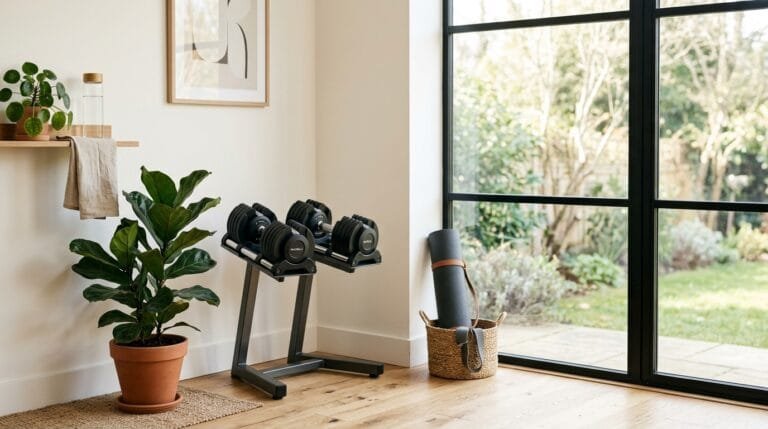
Adjustable Dumbbells – The Non-Negotiable Core One pair replaces an entire rack and allows precise progressive overload on every priority lift. For glutes they load hip thrusts, RDLs, and single-leg work effectively. For upper body they cover all major pressing and rowing patterns plus isolation work.
Aim for a range that supports at least 12–18 months of progress (many women do well with pairs that start light and reach 40–50+ lb per hand). Full criteria on weight range, adjustment mechanisms, handle comfort, and durability are covered in How to Choose the Best Adjustable Dumbbells for Home Gyms in 2026.
Bench Elevating the shoulders for hip thrusts significantly increases glute loading potential and range of motion. The same bench enables proper horizontal pressing and chest-supported rows that are easier on the lower back. An adjustable bench adds comfortable incline pressing options.
Resistance Bands Bands are unmatched for glute activation series, lateral stability work, and high-rep burnout sets. They also protect shoulder health through face pulls and pull-aparts and make pull-ups accessible via assistance. Detailed type comparisons (loop vs tube vs fabric) and buying advice appear in Resistance Bands Buying Guide: Loop vs. Tube vs. Fabric – Which Wins?.
Doorway Pull-Up Bar Vertical pulling builds the upper back, rear delts, and arms while reinforcing good posture. Band assistance allows beginners to start immediately and progress toward full bodyweight reps.
Mat Essential for floor-based glute work, initial hip-thrust variations, and overall joint comfort.
Optional Kettlebell Once the foundation is solid, a single kettlebell (commonly 18–35 lb / 8–16 kg range for many starting women) unlocks swings — one of the most effective dynamic glute and hamstring exercises. Sizing recommendations are here: How Heavy Should My Adjustable Kettlebell Be?.
Priority Exercise Library
Highest-Value Glute Exercises
- Dumbbell or banded hip thrust (bench elevates shoulders)
- Single-leg hip thrust
- Romanian deadlift
- Reverse lunge / walking lunge
- Bulgarian split squat
- Step-up
- Band monster walks and lateral walks
- Glute bridge variations (double- and single-leg)
- Kettlebell swing (when added)
Highest-Value Upper-Body Exercises
- Dumbbell bench press or floor press
- Incline dumbbell press
- Single-arm dumbbell row
- Chest-supported row
- Overhead press
- Lateral raises (strict form guidance in safe lateral-raise technique)
- Face pulls and band pull-aparts
- Pull-ups / chin-ups (band-assisted as needed)
- Overhead triceps work and biceps curls
Step-by-Step Build and Implementation Plan
- Establish a clear budget and allocate the largest share to adjustable dumbbells.
- Purchase a stable bench and doorway pull-up bar.
- Add a complete resistance-band set and quality mat.
- Optional: Introduce one kettlebell after 6–8 weeks of consistent training.
- Learn and film key lifts (especially hip thrust and row technique).
- Begin a progressive 3- or 4-day programme focused on the priority movements.
- Track every working set (weight × reps) to ensure progressive overload.
- Use bands for activation before heavier glute work and for upper-back health.
- Prioritise full range of motion and controlled tempos.
- Re-evaluate every 8–12 weeks and upgrade only when current loads become limiting.
Sample Progressive 3-Day Programme
Day 1 – Glute Emphasis + Horizontal Push/Pull Dumbbell hip thrust – 3–4 sets of 8–12 Romanian deadlift – 3 sets of 8–12 Reverse lunges – 3 sets of 8–10 per leg Dumbbell bench press – 3 sets of 8–12 Single-arm row – 3 sets of 10–12 per side Band face pulls – 2–3 sets of 15–20
Day 2 – Upper-Body Emphasis + Glute Accessory Overhead press – 3 sets of 8–12 Pull-ups or band-assisted pull-ups – 3 sets near failure Lateral raises – 3 sets of 12–15 Chest-supported or bent-over reverse fly – 3 sets of 12–15 Bulgarian split squat or step-up – 3 sets of 8–10 per leg Band pull-aparts – 2 sets of 15–20
Day 3 – Mixed Strength Goblet squat or dumbbell front squat – 3 sets of 8–12 Single-leg hip thrust – 3 sets of 8–12 per side Kettlebell swing (if available) or glute bridge – 3 sets of 10–15 Dumbbell floor press or close-grip press – 3 sets of 8–12 Additional pull-up variation or inverted row – 3 sets Core work (planks, dead bugs, or progressing toward ab-roller variations)
Rest 60–90 seconds on most exercises. Progress by adding weight or repetitions while maintaining clean form. Develop grip strength to improve pulling performance and loaded carries.
Budget, Space, and Progression Strategy
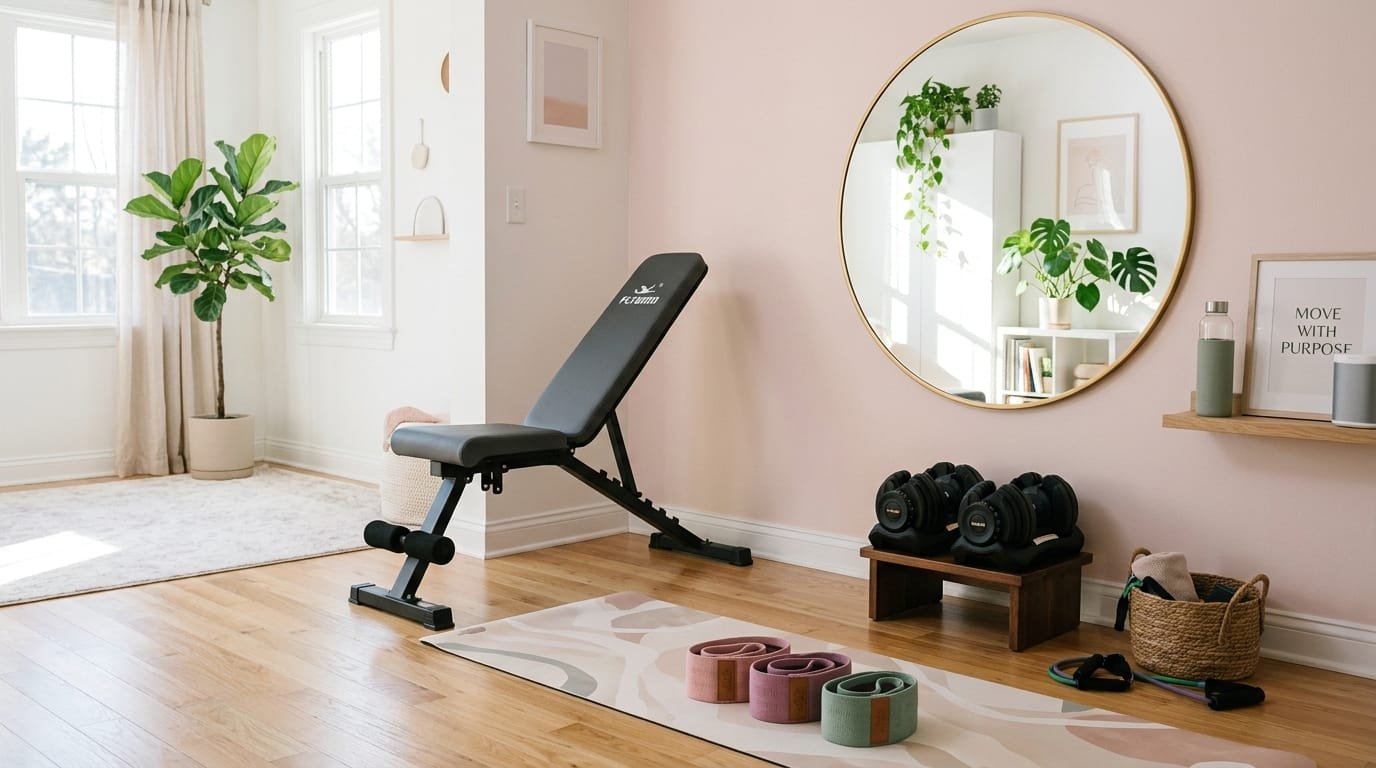
This starter combination fits in a corner, spare room, or even a large closet when foldable items are chosen. External examples of women’s home-gym setups and budget approaches can be reviewed in practical guides such as women’s home gym essentials resources.
Progressive overload is the primary driver of results. When the top end of the dumbbell range is regularly reached with good form and recovery, consider heavier adjustable handles, a second kettlebell, or (much later) a compact rack and barbell.
Recovery, Nutrition, and Technique Support
Aim for adequate protein (typically 1.6–2.2 g per kg of body weight), sufficient sleep, and manageable weekly volume. Use bands for glute activation and upper-back care. A foam roller or budget massage gun can help manage soreness once training frequency increases. Low-impact conditioning such as walking or a future manual treadmill pairs well with the strength work.
Common Mistakes That Limit Results
- Staying with bodyweight-only glute work too long
- Neglecting progressive overload on hip thrusts and rows
- Skipping upper-back work (face pulls, rows, pull-aparts)
- Choosing fixed dumbbells that quickly become too light
- Rushing load increases at the expense of range of motion and control
- Buying specialised machines before mastering the free-weight basics
Frequently Asked Questions
Do I need a barbell and rack to grow my glutes effectively? No. Dumbbell hip thrusts, RDLs, lunges, split squats, and band work produce excellent results for the large majority of women at beginner and intermediate stages.
How heavy should my adjustable dumbbells be? Choose a pair that allows progression for at least 12 months. Many women succeed with ranges that reach 30–50 lb per hand; stronger trainees may eventually need more.
Are bands alone enough for glute development? They are outstanding for activation, high-rep work, and progressive resistance, but combining them with dumbbells provides superior long-term loading potential.
How many days per week should I train? 3–4 sessions per week using a structure similar to the sample programme works well for most beginners. Allow recovery between heavier lower-body focused days.
Can this setup create a balanced physique? Yes. The listed exercises cover the major patterns required for both glute development and upper-body strength and posture.
What is the best next upgrade after the starter set? A kettlebell for swings, heavier dumbbell capacity if needed, or a more adjustable bench. Upgrade only when progressive overload on current tools becomes limited.
Is this setup suitable for complete beginners? Yes. Start with lighter loads, master technique, and progress systematically. Band assistance makes pull-ups accessible from the beginning.
Final Recommendation
Build your starter home gym around adjustable dumbbells, a stable bench, resistance bands, a doorway pull-up bar, and a quality mat. This combination supplies the highest-value exercises for glute growth (hip thrusts, RDLs, lunges, band walks) and upper-body strength (presses, rows, lateral raises, pull-ups) in a compact, cost-effective, and fully progressive package.
Master technique, track every working set, emphasise progressive overload, and support training with adequate protein and recovery. When these fundamentals are in place, the starter gym produces visible and functional results without unnecessary expense or space requirements. Begin with the core five items, follow a structured programme, and expand only when you have genuinely outgrown the current resistance levels — your glutes and upper body will respond with consistent effort.