Quiet Home Gym Equipment Options for Apartment Living
Quick Answer The quietest and most neighbour-friendly home gym equipment for apartments centres on resistance bands, adjustable dumbbells used with strict controlled tempos, a foldable bench, a removable doorway pull-up bar, and low-noise cardio machines such as magnetic-resistance bikes or compact magnetic rowers. These tools generate minimal airborne sound and almost no structural vibration when paired with thick rubber mats and proper technique. Avoid all weight dropping, high-impact plyometrics, and traditional running treadmills. This combination supports progressive full-body strength training and effective conditioning while dramatically reducing the risk of noise complaints or lease issues.
Why Noise Is the Primary Constraint in Apartment Gyms
In multi-unit buildings, sound travels in two main ways: airborne noise (voices, music, machine motors) and impact/structure-borne noise (dropped weights, jumping, heavy foot strikes). Impact noise is far more disruptive because it transmits through floors, ceilings, and shared walls. Many leases include “quiet enjoyment” clauses, and repeated complaints can lead to warnings or worse. Choosing equipment that is inherently quiet and adopting noise-conscious habits is therefore non-negotiable for long-term apartment training success. Independent apartment-gym resources consistently emphasise controlled free weights, bands, and magnetic cardio as the practical solution .
Comprehensive Noise Comparison of Home Gym Equipment
| Equipment Type | Typical Noise & Vibration Level | Apartment Suitability | Critical Noise-Control Requirements | Recommended Use Window |
|---|---|---|---|---|
| Resistance bands | Very low / near silent | Excellent | None | Any time |
| Adjustable dumbbells (controlled lowering) | Low | Excellent | Thick mat + never drop + slow eccentrics | Any time with control |
| Magnetic-resistance exercise bike | Very low | Excellent | Mat underneath | Any time |
| Compact magnetic rower | Low | Very good | Controlled strokes + thick mat | Daytime preferred |
| Doorway pull-up bar | Very low | Excellent | Smooth install/removal | Any time |
| Foldable bench | Low | Excellent | Stable placement, no scraping | Any time |
| Kettlebell (strictly controlled) | Low–moderate | Good | Soft landings + thick mat + no slamming | Daytime preferred |
| Jump rope on thick rubber | Moderate | Conditional | Heavy mat essential + soft landings | Daytime only |
| Walking pad at low speed | Low–moderate | Good | Quality mat + walking pace only | Daytime preferred |
| Traditional treadmill (running speeds) | High | Poor | Generally avoid | Not recommended |
| Barbell + iron plates with drops | Very high | Poor | Avoid or extreme mitigation only | High risk |
Quiet Strength Equipment – In-Depth Recommendations
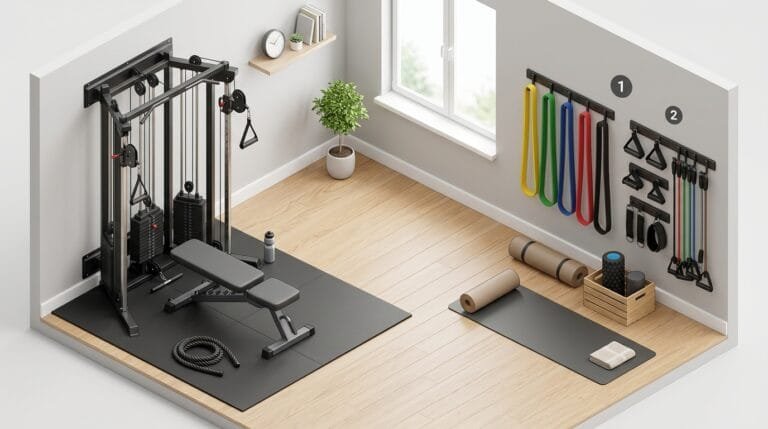
Resistance Bands – The Silent Foundation Bands produce virtually no sound or vibration. They allow progressive resistance, pull-up assistance, face pulls, pull-aparts, lateral walks, and full-body strength work. A well-chosen set of loop bands plus tube bands with handles covers warm-ups, primary lifts, and mobility. For differences between loop, tube, and fabric options and buying criteria, see our detailed guide: Resistance Bands Buying Guide: Loop vs. Tube vs. Fabric – Which Wins?.
Adjustable Dumbbells – Progressive Loading Without the Noise When weights are lowered under full control and placed gently on a thick mat, adjustable dumbbells rank among the quietest progressive strength tools available. They replace an entire rack of fixed dumbbells while occupying minimal space. Focus on deliberate eccentric tempos and never allow the weights to free-fall. Complete selection guidance (weight range, locking mechanisms, durability) is available here: How to Choose the Best Adjustable Dumbbells for Home Gyms in 2026.
Foldable Bench A stable foldable bench unlocks flat and incline pressing, supported rows, and hip thrusts with negligible added noise. Choose models that fold flat or stand vertically for easy storage and always place a mat underneath during use.
Doorway or Removable Pull-Up Bar Vertical pulling is essential for balanced upper-body development and produces almost no noise. Removable doorway bars are ideal for renters because they leave no permanent marks. Pair with bands for assistance progressions.
Kettlebell – Valuable but Technique-Critical A single kettlebell enables swings, cleans, and carries that are excellent for posterior-chain strength and conditioning. However, the bell must be guided to a soft landing on a thick mat; any slamming or dropping quickly becomes problematic. Sizing recommendations are covered in How Heavy Should My Adjustable Kettlebell Be?.
Quiet Cardio Options Ranked for Apartments
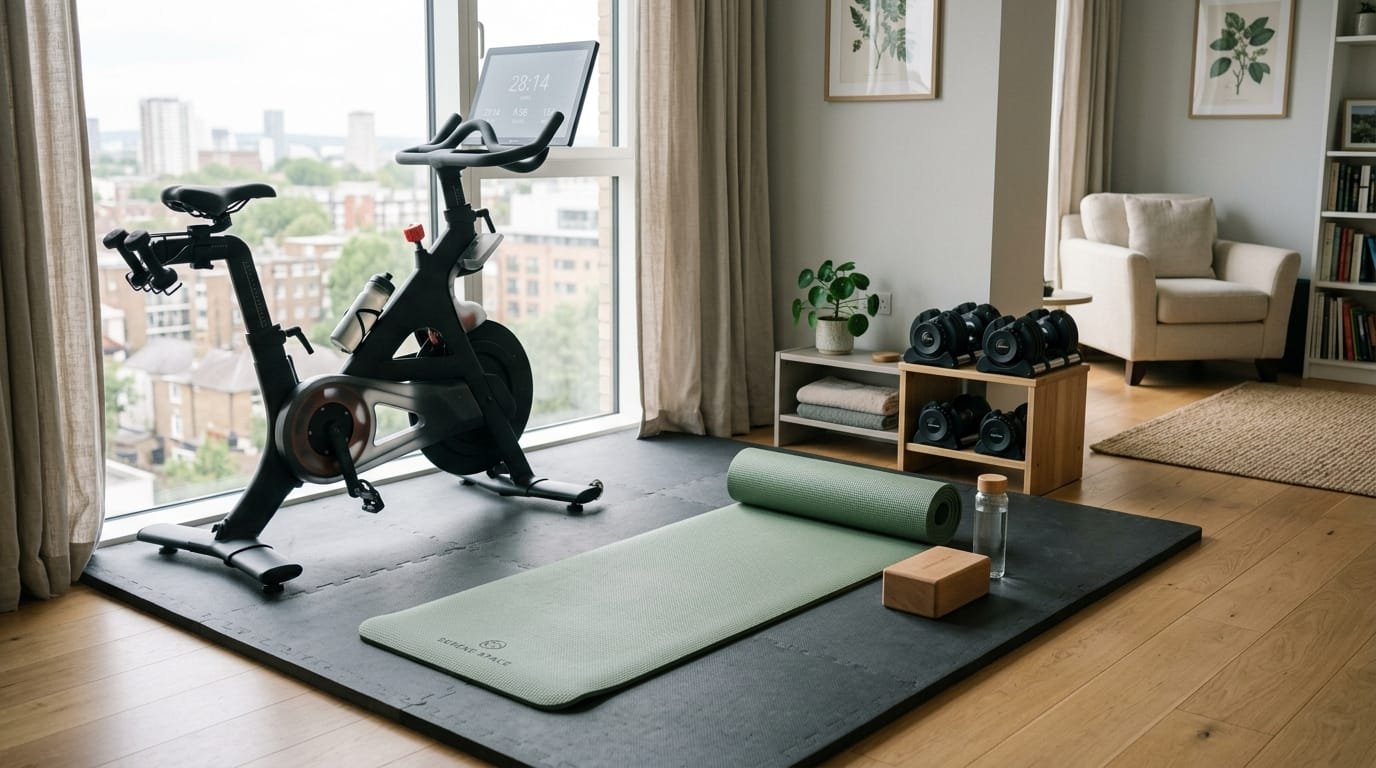
Magnetic-Resistance Exercise Bikes These are typically the quietest dedicated cardio machines, often operating in the 25–35 dB range (comparable to a quiet refrigerator). Belt-drive models further reduce mechanical noise. They are suitable for early mornings or late evenings when used on a mat. Practical quiet-cardio discussions appear in apartment-focused guides such as this quiet equipment overview.
Compact Magnetic Rowers Provide excellent full-body conditioning with relatively low noise when strokes remain controlled. Many models fold for storage. Always use a thick mat to minimise residual vibration transmission.
Walking Pads / Under-Desk Treadmills at Walking Speeds Acceptable when restricted to walking paces and placed on proper flooring. Higher speeds increase both motor noise and impact vibration and should be avoided in most apartments.
Jump Rope on Heavy Rubber Flooring High conditioning value but only viable with a thick, dense mat and preferably during daytime hours. Soft landing technique significantly reduces transmitted noise.
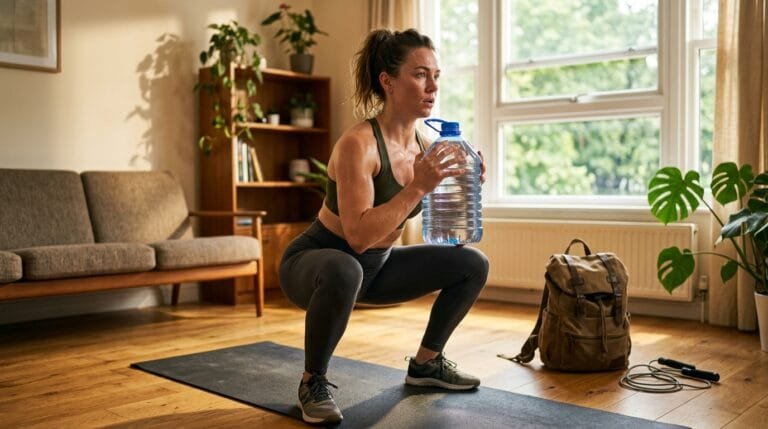
Modified Bodyweight + Band Circuits Completely silent when explosive jumping is replaced with step-back or controlled variations.
Flooring and Vibration Control – Non-Negotiable
Thick, dense rubber mats or interlocking tiles (minimum 8–15 mm, ideally thicker under primary lifting zones) are one of the highest-leverage investments for apartment gyms. Quality flooring can reduce impact noise transmission by a substantial margin and protects both your floors and your neighbour relationships. Place mats under all loaded equipment and the entire training zone where possible. Additional apartment flooring and noise-mitigation advice can be found in resources such as apartment workout equipment guides.
Step-by-Step: Building and Operating a Quiet Apartment Gym
- Evaluate your floor type, position in the building (ground floor vs upper), and neighbour proximity.
- Start with the quiet strength core: bands, adjustable dumbbells, foldable bench, and pull-up bar.
- Add one low-noise cardio option (magnetic bike is the safest default).
- Install thick rubber flooring across the entire training area.
- Establish strict technique rules: controlled eccentrics, no dropping, soft placements, minimal or modified jumping.
- Schedule more intense sessions during daytime or early evening hours when possible.
- Create a rapid set-up and complete pack-away routine so equipment never lives permanently on the floor.
- Test real-world noise (record audio or seek polite neighbour feedback) and refine technique or timing.
- Track training progress and only introduce new equipment that maintains the same low-noise standard.
- Maintain open communication with neighbours if you train near quiet hours.
Sample Quiet Progressive Programme
Session A – Upper Strength Focus Goblet or dumbbell front squat variation – controlled 3–4 × 8–12 Dumbbell floor/bench press – slow eccentric 3–4 × 8–12 Single-arm dumbbell row – 3 × 10–12 Band face pulls + pull-aparts – 3 × 15–20 Pull-ups or band-assisted pull-ups – 3 sets near failure
Session B – Lower + Hinge Focus Romanian deadlift – deliberate tempo 3 × 10–12 Dumbbell overhead press – 3 × 8–12 Bulgarian split squat or reverse lunge – 3 × 8–10 per leg Hanging knee raises or band core anti-rotation – 3 × 10–15 Optional controlled kettlebell swings on thick mat
Cardio / Conditioning Days Magnetic bike or rower – 20–40 minutes steady-state or intervals or carefully executed jump-rope intervals on heavy rubber or fully silent band + bodyweight circuit
Maintain healthy shoulder mechanics on all pressing and isolation work by applying the principles in safe lateral-raise technique. Build grip strength to improve pull-up performance and loaded carries. Progress core training with ab-roller variations once basic stability is established. Recovery tools such as a budget massage gun remain quiet and practical. Additional low-impact conditioning context is available in Does a Manual Treadmill Burn Belly Fat?.
Further real-world apartment and low-noise equipment examples appear in independent guides, including quiet apartment workout equipment discussions and broader compact apartment gym resources.
High-Risk Mistakes That Lead to Complaints
- Dropping dumbbells, kettlebells, or any weight even occasionally
- Performing box jumps, burpees, or high-impact plyometrics on inadequate flooring
- Running on a traditional treadmill
- Allowing metal-on-metal clanging during storage or plate changes
- Training at very early or late hours without mats and controlled technique
- Using thin or no flooring under loaded movements
Frequently Asked Questions
What is the single quietest strength training tool? Resistance bands, followed closely by adjustable dumbbells used with strict controlled lowering.
What is the quietest dedicated cardio machine for apartments? Magnetic-resistance exercise bikes, particularly belt-drive models, which often operate near refrigerator-level noise.
Can I build significant muscle and strength with only quiet equipment? Yes. Progressive overload using bands, adjustable dumbbells, controlled bodyweight progressions, and a pull-up bar is highly effective for both hypertrophy and strength.
How thick do apartment gym mats need to be? Minimum 8–15 mm dense rubber under lifting zones; thicker is better for impact reduction and neighbour consideration.
Are kettlebell swings realistic in an apartment? Yes when landings are soft and controlled, a thick mat is used, and sessions occur at reasonable hours. Aggressive slamming is not apartment-compatible.
Should barbell training be avoided completely? In most apartments, traditional barbell work involving drops carries high complaint risk. Controlled dumbbell, band, and bodyweight alternatives cover the large majority of training needs effectively.
How can I verify my setup is quiet enough? Record sessions on your phone, train at different times, and, where appropriate, ask neighbours for feedback. Adjust technique, timing, or equipment immediately if any issues arise.
Is a smart digital-resistance gym a good quiet option? Many digital resistance systems are very quiet and compact, making them viable apartment solutions, though cost is significantly higher than the band + dumbbell route.
Final Recommendation
Construct your apartment gym around inherently quiet tools: resistance bands, adjustable dumbbells used with controlled tempos, a foldable bench, a removable pull-up bar, and low-noise cardio such as a magnetic bike or compact rower. Invest in thick, dense rubber flooring, enforce a strict no-dropping rule, minimise or modify jumping, and schedule sessions with consideration for neighbours. This framework supports complete progressive strength training and effective conditioning while protecting relationships and lease compliance.
Begin with the quiet strength core, add one low-noise cardio option, master controlled technique, and expand only within the same noise standard. When silence and control are prioritised from day one, serious home training and apartment living become fully compatible. Your progress, your neighbours, and your long-term ability to train at home will all benefit.