Creating a Home Gym Routine You Won’t Abandon After One Month
Quick Answer
Create a home gym routine you won’t abandon after one month by starting with a realistic minimum effective dose (2–3 full-body sessions of 20–40 minutes), focusing on a small number of compound movements, building progressive overload through reps/tempo/variations rather than constant novelty, tracking adherence simply, designing the environment to reduce friction, and planning for low-motivation days in advance. Sustainability comes from systems that survive busy weeks, not from ambitious plans that require perfect conditions.
Why Most Home Gym Routines Fail After 30 Days
The majority of home training plans collapse within the first month for predictable reasons: the initial routine is too long or complex, requires perfect energy and schedule, lacks clear progression, creates decision fatigue, or ignores recovery and real-life interruptions. Motivation is high in week one and fades by week three or four when life intervenes. A routine that survives must be designed for the hard days, not the ideal ones.
Core Principles of a Routine That Lasts
- Start smaller than you think you need – A routine you can complete on your worst week beats an ambitious plan you abandon.
- Full-body sessions for frequency and efficiency – Hitting major patterns 2–3 times per week supports both progress and adherence.
- Minimum viable session ready – Always have a 15–20 minute version for low-energy or time-crunched days.
- Progressive overload without constant new equipment – Use reps, tempo, pauses, range of motion, unilateral work, and density.
- Low friction environment – Equipment ready, space clear, workout pre-written.
- Track adherence first, performance second – Showing up is the foundation; numbers improve later.
- Plan for disruption – Build flexibility into the system so missed or shortened sessions do not derail the whole plan.
Building the Sustainable Routine: Step-by-Step
Step 1: Choose a realistic weekly target
Most people with work and family demands succeed with 2–3 full-body sessions per week. Start at the lower end if your schedule is highly unpredictable. Four shorter sessions can work if windows are frequent but brief.
Step 2: Select 4–6 high-return exercises
Cover the essential patterns:
- Squat or lunge variation
- Hinge variation
- Horizontal push
- Horizontal pull
- Optional vertical push/pull or core/carry
Limit the total number so sessions stay short and recovery remains manageable.
Step 3: Create three versions of the workout
- Standard 30–40 minute version
- Short 15–20 minute minimum viable version
- Density or circuit version for time-crunched days
Having these ready eliminates decision fatigue.
Step 4: Design the environment for low friction
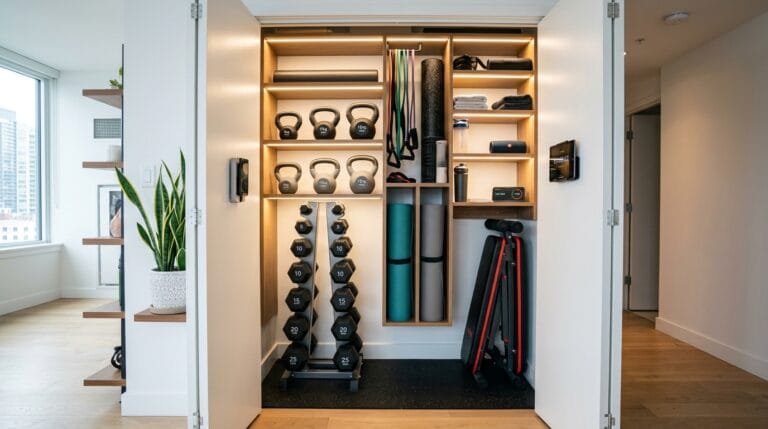
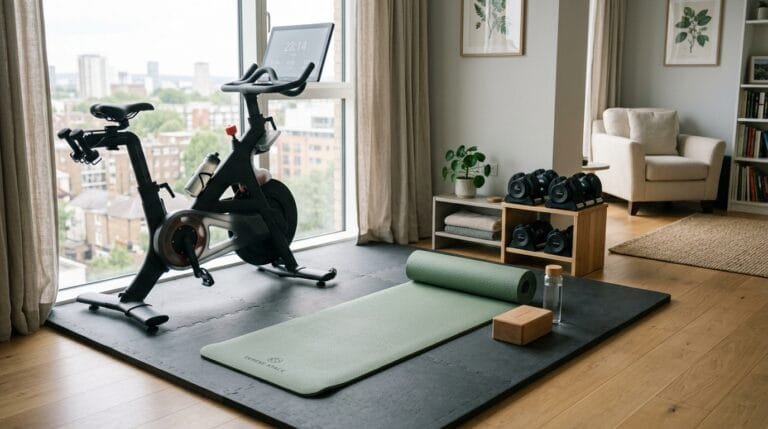
Keep bands, dumbbells, or a clear floor space prepared. The fewer steps between “I should train” and “I am training,” the higher the adherence rate.
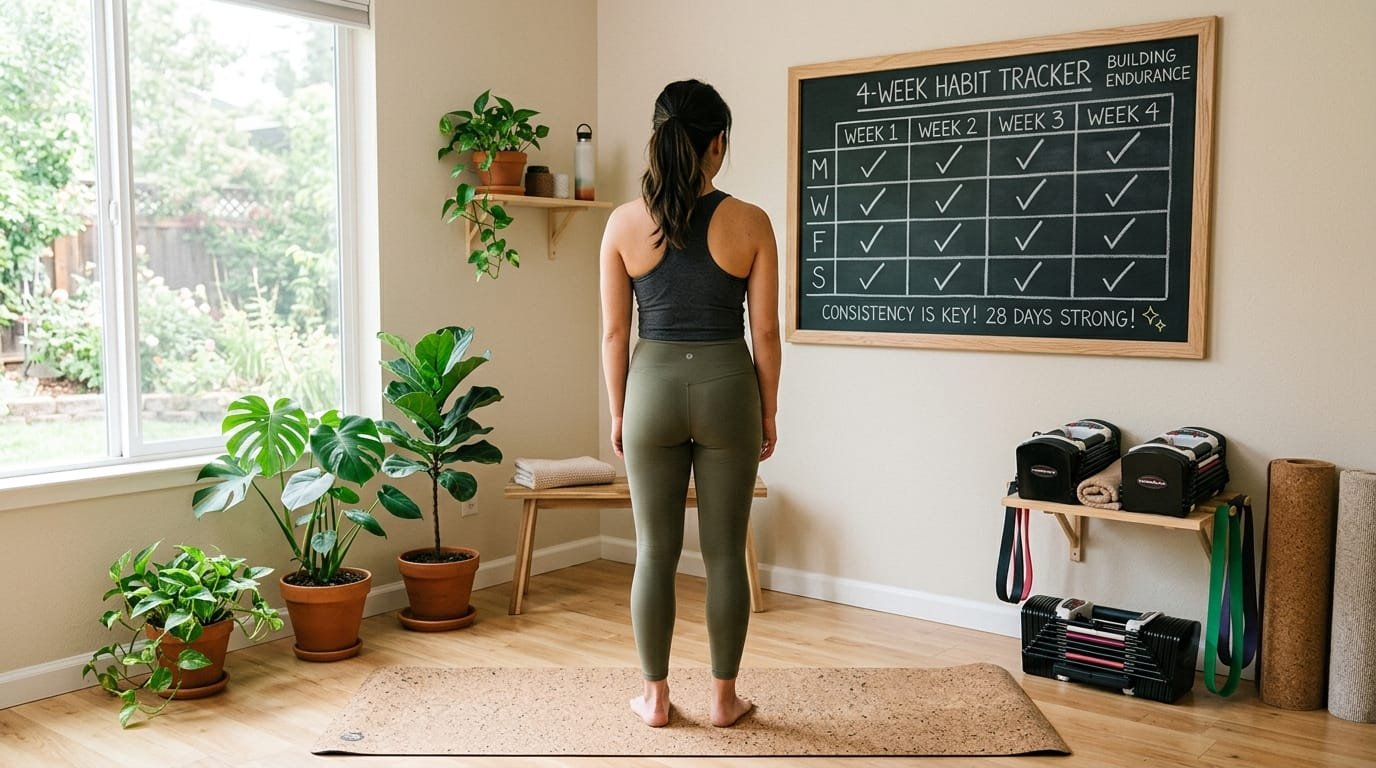
Step 5: Install a simple tracking system
Use a notebook, notes app, or basic spreadsheet. Record exercise, variation, sets, reps, tempo/pauses, and a brief note on form or energy. Review weekly.
Step 6: Apply progressive overload systematically
- Weeks 1–3: Focus on adding repetitions.
- Weeks 4–6: Emphasise tempo or pauses.
- Later blocks: Advance variations or density.
Change only one primary variable per block.
Step 7: Schedule deloads in advance
Every 4–8 weeks, reduce volume by 40–60% for 5–7 days. This prevents the “beaten up” feeling that leads to abandonment.
Step 8: Align with family and work realities
Communicate the plan, choose low-disruption times, and keep sessions short enough that they do not create household tension.
Step 9: Build identity and short-term goals
Focus on the identity of “someone who trains regularly” and set concrete 2–4 week process goals (sessions completed, specific progression targets).
Step 10: Review and adjust every 4–8 weeks
Use the log to decide what to keep, what to progress, and what to modify. Sustainability comes from iteration, not perfection on the first attempt.
Sample Sustainable Weekly Templates
Template 1 – Two Sessions (High-Demand Weeks)
- Session A: Squat/lunge + hinge + push + pull
- Session B: Slight variation of the same patterns or the same exercises with tempo/pause focus
Template 2 – Three Sessions (Most Sustainable)
- Three full-body sessions using the same core patterns
- Slight variation in exercise selection or progression focus across the week
Template 3 – Four Shorter Sessions
- Four 20–25 minute sessions
- Emphasise density or slightly lower volume per session
Progressive Overload Methods That Work with Minimal Equipment
- Add repetitions first within a defined range.
- Slow the tempo, especially the eccentric portion.
- Add pauses at the bottom of squats, the stretch of hinges, or the top of rows.
- Advance the variation (e.g., regular push-up to feet-elevated or archer).
- Increase density by shortening rest or completing more rounds in a fixed time.
These methods allow continued adaptation without requiring longer sessions or heavier weights. Detailed guidance on controlled, joint-friendly shoulder work can be found in Bent Arms vs. Straight Arms in Lateral Raises, The Hidden Mistake in Lateral Raises, and 3 Lateral Raise Modifications. Grip strength can be maintained or improved with short, focused efforts (Do Hand Grippers Really Work?).
Integrating Training into Family and Work Life
With family
- Train during predictable low-demand windows (early morning, nap time, after bedtime).
- Keep sessions short so they do not feel like a major absence.
- Occasionally make training visible or involve older children in simple movements.
- Communicate that training supports energy, mood, and long-term health for the whole household.
With work
- Use the transition period after work or a defined lunch window when possible.
- Keep a ready-to-go workout so decision fatigue does not kill the session.
- On extremely demanding work weeks, drop to the minimum viable session rather than skipping.
Recovery and Sustainability
Busy periods often reduce sleep and increase stress. These factors influence both motivation and adaptation:
- Protect sleep where possible.
- Keep protein intake consistent.
- Use deloads when fatigue accumulates.
- Accept maintenance weeks as successful weeks.
Common Mistakes That Undermine Consistency
| Mistake | Result | Better Approach |
|---|---|---|
| Rigid fixed calendar days | Frequent cancellations | Weekly session target |
| All-or-nothing mindset | Complete stops | Minimum viable sessions |
| No pre-planned workouts | Decision fatigue | Ready templates of different lengths |
| Neglecting recovery basics | Deeper fatigue | Sleep and protein as priorities |
| Constant programme changes | Loss of progressive focus | Stable core exercises with planned variation |
| Waiting for ideal conditions | Inaction | Train with the time and energy available |
Strength training with consistent stimulus remains highly effective for long-term strength and health even when total time is limited (strength training guidance). Practical home-gym approaches emphasise adaptable systems that survive family and work demands (home gym equipment prioritisation and budget home gym principles).
Frequently Asked Questions
How many strength sessions per week are realistic with family and work demands?
Two to three focused full-body sessions work for most people. Four shorter sessions are possible if recovery allows.
What is a minimum viable session?
A 15–20 minute full-body workout with 2 sets of a squat/lunge, hinge, push, and pull. It preserves the habit and provides a meaningful stimulus.
Should I train full-body or use a split?
Full-body is usually better. It ensures each pattern is trained even if a session is missed.
How do I progress when time is limited?
Add reps, slow tempo, add pauses, advance variations, or increase density. Track these changes weekly.
What if I miss several days?
Resume with the minimum viable session and rebuild frequency gradually. Do not try to make up all missed volume at once.
Can I train effectively with only bodyweight?
Yes. Use leverage changes, tempo, pauses, and unilateral progressions to keep the work challenging.
How important is sleep?
Critical. Poor sleep reduces recovery and motivation. Protect it as much as the schedule allows.
Should I involve family members?
When appropriate, yes. Short shared sessions or visible training can reduce friction and model positive habits.
Final Recommendation
Fitting strength training around family and work demands requires a flexible system rather than a rigid schedule. Set a realistic weekly target of 2–4 short full-body sessions, keep a minimum viable workout ready, prepare the environment in advance, and apply progressive overload through reps, tempo, pauses, or harder variations. Communicate the plan and its benefits clearly, protect sleep and protein intake, and treat consistency of weekly stimulus as the primary measure of success.
Create your three workout templates today, identify the most reliable time windows, and begin with the next available opportunity. When training is designed for real life rather than ideal conditions, it becomes a sustainable part of the week instead of another source of stress. Start simple, stay consistent, and let the cumulative effect of regular sessions deliver the results.