Combining Strength and Conditioning Efficiently in One Home Session
Quick Answer
Combine strength and conditioning efficiently in one home session by pairing compound strength movements with short, controlled conditioning efforts or by using density-based circuits that keep rest periods moderate. Structure the session so the most technically demanding strength work comes first, followed by higher-density finishing work. Sessions of 35–50 minutes can deliver meaningful strength stimulus and elevated heart-rate work when exercises are chosen well and rest is managed deliberately. Progressive overload still applies to both the strength and conditioning components.
Why Combine Strength and Conditioning in a Single Session
Many home trainees have limited time and prefer fewer weekly training days. Separating pure strength and pure conditioning sessions can push the weekly schedule beyond what is realistic. Combining both qualities in one session preserves training frequency, raises total energy expenditure, and still allows progressive strength work when the session is ordered correctly. The key is avoiding the common mistake of turning every set into a high-fatigue circuit that compromises technique and strength progression.
Core Principles for Efficient Hybrid Sessions
- Strength work first – Perform the heaviest or most technical lifts while fresh.
- Conditioning second or interleaved carefully – Elevate heart rate without destroying strength performance.
- Compound movements dominate – They deliver the highest return for both strength and metabolic demand.
- Rest is a programming variable – Longer rests protect strength; shorter rests increase conditioning stimulus.
- Progressive overload applies to both qualities – Track load/reps for strength and density/effort for conditioning.
- Technique stays non-negotiable – Fatigue is allowed; form breakdown is not.
Session Structure Options Compared
| Structure | Strength Emphasis | Conditioning Emphasis | Best For | Typical Length |
|---|---|---|---|---|
| Strength then conditioning finisher | High | Moderate | Strength priority with added work capacity | 40–50 min |
| Alternating strength and short conditioning | Moderate–High | Moderate–High | Balanced hybrid | 35–45 min |
| Density circuit (controlled) | Moderate | High | Time-efficient full-body work | 30–40 min |
| Strength supersets + easy cardio intervals | High | Low–Moderate | Strength focus with light conditioning | 40–50 min |
| Complexes (same implement) | Moderate | High | Minimal equipment, high density | 25–40 min |
Shoulder-friendly technique remains essential when upper-body strength work is performed under some fatigue (Bent Arms vs. Straight Arms in Lateral Raises, The Hidden Mistake in Lateral Raises, and 3 Lateral Raise Modifications). Grip strength supports loaded carries and dense finishing work (Do Hand Grippers Really Work?).
Step-by-Step Framework for Hybrid Home Sessions
- Decide the primary goal of the session
Strength priority, balanced hybrid, or conditioning priority with strength maintenance. - Select 3–5 compound strength movements
Cover squat/lunge, hinge, push, and pull patterns. - Choose conditioning elements that do not require new skill under fatigue
Simple options include short carries, easy bike or marching intervals, controlled kettlebell swings, or bodyweight density work. - Order the session correctly
Most demanding strength lifts first, then accessory strength, then conditioning or density work. - Set rest periods deliberately
2–3 minutes for main strength work; 30–90 seconds for conditioning or density segments. - Keep total session length realistic
35–50 minutes is sufficient for most hybrid goals. - Track both strength and conditioning metrics
Load and reps for strength movements; rounds, time, or effort for conditioning. - Progress one quality at a time when possible
Advance strength loads or conditioning density, but avoid progressing both aggressively in the same week. - Monitor recovery
Hybrid sessions raise systemic stress; ensure sleep and overall volume remain manageable. - Adjust based on results
If strength stalls, increase rest or reduce conditioning density. If conditioning lags, shorten strength rests or add a short finisher.
Sample Hybrid Session Templates
Template A – Strength Priority + Conditioning Finisher (40–50 minutes)
- Goblet squat or split squat – 3–4 × 6–10 (2–3 min rest)
- Romanian deadlift – 3 × 6–10 (2–3 min rest)
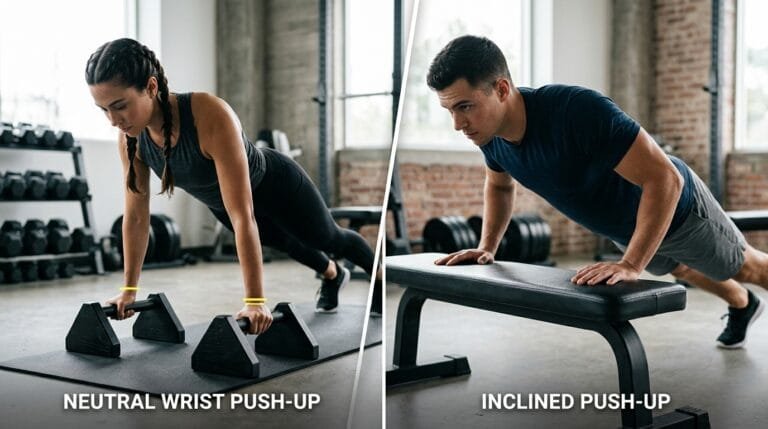
- Push-up or floor press variation – 3 × 6–12 (2 min rest)
- Single-arm row – 3 × 8–12 per arm (90–120 sec rest)
- Finisher: 8–10 minutes of alternating 40 sec work / 20 sec rest (carries, easy swings, or marching)
Template B – Alternating Strength and Short Conditioning (35–45 minutes)
- Squat variation – 3 × 8
Immediately followed by 45–60 sec easy march or step-ups - Hinge variation – 3 × 8
Immediately followed by 45–60 sec controlled movement - Push variation – 3 × 8–10
- Pull variation – 3 × 10–12
- Optional short core or carry finisher
Template C – Controlled Density Circuit (30–40 minutes)
Perform 3–5 rounds of:
- Squat or lunge variation × 8–10
- Push variation × 8–10
- Hinge or bridge variation × 8–10
- Pull variation × 10–12
- Carry or core × 30–40 sec
Rest 60–90 seconds between rounds. Focus on controlled technique rather than racing.
Template D – Minimal Equipment Complex
Using one kettlebell or pair of dumbbells:
- Squat × 6–8
- Hinge × 6–8
- Push × 6–8
- Row or pull × 8–10
- Carry × 30–40 sec
Repeat for 3–5 rounds with controlled rest.
Progressive Overload in Hybrid Sessions
Strength Component
- Increase load
- Add repetitions
- Improve tempo control or add pauses
Conditioning Component
- Reduce rest periods
- Increase work intervals
- Add rounds
- Raise effort while keeping movement quality
Advance primarily one quality per training block so progress remains clear and recovery stays manageable.
Exercise Selection Guidelines
Best Strength Movements for Hybrid Sessions
- Goblet or split squats
- Romanian deadlifts or single-leg RDLs
- Floor press, push-ups, or overhead press variations
- Single-arm or two-arm rows
- Hip thrusts or glute bridges
Best Conditioning Pairings
- Suitcase or farmer carries
- Controlled kettlebell swings
- Easy stationary bike or marching
- Short sled-style drags if available
- Bodyweight density work (controlled mountain climbers, step-ups)
Avoid highly technical or maximal lifts deep into a fatigued state.
Common Mistakes When Combining Strength and Conditioning
| Mistake | Result | Better Approach |
|---|---|---|
| Turning every strength set into a race | Technique breakdown and stalled strength | Keep main lifts controlled with adequate rest |
| Excessive conditioning volume | Recovery debt and strength loss | Limit finishers to 8–12 minutes |
| No clear session priority | Mediocre results in both qualities | Decide strength or hybrid emphasis in advance |
| Progressing strength and conditioning hard simultaneously | Overreaching | Advance one quality at a time |
| Poor exercise order | Strength work performed under heavy fatigue | Strength first, conditioning later |
| Ignoring recovery | Persistent fatigue | Monitor sleep and weekly volume |
Equipment Options for Effective Hybrid Sessions
| Equipment | Strength Value | Conditioning Value | Space Impact |
|---|---|---|---|
| Bodyweight only | Moderate–High | High (with density) | None |
| Resistance bands | High | High | Very low |
| Dumbbells | Very High | High | Low–moderate |
| Kettlebell | Very High | Very High | Low |
| Suspension trainer | High | Moderate–High | Low |
Most home trainees can run effective hybrid sessions with bands plus one pair of dumbbells or a single kettlebell.
Strength training remains the foundation for long-term physical capacity, while added conditioning improves work capacity and energy expenditure (strength training guidance). Practical home-gym approaches emphasise time-efficient systems that deliver both qualities without complexity (home gym equipment prioritisation and budget home gym principles).
Frequently Asked Questions
How often should I use hybrid sessions?
Two to four times per week works well for most people. Adjust total weekly volume so recovery remains adequate.
Will hybrid sessions limit my strength gains?
They can if conditioning is excessive or strength work is performed under heavy fatigue. When strength lifts are prioritised and properly rested, strength gains continue.
Can beginners use this approach?
Yes, provided technique is solid and density is kept moderate. Beginners often progress well with simple full-body hybrid sessions.
How long should the conditioning portion be?
Eight to twelve minutes of focused finishing work is sufficient for most goals. Longer conditioning can be performed on separate days if needed.
Is it better to separate strength and conditioning?
Separation can allow higher performance in each quality. Hybrid sessions are the practical choice when time or schedule limits the number of weekly training days.
What is the best conditioning method to pair with strength?
Simple, low-skill options such as carries, controlled swings, marching, or easy bike intervals that do not degrade under fatigue.
How do I know if the session is balanced correctly?
Strength numbers on the main lifts should remain stable or improve over time, and you should finish the session feeling worked but not destroyed.
Can I build muscle with hybrid sessions?
Yes, provided progressive tension is applied to the strength movements and protein intake is adequate.
Final Recommendation
Combining strength and conditioning efficiently in one home session works best when compound strength movements are performed first with adequate rest, followed by short, controlled conditioning or density work. Choose 3–5 major patterns, manage rest periods deliberately, track both strength and conditioning metrics, and progress one quality at a time. Sessions of 35–50 minutes are sufficient for meaningful results.
Select one of the sample templates today, schedule two or three hybrid sessions this week, and begin with loads and densities you can control with solid technique. Log performance on both the strength and conditioning elements and adjust based on recovery and results. When hybrid sessions are structured this way, you gain the benefits of both qualities without needing separate training days or additional equipment. Start with the next session—the combination of progressive strength work and efficient conditioning delivers consistent progress in limited time.