Grip Width and Elbow Flare: How They Change Bench Press Shoulder Stress
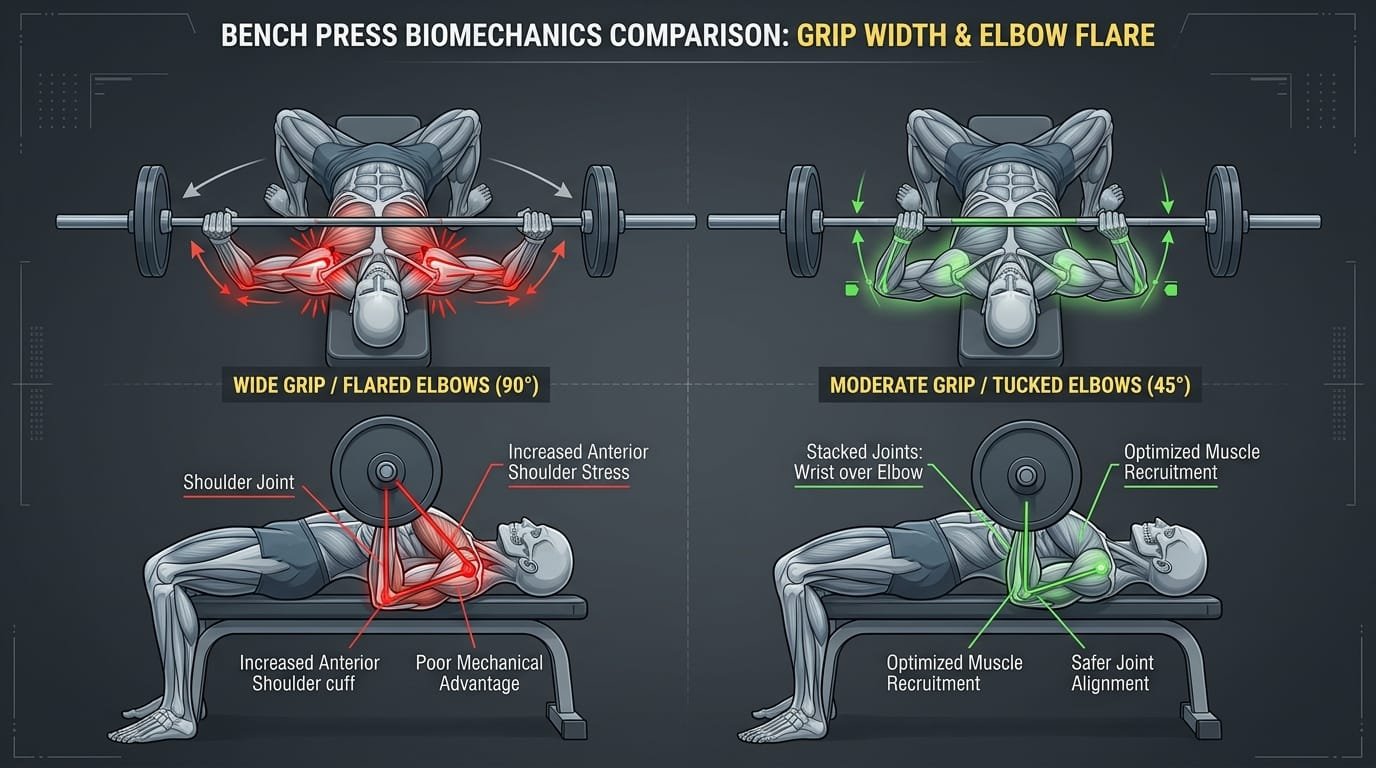
Quick Answer Wider grip widths and greater elbow flare increase shoulder abduction angles, elevating compressive forces at the acromioclavicular (AC) joint and shear forces at the glenohumeral joint. Biomechanical research shows that grips wider than approximately 1.5–2× biacromial width and elbow flare approaching 90° raise the risk of distal clavicular osteolysis, rotator-cuff irritation, and anterior shoulder overload. A moderate grip (roughly 1.25–1.5× biacromial width) with elbows positioned at 45–70° of abduction generally reduces joint loads while still allowing strong pectoralis major activation. Consistent scapular retraction further lowers stress. Individual anatomy, mobility, and injury history should guide the final choice.
Why Grip Width and Elbow Flare Are Critical for Shoulder Health
The bench press is one of the most effective upper-body strength exercises, yet it is also a frequent source of shoulder pain among both recreational and competitive lifters. Two of the most controllable technical variables that directly influence joint loading are grip width and the resulting elbow flare (shoulder abduction angle).
Grip width is typically expressed relative to biacromial width—the distance between the outer edges of the acromion processes. Elbow flare is the angle formed between the upper arm and the torso at the bottom of the press. Wider grips force the elbows farther from the body, increasing abduction. This lengthens the moment arm at the shoulder, raises joint reaction forces, and can reduce subacromial space. Narrower grips keep the elbows closer to the torso, shifting more demand to the triceps and often reducing peak shoulder stress.
A 2024 study published in Frontiers in Physiology examined 21 technical variations of the barbell bench press, systematically varying grip width (1, 1.5, and 2 biacromial widths), shoulder abduction angles (45°, 70°, and 90°), and scapular positions. The results showed that narrower grips (<1.5 biacromial widths) significantly decreased acromioclavicular compression and glenohumeral posterior shear forces. Scapular retraction produced similar protective effects. These findings support earlier clinical recommendations that grips exceeding roughly 1.5–2× biacromial width increase risk for certain shoulder pathologies (see the full open-access paper: Effects of bench press technique variations on musculoskeletal shoulder loads and related analyses).
How Wider Grips and Greater Flare Increase Shoulder Stress
Acromioclavicular (AC) Joint Compression Wider grips increase compressive forces at the distal clavicle. Repeated high compression is strongly associated with distal clavicular osteolysis, commonly called “weightlifter’s shoulder.” The 2024 biomechanical data confirmed higher AC compression with grips of 2 biacromial widths compared with narrower options.
Glenohumeral Shear and Rotator-Cuff Demand Greater abduction angles elevate posterior shear forces at the glenohumeral joint and require higher rotator-cuff activity to keep the humeral head centered in the glenoid. Over time this can contribute to irritation or overload of the rotator cuff tendons and joint capsule.
Subacromial Space Reduction Abduction angles approaching or exceeding 90° can narrow the space under the acromion. In individuals with limited upward rotation of the scapula, poor posterior cuff strength, or anatomical variations (e.g., a type-III acromion), this increases the likelihood of impingement symptoms.
Increased Moment Arms and Joint Torque Wider grips create larger horizontal moment arms at the shoulder, increasing the torque the joint must resist. Narrower grips reduce this lever arm and shift a greater proportion of the load toward elbow extension, which is generally better tolerated by the shoulder complex.
Clinical guidelines and reviews have long recommended keeping hand spacing no wider than approximately 1.5× biacromial width for lifters with a history of rotator-cuff issues, impingement, or AC-joint problems, precisely because of these mechanical relationships.
Moderate vs. Extreme Positions: Practical Comparison
| Position | Typical Grip Width | Approximate Elbow Angle | Relative Shoulder Stress | Primary Trade-off | Best Suited For |
|---|---|---|---|---|---|
| Narrow / Tucked | ≤1.0–1.25× biacromial | 30–45° | Lower | Higher triceps demand, longer range of motion | Shoulder-sensitive lifters, triceps focus |
| Moderate (Recommended default) | 1.25–1.5× biacromial | 45–70° | Moderate / Controlled | Balanced chest & triceps activation | Most recreational & intermediate lifters |
| Wide / Flared | ≥1.75–2.0× biacromial | 75–90°+ | Higher | Greater pectoralis emphasis, higher joint load | Advanced lifters with excellent mobility |
Most recreational and intermediate lifters experience the best combination of performance, muscle activation, and joint comfort in the moderate range. Competitive powerlifters sometimes adopt wider grips to shorten the range of motion and lift heavier absolute loads, but they typically possess superior mobility, scapular control, and recovery capacity that allow them to tolerate the elevated stress.
The Critical Role of Scapular Position
Retracting and depressing the scapulae (packing the shoulder blades firmly against the bench) consistently reduces both glenohumeral and acromioclavicular reaction forces across all grip widths studied. A released or protracted scapular position increases joint loading. Maintaining scapular retraction throughout the entire set is one of the highest-leverage ways to lower shoulder stress regardless of the exact grip chosen. This finding appears repeatedly in the biomechanical literature and is a cornerstone of technique recommendations from physical therapists and strength coaches.
Step-by-Step Guide to Finding Your Optimal Grip and Elbow Flare
- Establish a reference for biacromial width Have a partner measure the distance between the outer edges of your acromion processes, or use a practical visual starting point of hands slightly wider than shoulder width.
- Begin with a moderate grip Position the hands so that at the bottom of the press—when the bar touches the lower chest or mid-sternum—the forearms are roughly vertical when viewed from the front. This typically produces an elbow angle of 45–70°.
- Confirm elbow position from multiple angles Film from the side and from above (or have a partner observe). The elbows should neither sit directly beside the torso (excessively tucked) nor form a full 90° “T” shape with the body.
- Prioritize and maintain scapular retraction Before unracking, actively retract and depress the shoulder blades. Keep that packed position throughout the set; do not allow the scapulae to protract as the bar descends or ascends.
- Test systematically and adjust Perform several sets with the moderate grip. If the front of the shoulder pinches or aches, narrow the grip slightly or reduce flare. If the movement feels excessively triceps-dominant and chest engagement is poor, widen the grip modestly while re-checking scapular position.
- Respect individual anatomy and training history Lifters with previous AC-joint irritation, rotator-cuff tendinopathy, limited external rotation, or a history of impingement generally fare better with narrower-to-moderate grips and controlled flare.
- Re-evaluate periodically As mobility, strength, and technique improve, the optimal grip may shift slightly. Re-test every few training blocks.
Programming and Technique Recommendations for Long-Term Shoulder Health
- Make a moderate grip the default for the majority of weekly bench-press volume.
- Reserve wider grips for lower-volume, higher-intensity work only if they remain comfortable and recovery is excellent.
- Include scapular-retraction and external-rotation activation drills in every upper-body warm-up.
- When shoulder stress needs further reduction, substitute or supplement with floor presses, board presses, neutral-grip dumbbell presses, or incline variations with a controlled arm path.
- Progress load only when technique and joint comfort remain solid across the entire set.
- Monitor total weekly pressing volume; high-volume wide-grip work is a common contributor to cumulative shoulder overload.
Integrating Shoulder-Friendly Bench Technique with the Rest of Your Training
Controlling grip width and elbow flare improves pressing safety and longevity with adjustable dumbbells and carries over to other horizontal pressing patterns. Strong grip endurance supports consistent bar control across different widths. Core stability developed through ab roller work and proper bracing helps maintain torso rigidity so the shoulders are not forced to compensate for a collapsing midsection.
Recovery tools such as a budget massage gun can help manage residual tension in the chest, anterior shoulder, and upper back. Light cardio on a manual treadmill or mobility flows with resistance bands aid recovery between sessions. Continue applying the shoulder-mechanics principles from your lateral raise guidance so isolation work reinforces rather than conflicts with the arm path used under the barbell. Kettlebell floor presses or neutral-grip variations can also serve as lower-stress alternatives when the shoulders need additional recovery.
Frequently Asked Questions
Is a wider grip always more dangerous for the shoulders? Not in absolute terms, but research consistently demonstrates higher AC-joint compression and glenohumeral shear with grips approaching or exceeding 2× biacromial width and large abduction angles. Risk increases with load, weekly volume, and any pre-existing vulnerability.
What is the safest default elbow angle for most lifters? Current biomechanical and clinical evidence points to roughly 45–70° of shoulder abduction as a productive and relatively joint-friendly range for the majority of trainees.
Can I still build a well-developed chest with a narrower or moderate grip? Yes. Moderate and even narrower grips still heavily recruit the pectoralis major—particularly the clavicular fibers—while shifting additional work to the triceps. Many lifters successfully develop impressive chests using controlled arm paths.
Should I change my grip width if I already experience shoulder pain during benching? In most cases, yes. Narrowing the grip, reducing flare, limiting range of motion slightly, or switching temporarily to dumbbells or neutral-grip variations frequently allows continued training while symptoms resolve. Persistent or worsening pain warrants assessment by a qualified professional.
Does scapular retraction really make a meaningful difference? Yes. Biomechanical data show that retracted scapulae reduce both glenohumeral and acromioclavicular reaction forces across multiple grip widths. It is one of the highest-return technique cues available.
How do I measure biacromial width accurately? Have a partner measure the distance between the most lateral points of the acromion processes with a tape measure while you stand relaxed. Alternatively, use the practical cue of placing the hands so the forearms are vertical at the bottom of the press and adjust from there.
Final Recommendation
Grip width and elbow flare are two of the most powerful levers for managing shoulder stress in the bench press. Wider grips and near-90° flare increase joint loading at the AC and glenohumeral joints; moderate grips with 45–70° of elbow flare generally offer the best balance of performance, muscle activation, and long-term joint health for most lifters. Pair any grip choice with consistent scapular retraction for additional protection.
Start with a moderate grip that produces roughly vertical forearms at the bottom of the press, film your sets from multiple angles, and adjust based on comfort and performance. Prioritize technique quality and recovery capacity over maximal grip width or load. When grip width and elbow position are chosen deliberately and scapular control is maintained, the bench press remains one of the most effective upper-body strength and hypertrophy exercises while keeping the shoulders resilient across years of training.
Make the moderate, controlled arm path your default, monitor joint feedback closely, and progress only when both strength and comfort improve together.