How Long Does It Take to See Results with Resistance Bands Alone?
Quick Answer Most people notice initial strength and neuromuscular improvements within 2–4 weeks of consistent resistance-band training. Visible muscle tone and measurable strength gains typically appear between 6–12 weeks. More substantial body-composition changes—clearer muscle shape and fat loss—usually require 3–6 months of progressive, well-programmed training combined with adequate protein intake and recovery. Results depend heavily on training consistency, progressive overload, nutrition, sleep, and starting fitness level. Research shows resistance bands can produce strength and hypertrophy outcomes comparable to free weights when effort and volume are matched, especially for beginners and intermediate trainees.
Why Resistance Bands Can Deliver Real, Measurable Results
Resistance bands create variable (accommodating) resistance that increases as the elastic stretches. This provides continuous mechanical tension throughout the range of motion—one of the primary drivers of both strength gains and muscle hypertrophy. Systematic reviews and controlled trials have found that elastic resistance training produces strength improvements similar to conventional weight training when sets are taken close to failure and progressive overload is applied.
A 2019 systematic review comparing elastic resistance to conventional resistance reported no significant difference in strength gains across the included studies. More recent evidence summaries, including analyses referenced by the American College of Sports Medicine, continue to support the effectiveness of band-based training for both strength and hypertrophy when programming principles are followed. Bands are especially effective for beginners, home trainees, travelers, and individuals prioritising joint-friendly progressive loading.
The main practical limitation is the ceiling of available resistance. Very advanced lifters chasing maximal strength or elite-level hypertrophy may eventually need heavier free weights or machines. For the large majority of people, however, a good set of bands alone is sufficient to produce meaningful, visible results over months of consistent training.
Detailed Timeline of Expected Results with Bands Alone
| Timeframe | Typical Adaptations and Visible Changes | Primary Physiological Drivers | Practical Notes |
|---|---|---|---|
| Weeks 1–2 | Improved movement coordination, reduced DOMS, better mind-muscle connection | Neural adaptations (motor-unit recruitment) | Strength “feels” better before muscles look bigger |
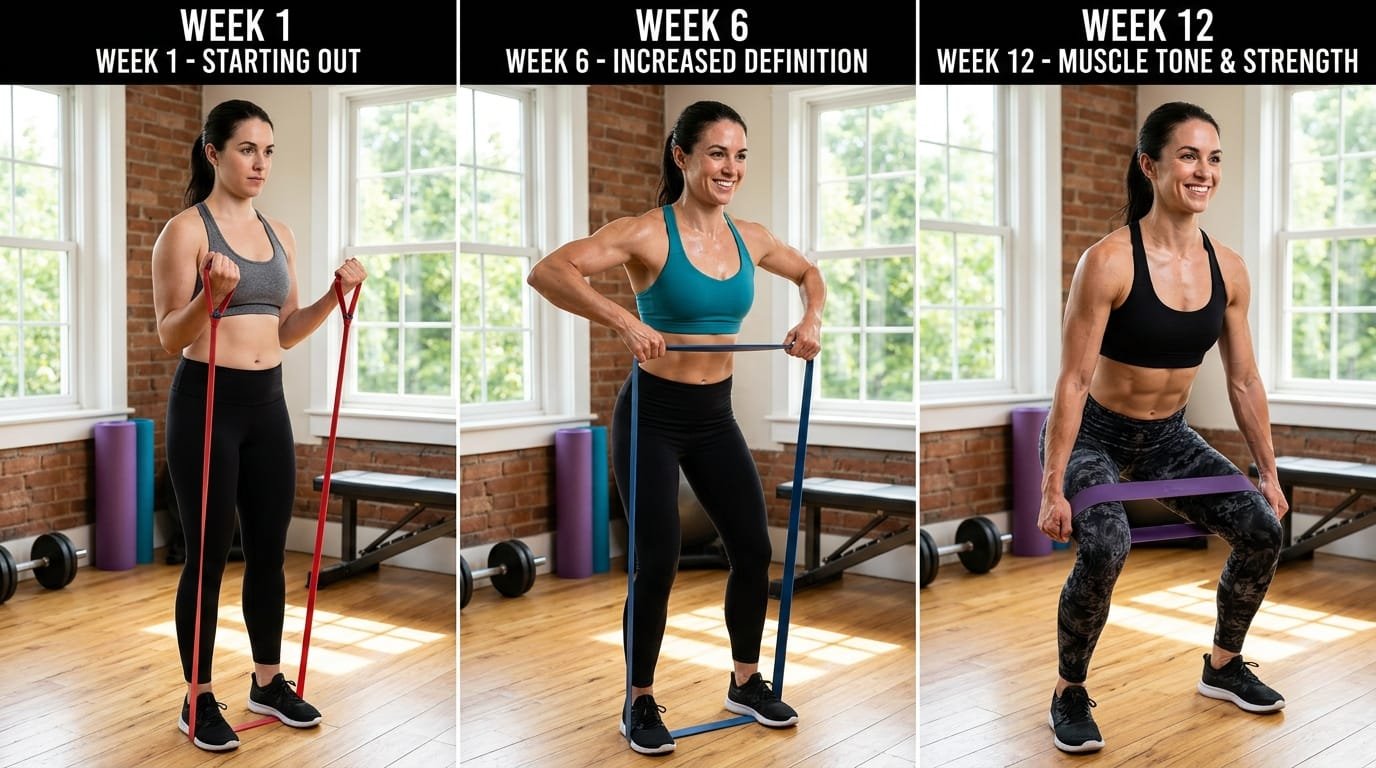
| Weeks 3–6 | Measurable strength increases (often 10–20% in beginners), better posture, improved muscular endurance | Continued neural gains + early myofibrillar hypertrophy | Most noticeable in previously untrained individuals |
| Weeks 6–12 | Visible muscle tone, firmer appearance, clearer definition in arms, shoulders, glutes, and legs | Progressive mechanical tension + sufficient volume | Photos and measurements become useful here |
| Months 3–6 | Noticeable muscle shape changes, improved body composition, significant functional strength | Sustained progressive overload + nutrition support | This is where “transformation” becomes obvious |
| 6+ Months | Substantial long-term improvements; progress slows without further advancement | Advanced programming, recovery management, and periodisation | Plateau is normal; adjust variables to continue |
These timelines assume 3–4 quality training sessions per week, deliberate progression, protein intake in the range of approximately 1.6–2.2 g per kg of body weight for muscle-focused goals, and adequate sleep. Individual results vary based on age, genetics, training history, and adherence.
Key Factors That Accelerate or Delay Results
Training Quality and Programming
- Frequency of 3–4 sessions per week is effective for most people.
- Most working sets should approach muscular failure (leaving 0–3 reps in reserve).
- Progressive overload must be applied—move to a stronger band, add repetitions, add sets, or slow the eccentric tempo.
- Prioritise multi-joint movements (squat and lunge patterns, horizontal and vertical pushes and pulls, hip hinges) and supplement with isolation work.
Nutrition and Recovery
- A caloric surplus supports faster muscle growth; a moderate deficit supports fat loss while preserving muscle if protein is high and training stimulus remains strong.
- Sleep (7–9 hours) and stress management significantly influence recovery and adaptation rates.
- Consistency across months outweighs any single “perfect” workout or extreme short-term effort.
Individual Differences
- Complete beginners usually progress faster than those with years of training experience.
- Younger trainees and those returning after a layoff often see quicker early gains.
- Genetics influence the rate and upper ceiling of muscle growth, but nearly everyone can make substantial improvements with proper application of the fundamentals.
How to Structure an Effective Bands-Only Training Program
A simple, evidence-aligned full-body template performed three days per week might include:
- Lower-body squat or lunge variation
- Horizontal push (banded chest press or push-up variation)
- Horizontal pull (seated or standing banded row)
- Vertical pull or face-pull / band pull-apart variation
- Hip-hinge or glute-bridge / hip-thrust variation
- Core anti-extension or anti-rotation work
- Optional isolation movements (biceps curls, triceps extensions, lateral raises, etc.)
Progress by increasing band tension, adding repetitions within an 8–15 range, adding a set, or lengthening the eccentric portion of the lift. Keep a simple training log so progression is intentional rather than random. Reassess exercise selection and volume every 4–6 weeks.
Step-by-Step Guide to Maximising Results with Resistance Bands Alone
- Invest in a quality set of bands that offers multiple resistance levels (light through heavy or extra-heavy).
- Master technique with lighter bands before increasing tension.
- Train most sets close to failure while maintaining strict form.
- Apply progressive overload on a weekly or bi-weekly basis.
- Emphasise compound movements that train large muscle groups.
- Support training with protein-rich meals and appropriate total calories for your goal (surplus for growth, controlled deficit for fat loss).
- Prioritise recovery—sleep, manage stress, and avoid excessive daily volume that impairs progress.
- Track progress objectively with photos, circumference measurements, strength logs, and how clothing fits.
- Re-evaluate every 4–6 weeks and adjust volume, intensity, or exercise selection as needed.
- Commit to at least 12 weeks of consistent training before judging the overall effectiveness of the approach.
Common Mistakes That Significantly Delay Progress
- Using bands that are too light and never approaching muscular failure
- Failing to increase tension, repetitions, or volume over successive weeks
- Neglecting lower-body and posterior-chain exercises
- Inconsistent training frequency or long gaps between sessions
- Inadequate protein intake or overall poor nutrition
- Expecting dramatic visual changes in under 4–6 weeks
- Performing only high-repetition endurance-style work without sufficient peak tension
- Ignoring recovery and sleep
Integrating Band Training with Broader Fitness and Recovery Habits
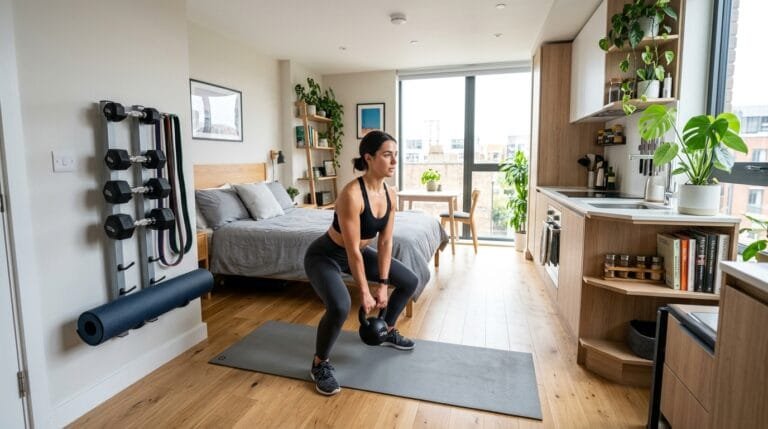
Resistance bands integrate seamlessly with other home-friendly tools. They complement adjustable dumbbells when you eventually want to add external load, and they enhance kettlebell training by providing accommodating resistance on swings, presses, or rows. Strong grip endurance improves control during banded pulling movements. Core stability developed through ab roller work or anti-rotation drills transfers directly to better performance on banded presses and hinges.
Recovery tools such as a budget massage gun can help manage residual muscle tension after higher-volume sessions. Light cardio on a manual treadmill or mobility flows using the same resistance bands support recovery and movement quality. Continue applying sound shoulder-mechanics principles from your lateral raise guidance so banded isolation work remains joint-friendly and productive.
Frequently Asked Questions
Can resistance bands alone build significant muscle? Yes. Controlled studies and systematic reviews indicate that elastic resistance training can produce strength and hypertrophy outcomes comparable to free-weight training when effort, volume, and progressive overload are similar—particularly for beginners and intermediate trainees. See supporting evidence summarised in resources such as the Cleveland Clinic overview of resistance-band training and related research syntheses.
How soon will I feel stronger? Neural adaptations frequently produce noticeable strength improvements within 2–4 weeks. Visible changes in muscle size and definition usually become apparent several weeks later.
Do I need to train to complete failure on every set? Taking most sets close to failure (within 0–3 reps in reserve) is highly effective. Training to absolute failure on every set is unnecessary and can impair recovery if volume is already high.
What should I do if progress stalls after a few months? Increase band resistance, add training volume, slow eccentric tempos, improve protein intake and overall nutrition, introduce new exercise variations, or insert a deload week. Plateaus are normal and usually resolve with systematic adjustment.
Are resistance bands sufficient for advanced lifters? They remain excellent for accessory work, travel, warm-ups, and joint-friendly training. However, once available band tension becomes limiting for primary compound movements, adding free weights or machines is often beneficial for continued maximal strength and advanced hypertrophy goals.
How critical is nutrition when training with bands only? Extremely important. Without adequate protein and appropriate total calories, even well-designed training produces limited visible results. Nutrition and training work together.
Can I build lower-body muscle effectively with bands? Yes. Banded squats, Romanian deadlifts, hip thrusts, lunges, and glute bridges can provide substantial stimulus when tension is progressive and effort is high.
Final Recommendation
Resistance bands alone are a legitimate, science-supported tool for building strength, muscle tone, and improved body composition. Expect early strength and coordination gains within 2–4 weeks, clearer visual changes by 6–12 weeks, and more substantial transformations over 3–6 months of consistent, progressive training. Long-term success depends far more on effort, progressive overload, nutrition, and recovery than on the specific piece of equipment used.
Select a quality set of bands with multiple resistance levels, prioritise compound movements, train close to failure, and progress deliberately. Track your workouts and take regular progress photos. When these fundamentals are in place, resistance bands become a highly effective, convenient, portable, and joint-friendly path to real results—no gym membership required.
Commit to at least 12 weeks of consistent application, adjust variables based on feedback, and allow progressive tension and recovery to drive adaptation. The results will follow for those who stay the course.