
Simple Mobility Work That Actually Supports Strength Progress
Quick Answer
Simple mobility work supports strength progress when it improves the specific positions required by your main lifts, is performed consistently in short sessions, and is paired with progressive strength training. Focus on hips, thoracic spine, shoulders, and ankles with controlled end-range work, isometrics, and dynamic patterns that transfer directly to squatting, hinging, pressing, and pulling. Five to twelve minutes daily or before sessions is sufficient; more is rarely better. Mobility is a tool to express strength, not a separate goal.
Why Most Mobility Work Fails to Help Strength
Generic stretching routines often improve flexibility in isolation but do not change the positions used under load. Strength progress requires the ability to reach and own specific joint angles while producing force—deep squat positions, neutral spine during hinges, stable overhead positions, and full-range pressing and pulling. Mobility work that does not target these positions, or that is done so aggressively it creates fatigue or instability, adds little value.
Many trainees spend 20–30 minutes on long passive stretches or elaborate routines that feel productive yet never appear in their squat depth, hinge quality, or overhead stability. The missing element is specificity and subsequent loading. Range that is not strengthened is often lost. The most effective approach is therefore limited, specific, and immediately paired with progressive resistance training in the newly available positions.
Core Principles of Strength-Supportive Mobility
- Specificity – Train the ranges and positions your lifts actually use.
- Control over passive range – Own the end range with muscular engagement rather than relying on passive tissue compliance alone.
- Short and frequent – Daily or near-daily 5–12 minute sessions outperform long, infrequent ones.
- Pair with strength work – Mobility creates the opportunity; progressive loading fills it and makes the change durable.
- Pain-free only – Mild stretch sensation is acceptable; joint pain or sharp pinching is not.
- Progress the mobility itself – Add range, add isometric holds, or add light load over time so the mobility work continues to advance.
- Subtract when possible – Once a position is owned under load, the supporting drill can often be reduced or removed.
These principles keep mobility work efficient and directly accountable to strength outcomes.
Priority Areas for Strength Trainees
| Joint / Region | Strength Relevance | Key Positions to Improve | Simple Tools |
|---|---|---|---|
| Hips | Squats, hinges, lunges | Deep flexion, internal/external rotation, extension | Bodyweight, band |
| Thoracic spine | Overhead pressing, front rack, posture | Extension and rotation | Foam roller, bodyweight |
| Shoulders | Pressing, pulling, overhead stability | Flexion, external rotation, scapular control | Band, light dumbbell |
| Ankles | Squats, lunges, pulling stance | Dorsiflexion | Bodyweight, wall |
| Wrists | Front rack, push-ups, carries | Extension | Bodyweight |
Shoulder mobility and control directly influence pressing safety and progress (Bent Arms vs. Straight Arms in Lateral Raises, The Hidden Mistake in Lateral Raises, and 3 Lateral Raise Modifications). Grip and forearm resilience support carrying and pulling strength (Do Hand Grippers Really Work?).
High-Value Mobility Drills That Transfer to Strength
Hips
- 90/90 hip switches or seated hip rotations – controlled transitions between internal and external rotation. Perform slowly and actively drive the movement with the hip muscles rather than momentum.
- Couch stretch or rear-foot-elevated hip flexor stretch with glute engagement – keep the posterior chain active so the stretch occurs in the hip flexor rather than through lumbar extension.
- Deep bodyweight squat hold with elbows inside knees – only if knees and back remain comfortable; use a light counterbalance if needed.
- Single-leg Romanian deadlift reach – combines active hinge mobility with balance and posterior-chain control.
Thoracic Spine
- Foam-roller thoracic extensions – work segmentally, pausing briefly at each level while keeping the ribs down and the lumbar spine neutral.
- Thread-the-needle or open-book rotations – drive the movement from the upper back rather than the lower back or shoulders.
- Quadruped thoracic rotations with hand behind head – maintain a stable pelvis and reach the elbow toward the ceiling with control.
Shoulders
- Band or stick dislocates – slow, controlled range; stop short of any pinching.
- Wall slides or floor angels with ribs down – focus on upward rotation and scapular control rather than simply reaching overhead.
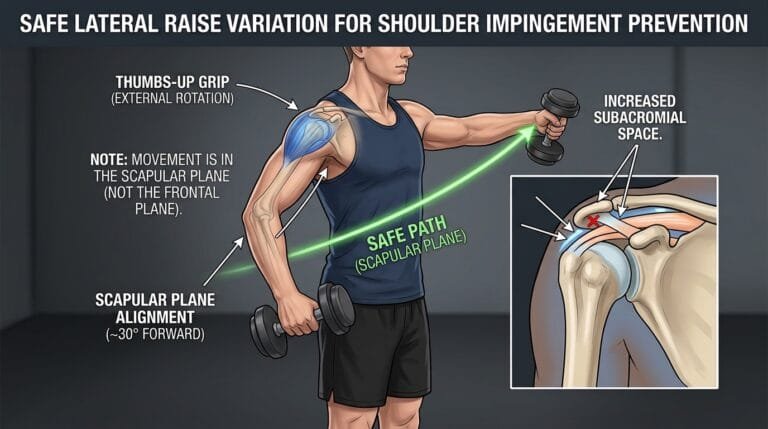
- Scapular-plane raises with light load and full control – keep the arms roughly 30 degrees forward of the frontal plane.
- External-rotation isometrics or light band external rotations – useful for both mobility and shoulder resilience.
Ankles
- Knee-to-wall dorsiflexion mobilisations – keep the heel down and track the knee over the centre of the foot.
- Elevated calf stretch with bent and straight knee – addresses both soleus and gastrocnemius contributions to dorsiflexion.
Wrists
- Controlled wrist circles and gentle extension holds on all fours – useful for front-rack positions and push-up variations.
Perform 1–2 sets of 8–12 controlled repetitions or 20–40 second holds per drill. Quality of movement is more important than quantity.
Step-by-Step Mobility Integration
- Identify the lift positions that feel limited or unstable under load.
- Choose 3–5 drills that address those exact limitations.
- Perform them daily or immediately before strength sessions (5–12 minutes total).
- Emphasise slow movement and muscular control at the end range.
- Pair every mobility gain with strength work in the newly available range.
- Track whether the main lifts feel more stable or achieve greater comfortable depth.
- Progress the mobility drills by increasing range, adding isometric holds, or adding light load.
- Reduce or remove drills once the position is owned under load.
- Reassess every 4–6 weeks and adjust the selection.
- Keep the total mobility time short so it never displaces progressive strength work.
This sequence ensures mobility remains a support system rather than a competing priority.
Sample Pre-Session Mobility Sequences (6–10 Minutes)
Squat-Focused
- Knee-to-wall ankle mobilisations – 8–10 per side
- 90/90 hip switches – 6–8 per side
- Deep squat hold with gentle pressure – 2 × 20–30 seconds
- Thoracic extensions on roller – 8–10
Hinge and Pull-Focused
- Couch stretch with glute activation – 30 seconds per side
- Quadruped thoracic rotations – 8 per side
- Band pull-aparts or face pulls – 12–15
- Single-leg RDL reach – 6–8 per side
Press-Focused
- Wall slides or floor angels – 8–10
- Band dislocates – 8–10
- Scapular-plane light raises – 10–12
- External-rotation isometrics – 2 × 15–20 seconds per side
These sequences are intentionally short so they improve readiness without creating fatigue.
Programming Guidelines
- Frequency: most days of the week or before every strength session
- Duration: 5–12 minutes
- Intensity: mild to moderate stretch sensation, full control, no joint pain
- Progression: range first, then isometric hold time, then light loading
- Pairing: always follow improved range with strength work in that range
Mobility without subsequent loading rarely produces lasting strength benefits. The strength work is what locks the new range into usable performance. Treat mobility as preparation and insurance, not as the main training stimulus.
How to Know the Mobility Work Is Helping
Useful indicators include:
- Greater comfortable depth in squats or hinges with unchanged load
- More stable overhead positions
- Less compensatory movement (for example, less lumbar extension when trying to reach overhead)
- Faster warm-up times for the main lifts
- Reduced sense of restriction during daily activities that mirror the lifts
If these outcomes are not appearing after 3–6 weeks of consistent work, change the drills or reduce the volume of mobility work and reassess technique and loading in the main lifts.
Common Mobility Mistakes That Fail to Help Strength
| Mistake | Result | Better Approach |
|---|---|---|
| Long, passive stretching only | Temporary range, little transfer | Controlled, active end-range work |
| Too much total mobility volume | Fatigue, reduced strength performance | Keep sessions short |
| Random drill selection | No change in lift positions | Target specific lift limitations |
| Stretching painful ranges | Irritation or instability | Stay pain-free |
| Neglecting strength in new ranges | Mobility gains disappear | Load the new range promptly |
| Treating mobility as the main workout | Missed progressive overload | Mobility supports, strength drives |
| Changing drills too frequently | No cumulative adaptation | Stay with a small selection for 4–6 weeks |
Integrating Mobility with High-Frequency or High-Volume Training
When training frequency is already high, mobility work must stay especially brief and low-intensity. In these cases it functions more as daily maintenance and preparation than as a developmental stimulus. Focus on the one or two positions that feel most restricted and drop everything else. This prevents mobility work from competing with recovery resources needed for the main training.
Equipment-Free and Minimal-Equipment Options
Almost all of the highest-value drills can be performed with bodyweight, a wall, and a simple band or stick. A foam roller is useful for thoracic work but not essential. This keeps the barrier to daily practice extremely low and makes consistency realistic even when travelling or training in constrained spaces.
Long-Term Perspective
Mobility needs change across training years. Early in a lifting career, restrictions may be large and progress rapid. Later, most trainees need only short maintenance doses for positions that remain stubborn. Periodically revisiting the question “Which lift positions still feel limited?” keeps the mobility work relevant and prevents it from becoming an unexamined habit.
Strength training itself remains the primary driver of long-term progress and resilience (strength training guidance). Practical home-gym approaches emphasise simple, sustainable systems that include only the mobility work that earns its place (home gym equipment prioritisation and budget home gym principles).
Frequently Asked Questions
How much mobility work do I actually need?
Most strength trainees do well with 5–12 minutes most days. More is rarely better and can interfere with recovery or reduce the energy available for progressive strength work.
Should I stretch before or after training?
Short, specific dynamic and controlled work before sessions is usually most helpful for performance. Longer static work, if used at all, fits better after training or at a separate time.
Can mobility work replace warm-ups?
It can form the core of a warm-up when the drills match the session’s main lifts. Add a few lighter sets of the actual exercises afterward to complete preparation.
What if I am very restricted in one area?
Focus on that area daily with controlled drills, and reduce strength-exercise range as needed until mobility improves. Seek professional assessment if restrictions are severe, asymmetrical, or painful.
Is foam rolling useful?
It can help some people feel ready to move and is reasonable as a short preparatory activity. It is not a primary mobility method and should not consume large amounts of time.
How long before I see transfer to my lifts?
Noticeable improvement in comfort or depth often appears within 2–6 weeks of consistent, specific work that is paired with strength training in the new ranges.
Should older trainees do more mobility?
They often benefit from consistent short sessions, but the principles remain identical: specific, controlled, and paired with progressive strength work. Extra volume is not automatically better.
Can I do mobility every day?
Yes, provided intensity stays low and total time remains short. Daily exposure works well for most people and supports the “little and often” approach that tends to transfer best.
What if mobility work seems to make me feel weaker?
Reduce the volume or intensity. Excessive stretching or aggressive end-range work before heavy lifting can temporarily reduce force production in some individuals. Keep the sessions short and controlled.
Do I need to mobilise every joint?
No. Prioritise the positions that actually limit your main lifts. Time spent on unrestricted areas produces little return.
Final Recommendation
Simple mobility work supports strength progress when it is specific to the positions your lifts require, controlled at the end range, short enough to do consistently, and immediately paired with progressive loading. Focus on hips, thoracic spine, shoulders, and ankles with a handful of high-transfer drills. Five to twelve minutes most days is enough.
Identify the lift positions that currently limit you, choose 3–5 matching drills, perform them before sessions or daily, and load the new ranges in your strength work. Review every 4–6 weeks and remove drills once the positions are owned under load. When mobility is treated as a targeted support tool rather than a separate discipline, strength progress becomes smoother and more sustainable. Start with the positions that feel most restricted, keep the work short, and let the main lifts become the measure of success.