Results Timeline of Home Strength Training: What to Expect After 4, 8, and 12 Weeks
Quick Answer After 4 weeks of consistent home strength training, most beginners experience clear strength gains driven primarily by neural adaptations, improved movement coordination, and reduced delayed-onset muscle soreness. By 8 weeks, early muscle hypertrophy becomes measurable, strength continues to climb, and subtle changes in muscle firmness or clothing fit commonly appear. At the 12-week mark, visible muscle development, improved body composition, and substantial cumulative strength increases are typical when progressive overload, adequate protein, and recovery are maintained. Individual results vary with training age, nutrition, sleep, and program quality, but these milestones offer realistic, evidence-based expectations for home-based resistance training using dumbbells, kettlebells, resistance bands, or bodyweight progressions.
Why Home Strength Training Delivers Predictable Adaptations
Home strength training operates through the same core mechanisms as gym-based training: mechanical tension, progressive overload, and sufficient recovery. When sets are performed close to muscular failure and resistance is increased over time, the nervous system improves motor-unit recruitment, muscle protein synthesis is repeatedly elevated, and cumulative exposure leads to increases in muscle-fibre cross-sectional area.
A comprehensive review of resistance-training studies found that the average time point of the first statistically significant strength increase is approximately 4.3 weeks, accompanied by an average strength gain of about 17% at that stage. A plateau in the rate of further strength increase often emerges between weeks 8 and 12. Detectable hypertrophy, measured by ultrasound, can begin as early as 3–4 weeks in untrained individuals, although visual changes in the mirror typically lag behind these structural adaptations. Supporting summaries of these timelines appear in resources such as those from Harvard Health and practical analyses of beginner progression curves.
Home equipment—adjustable dumbbells, kettlebells, resistance bands, and progressive bodyweight variations—can generate the required mechanical tension when programmed with intent. The decisive variables remain consistency, progressive overload, proximity to failure, and nutritional support rather than the specific brand of equipment.
Detailed 4-, 8-, and 12-Week Results Timeline
| Timeframe | Dominant Adaptations | What Most People Notice | Typical Beginner Strength Gains | Visible or Measurable Changes |
|---|---|---|---|---|
| Weeks 1–4 | Neural (motor-unit recruitment, coordination) | Workouts feel more controlled; same loads become easier; soreness declines | 10–20%+ on many movements | Minimal size change; improved “toned” feeling |
| Weeks 4–8 | Early hypertrophy + continued neural gains | Clothes may fit differently; pumps last longer; clear strength progress | Additional 5–15% | Measurable muscle thickness; subtle firmness |
| Weeks 8–12 | Structural hypertrophy more pronounced | Visible muscle shape in arms, shoulders, back, legs; better composition | Cumulative 20–40%+ from baseline common | Clearer definition; lean-mass gains often detectable |
These ranges assume 3–5 full-body or upper/lower sessions per week, progressive overload, protein intake of approximately 1.6–2.2 g per kg of body weight, and adequate sleep. True beginners progress faster than those with prior training experience.
Weeks 1–4: The Neural Adaptation Window
In the first month the nervous system is the primary driver of performance improvement. The brain and spinal cord become more efficient at recruiting motor units, improving inter-muscular coordination, and increasing firing rates. This allows an individual to lift heavier loads or complete more repetitions with essentially the same muscle mass. Many beginners report that exercises that felt awkward or unstable in week 1 become noticeably smoother by weeks 3–4.
Delayed-onset muscle soreness usually peaks after the initial sessions and then diminishes as the body adapts to the new stimulus. Subjective energy and mood frequently improve due to acute endorphin and hormonal responses. Muscle protein synthesis is elevated after each session, but the cumulative accretion of new contractile tissue is still relatively small and rarely produces obvious visual changes.
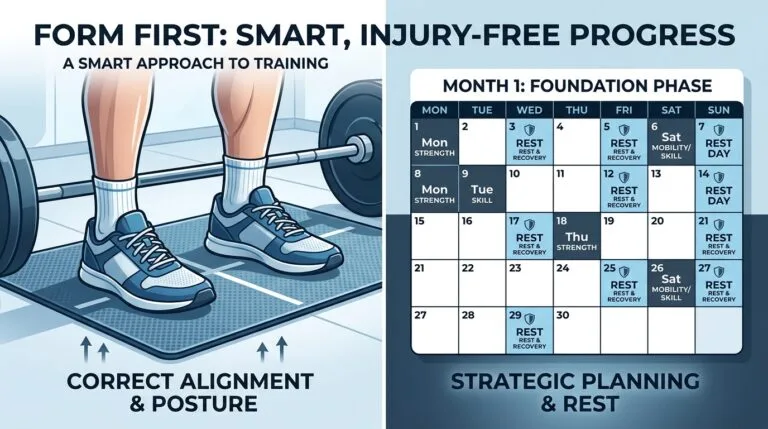
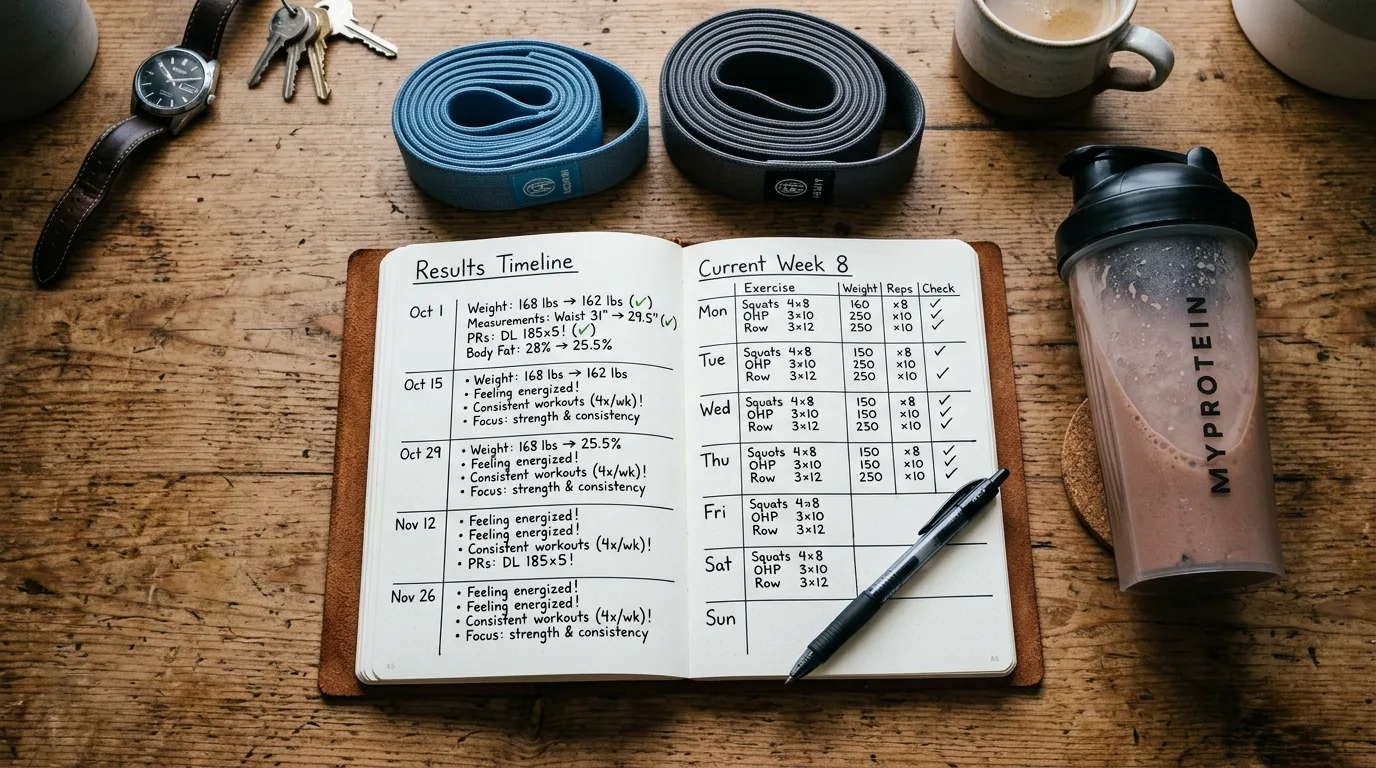
Practical priorities during this phase include mastering technique, establishing the habit of progressive overload (adding repetitions or load whenever possible), and ensuring recovery through sleep and protein intake. Tracking key lifts provides clear evidence of progress even when the mirror has not yet changed.
Weeks 4–8: Early Structural Changes Emerge
By the two-month mark, structural adaptations become more detectable. Muscle-fibre cross-sectional area begins to increase. Ultrasound studies have recorded measurable hypertrophy in novices within 3–6 weeks. Strength gains continue, although the rate of improvement often slows relative to the rapid neural window of the first month.
Common observations at this stage include:
- Greater muscle firmness and a longer-lasting post-workout pump
- Subtle improvements in how clothing fits around the arms, shoulders, or legs
- Continued ability to add weight or repetitions on primary movements
- Improved work capacity and faster recovery between sets
Body-composition shifts (fat loss or simultaneous recomposition) become more probable if a moderate calorie deficit or high-protein maintenance intake is maintained alongside training. Progress photos taken under consistent lighting and conditions often begin to reveal early changes that daily mirror checks miss.
Weeks 8–12: Visible Development and Cumulative Strength
Three months of consistent progressive training typically produces the first clearly visible results for most beginners. Cumulative strength increases of 20–40% or more on major compound movements are common. Muscle thickness and lean-mass gains become apparent in measurements and progress photos. The arms, shoulders, chest, back, and legs frequently display improved shape, density, and separation.
Meta-analytic data on resistance-training interventions report average fat-free mass gains in the region of 1.5 kg over approximately 10-week periods, with substantial individual variation. Beginners operating under favourable conditions (progressive overload, sufficient protein, adequate calories or a controlled deficit, and solid recovery) can often reach the higher end of realistic short-term rates. At this point the training effect is no longer predominantly neural; genuine tissue growth and elevated force-production capacity are present. External comments about looking stronger or more athletic commonly begin around this timeframe.
Key Variables That Accelerate or Slow the Timeline
Factors that accelerate progress
- True beginner status
- Consistent progressive overload applied weekly
- Protein intake at or above 1.6 g per kg of body weight
- Calorie surplus (for maximising muscle gain) or controlled deficit (for recomposition)
- 7–9 hours of quality sleep
- 3–5 hard sessions per week
- Most working sets taken within 0–3 repetitions of failure
Factors that slow progress
- Intermediate or advanced training age
- Inconsistent session attendance
- Insufficient protein or total energy intake
- Chronic sleep restriction or high life stress
- Absence of progressive overload
- Excessive concurrent cardio volume that impairs recovery
Step-by-Step Guide to Maximising Results Across a 12-Week Block
- Select a simple progressive template (full-body three times per week or an upper/lower split four times per week).
- Emphasise compound movements that can be overloaded with home equipment (squat and hinge patterns, horizontal and vertical pushes and pulls, loaded carries).
- Target each major muscle group 2–3 times weekly with a total of roughly 6–20 hard sets.
- Perform the majority of working sets within 0–3 repetitions of failure.
- Increase load, repetitions, or sets whenever current targets become achievable with good form.
- Consume adequate protein and align total calories with the primary goal (surplus for pure size, deficit for fat loss with muscle retention).
- Prioritise 7–9 hours of sleep and manage overall stress.
- Take standardised progress photos and circumference measurements every four weeks.
- Insert a deload week (reduced volume or intensity) if performance stalls or joint discomfort accumulates.
- At the 12-week mark, reassess strength numbers, photos, and measurements, then adjust volume, exercise selection, or goals for the next block.
Practical Home-Equipment Progression Across the Timeline
- Weeks 1–4: Establish technical proficiency with moderate loads; prioritise adding repetitions.
- Weeks 5–8: Begin more aggressive load increases once movement quality is solid.
- Weeks 9–12: Continue progressive overload and consider modest increases in volume or the strategic use of intensity techniques if recovery permits.
Adjustable dumbbells, kettlebells, and resistance bands enable continuous progression without access to a full commercial gym.
Integrating Strength Training with Grip, Core, Conditioning, and Recovery
Stronger grip endurance directly improves performance on pulling movements, carries, and hangs. Core stability developed through ab roller variations enhances force transfer and postural control under load. Low-impact conditioning on a manual treadmill or additional band work supports work capacity without excessive joint stress. A budget massage gun can assist recovery between sessions. Maintain sound shoulder mechanics using the principles outlined in your lateral raise guidance so upper-body progress remains joint-friendly and sustainable.
Frequently Asked Questions
When will strength improvements become noticeable? Most beginners experience clear strength gains within the first 4 weeks, driven largely by neural adaptations.
When does muscle growth become visible in the mirror? Measurable hypertrophy often begins around 4–8 weeks; for most people, clearly visible changes appear between 8 and 12 weeks of consistent training and nutrition. Supporting timeline discussions are available from sources such as Harvard Health.
How much muscle can a beginner realistically gain in 12 weeks? Average lean-mass gains in the range of 1–3 kg are realistic under good conditions, with wide individual variation depending on genetics, nutrition, and program adherence.
Is a commercial gym required to achieve these timelines? No. Progressive home training with dumbbells, kettlebells, bands, or advanced bodyweight variations can produce comparable early results when effort and progressive overload are present.
What should I do if little progress is visible by week 8? Audit consistency of training, application of progressive overload, protein intake, total calories, sleep quality, and overall recovery. Most plateaus stem from one or more of these controllable factors.
Do women follow a different timeline? Women experience the same sequence of neural then structural adaptations. Absolute muscle gains are typically smaller on average, yet relative strength improvements and visible changes occur on broadly similar schedules.
How important is progressive overload compared with simply “working out”? Progressive overload is essential. Performing the same workouts with the same loads indefinitely produces rapid plateaus after the initial neural window closes.
Final Recommendation
Home strength training produces reliable, staged results across a 12-week timeline when the fundamentals are respected. Expect rapid strength gains and improved coordination in the first 4 weeks, early structural changes and continued strength progress by 8 weeks, and clearly visible muscle development plus substantial cumulative strength increases by 12 weeks. These outcomes depend on progressive overload, sufficient protein, adequate recovery, and consistency—not on perfect equipment or complex programming.
Commit to a straightforward progressive plan, track key lifts and standardised progress photos, and support the work with nutrition and sleep. At the 12-week mark, evaluate results objectively and plan the next training block. The cumulative effect of repeated, well-executed 12-week cycles is what produces lasting improvements in strength, physique, and long-term health. Stay consistent, apply progressive mechanical tension, and the timeline will deliver.