How Long to Build Noticeable Grip Strength with Daily Hand Gripper Training
Quick Answer Most people notice the first improvements in crush-grip strength within 2–4 weeks of consistent, progressive hand-gripper training. Functionally noticeable gains—easier jar lids, stronger grocery carries, higher numbers of clean closes, and better holds during pulling exercises—typically become clear between 4–8 weeks. More substantial strength increases and early forearm density develop over 8–12 weeks, with continued progress across 3–6 months when progressive overload is maintained. Daily training can accelerate early neural adaptations, but volume and intensity must be managed carefully to protect tendons. Results depend on starting level, progressive resistance, session quality, recovery, and consistency.
Grip Strength Qualities and What Hand Grippers Actually Train
Grip strength is not a single ability. It comprises several distinct qualities:
- Crush grip – closing the hand against resistance (the primary target of hand grippers).
- Support grip – holding an object for time (dead hangs, farmer carries, barbell holds).
- Pinch grip – thumb-to-finger compression.
- Wrist and forearm stability – supporting force transfer during pressing, pulling, and carrying.
Hand grippers load the finger flexors (flexor digitorum superficialis and profundus) and intrinsic hand muscles in a dynamic closing pattern. When the wrist is kept neutral or slightly extended, they also challenge the wrist flexors to a degree. They are highly specific for crush strength and can contribute to lower- and mid-forearm density. They transfer less directly to pure support-grip endurance or maximal pinch strength, which benefit from complementary hanging, carrying, and pinching work.
A detailed evidence-based review of grip training on Stronger by Science notes that grippers are particularly useful for dynamically loading the finger flexors at favourable muscle lengths and can be performed almost anywhere, allowing extra volume with low systemic fatigue.
Evidence-Based Timeline for Noticeable Strength Gains
Controlled studies and practical experiments show consistent patterns of adaptation:
| Timeframe | Typical Observable Changes | Dominant Physiological Drivers | Practical Markers of Progress |
|---|---|---|---|
| Days 1–14 | Better coordination, less fatigue on submaximal sets | Neural efficiency, motor learning | Same gripper feels smoother |
| Weeks 2–4 | Noticeable ease closing previous resistance, daily tasks easier | Continued neural adaptations, early strength | Functional improvements in everyday gripping |
| Weeks 4–8 | Clear strength gains (often 10–25%+ in beginners), higher closes | Strength increases + early hypertrophy | Most reliable window for “noticeable” results |
| Weeks 8–12 | Substantial crush-grip improvement, emerging forearm density | Progressive overload + muscle growth | Grip less limiting in rows, deadlifts, pulls |
| 3–6 Months | Marked strength and visible forearm changes for consistent trainees | Sustained progressive loading | Long-term ceiling begins to appear without variation |
Specific findings include:
- Progressive gripper protocols frequently produce 10–30% increases in maximal crush-grip strength over 4–12 weeks in previously untrained or recreational participants.
- One intervention using a custom progressive gripper device reported a 26.5% increase in dynamic gripper 1RM after six weeks of heavy, low-repetition training.
- Unilateral handgrip training studies have demonstrated significant strength gains in the trained limb by approximately the third week, with continued improvement thereafter.
- A 30-day practical comparison of daily gripper work versus other methods showed meaningful crush- and pinch-grip improvements even in that short window.
- A systematic review and meta-analysis of hand-focused strength and proprioceptive training found small-to-moderate improvements in grip strength (Hedges’ g ≈ 0.44) across healthy adults, with larger effects often observed in beginners and older adults (see the open-access review in PMC).
Early gains are predominantly neural. Visible forearm size changes and higher absolute strength levels require longer progressive loading.
Why Daily Training Can Work—and Where Caution Is Essential
The hands and forearms recover relatively quickly compared with larger muscle groups, making daily or near-daily practice feasible for many people. Frequent exposure accelerates motor learning and neural drive to the finger flexors. Short sessions (5–15 minutes) are easy to fit into daily routines and support high cumulative volume over weeks.
Connective tissues, however, adapt more slowly than muscle. High daily volume of heavy closes without recovery management elevates the risk of flexor tendon soreness, medial or lateral elbow irritation, or overuse. Successful long-term approaches often use:
- Daily or near-daily moderate sessions, or
- 5–6 days per week with some lighter technique or higher-rep days, and
- Planned deloads every 4–6 weeks.
Tendon health is the limiting factor more often than muscular recovery.
Step-by-Step Program to Build Noticeable Grip Strength with Daily Grippers
- Choose progressive resistance – Select an adjustable gripper or a full set of increasing difficulties so overload remains possible for months.
- Establish correct technique – Seat the handle deep in the palm, maintain a neutral or slightly extended wrist, and complete full closes with control, emphasising the ring and pinky fingers.
- Start with appropriate load – Begin with a resistance you can close for 8–12 clean repetitions.
- Structure each session – Perform 3–5 sets per hand of 5–12 repetitions. Heavier loads (5–8 reps) emphasise pure strength; moderate loads (8–12) blend strength and hypertrophy. Rest 60–90 seconds between sets.
- Train most days – Aim for 5–7 sessions per week initially, reducing intensity on days when residual soreness is present.
- Apply progressive overload systematically – Increase resistance, add repetitions, add a set, or slow the eccentric phase once current loads become manageable.
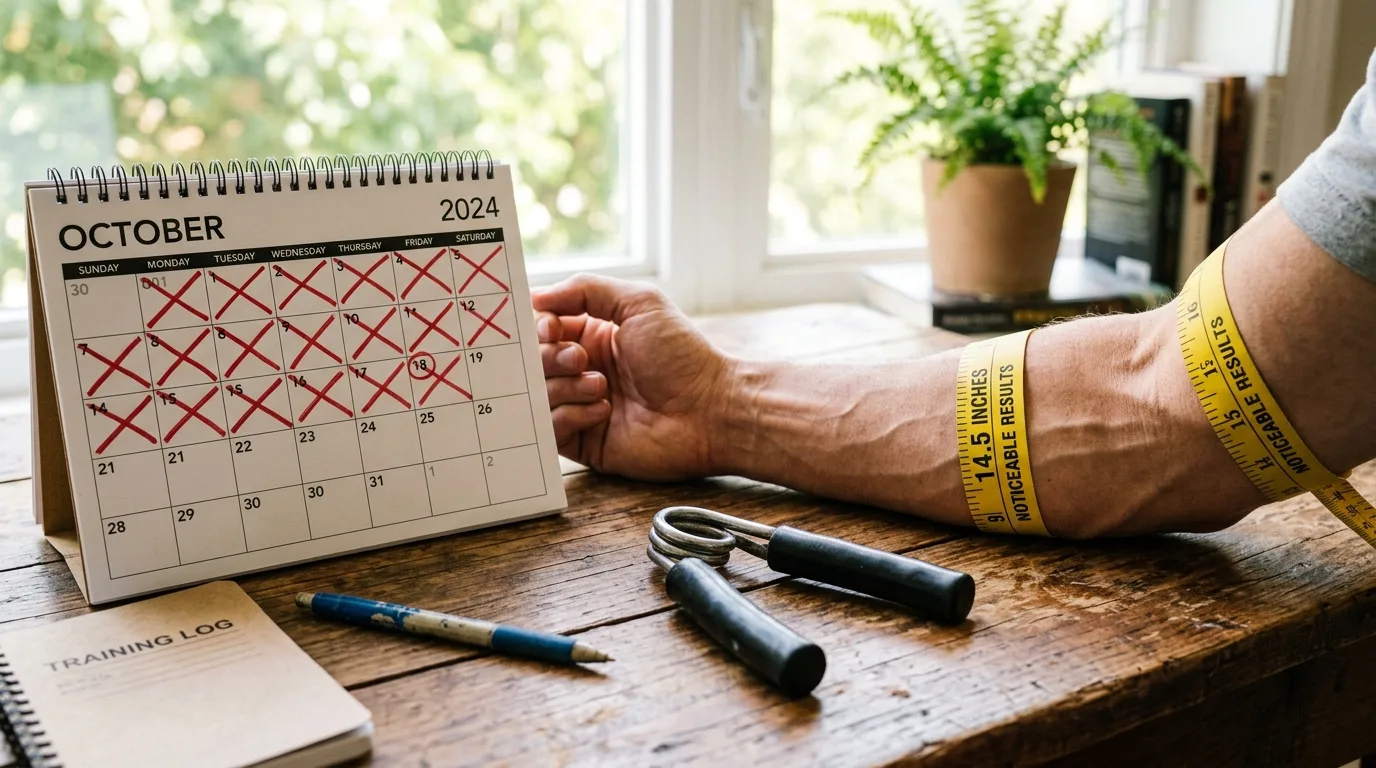
- Track objective metrics – Record the heaviest gripper closed for a target rep range and note functional improvements (jar lids, carries, gym holds).
- Add complementary exercises (recommended) – Wrist curls, reverse wrist curls, hammer curls, or light support holds 2–3 times per week for balanced forearm development.
- Schedule deloads – Every 4–6 weeks, reduce volume or intensity for 5–7 days to allow connective-tissue recovery.
- Support recovery fundamentals – Prioritise sleep, protein intake (approximately 1.6–2.2 g per kg body weight), and overall training stress management.
A practical minimal effective dose for many trainees is 10–20 quality closes per hand on most days, progressed over time.
Factors That Determine How Quickly Results Appear
- Training history – Complete beginners usually progress faster than those with prior grip exposure.
- Quality of progressive overload – Remaining on the same easy gripper produces rapid plateaus.
- Volume–intensity balance – Insufficient stimulus slows gains; excessive daily heavy work risks irritation.
- Age and recovery capacity – Younger individuals and those with strong recovery habits adapt more quickly.
- Nutrition and sleep – Adequate protein and consistent 7–9 hours of sleep support both neural and muscular adaptations.
- Consistency – Missed weeks interrupt momentum more than almost any other variable.
- Technique precision – Full, controlled closes recruit the target muscles more effectively than partial or momentum-driven repetitions.
Realistic Expectations and Frequent Mistakes
Functional improvements (daily tasks feeling easier, better gym holds) usually precede large visible forearm changes. Crush-grip strength rises earlier than support-grip endurance or overall forearm circumference. Grippers alone produce the clearest changes in crush strength and lower-forearm density; fuller, balanced development benefits from additional wrist-flexion, wrist-extension, and brachioradialis work.
Common errors that limit progress or increase injury risk include:
- Using only light grippers for very high repetitions indefinitely.
- Jumping to heavy resistance too soon and sacrificing full range of motion.
- Ignoring early tendon or elbow discomfort.
- Expecting dramatic forearm size from grippers in isolation within a few weeks.
- Failing to increase resistance over successive weeks.
- Combining very high daily gripper volume with already high pulling volume without recovery management.
Integrating Gripper Training with the Rest of Your Program
Hand grippers enhance performance across a wide range of training tools. Stronger crush grip improves control and endurance with adjustable dumbbells and kettlebell exercises, especially rows, carries, and pulls. Enhanced grip endurance supports better execution of ab roller rollouts and hanging variations.
Low-impact cardio options such as a manual treadmill or mobility and strength work with resistance bands pair well on lighter days. Recovery tools like a budget massage gun can help manage residual forearm and elbow tension. Continue applying sound shoulder-mechanics principles from your lateral raise guidance so upper-body sessions remain balanced and productive. For related evidence on whether grippers increase overall forearm size, see the dedicated discussion on that topic.
Frequently Asked Questions
How soon will I notice grip strength improvements with daily gripper training? Many people feel initial changes within 2–4 weeks. Clearer, functionally noticeable strength most commonly appears between 4–8 weeks of progressive work.
Is daily gripper training safe and effective? Yes for most people when volume and intensity are managed. Alternate harder and easier days or keep the majority of sessions moderate to protect tendons. Deload periodically.
How much strength can realistically be gained? Beginners often achieve 10–30% improvements in crush-grip measures over 8–12 weeks. Long-term gains continue with consistent progressive overload, though the rate slows.
Will grippers alone build impressive forearms? They increase density and size in the finger flexors and lower forearm. Balanced, high-level development usually requires additional wrist-flexion/extension and brachioradialis work.
Should I emphasise heavy closes or higher repetitions? Both have value. Heavier closes (approximately 5–8 reps) prioritise maximal strength; moderate ranges (8–12) blend strength and hypertrophy. Progress the resistance over time regardless of the chosen rep range.
When should additional grip modalities be introduced? After 4–6 weeks of consistent gripper training, or earlier if support-grip endurance or pinch strength are specific performance goals.
Do results transfer to deadlifts and pull-ups? Crush-grip improvements help, but specific heavy holds, farmer carries, and thick-bar or axle work transfer more directly to those lifts. Grippers remain an excellent supplementary tool.
Final Recommendation
Noticeable grip strength from daily hand-gripper training typically emerges within 4–8 weeks for consistent trainees, with early neural improvements appearing even sooner. Substantial, lasting gains develop over 8–12 weeks and beyond when progressive overload is applied and recovery is respected. Daily practice accelerates skill acquisition and early strength but must be balanced against tendon health through intelligent volume control and periodic lighter periods.
Select progressive grippers, train with controlled full closes on most days, track objective progress, and support the work with adequate protein, sleep, and complementary forearm exercises. Remain consistent for at least 8–12 weeks before judging overall effectiveness. When these elements are in place, hand grippers become one of the most time-efficient and accessible tools for building real-world crush-grip strength that improves both daily function and training performance.