Resistance Bands Buying Guide: Which Type Actually Lasts and Performs
Quick Answer
The resistance bands that last longest and perform best are high-quality natural latex or layered latex loop bands and tube bands with robust handles and strong anchoring points. Look for continuous-loop or welded construction, consistent resistance ratings, and brands that publish material specifications and durability testing. Avoid cheap, thin, single-layer bands that snap or lose elasticity quickly. Match the band type to your primary use (strength training, mobility, assisted work, or travel), prioritise material quality over the lowest price, and replace bands at the first sign of cracking or significant elasticity loss. A small set of durable bands outperforms a large collection of low-quality ones.
Why Band Quality Matters More Than Most People Expect
Resistance bands appear simple, yet they fail more often than almost any other home-gym tool when quality is poor. Snapping bands create safety risks, sudden loss of resistance ruins workouts, and rapid elasticity degradation forces repeated purchases that cost more over time. High-quality bands maintain consistent tension, survive hundreds of sessions, and deliver reliable progressive overload. Low-quality bands do the opposite. Choosing correctly saves money, improves training consistency, and reduces injury risk from unexpected failure.
Main Types of Resistance Bands and Their Real-World Performance
| Type | Best Uses | Durability Potential | Performance Notes | Ideal For |
|---|---|---|---|---|
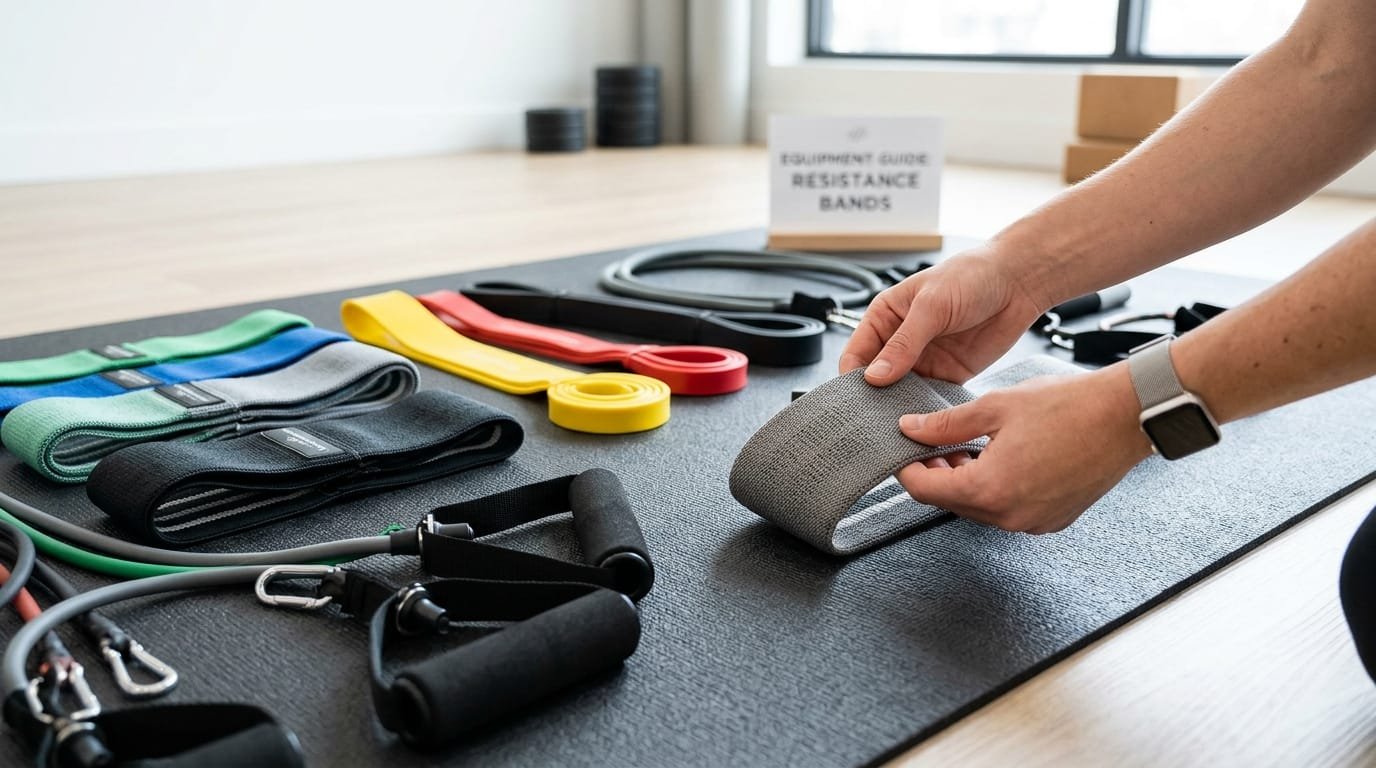
| Flat Loop Bands (Continuous) | Strength, glute work, assisted pull-ups, mobility | High when layered latex | Excellent tension curve, no handles to fail | Most home strength trainees |
| Tube Bands with Handles | Pressing, rowing, standing exercises | Moderate to High | Convenient grip, but handles and connection points are failure sites | Beginners and general fitness |
| Therapy / Mini Bands | Lateral walks, activation, rehab | Moderate | Convenient but often thinner; quality varies widely | Warm-ups and accessory work |
| Superbands / Large Loops | Assisted pull-ups, heavy stretching, mobility | High | Thick and strong when well made | Pull-up progression and mobility |
| Fabric / Cloth Bands | Glute activation, lateral work | High (different failure mode) | Comfortable, less snap risk, but different resistance feel | Lower-body activation |
| Figure-8 or Specific Shapes | Isolation movements | Variable | Limited versatility | Niche uses only |
Continuous flat loop bands made from layered natural latex generally offer the best combination of durability and training performance for most users.
Material Matters: What Actually Lasts
Natural Latex (Layered)
The gold standard for most strength and fitness bands. Layered construction resists tearing better than single-layer tubing. High-quality latex maintains elasticity longer and provides a smooth resistance curve.
Synthetic Rubber / TPE
Often cheaper. Some formulations perform adequately, but many degrade faster, become sticky, or lose tension more quickly than good latex.
Fabric-Covered Bands
Excellent comfort and low snap risk. Resistance feel is different (more linear in some designs) and they are generally very durable for activation and lateral work.
Key Durability Indicators
- Multiple layers rather than single thin sheets
- Consistent thickness and colour throughout the band
- Manufacturer ratings for elongation and tensile strength
- Absence of strong chemical odour (can indicate lower-grade materials)
- Smooth, even surface without visible seams or weak spots
Critical Performance Factors Beyond Material
Resistance Consistency
Good bands provide predictable tension at given elongation percentages. Poor bands feel uneven or lose resistance after limited use.
Snap Resistance
Look for bands tested for high elongation before failure. Layered designs and proper thickness improve safety margins.
Handle and Attachment Quality (Tube Bands)
Handles should be comfortable and securely attached. Carabiners, clips, and door anchors are common failure points—inspect them regularly.
Length and Width Options
Longer loops allow more exercise variety. Wider bands usually mean higher resistance and often better durability.
How to Match Band Type to Your Training Goals
Strength and Muscle Building
Prioritise thick flat loop bands or heavy tube bands. Progressive overload comes from stronger bands, higher elongation, slower tempos, or increased volume.
Assisted Pull-Ups and Mobility
Large continuous loops (superbands) in graduated strengths work best.
Glute Activation and Lateral Work
Mini loops or fabric bands excel. Comfort and stay-in-place design matter more than maximum resistance.
Travel and Minimalist Training
A compact set of flat loops or light tube bands packs easily and covers most movement patterns.
Rehab and Gentle Strengthening
Lighter therapy resistance bands with smooth resistance curves are preferable.
Step-by-Step Buying Process
- Define your primary uses (strength, assistance, activation, travel).
- Decide whether you prefer loops or handled tubes.
- Set a budget that favours quality over quantity.
- Shortlist bands made from layered natural latex or proven fabric designs.
- Check resistance ranges and whether the set includes progressive strengths.
- Read recent user reviews that mention longevity and snap rates.
- Verify return policy and warranty if offered.
- Start with 3–5 bands covering light to heavy resistance.
- Inspect new bands carefully before first use.
- Establish a simple care and inspection routine.
Care Practices That Maximise Lifespan
- Inspect bands before every session for nicks, tears, or thin spots.
- Avoid sharp objects, rough flooring, and direct sunlight during storage.
- Clean with mild soap and water when needed; dry thoroughly.
- Do not overstretch beyond the manufacturer’s recommended range.
- Store loosely rather than tightly stretched or folded sharply.
- Replace any band that shows cracking, sticky residue, or significant loss of elasticity.
Proper care can double or triple the useful life of quality bands.
Safety Considerations
Bands store energy. A breaking band can snap back with force. Mitigate risk by:
- Inspecting before use
- Choosing layered, reputable products
- Avoiding pulling bands toward the face at high tension
- Using controlled tempos
- Replacing worn bands promptly
Shoulder-friendly technique remains important when bands are used for raising or pressing patterns (Bent Arms vs. Straight Arms in Lateral Raises, The Hidden Mistake in Lateral Raises, and 3 Lateral Raise Modifications). Grip demands can also appear during high-tension work (Do Hand Grippers Really Work?).
Cost vs Value Analysis
Cheap multi-packs often cost less upfront but require frequent replacement. A smaller set of high-quality layered latex bands usually costs more initially yet delivers lower cost per session and better training consistency. Practical home-gym advice favours durable, multi-use tools that reduce long-term spending and clutter (home gym equipment prioritisation and budget home gym principles).
Strength training with progressive resistance—including well-chosen bands—remains highly effective for building and maintaining muscle and function (strength training guidance).
Common Buying Mistakes
| Mistake | Result | Better Approach |
|---|---|---|
| Buying the cheapest large set | Frequent breakage and inconsistent resistance | Invest in fewer, higher-quality bands |
| Ignoring material specifications | Rapid degradation | Choose layered natural latex or proven fabric |
| Using damaged bands | Safety risk and poor performance | Inspect and replace promptly |
| Expecting bands to feel exactly like weights | Frustration with resistance curve | Learn to use tension and tempo effectively |
| Storing bands in direct sun or stretched | Shortened lifespan | Store loosely in a cool, dry place |
| Using one band for every purpose | Compromised training effect | Build a small progressive set |
Frequently Asked Questions
How long should a good resistance band last?
With proper care and inspection, high-quality latex loop bands often last 1–3 years or longer of regular use. Heavy daily use or poor storage shortens lifespan.
Are latex bands better than fabric resistance bands?
They serve different purposes. Latex generally offers a smoother progressive resistance curve for strength work. Fabric bands excel in comfort and durability for activation and lateral movements.
Can resistance bands build significant strength?
Yes when progressive overload is applied through stronger bands, greater elongation, slower tempos, increased volume, or more challenging leverage.
What resistance levels do I need as a beginner?
A light, medium, and heavy band (or the equivalent in a progressive set) covers most early needs. Add stronger bands as strength improves.
Are tube resistance bands with handles less durable?
Often yes, because handles, clips, and connection points introduce additional failure modes. High-quality versions still perform well when inspected regularly.
How do I know when to replace a Resistance band?
Replace at the first sign of cracking, tears, sticky surface, or noticeable loss of elasticity.
Can I use bands for heavy strength training?
Yes. Thick loop bands and heavy tubes can provide substantial resistance, especially when combined with slower tempos and full ranges of motion.
Do colour codes mean the same resistance across resistance brands?
No. Resistance ratings vary between manufacturers. Always check the actual stated resistance or test the feel.
Final Recommendation
The resistance bands that actually last and perform are those made from quality layered natural latex (or durable fabric for specific uses), constructed as continuous loops or robust tube systems, and matched to your primary training needs. Buy fewer, better bands rather than large cheap sets. Inspect them regularly, store them properly, and replace them at the first signs of wear.
A small, progressive collection of durable resistance bands supports strength training, mobility, assisted work, and travel workouts with minimal space and cost. Pair them with solid movement technique, progressive programming, and basic care habits.
Assess your main uses, prioritise material quality and construction, and invest in bands that will survive repeated sessions. The right set becomes a reliable, long-term tool rather than a recurring expense or safety concern. Choose quality, inspect routinely, and train with confidence.