How to Modify Common Exercises if You Have Knee or Shoulder Limitations
Quick Answer
Knee and shoulder Exercise limitations do not mean you must stop training—they require intelligent, systematic modifications. For knees, reduce depth, switch to reverse lunges or box squats, limit impact, and strengthen the hips and quadriceps in pain-free ranges. For shoulders, avoid or limit painful overhead positions, use neutral-grip pressing, elevate the torso during horizontal pressing, and prioritise external rotation and scapular control. The objective is to maintain progressive stimulus while keeping symptoms stable or improving. Always respect pain signals, regress when necessary, and progress conservatively.
Understanding Limitations Versus Injury
Not every sensation of discomfort equals tissue damage. Many trainees successfully continue making strength and muscle progress by adjusting range of motion, load, tempo, implement, and exercise selection.
- Sharp, pinching, stabbing, or progressively worsening pain is a clear stop signal.
- Mild joint awareness or muscle fatigue that settles within 24 hours is often tolerable.
- When symptoms are unclear or persistent, professional assessment is the safest path.
The guiding principle is simple: train the affected joint through its available pain-free range rather than avoiding the joint entirely.
Knee-Friendly Modifications for Common Exercises
| Original Exercise | Typical Provocation | Primary Modifications | Why the Modification Helps |
|---|---|---|---|
| Back Squat / Goblet Squat | Pain in deep flexion or at the bottom | Box squat to pain-free height, reduced depth, small heel elevation, slower eccentric | Limits end-range compressive and shear stress while retaining loading |
| Forward Lunge | Anterior knee pain, high shear | Reverse lunge, static split squat, step-back to a box | Reduces forward knee travel and shear forces |
| Walking Lunge | Cumulative impact and instability | Stationary split squat or controlled reverse lunge | Eliminates repeated impact and improves balance demands |
| Deep Leg Press | Excessive knee flexion under load | Partial range of motion, higher foot placement on the platform | Decreases peak joint stress |
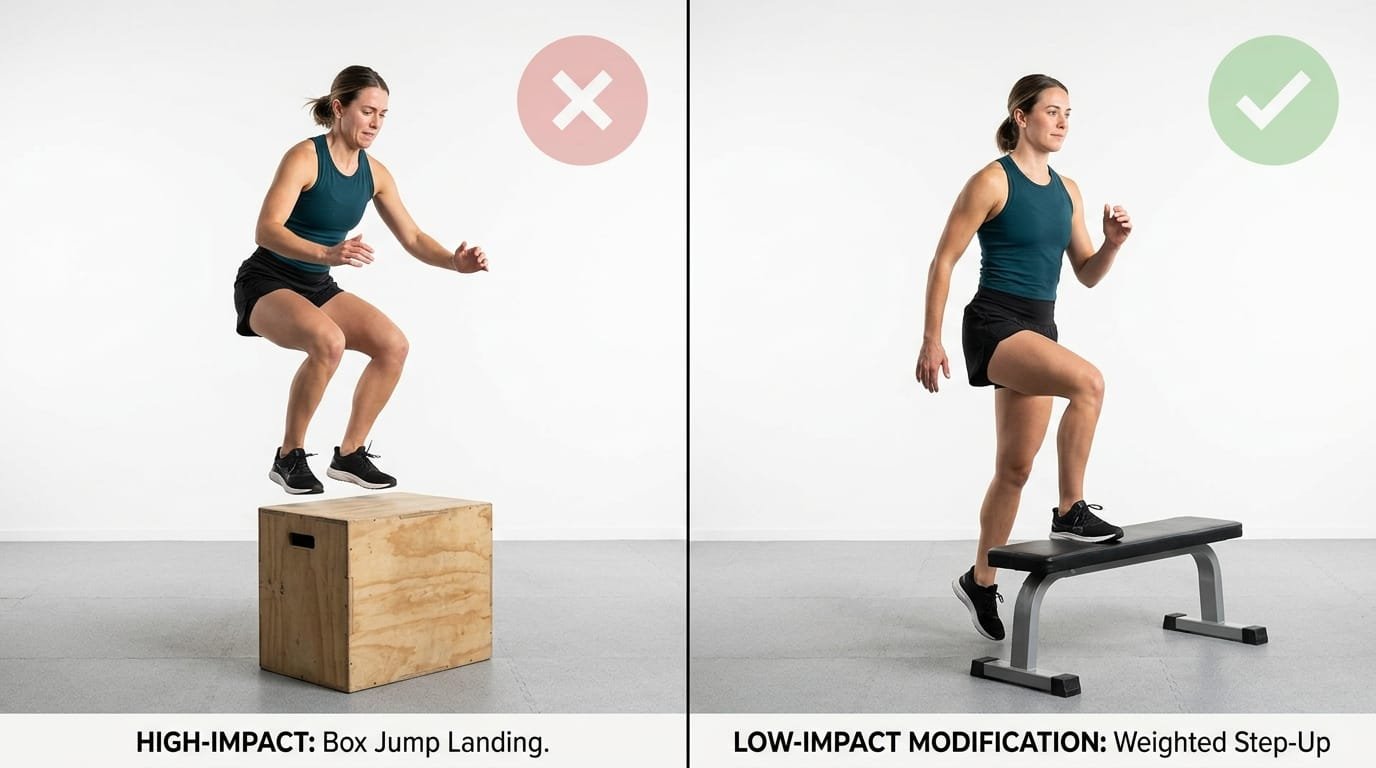
| Running / Jumping | High ground-reaction forces | Cycling, elliptical, sled pushes, incline walking | Maintains conditioning with substantially lower impact |
| Pistol Squat or Deep Single-Leg Work | Extreme mobility and loading demand | Assisted versions, box pistols, or elevated single-leg squats | Builds capacity gradually within tolerable ranges |
Supporting Strategies for Knee Resilience
- Strengthen the glutes and lateral hips (glute bridges, side-lying abductions, band monster walks).
- Address limited ankle dorsiflexion if it forces compensatory knee movement.
- Emphasise controlled tempos instead of bouncing out of the bottom position.
- Use low-impact conditioning (cycling, swimming, or elliptical) on higher-irritability days.
- Consider isometric holds in pain-free angles to build tolerance without movement.
Shoulder-Friendly Modifications for Common Exercises
| Original Exercise | Typical Provocation | Primary Modifications | Why the Modification Helps |
|---|---|---|---|
| Strict Overhead Press | Impingement or pain near lockout | Landmine press, neutral-grip dumbbell press in scapular plane, incline press | Places the arm in a more anatomically friendly path |
| Barbell Bench Press | Pain at the bottom or with wide grip | Neutral-grip dumbbells, floor press, elevated push-ups | Reduces extreme shoulder extension and external rotation |
| Behind-the-Neck Press or Upright Row | High impingement risk | Eliminate entirely; substitute front raises or scapular-plane lateral raises | Removes the most provocative positions |
| Wide-Grip Pull-Ups / Pulldowns | End-range shoulder strain | Neutral or underhand grip, reduced range if needed | Creates a more joint-friendly shoulder position |
| Deep Dips | Anterior shoulder stress | Partial-range dips or controlled bench dips | Limits excessive shoulder extension |
| Straight-Arm Lateral Raises | Superior shear or impingement | Scapular-plane raises, slight elbow bend, cable or band variations | Reduces provocative loading angles |
Supporting Strategies for Shoulder Resilience
- Prioritise external-rotation strength and scapular control (face pulls, band pull-aparts, prone Ys and Ts).
- Keep the elbows slightly forward of the torso during pressing when possible.
- Use slower eccentrics and avoid aggressive end-range stretching under heavy load.
- Maintain thoracic extension and rotation so the scapulae can move freely.
- Include regular soft-tissue and mobility work for the posterior shoulder and upper back.
Detailed Exercise-by-Exercise Modifications
Squat Pattern with Knee Limitations
Preferred options:
- Box squat to a height that stays pain-free
- Goblet squat with a small heel lift on plates or wedges
- Chair sit-to-stand focusing on controlled descent
- Partial-range squats emphasising the pain-free portion of the movement
Lunge and Split-Stance Patterns with Knee Limitations
Preferred options:
- Reverse lunges
- Static split squats with rear foot elevated or on the floor
- Low step-ups with controlled eccentric
Horizontal Pressing with Shoulder Limitations
Preferred options:
- Neutral-grip dumbbell floor press
- Elevated push-ups (hands on a bench or secure boxes)
- Landmine press
Vertical Pressing with Shoulder Limitations
Preferred options:
- Landmine press
- Single-arm dumbbell press performed slightly in front of the body (scapular plane)
- Partial-range overhead work only if completely symptom-free
Pulling Movements with Shoulder Limitations
Preferred options:
- Neutral-grip rows and neutral-grip pull-ups or pulldowns
- Reduced range of motion if the fully stretched or fully contracted position provokes symptoms
- Emphasis on controlled scapular retraction and depression
Step-by-Step Process for Modifying Any Exercise
- Identify the exact joint position or portion of the range that provokes symptoms.
- Reduce the range of motion to the current pain-free zone.
- Change the implement—dumbbells, kettlebells, bands, or cables often feel better than a barbell.
- Alter body position, grip, or angle (neutral grips, landmine setups, elevated surfaces).
- Slow the tempo, particularly the eccentric phase.
- Reduce external load and increase focus on control.
- Strengthen the supporting musculature (hips and quadriceps for knees; rotator cuff and scapular stabilisers for shoulders).
- Re-test the original movement every 1–2 weeks to assess improvement.
- Document successful modifications and symptom response.
- Seek professional evaluation if pain persists, worsens, or is accompanied by significant weakness or instability.
Programming Principles When Managing Limitations
- Keep overall training frequency as consistent as possible; only remove or modify the aggravating variations.
- Use higher repetition ranges and controlled tempos when loads must remain light.
- Balance pushing and pulling volume carefully to protect shoulder health.
- Include dedicated activation and mobility work for the hips, ankles, thoracic spine, and rotator cuff.
- Monitor symptoms for 24–48 hours after sessions and adjust volume or intensity accordingly.
- Maintain progressive overload within the available pain-free capacity—progress can still occur.
Integration with Complete Home Training
Shoulder modifications should align with established safe lateral-raise technique and overall shoulder-health practices (safe lateral-raise guidance and shoulder health routine.
Kettlebell exercises can frequently be modified by shortening range of motion or switching to single-arm variations (kettlebell sizing guide. Grip strength remains fully trainable and improves control of any implement (grip strength guidance.
Resistance bands are particularly valuable for joint-friendly loading and activation work (Resistance Bands Buying Guide. Core stability helps protect both the knees and shoulders during loaded movements (ab roller progressions. Low-impact conditioning such as cycling, elliptical, or incline treadmill walking is often better tolerated than high-impact options (manual treadmill guidance.
Recovery practices become even more critical when managing joint limitations (Best Post-Workout Recovery Tools, Best Massage Gun for Post-Workout Recovery on a Budget, and Sleep and Recovery Strategies. Tracking both performance and symptom response guides intelligent decision-making (Best Ways to Track Progress Without a Gym or Personal Trainer.
External clinical and coaching resources consistently recommend range-of-motion adjustments, grip and angle changes, supporting-muscle strengthening, and low-impact conditioning alternatives as the primary tools for training around knee and shoulder limitations (smart exercise modifications for pain and joint-friendly training approaches).
Common Mistakes When Training Around Limitations
- Completely avoiding the affected joint instead of exploring pain-free ranges
- Pushing through sharp or worsening pain
- Neglecting the supporting muscle groups (hips for knees, rotator cuff and scapular muscles for shoulders)
- Progressing load too aggressively once a modification feels comfortable
- Relying exclusively on machines or isolation work and losing overall movement capacity
- Skipping mobility and activation work for adjacent joints
- Failing to re-test original movements periodically
Frequently Asked Questions
Can I still build muscle and strength with knee or shoulder limitations?
Yes. Progressive mechanical tension applied in pain-free ranges, combined with adequate protein and recovery, still produces adaptation.
Should I stop training entirely if a movement hurts?
Stop the specific painful variation. In the large majority of cases you can continue training the rest of the body and the affected joint within its current tolerable range.
Are resistance bands better than free weights for joint limitations?
They can feel more accommodating for some individuals because tension increases through the range, but both free weights and bands work well when technique and load are managed intelligently.
How long should I continue using modifications?
Use them for as long as they are needed. Re-test the original movement every one to two weeks to determine whether range or load tolerance has improved.
Is cycling a good option when knees are sensitive?
Frequently yes. Cycling provides low-impact conditioning and can strengthen the quadriceps with relatively low compressive stress when bike fit is appropriate.
What are the safest pressing options for sensitive shoulders?
Neutral-grip floor presses, landmine presses, and elevated push-ups are among the most commonly well-tolerated variations.
Do I need to see a physiotherapist or doctor?
Persistent or worsening pain, significant weakness, instability, swelling, or uncertainty about the underlying issue warrants professional assessment.
Can I train upper body if my knees are limited, and vice versa?
Yes. Limitations in one area rarely require complete rest of the entire body. Maintain training stimulus elsewhere while modifying the affected region.
Final Recommendation
Knee and shoulder limitations are best managed through systematic exercise modification rather than complete cessation of training. Reduce range of motion to the pain-free zone, change grips and angles, select more joint-friendly variations, strengthen supporting musculature, and progress conservatively while closely monitoring symptoms. Maintain overall training consistency so that strength, muscle, and fitness are preserved or improved.
Use the comparison tables and step-by-step process in this guide to adjust squats, lunges, presses, pulls, and conditioning to your current capacity. Combine these modifications with dedicated shoulder-health work, hip strengthening, solid recovery habits, and simple performance-plus-symptom tracking. Training around limitations is a practical skill—once mastered, it allows continued progress for years while protecting long-term joint health. Begin with the most conservative variation that still provides a meaningful stimulus, execute it with high quality, and build capacity from there.