How to Modify Common Exercises for Knee or Shoulder Limitations
Quick Answer
Modify common exercises for knee or shoulder limitations by reducing range of motion, changing body position or leverage, switching to supported or unilateral variations, slowing tempo, and substituting less stressful alternatives while keeping the target muscle groups working. All modifications should remain pain-free. Obtain guidance from a qualified professional for persistent or diagnosed issues, and progress only when symptoms stay stable or improve.
Important Medical Disclaimer
This article offers general educational information only. It is not medical advice, diagnosis, or treatment. Knee and shoulder limitations vary widely by cause, severity, and individual factors. Consult a physician, physical therapist, or other qualified healthcare provider before modifying exercises or beginning a training programme with existing joint limitations. Stop any movement that produces sharp, radiating, or worsening pain.
Core Principles of Exercise Modification
- Pain-free execution – The modified version must not reproduce injury-site pain.
- Maintain training effect – Keep tension on the intended muscles as much as possible.
- Reduce joint stress first – Range, leverage, and support are the primary tools.
- Progress gradually – Expand range, load, or complexity only when the current version is fully comfortable.
- Address both sides – Train the unaffected side and the rest of the body to limit deconditioning.
- Professional input – Persistent limitations benefit from individualised assessment.
Knee-Limitation Modifications
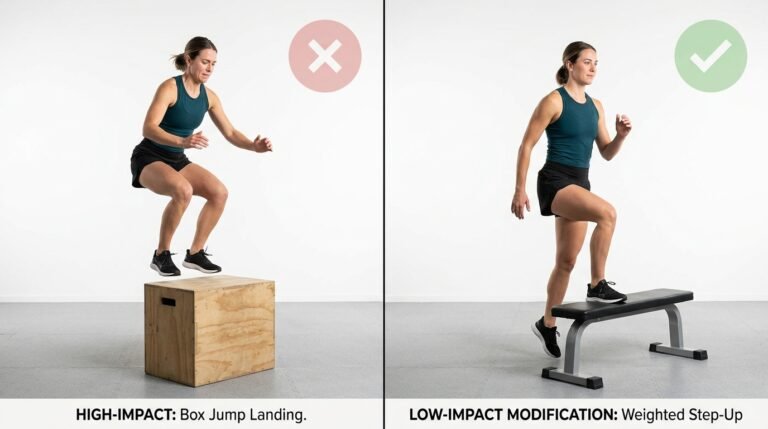
Common knee-sensitive exercises include squats, lunges, step-ups, and leg presses. The main stressors are deep flexion, forward knee travel under load, and impact.
| Original Exercise | Primary Stress on Knee | Effective Modifications | Progression Path |
|---|---|---|---|
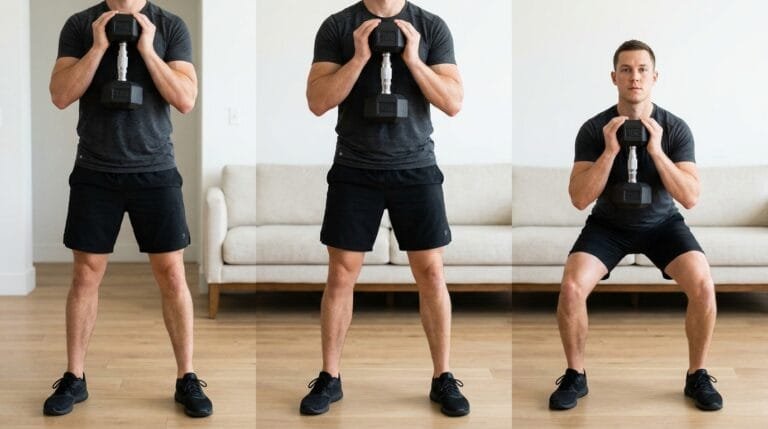
| Back or goblet squat | Deep flexion, compressive load | Box squat to higher height, partial-range squat, landmine squat, supported squat | Lower box height → add tempo → add load |
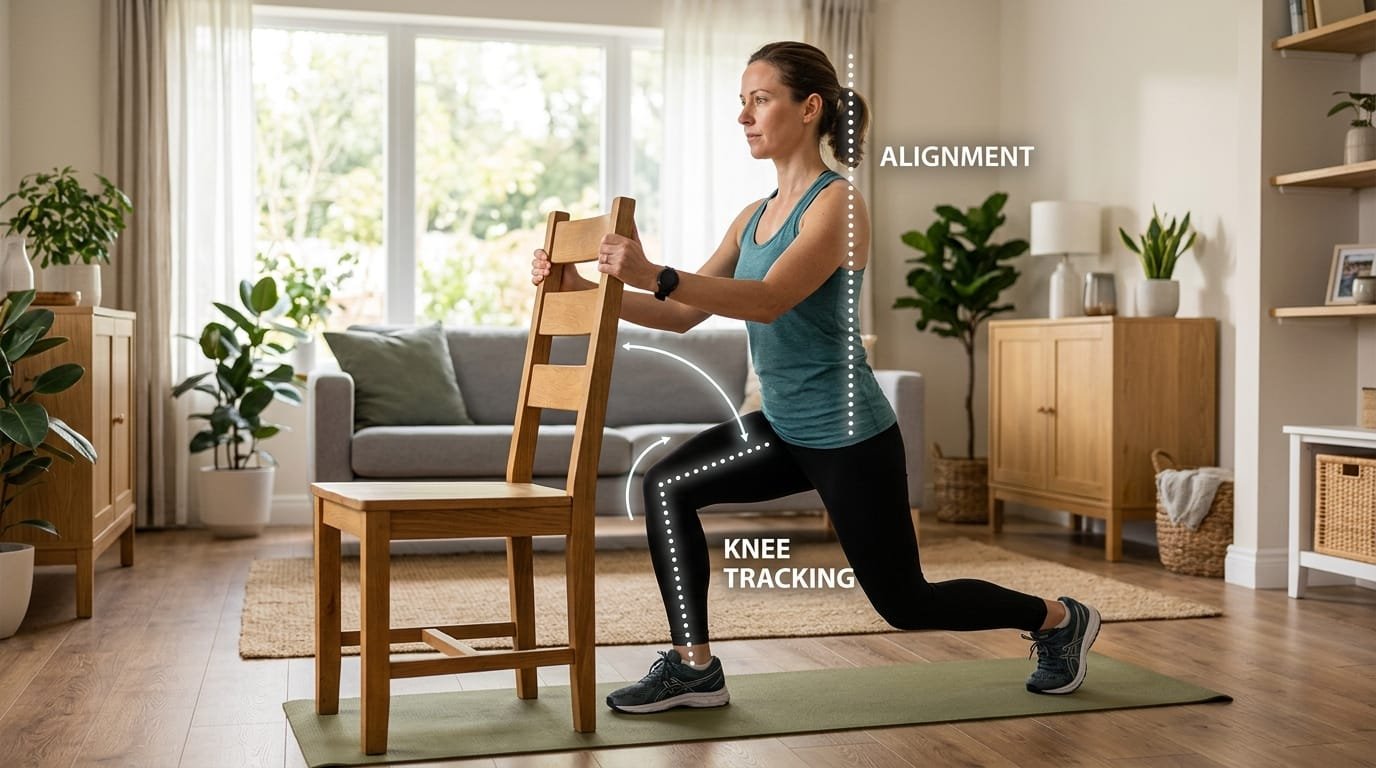
| Forward lunge | Forward knee travel, deceleration | Reverse lunge, static split squat, elevated rear-foot split squat with shorter range | Increase depth gradually → add load |
| Walking lunge | Repeated deceleration and flexion | Reverse lunge or split squat only | Controlled tempo → longer steps if tolerated |
| Step-up | Single-leg loading through flexion | Lower step height, reverse lunge, supported single-leg squat | Raise step → add load |
| Leg extension | Open-chain shear (machine) | Terminal knee extension with band, isometric holds, closed-chain alternatives | Increase range or resistance slowly |
Additional knee-friendly guidelines
- Prefer hip-dominant hinges (Romanian deadlift, single-leg RDL, glute bridge) when knee flexion is limited.
- Use slower eccentric tempos to reduce peak forces.
- Keep the knee tracking in line with the toes and avoid dynamic valgus.
- Elevate the heels slightly only if it improves comfort and is approved by a clinician.
Shoulder-Limitation Modifications
Common shoulder-sensitive exercises include overhead presses, upright rows, bench presses, and many lateral-raise variations. Stressors include end-range elevation, internal rotation under load, and excessive horizontal abduction.
| Original Exercise | Primary Stress on Shoulder | Effective Modifications | Progression Path |
|---|---|---|---|
| Overhead press | End-range elevation, stability demand | Landmine press, high-incline press, partial-range press, single-arm neutral-grip press | Increase range → add load |
| Bench press / push-up | Horizontal abduction, peak stretch | Floor press, neutral-grip dumbbell press, elevated push-up, partial-range push-up | Lower elevation → full range if tolerated |
| Upright row | Internal rotation + elevation | Face pulls, band pull-aparts, high-to-low rows | Focus on external-rotation bias |
| Lateral raise | Lever arm and potential impingement | Bent-arm lateral raise, scapular-plane raise, partial-range raise, supported raise | See detailed guidance below |
| Pull-up / chin-up | End-range elevation and stability | Lat pulldown (if available), band-assisted or partial-range, inverted row | Increase range or reduce assistance |
Shoulder-friendly lateral-raise options are particularly useful. Bent-arm variations reduce joint torque, scapular-plane angles often feel better than pure frontal-plane raises, and controlled tempos improve tolerance. Detailed comparisons and technique notes are available in Bent Arms vs. Straight Arms in Lateral Raises, The Hidden Mistake in Lateral Raises, and 3 Lateral Raise Modifications.
Step-by-Step Modification Process
- Identify the exact movement and the specific part of the range or loading that produces symptoms.
- Reduce range of motion first (partial reps, elevated surfaces, box heights).
- Change leverage or support (shorten the lever arm, add hand or body support).
- Switch to a less stressful variation of the same pattern (reverse lunge instead of forward lunge, floor press instead of full bench press).
- Slow the tempo and add pauses to improve control and reduce peak forces.
- Test the modified version with very light load or bodyweight.
- Confirm the movement remains pain-free during and 24 hours after the session.
- Progress one variable at a time (range → load → volume → speed).
- Continue training the rest of the body normally to limit overall deconditioning.
- Reassess with a qualified professional if symptoms persist or worsen.
Programming Considerations with Limitations
- Keep total session volume moderate while the limited joint is being managed.
- Place the modified exercises earlier in the session when focus and control are highest.
- Use higher-repetition ranges with lighter loads when heavy loading is not tolerated.
- Maintain full-body frequency (2–4 sessions per week) by training healthy patterns without restriction.
- Grip strength can usually be trained normally if the upper limb is unaffected (Do Hand Grippers Really Work?).
Sample Modified Full-Body Session (Knee + Shoulder Considerations)
- Box squat or reverse lunge – 3 × 8–12 (pain-free depth)
- Romanian deadlift or single-leg RDL – 3 × 8–12
- Floor press or elevated push-up – 3 × 8–12
- Single-arm row or band face pull – 3 × 10–15
- Optional core work that does not stress the limited joints
Common Mistakes When Modifying Exercises
| Mistake | Result | Better Approach |
|---|---|---|
| Pushing into pain | Aggravation or delayed healing | Stay strictly pain-free |
| Reducing load but keeping full stressful range | Continued irritation | Shorten range first |
| Abandoning the movement pattern entirely | Unnecessary loss of capacity | Find a tolerable variation |
| Progressing too many variables at once | Symptom flare | Change one variable at a time |
| Neglecting the rest of the body | Systemic deconditioning | Train healthy tissues normally |
| Self-diagnosing complex issues | Missed underlying problems | Seek professional assessment for persistent limitations |
Strength training with intelligent modifications remains highly effective for maintaining and rebuilding capacity (strength training guidance). Practical home-gym approaches emphasise adaptable systems that work around limitations rather than forcing painful patterns (home gym equipment prioritisation and budget home gym principles).
Frequently Asked Questions
When should I see a professional instead of just modifying?
If pain is sharp, worsening, associated with swelling, instability, or night pain, or if it persists beyond a couple of weeks of careful modification, seek evaluation.
Are partial-range movements effective?
Yes, when they allow pain-free loading of the target muscles. Range can be expanded later as tolerance improves.
Can I still build muscle with modified exercises?
Yes. Progressive tension in a pain-free range produces meaningful results. Full range is ideal when available, but it is not required for progress.
Is it better to rest completely?
Complete rest of the entire body is rarely optimal. Training healthy tissues and introducing appropriate early loading to the limited area (when cleared) usually produces better outcomes.
How do I know if a modification is working?
Symptoms remain stable or improve during and 24–48 hours after training, and function gradually increases.
Should I stretch a painful knee or shoulder?
Aggressive stretching into pain is often counterproductive. Follow clinician guidance on mobility work.
Can I use machines instead of free weights?
Machines can offer useful support and fixed paths for some people, but the same principles of pain-free range and controlled loading still apply. Home trainees can achieve similar results with the modifications listed above.
How long will I need to use modifications?
It depends on the underlying issue. Some limitations resolve in weeks; others require longer management. Progress is guided by symptoms and professional advice, not by a fixed calendar.
Final Recommendation
Modifying common exercises for knee or shoulder limitations centres on staying pain-free while preserving as much training effect as possible. Reduce range of motion, alter leverage or support, switch to less stressful variations of the same pattern, and slow tempos before adding load. Progress one variable at a time and continue training the rest of the body. Seek professional guidance for persistent or unclear problems.
Identify the specific part of each movement that produces symptoms, apply the least change that makes the exercise comfortable, and track response over 24–48 hours. When modifications are applied systematically, strength training can continue productively and support long-term joint health rather than aggravating existing limitations. Start with the smallest effective change, prioritise control, and let symptom stability guide every progression decision.