20–30 Minute Full-Body Workouts That Still Build Strength
Quick Answer
You can build and maintain strength with 20–30 minute full-body workouts by focusing exclusively on compound movements, keeping rest periods short but purposeful, training close to technical failure on most sets, and applying progressive overload through added reps, slower tempos, pauses, or harder variations. Two to four such sessions per week, built around a squat or lunge, hinge, push, and pull, deliver a high strength stimulus when intensity and exercise selection are prioritised over volume and variety. Consistency with this efficient format outperforms longer, less focused sessions that are frequently skipped.
Why Short Full-Body Workouts Work for Strength
Strength is driven primarily by mechanical tension and progressive overload on multi-joint movements. A well-designed 20–30 minute session can produce high tension on the major muscle groups if unnecessary isolation work is removed and rest periods are managed intelligently. Full-body frequency (hitting each pattern multiple times per week) further supports strength gains and skill practice. The limiting factor is rarely session length—it is the quality of the work performed inside that time.
Core Principles of Effective Short Strength Workouts
- Compound movements only – Prioritise exercises that train multiple large muscle groups.
- High effort on working sets – Leave 1–3 repetitions in reserve on most sets; avoid pure junk volume.
- Managed rest – 60–90 seconds for most exercises keeps density high without completely sacrificing performance.
- Progressive overload – Track and improve one variable each week (reps, tempo, variation, or load).
- Minimal setup and transition time – Choose exercises that require little equipment change.
- Consistent frequency – 2–4 sessions per week beat sporadic longer workouts.
Essential Movement Patterns for Short Sessions
| Pattern | Efficient Exercise Options | Why It Fits Short Workouts |
|---|---|---|
| Squat / Lunge | Goblet squat, Bulgarian split squat, reverse lunge | High lower-body stimulus, minimal equipment |
| Hinge | Romanian deadlift, kettlebell swing, single-leg RDL | Posterior-chain strength in limited time |
| Horizontal Push | Floor press, push-up variations, single-arm press | Chest, shoulders, triceps with rapid setup |
| Horizontal Pull | Single-arm row, inverted row, band row | Balances pushing and builds upper-back strength |
| Optional Vertical | Overhead press variation, pike push-up, band pulldown | Added when time allows |
| Core / Carry | Suitcase carry, plank variations, dead bug | Finisher that improves stability and grip |
Shoulder-friendly technique on all pressing and raising patterns is essential even in short sessions (Bent Arms vs. Straight Arms in Lateral Raises, The Hidden Mistake in Lateral Raises, and 3 Lateral Raise Modifications). Grip strength supports rows and carries and can be trained with minimal extra time (Do Hand Grippers Really Work?).
Sample 20–30 Minute Full-Body Strength Workouts
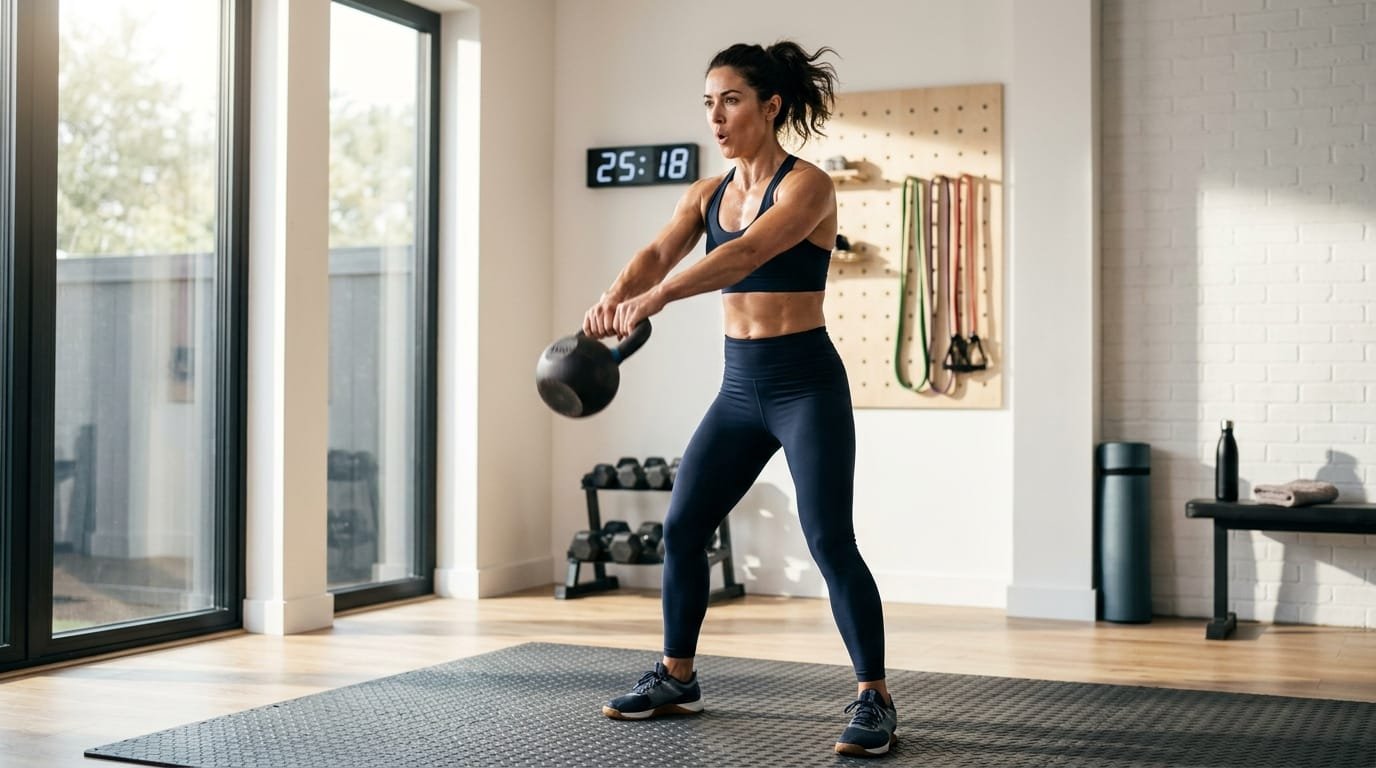
Workout A (Dumbbell or Kettlebell Focus)
- Goblet squat or Bulgarian split squat – 3 sets of 8–12
- Romanian deadlift – 3 sets of 8–12
- Floor press or push-up variation – 3 sets of 8–12
- Single-arm row – 3 sets of 8–12 per arm
- Optional: Suitcase carry or plank – 2 sets
Rest 60–90 seconds between sets. Total time stays inside 30 minutes when transitions are kept short.
Workout B (Bodyweight Bias with Optional Load)
- Bulgarian split squat or reverse lunge – 3 sets of 8–12 per leg
- Single-leg Romanian deadlift or hip hinge – 3 sets of 8–12 per leg
- Feet-elevated or archer push-up progression – 3 sets of 6–12
- Inverted row or single-arm row – 3 sets of 8–12
- Optional: Dead bug or carry – 2 sets
Workout C (Density-Oriented)
Choose four compound movements. Set a timer for 25 minutes and rotate through them, performing 6–10 controlled repetitions each time, resting only as needed to maintain form. Track total quality rounds or repetitions and try to improve weekly.
Step-by-Step Guide to Building Your Own Short Session
- Select one exercise for each main pattern (squat/lunge, hinge, push, pull).
- Decide the target rep range (usually 6–12 for strength focus).
- Warm up efficiently (3–5 minutes of light movement and activation).
- Perform 2–4 working sets per exercise with high effort.
- Keep rest periods to 60–90 seconds for most sets.
- Track the session immediately.
- Progress one variable the following week.
- End with a brief optional core or carry if time remains.
- Repeat 2–4 times per week with at least one rest or light day between sessions.
- Deload every 4–8 weeks by reducing sets or effort.
Progressive Overload Inside 20–30 Minutes
Because session length is limited, progression must be deliberate:
- Add repetitions within the target range
- Slow the eccentric phase
- Insert short pauses at the hardest point
- Move to a harder variation or unilateral version
- Reduce rest periods slightly while maintaining output
These methods allow continuous strength gains without extending the workout.
Warm-Up and Transition Efficiency
A short session cannot afford a long warm-up. Use:
- 1–2 minutes of light cardio or jumping jacks
- 1–2 light sets of the first exercise
- Quick scapular and core activation if needed
Prepare equipment in advance so transitions take seconds rather than minutes.
Programming Frequency and Recovery
- 2 sessions per week: excellent for maintenance and steady gains
- 3 sessions per week: optimal for most people seeking strength progress
- 4 sessions per week: possible if recovery and life stress allow
Prioritise sleep and protein intake. Short, hard sessions still require recovery to produce adaptation.
Common Mistakes That Reduce Effectiveness
| Mistake | Result | Better Approach |
|---|---|---|
| Including too many exercises | Rushed sets and poor focus | Limit to 4–5 main movements |
| Resting too long | Session exceeds 30 minutes | Cap rest at 90 seconds for most sets |
| Training too far from failure | Insufficient stimulus | Leave only 1–3 reps in reserve |
| Neglecting progression | Plateau despite consistency | Track and improve one variable weekly |
| Skipping warm-up entirely | Higher injury risk and poorer performance | Use a 3–5 minute efficient warm-up |
| Adding isolation work | Time stolen from compounds | Save isolation for longer sessions if needed |
Strength training performed with high quality and progressive overload remains one of the most reliable ways to build strength, even in short sessions (strength training guidance). Practical home-gym approaches emphasise efficient formats that fit real schedules (home gym equipment prioritisation and budget home gym principles).
Frequently Asked Questions
Can 20–30 minute workouts really build strength?
Yes. Strength is driven by tension and progressive overload on compound movements, not by session length. Short, focused workouts deliver both when designed correctly.
How many sets do I need per exercise?
Two to four hard sets are sufficient for most people in a short full-body format.
Should I train to failure in short sessions?
Train close to technical failure (1–3 reps in reserve) on most sets. Absolute failure on every set increases recovery demand and can reduce weekly quality.
Is full-body better than a split for short workouts?
Yes for most trainees with limited time. Full-body frequency allows each pattern to be trained more often across the week.
What if I have only 20 minutes?
Reduce to three or four compound movements and keep rest periods tighter. Focus on quality over quantity.
Can I use only bodyweight for these workouts?
Yes. Advance leverage, tempo, pauses, and unilateral variations to keep the stimulus progressive.
How long can I continue progressing with this format?
Many people make continuous strength gains for months or years by consistently applying the non-load progression methods.
Should I add cardio to these sessions?
Optional short finishers can be included if time allows, but they should not compromise the strength work.
Final Recommendation
Twenty to thirty minute full-body workouts build strength effectively when they prioritise compound movements, high effort, managed rest, and consistent progressive overload. Select one exercise per main pattern, perform 2–4 quality sets, keep transitions short, and track weekly improvement in reps, tempo, or variation. Two to four such sessions per week fit almost any schedule and produce reliable results.
Design your first short session today using the sample templates, prepare the equipment in advance, and focus on clean, hard sets. When intensity and progression are high, limited time becomes an advantage rather than a limitation. Start with two sessions this week and build the habit—the strength gains will follow.