Home Training Considerations for Older Adults Wanting Strength and Function
Quick Answer
Older adults can build meaningful strength and improve function at home by prioritising progressive resistance training on the major movement patterns (squat/lunge, hinge, push, pull, and carry), starting with manageable loads or bodyweight, using controlled tempos, and focusing on movements that transfer to daily activities. Two to four short full-body sessions per week, combined with balance and mobility work, produce reliable improvements in muscle strength, bone density, metabolic health, and independence. Safety comes from gradual progression, joint-friendly technique, and professional clearance when needed.
Why Strength Training Matters More with Age
After approximately age 50, adults can lose 1–2 % of muscle mass per year without intervention, with faster declines in strength and power. This contributes to reduced mobility, higher fall risk, lower metabolic health, and loss of independence. Progressive resistance training is one of the most effective countermeasures. It improves muscle strength and size, supports bone mineral density, enhances insulin sensitivity, and preserves the ability to perform everyday tasks such as rising from a chair, climbing stairs, carrying groceries, and recovering from a loss of balance. Home-based programmes remove travel barriers and allow consistent training in a familiar environment.
Core Principles for Older Adult Home Training
- Progressive resistance is non-negotiable – The stimulus must gradually increase over time.
- Function first – Choose exercises that resemble daily movements.
- Joint-friendly technique – Controlled tempos, full pain-free range, and stable positions.
- Balance and power matter – Include elements that train reaction and stability.
- Consistency over intensity – Regular moderate sessions outperform sporadic hard ones.
- Recovery is part of the programme – Sleep, protein, and rest days support adaptation.
- Individual starting point – Begin at the current capacity, not at an idealised level.
Essential Movement Patterns and Home Options
| Pattern | Functional Benefit | Home Exercise Options | Progression Methods |
|---|---|---|---|
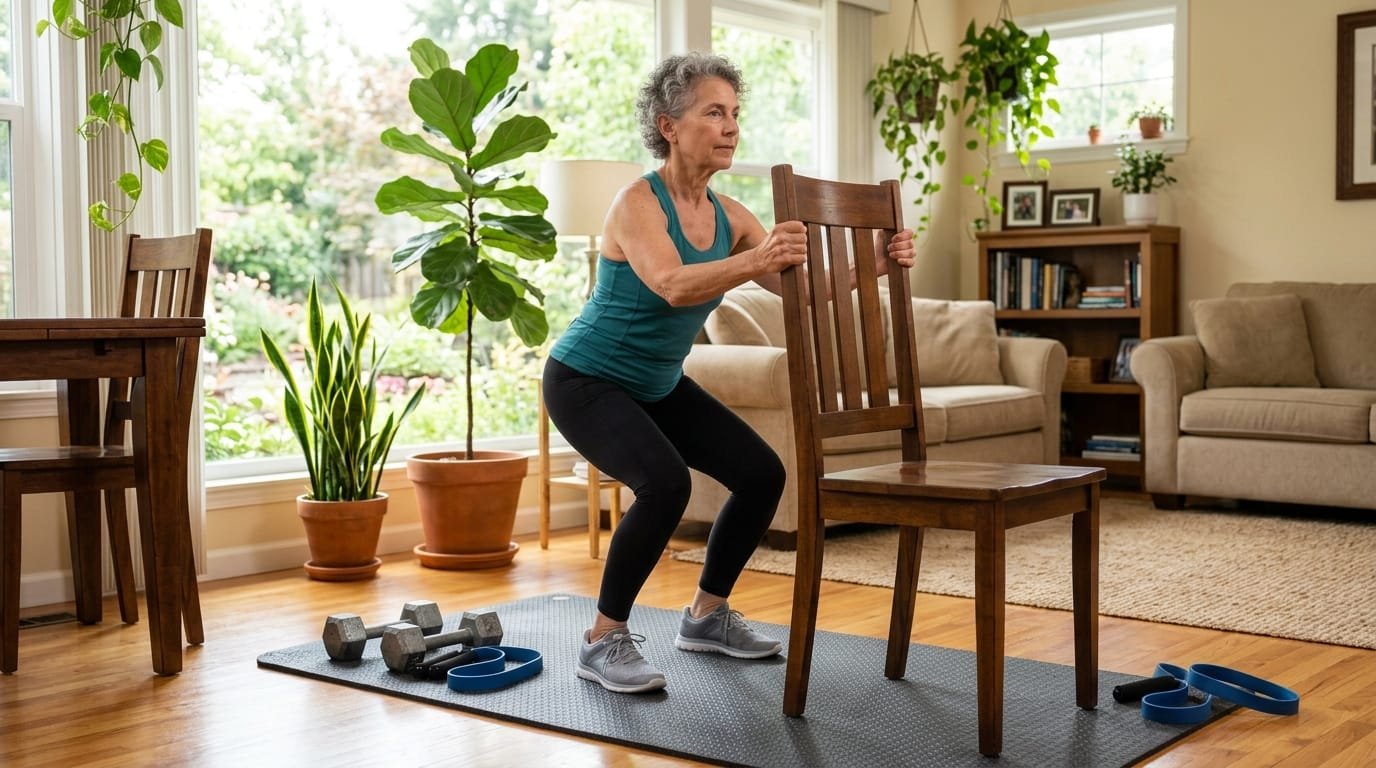
| Squat / Sit-to-Stand | Rising from chairs, toilets, cars | Bodyweight squat, sit-to-stand from chair, goblet squat, box squat | Depth, tempo, load, single-leg |
| Hinge | Picking up objects, posture | Romanian deadlift, hip hinge with stick, glute bridge, single-leg RDL | Range, tempo, load |
| Push | Pushing doors, rising from floor | Elevated push-up, wall push-up, floor press, band press | Elevation height, tempo, load |
| Pull | Carrying, posture, opening doors | Band row, single-arm dumbbell row, towel row, face pulls | Band strength, tempo, pause |
| Carry / Core | Walking with loads, stability | Suitcase carry, farmer carry with bags, dead bug, bird dog | Distance, load, duration |
| Balance | Fall prevention | Single-leg stand, tandem stance, heel-to-toe walk | Time, eyes closed, unstable surface |
Shoulder-friendly technique remains important for long-term joint health (Bent Arms vs. Straight Arms in Lateral Raises, The Hidden Mistake in Lateral Raises, and 3 Lateral Raise Modifications). Grip strength is strongly linked to overall function and independence in older adults and can be trained directly (Do Hand Grippers Really Work?).
Step-by-Step Home Programme Design
- Obtain medical clearance if you have chronic conditions, recent surgery, or significant joint issues.
- Assess current capacity with simple tests: sit-to-stand repetitions in 30 seconds, single-leg balance time, and comfortable walking speed.
- Select 4–6 exercises that cover the major patterns and match your current ability.
- Start with 2 full-body sessions per week, adding a third when recovery is good.
- Use controlled tempos (2–3 second lowering phase) to improve strength and reduce joint stress.
- Begin with 1–3 sets of 8–12 repetitions (or 8–20 for bodyweight variations).
- Progress one variable at a time: first repetitions, then range or tempo, then load or difficulty.
- Include balance practice at the start or end of sessions.
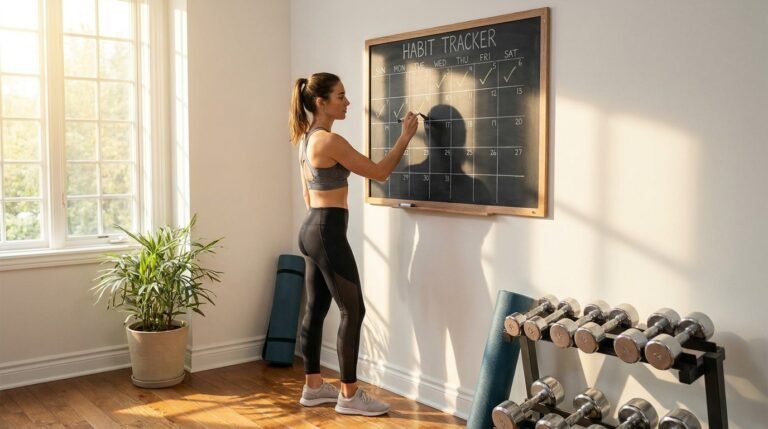
- Track sessions simply (exercise, sets, reps, how it felt).
- Reassess every 4–6 weeks and adjust exercises or volume as capacity improves.
Sample Beginner to Intermediate Home Sessions
Session A (Foundation)
- Sit-to-stand or box squat – 2–3 × 8–12
- Hip hinge or Romanian deadlift – 2–3 × 8–12
- Elevated push-up or wall push-up – 2–3 × 8–12
- Band or dumbbell row – 2–3 × 10–15
- Single-leg balance or tandem stance – 2 × 20–40 seconds per side
Session B (Progression Focus)
- Goblet squat or reverse lunge – 3 × 8–12
- Single-leg glute bridge or RDL – 3 × 8–12 per side
- Floor press or band press – 3 × 8–12
- Single-arm row or face pull – 3 × 10–15
- Suitcase carry or dead bug – 2–3 sets
Keep total session time between 25 and 45 minutes. Rest as needed to maintain good form.
Progression Strategies That Work at Home
- Add repetitions within a comfortable range.
- Slow the eccentric phase to increase time under tension.
- Increase range of motion once control is solid.
- Move to unilateral versions for greater challenge and balance demand.
- Add light external load (dumbbell, household object, or stronger band).
- Reduce support (e.g., from chair-assisted to free-standing).
These methods allow continuous improvement without requiring heavy commercial equipment.
Safety and Joint Considerations
- Warm up with 5 minutes of light movement (marching, arm circles, gentle hip hinges).
- Stay within pain-free ranges; mild muscle effort is acceptable, joint pain is not.
- Prioritise stability before load—use a chair or wall for support when learning new patterns.
- Breathe continuously; avoid prolonged breath-holding.
- Stop and regress if form breaks down or symptoms increase.
- Schedule sessions with at least one recovery day between them when starting.
Recovery, Protein, and Lifestyle Factors
Muscle protein synthesis remains responsive to training and protein intake in older age, but the response is often blunted (“anabolic resistance”). Practical strategies include:
- Distributing protein across meals (roughly 25–40 g per meal for many older adults).
- Prioritising sleep quality and duration.
- Staying generally active with daily walking.
- Managing underlying health conditions in partnership with healthcare providers.
Common Barriers and Solutions
| Barrier | Impact | Practical Solution |
|---|---|---|
| Fear of injury | Avoidance of training | Start with supported, controlled movements and gradual progression |
| Joint discomfort | Reduced adherence | Modify range, choose joint-friendly variations, consult a professional |
| Lack of equipment | Perceived limitation | Bodyweight, bands, and household items cover most needs |
| Low motivation or energy | Missed sessions | Short sessions, fixed schedule, minimum viable workout |
| Uncertainty about form | Hesitation | Use simple patterns, mirror or video check, professional input if needed |
| Comparison to younger self | Frustration | Measure progress against current baseline, not past performance |
Strength training remains one of the most effective ways to preserve function and independence with age (strength training guidance). Practical home-gym approaches emphasise accessible systems that work in real living environments (home gym equipment prioritisation and budget home gym principles).
Frequently Asked Questions
Is it safe to start strength training later in life?
Yes, for the large majority of older adults. Medical clearance is recommended when chronic conditions or recent injuries are present. Start conservatively and progress gradually.
How many times per week should I train?
Two to three full-body sessions per week produce excellent results for most older adults. A fourth session can be added if recovery is good.
Do I need weights or are bodyweight exercises enough?
Bodyweight exercises are an excellent starting point and can be progressed for a long time. Adding bands or light dumbbells expands options and makes progressive overload easier.
What if I have arthritis or joint replacements?
Many people with these conditions train successfully with modified ranges and controlled tempos. Work with a physical therapist or knowledgeable trainer to tailor the programme.
How long before I notice improvements?
Strength and confidence often improve within 4–8 weeks of consistent training. Functional changes such as easier sit-to-stands or better balance follow a similar timeline.
Should I do cardio as well?
Yes. Regular walking or other aerobic activity complements strength training for cardiovascular and metabolic health. The two modalities support each other.
Is power training appropriate?
Yes, when introduced carefully. Moving through the concentric phase with intent (while keeping control) helps preserve the ability to react quickly and recover from balance losses.
What is the most important exercise for older adults?
There is no single most important exercise. The combination of squat/sit-to-stand, hinge, push, pull, and balance work covers the major needs. Sit-to-stand and carrying variations have especially high functional transfer.
Final Recommendation
Home strength training for older adults who want strength and function centres on progressive resistance for the major movement patterns, joint-friendly technique, and consistency. Two to four short full-body sessions per week, built around sit-to-stand, hinge, push, pull, and balance work, produce reliable improvements in muscle strength, daily function, and independence. Start at your current capacity, progress one variable at a time, and prioritise control over intensity.
Obtain medical clearance if needed, choose 4–6 simple exercises that match your present ability, schedule two sessions this week, and track how the movements feel. When strength training is approached this way, age becomes less of a barrier and more of a reason to train. Begin with the next available opportunity—the functional returns compound over months and years.