Flat Bench vs. Adjustable Weight Bench: Which One Should You Choose?
Quick answer: An adjustable bench lets you train the incline bench press, which research shows meaningfully increases upper chest (clavicular head) activation compared to flat pressing — genuinely useful if upper chest development is a specific goal. But it’s worth knowing that EMG activation differences don’t always translate directly into proportionally different long-term muscle growth, based on the limited longitudinal research available. A flat bench alone remains a completely legitimate, effective choice for most training goals.
Researched and written by the GymGoodies team, fact-checked against manufacturer specs and current fitness guidance.
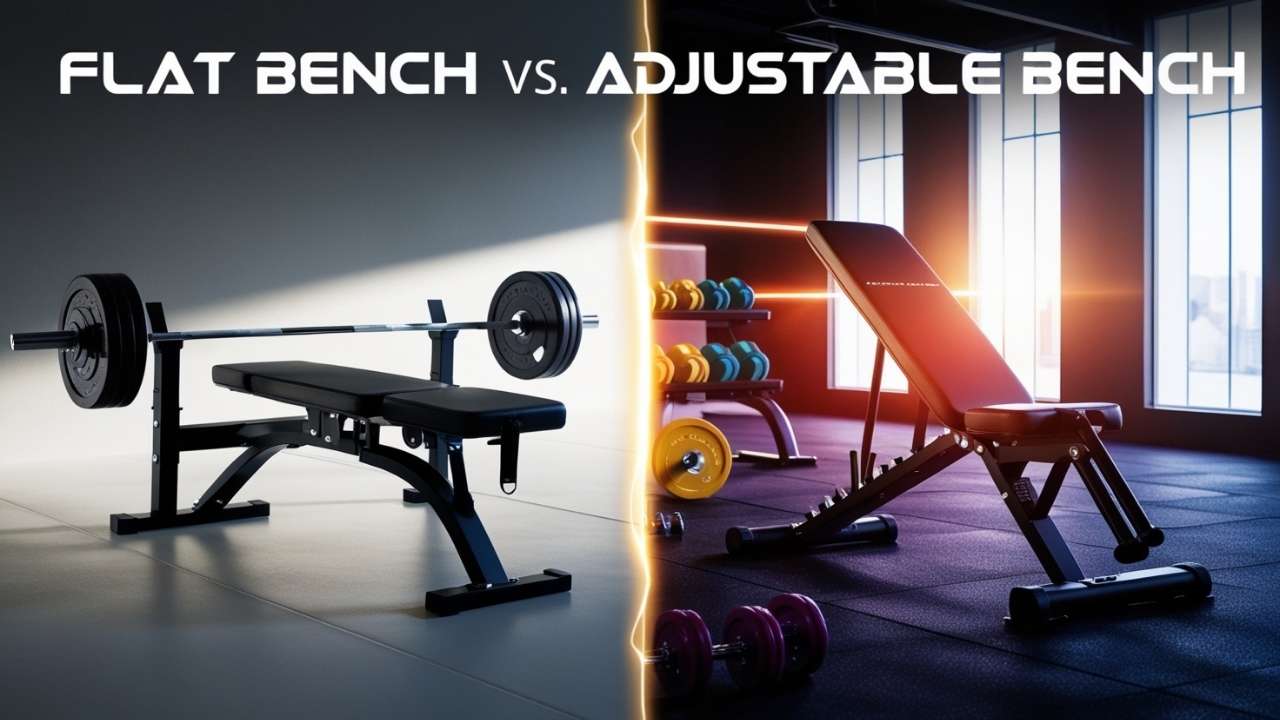
Choosing between a flat bench and an adjustable (incline-capable) bench comes down to a genuinely researchable question: does the added versatility translate into meaningfully different training outcomes, or is it more about convenience and variety? Here’s what the evidence actually shows.
What an Adjustable Bench Adds
A flat bench only allows the standard horizontal bench press position. An adjustable bench lets you set various incline angles (and sometimes decline angles), enabling incline bench press, incline dumbbell work, and other angle-specific exercises that a flat bench simply can’t accommodate.
What the Research Shows About Incline Angle and Chest Activation
A 2025 study published in the European Journal of Sport Sciences examined how different incline angles affect activation of the clavicular head (upper portion) of the pectoralis major during the barbell incline bench press. The researchers found that incline angles above 32 degrees produced significantly higher neuromuscular activation of the upper chest, with 43 degrees identified as the most effective angle tested — genuinely useful, specific data if upper chest development is a goal you’re actively training for.
The Important Nuance: EMG Doesn’t Always Predict Actual Growth
This is where it’s worth applying the same caution we’ve raised elsewhere on this site regarding EMG research generally. According to an in-depth analysis from Stronger by Science, while EMG research consistently shows incline bench pressing produces higher upper chest activation than flat bench pressing, the limited longitudinal research directly measuring actual muscle growth over a real training program found a more complicated picture — muscle swelling measurements (an acute proxy sometimes used to estimate hypertrophy potential) didn’t consistently match the EMG findings, and didn’t fully align with results from the one existing study specifically measuring long-term regional hypertrophy differences between flat and incline bench training.
The honest takeaway: incline bench pressing does appear to produce somewhat greater upper chest development than flat bench pressing based on the limited longitudinal evidence available, but the size of that difference, and how well acute EMG data predicts it, is less clean and definitive than EMG research alone might suggest.
What This Means for Your Bench Choice
Given this nuance, the practical decision comes down to less certainty than a purely EMG-based argument would suggest, but the core preference pattern still holds:
- If upper chest development is a specific priority, incorporating incline pressing (which requires an adjustable bench) is a reasonable, evidence-informed choice — even accounting for the EMG-to-hypertrophy uncertainty, the available longitudinal research does lean toward some genuine benefit.
- If general chest development, without a specific upper-chest emphasis, is your goal, a flat bench remains a completely legitimate primary tool — flat bench pressing effectively trains the chest as a whole, and research on decline angles specifically has found relatively similar overall pec activation across flat, incline, and decline positions when comparing the mid and lower fibers.
What About the Decline Position?
If you’re considering an adjustable bench partly for decline training specifically to target the lower chest, it’s worth knowing the evidence here is weaker than commonly assumed. Some EMG research comparing bench angles has found that all three regions of the pectoralis major show fairly similar activation at a flat (0-degree) bench angle already, without a dramatic additional benefit from declining further — meaning if lower chest development is your specific goal, a flat bench may already be doing a reasonable job without necessarily needing a decline-capable adjustable bench.
Other Genuine Benefits of an Adjustable Bench
Beyond the chest-activation research specifically, adjustable benches offer some additional practical value worth factoring in:
- Versatility for exercises beyond pressing — incline dumbbell curls, seated shoulder work, and various rows can all use an adjustable bench’s different angle settings
- Space efficiency for a home gym — one adjustable bench can replace what would otherwise require multiple dedicated flat and incline benches
- Progressive angle adjustment — letting you fine-tune training emphasis over time as your goals shift, rather than being locked into one fixed position
When a Flat Bench Alone Is a Completely Reasonable Choice
- If your primary goal is overall chest strength and development, not a specific upper-chest emphasis
- If budget or space is limited — flat benches are generally more affordable and often more stable (fewer moving parts and adjustment mechanisms) than adjustable versions
- If you already have access to an adjustable bench elsewhere (a commercial gym) and only need a flat bench for home training specifically
Practical Considerations When Buying an Adjustable Bench
- Stability matters more than with a flat bench — the adjustment mechanism adds moving parts, and a poorly built adjustable bench can feel less stable during heavy pressing than a solid flat bench, which is worth testing or researching before purchasing
- Weight capacity varies more between models than with flat benches — check this specifically against your actual training loads, not just body weight, since the bench needs to support both you and the loaded barbell
- Incremental angle settings — some adjustable benches offer more granular angle options than others, which matters if you want to specifically target the 32-43 degree range the research identifies as most effective for upper chest activation
How This Connects to Foundational Barbell Training
If you’re building your barbell training foundation, our Barbell Basics for Beginners guide covers the standard flat bench press as one of the core compound lifts — a flat bench is sufficient for building this foundational strength and technique before considering whether incline variations serve a specific goal you’re working toward. The bench press is also a foundational push movement in our Push vs. Pull Exercises guide, and this same EMG-versus-actual-outcomes nuance we’ve covered here echoes what we discussed in our breakdown of bent vs. straight arm lateral raise activation data — a useful reminder that acute muscle activation research is genuinely informative, but shouldn’t be treated as a complete, settled predictor of long-term training outcomes on its own.
A Reasonable Way to Decide
- If you’re a beginner still building foundational strength and technique, a flat bench is entirely sufficient — mastering the fundamental movement pattern matters more than angle variety at this stage.
- If you have a specific upper-chest development goal and have already built solid pressing fundamentals, an adjustable bench with the ability to reach the 32-43 degree range genuinely adds evidence-supported value.
- If budget and space allow, an adjustable bench offers more long-term training flexibility without meaningfully sacrificing anything a flat bench provides, assuming you choose a stable, well-built model.
Frequently Asked Questions
Is incline bench press definitely better for upper chest growth than flat bench?
The EMG evidence strongly suggests higher acute upper chest activation with incline pressing, and the limited longitudinal research leans toward some genuine long-term benefit too — though the size of that advantage is less certain than EMG data alone would suggest.
Do I need a decline-capable bench for lower chest development?
Not necessarily — research suggests flat bench pressing already activates the lower chest fibers reasonably well, without requiring a dramatic additional benefit from declining further.
Is an adjustable bench less stable than a flat bench for heavy pressing?
This varies significantly by specific model and build quality — a well-built adjustable bench can be plenty stable, but it’s worth specifically checking weight capacity and stability reviews, since the added adjustment mechanism introduces more potential points of instability than a simpler flat bench.
Bottom Line
An adjustable bench genuinely earns its place if upper chest development is a specific goal — research supports meaningfully higher upper chest activation with incline angles in the 32-43 degree range, with some longitudinal evidence suggesting this translates into real, if less dramatic than EMG alone would suggest, growth differences. But a flat bench remains a completely legitimate, effective primary tool for general chest development and foundational strength training, and shouldn’t be seen as an inferior starting point.
Do you train primarily on a flat bench, or do you use incline variations regularly? Let us know in the comments whether you’ve noticed a difference in upper chest development.