Simple Ways to Make Bodyweight Exercises Harder Without New Equipment
Quick Answer
You can make bodyweight exercises significantly harder without any new equipment by manipulating leverage, tempo, pauses, range of motion, unilateral loading, density (less rest or more work in less time), and advanced variations. Progress from easier to harder versions of push-ups, squats, hinges, rows, and core movements while tracking repetitions, control, and difficulty. These methods create genuine progressive overload and allow continued strength and muscle gains using only your bodyweight.
Why Bodyweight Training Can Keep Progressing
Bodyweight exercises become easy when the same version is repeated without increasing demand. Progressive overload still applies: the stress on the muscles must gradually rise. Because you cannot add external plates, you change the mechanical difficulty of the movement itself. Leverage, speed, stability, range, and volume become your progression tools. When these variables are applied systematically, bodyweight training remains effective for long periods.
Core Methods to Increase Difficulty
| Method | How It Works | Example Applications | Difficulty Increase |
|---|---|---|---|
| Leverage changes | Alter body angle or limb position | Feet-elevated push-ups, archer push-ups | High |
| Tempo manipulation | Slow the eccentric or entire rep | 4-second lower on squats or push-ups | Moderate–High |
| Paused reps | Hold at the hardest point | Pause at bottom of push-up or squat | Moderate–High |
| Expanded range of motion | Increase depth or stretch | Deficit push-ups, deeper pistol progressions | Moderate |
| Unilateral variations | Train one limb at a time | Single-leg squats, one-arm push-up progressions | High |
| Density | More work in less time | Shorter rest or more total reps in fixed time | Moderate |
| Advanced skill variations | Move to harder skill progressions | From regular to diamond to archer push-ups | High |
Method 1: Change Leverage and Body Angle
Small changes in body position dramatically alter the percentage of bodyweight being lifted.
Push-ups
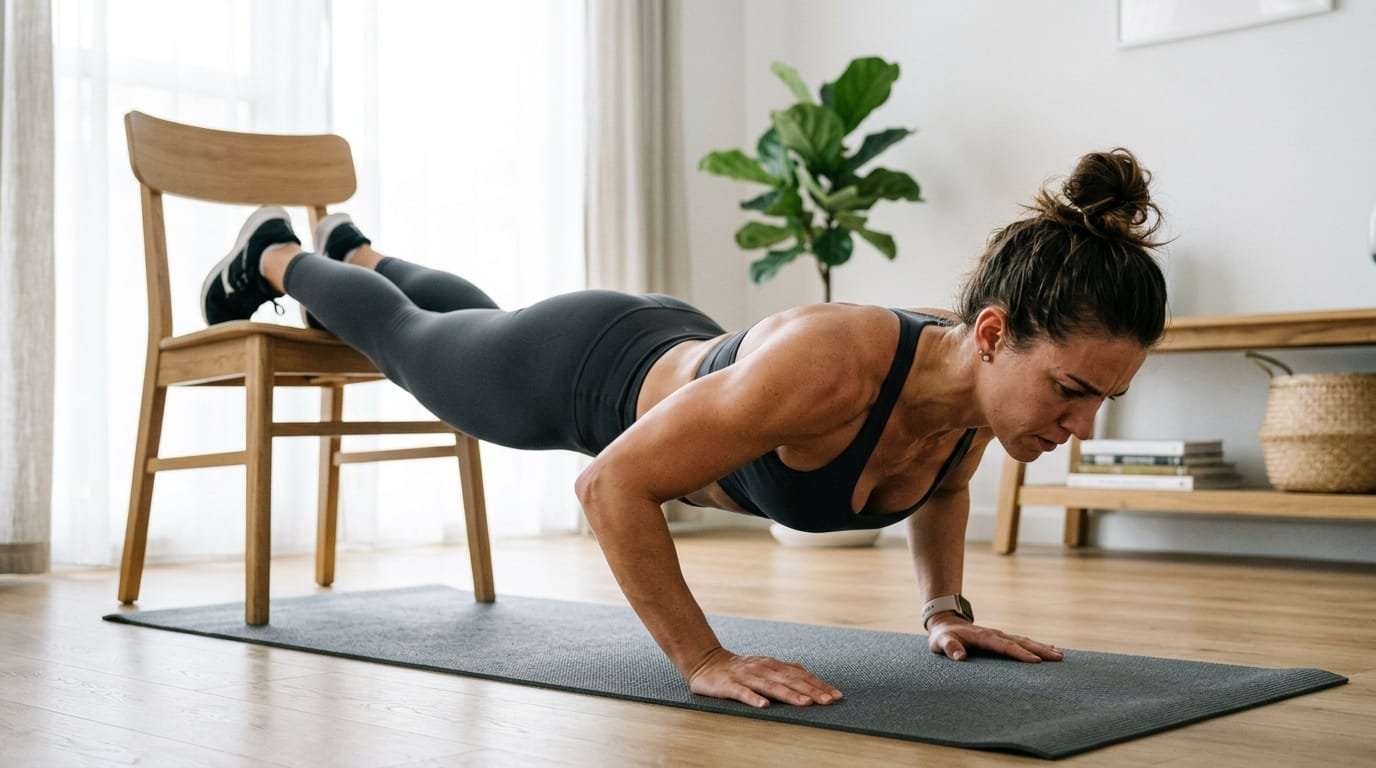
- Incline (hands elevated) → standard → decline (feet elevated)
- Wide → shoulder-width → close / diamond
- Archer or typewriter push-ups
- One-arm assisted → one-arm push-up progressions
Squats and lunges
- Assisted squat → regular bodyweight squat → deep squat
- Reverse lunge → walking lunge → Bulgarian split squat (rear foot elevated on a chair or sofa)
- Shrimp squat or pistol squat progressions
Rows
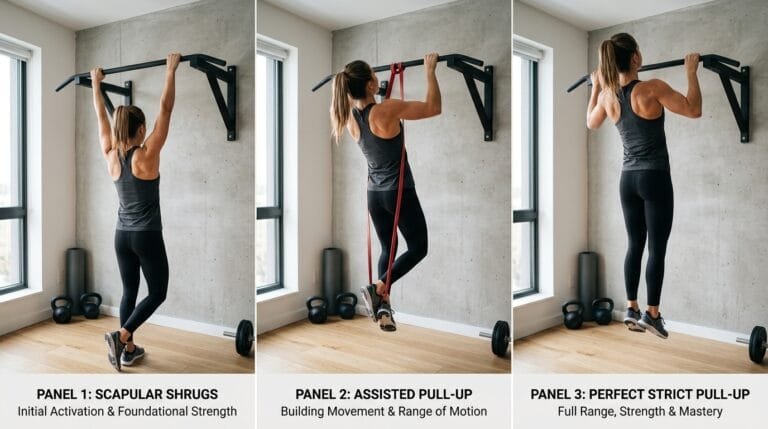
- Inverted rows with feet closer → feet elevated → single-arm variations (using a sturdy table or bar)
Method 2: Slow Tempo and Eccentric Emphasis
Performing the lowering phase in 3–5 seconds increases time under tension and muscle damage signals without any equipment. A set of 8 slow push-ups or squats can feel harder than 15 fast ones. Apply this to every major pattern: push, squat, hinge, and row.
Method 3: Add Pauses
Inserting a 1–3 second pause at the most difficult point removes elastic energy and forces the muscles to produce force from a dead stop. Effective locations include:
- Bottom of a push-up or squat
- Stretch position of a Romanian-style hinge or single-leg RDL
- Peak contraction of an inverted row or glute bridge
Method 4: Expand Range of Motion
Greater range increases mechanical tension. Examples:
- Push-ups with hands on books or parallettes (if already owned) or simply deeper chest-to-floor
- Squats to full depth while maintaining control
- Single-leg Romanian deadlifts with a greater hip hinge
- Hanging knee raises to toes-to-bar progressions if a bar is available
Only increase range when form and joint comfort remain solid.
Method 5: Unilateral (Single-Limb) Training
Training one side at a time roughly doubles the relative load on that limb and improves balance and stability. Progressions include:
- Split squats → Bulgarian split squats → assisted pistols → full pistols
- Single-leg glute bridges → single-leg hip thrusts
- One-arm scapular push-ups and archer push-ups
- Single-arm inverted rows
Method 6: Density and Volume Strategies
Keep the same exercise and number of repetitions but reduce rest periods, or set a fixed time window and try to complete more quality repetitions each week. Density improvements are measurable and highly effective for continued progress.
Method 7: Skill and Coordination Progressions
Many bodyweight exercises exist on a continuum of skill. Moving along that continuum provides progressive overload:
- Regular push-up → archer → one-arm
- Squat → shrimp squat → pistol
- Hollow body hold → advanced tuck → full front lever progressions (advanced)
Step-by-Step Progression System
- Master the basic version with perfect form for the target sets and reps.
- Choose one method of increasing difficulty (tempo, pause, leverage, etc.).
- Apply that method until the exercise feels manageable again.
- Add a second method or move to a harder variation.
- Film sets periodically to confirm technique stays clean.
- Track repetitions, tempo, and variation so progress remains visible.
- Deload every 4–8 weeks by reducing volume or difficulty.
- Balance pushing and pulling patterns to protect the shoulders.
- Support the work with scapular control and grip strength (Do Hand Grippers Really Work?).
- Reassess every 8–12 weeks and adjust the progression ladder.
Sample Progressions for Key Patterns
Pushing
Elevated push-ups → standard → slow tempo → paused → feet-elevated → archer → one-arm progressions
Squatting
Bodyweight squat → deep squat → split squat → Bulgarian split squat → shrimp or pistol progressions
Hinging
Glute bridge → single-leg bridge → single-leg Romanian deadlift (bodyweight) → deeper range or paused versions
Pulling
Inverted rows (feet on floor) → feet elevated → single-arm variations → towel or harder leverage rows
Shoulder-friendly mechanics remain important as difficulty increases. Controlled lateral-raise patterns and scapular work help maintain joint health (Bent Arms vs. Straight Arms in Lateral Raises, The Hidden Mistake in Lateral Raises, and 3 Lateral Raise Modifications).
Programming Guidelines
- Train each major pattern 2–4 times per week.
- Keep most sets 1–3 repetitions short of failure so weekly improvement remains possible.
- Use higher quality over high fatigue.
- Prioritise recovery—progressive overload only works when the body can adapt.
Strength training with progressive bodyweight methods remains highly effective for building muscle and strength (strength training guidance). Practical home-gym approaches emphasise mastering leverage and control before adding external load (home gym equipment prioritisation and budget home gym principles).
Common Mistakes That Limit Progress
| Mistake | Result | Better Approach |
|---|---|---|
| Jumping to advanced variations too soon | Form breakdown and potential irritation | Earn each step with clean reps |
| Only adding repetitions with poor form | Reduced effective stimulus | Prioritise control and full range |
| Neglecting unilateral work | Persistent imbalances | Include single-limb variations regularly |
| No tracking | Invisible progress | Log sets, tempo, and variation |
| Ignoring recovery | Stalled adaptation | Schedule deloads and manage total stress |
| Changing too many variables at once | Confusion about what worked | Change one variable at a time |
Frequently Asked Questions
How long can I keep progressing with bodyweight only?
Many people make continuous improvements for 12–24 months or longer by systematically advancing leverage, tempo, and variations.
Do slow tempos really make exercises harder?
Yes. Longer eccentrics increase time under tension and can make a set substantially more challenging.
Are one-arm or pistol progressions necessary?
They are excellent long-term options but not required. Many intermediate progressions (archer push-ups, Bulgarian split squats, paused work) provide ample stimulus.
Can bodyweight exercises build significant muscle?
Yes, especially when progressive overload is applied and nutrition supports growth. Higher-repetition and high-tension sets are effective.
How do I know when to move to a harder variation?
When you can complete the top of your target rep range with excellent form and control for multiple sessions.
Should I train to failure on bodyweight exercises?
Training close to failure is useful, but leaving 1–3 repetitions in reserve most of the time allows better weekly progression and recovery.
Is core work also progressive with these methods?
Yes. Move from basic planks to longer holds, then to more leveraged positions (for example, from plank to RKC plank to single-arm or single-leg variations).
What if my wrists or shoulders bother me as exercises get harder?
Regress to elevated or neutral-wrist versions, improve scapular control, and progress more slowly while maintaining joint-friendly technique.
Final Recommendation
Bodyweight exercises become harder—and more effective—when you deliberately change leverage, tempo, pauses, range of motion, laterality, and density. These methods create genuine progressive overload without any additional equipment. Master the basic versions, then advance one variable at a time while tracking your work and protecting joint health.
Start by filming your current push-ups, squats, and rows, choose one method of increasing difficulty, and apply it consistently for the next four to six weeks. When that becomes manageable, add the next method or variation.
With this approach, bodyweight training remains a powerful, equipment-free path to continued strength and muscle development. The only limit is how systematically you apply the progression tools already available to you.